A Guide to Cash Flow Management for Small Business
A practical guide to cash flow management for small business. Learn forecasting, AR automation, and strategies to reduce DSO for professional services firms.
Profitability is a lagging indicator. For professional services firms in the $3M–$50M range, a strong P&L can mask a precarious cash position, creating a gap between reported earnings and actual liquidity.
This disconnect between profit and cash is a primary source of unmanaged risk. It forces firms into a reactive cycle: an unexpected cash gap emerges, and the reflexive solution is to draw on an expensive line of credit, eroding value.
The Hidden Risks of Profitability
A positive P&L provides a sense of security, but it reflects past performance. Cash is the operational fuel for payroll, rent, and strategic investments. A thin cash cushion means a single delayed payment can trigger a crisis.
This isn't a theoretical problem. Data shows that while 82% of firms report healthy profit margins, 88% have faced unexpected cash shortages. The profits exist on paper, but timing gaps prevent them from being accessible working capital.
Profitability Is Not Liquidity
The core issue is the cash conversion cycle. Revenue is recognized when an invoice is issued, but the cash is not usable until the client pays. This delay, measured as Days Sales Outstanding (DSO), is where profitable firms encounter financial distress.
A firm can be profitable yet fail due to poor cash management. The inverse is rarely true. Mastering the cash conversion cycle is the foundation of a resilient financial operation.
Recent analysis found 54% of small businesses hold less than a one-month cash reserve. For a deeper look at the data, you can explore the full findings on small business cash flow.
From Back Office to Strategic Function
Viewing cash flow management as a back-office task is a strategic error. It is a core operational discipline that enables growth. Without a predictable cash position, decisions on hiring, technology investment, or market expansion are deferred.
This operational shift requires a change in approach:
- Move from historical reporting to predictive forecasting.
- Systematize the accounts receivable and collections process.
- View the AR ledger as a primary source of working capital.
This guide provides an operator's manual for building that resilient financial foundation, covering forecasting, working capital optimization, and effective collections workflows.
Building a Predictive Cash Flow Forecast
Managing finances by looking at historical reports is like driving while looking in the rearview mirror. For a professional services firm, this creates significant liability. The objective is to move from reaction to prediction.
A 13-week rolling cash flow forecast is the most effective tool for this. It provides a tactical, quarter-long view that is immediate enough for current decisions yet long enough to anticipate future needs. It is a living model, updated weekly with data from the sales pipeline, project timelines, and client payment behavior.
This turns abstract financial data into actionable intelligence, enabling informed decisions on hiring, investment, and operational expenditures.
Moving Beyond Simple Historical Data
A common mistake is building a forecast based solely on past performance. Historical data cannot account for a new client engagement, a project delay, or a shift in a client’s payment patterns.
An effective forecast integrates multiple data streams to create an accurate projection of cash inflows and outflows. This is where the distinction between a profitable company and a cash-healthy company becomes clear.
This infographic illustrates how easily profit can mask underlying cash flow vulnerabilities.
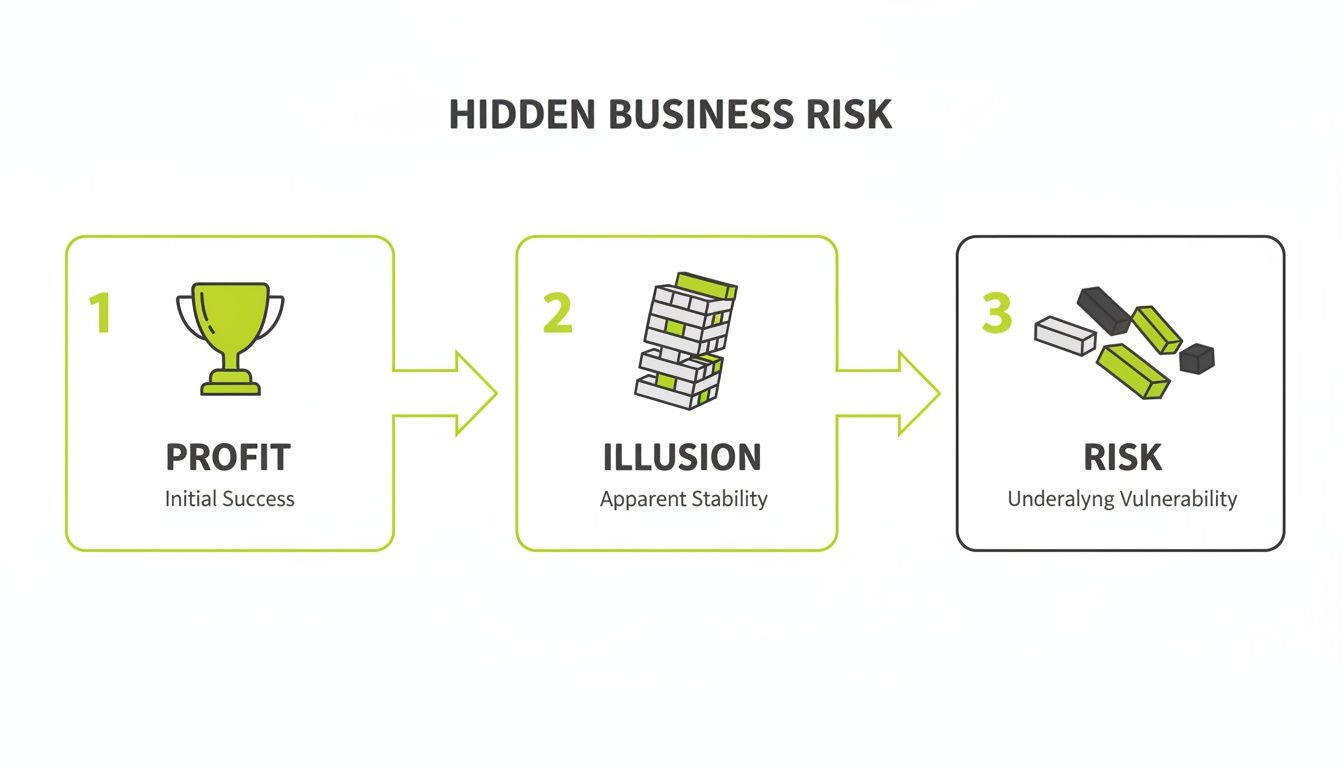
Without clear visibility into future cash positions, a strong profit figure is an illusion of stability, concealing operational risks.
Core Components of a Rolling Forecast
The quality of a forecast depends entirely on the quality of its inputs. For firms in the $3M–$50M revenue range, this must be a rigorous, repeatable process.
Here are the data points required to build a reliable forecast.
<br>
***
Key Inputs for a 13-Week Rolling Cash Flow Forecast
This table outlines the essential data points needed to build a reliable and dynamic cash flow forecasting model for a professional services firm.
Data Category | Specific Inputs | Source of Data | Frequency of Update |
|---|---|---|---|
Projected Inflows | Confirmed client retainers, scheduled milestone payments, invoices sent (based on historical Days Sales Outstanding, not due dates). | CRM, Project Management Software, Accounting System | Weekly |
Operating Outflows | Payroll & benefits, rent/mortgage, utilities, software subscriptions, insurance, recurring professional fees. | Payroll System, Bank Statements, Accounting Software | Weekly/Monthly |
Variable Outflows | Contractor payments, project-specific expenses, performance bonuses, quarterly tax payments, debt service. | Project Budgets, Accounting System, Loan Schedules | Weekly/As Incurred |
Opening Cash Balance | The actual cash amount in all bank accounts at the beginning of the forecast period (Week 1). | Bank Statements | Weekly |
***
<br>
Systematically gathering these inputs is the foundation of a forecast that can be trusted for critical business decisions.
A 13-week forecast is not a "set it and forget it" document. It's a living model that must be updated weekly. This constant refresh ensures the model reflects real-time operational changes.
For firms lacking the internal resources to implement this discipline, professional CFO services can provide the necessary expert guidance.
Scenario Modeling for Resilience
A single forecast is useful; scenario modeling makes it powerful. By building best-case, worst-case, and most-likely scenarios, you can stress-test the firm’s ability to handle unexpected events.
What if a major client pays 30 days late? What if a key project is lost? Modeling these outcomes prepares you to act with confidence, not panic. It identifies potential cash gaps weeks or months in advance, providing time to adjust spending, intensify collections, or arrange financing on favorable terms.
This proactive approach to cash flow management for small business separates firms that thrive from those that merely survive.
Accelerating Cash Conversion with AR Automation
The accounts receivable ledger is the largest and most accessible source of untapped working capital. Inefficient AR processes keep this cash locked up, forcing reliance on credit lines to fund operations for which revenue has already been earned.
The goal is not aggressive collection tactics but a systematic process that closes the gap between invoicing and payment. This requires examining the entire cycle, from initial contract terms to final payment reconciliation.

Optimizing the AR Cycle from the Start
Faster payment collection begins with clear expectations. Vague contracts and inconsistent invoicing create confusion, which leads to payment delays.
Standardize internal processes first. Lock in firm payment terms in all client agreements and ensure your team issues accurate invoices on a predictable schedule. Every day an invoice is delayed is an interest-free loan to your client.
A surprising 70% of small businesses still manage finances with spreadsheets, creating bottlenecks that harm cash flow. In contrast, firms using electronic billing get paid up to four times faster. Read more about these cash flow trends at CAFLOU.
The Role of Intelligent Automation
Manual AR management is reactive and inefficient. It relies on ad-hoc follow-ups, spreadsheet tracking, and administrative hours that could be redirected to strategic analysis. This is where accounts receivable automation provides a distinct advantage.
Modern AI AR automation transforms this manual process into a data-driven system. It integrates with your accounting software to execute the collections workflow, freeing your team from routine tasks.
A well-designed system ensures:
- Consistent communication: Personalized reminders are sent on a defined schedule, eliminating missed follow-ups.
- Logical escalation: Rules-based workflows move from gentle reminders to direct engagement as invoices age.
- Centralized data: All communications, payments, and notes are logged automatically, creating a single source of truth.
The purpose of automation is not to replace human judgment but to augment it. The system handles 90% of routine follow-ups, allowing finance professionals to focus on the 10% of complex cases requiring direct intervention.
For firms using QuickBooks, dedicated QuickBooks AR automation tools are particularly effective. They sync invoice and payment data in real time, eliminating manual entry and providing an accurate, up-to-the-minute view of receivables.
From Reactive Collections to Proactive Cash Management
Implementing the right AR software for professional services shifts the mindset from chasing overdue payments to proactively managing the cash conversion cycle. The system flags at-risk accounts early, enabling intervention before a 30-day invoice becomes a 90-day problem. Explore the benefits of accounts receivable automation for a deeper analysis.
This control has a measurable financial impact. A firm with $10M in annual revenue and a 60-day DSO has approximately $1.64M tied up in receivables. A sustained 15% reduction in DSO—a realistic target with automation—unlocks nearly $250,000 in working capital.
This is what superior cash flow management for small business looks like. It is not about working harder, but about implementing a system that is precise, predictable, and intelligent.
Designing a Human-Centric Collections Workflow
Effective collections are about clear, consistent, professional communication. The objective is to design a workflow that accelerates payment without damaging client relationships.
When follow-ups are sporadic, control is lost, and invoices age unnecessarily. Systematizing this process is a cornerstone of disciplined cash flow management for small business.
Establishing a Multi-Stage Communication Cadence
A structured collections strategy is built on appropriate escalation. It begins with gentle, automated reminders and involves human intervention only when necessary. This preserves your team’s time for high-impact work while maintaining consistency.
This approach ensures every client receives the same professional treatment and prevents invoices from being overlooked. It builds a predictable system rather than relying on reactive calls when cash is tight.
A well-designed workflow is a reflection of your firm's operational discipline. It signals to clients that you are organized and professional, from project delivery through final payment.
A typical cadence for a professional services firm includes:
- Invoice Sent: The cycle begins upon invoice delivery.
- 7 Days Past Due: A polite, automated email reminder is sent, assuming a simple oversight.
- 21 Days Past Due: A second automated email is sent with a more direct tone, referencing the prior reminder.
- 30 Days Past Due: The system flags the account for human review. A finance team member makes a personal call to understand the situation.
- 45+ Days Past Due: The conversation shifts to payment plans or potential service interruptions, if necessary.
This structured sequence keeps you in control of the collections process.
* **Visual Idea: A clean, modern flowchart illustrating a multi-stage collections workflow. It starts with 'Invoice Issued' and branches into automated email/SMS reminders at Day +7 and Day +21, a personalized follow-up call at Day +30, and a formal notice at Day +60. The design should be minimalist, using icons and clear labels to show the escalation from automated to human-centric interaction. ***
Orchestrating the Workflow with Technology
Executing a multi-stage follow-up plan manually is prone to error. Accounts receivable automation is an operational necessity as invoice volume grows.
The right AR software for professional services orchestrates this entire workflow. It ensures the right message reaches the right person at the right time. Platforms with AI AR automation can even adjust communication tone and timing based on a client’s payment history.
For firms on QuickBooks, dedicated QuickBooks AR automation tools are transformative. They create a seamless link between accounting data and the collections engine:
- Syncs Invoice Data: Automatically pulls new and outstanding invoices from QuickBooks.
- Executes Workflows: Triggers the predefined communication cadence for every invoice.
- Logs Activity: Creates a complete audit trail of emails, notes, and calls for each account.
- Reconciles Payments: Syncs payment information back to QuickBooks, automating cash application.
This automation removes the manual friction that causes delays and frees your finance team for strategic analysis. The data generated helps to reduce DSO and refine strategy over time. See how this integrates into the full order-to-cash process.
* **Visual Idea: Cinematic shot of a controller calmly reviewing a dashboard on a tablet. The screen shows a prioritized list of at-risk accounts, with key metrics like 'Days Overdue' and 'Amount Outstanding' clearly visible. The background is a modern, organized office, conveying a sense of control and clarity. ***
Essential Metrics for Proactive Financial Control

You cannot manage what you do not measure. For professional services firms, controlling financial health requires looking beyond surface-level numbers to the operational metrics that directly impact cash position.
This requires a clean dashboard providing an at-a-glance view of the metrics that matter. Effective cash flow management for small business relies on tracking KPIs that allow intervention before a small issue becomes a large problem.
Beyond DSO: The Core AR Metrics You Really Need
Most firms focus on Days Sales Outstanding (DSO), the average time to get paid. While a useful starting point, DSO can be misleading. A few large, current invoices can skew the average, masking problems with older, delinquent accounts.
To get a complete picture, add these focused metrics:
- Average Days Delinquent (ADD): This measures the average number of days invoices are past due. By excluding current invoices, ADD provides an unfiltered view of collections effectiveness.
- Collections Effectiveness Index (CEI): This calculates the percentage of collectible receivables that were actually collected during a specific period. A CEI near 100% indicates optimal performance and is not distorted by sales fluctuations.
Analyzing DSO, ADD, and CEI together provides a multi-dimensional view. A low DSO may seem positive, but a rising ADD can be an early warning that key clients are delaying payments—an insight that enables decisive action.
Establishing Benchmarks for Your Firm
Knowing your metrics is one part of the equation; understanding what they mean is the other. For most professional services firms, a healthy DSO is between 30 and 45 days. An ADD of 5 to 10 days is an excellent target, indicating that late payments are collected quickly.
Consistency is more important than the absolute number. A stable DSO of 40 is preferable to one that fluctuates between 25 and 60. Predictability is the foundation of a reliable cash flow forecast.
These metrics directly reflect your operational discipline—from invoicing accuracy to follow-up cadence. Managing major outflows like payroll is also critical; for more on that, see this guide on How to Do Payroll for Small Business.
Building Your At-A-Glance Dashboard
Your cash flow dashboard should be a focused tool that enables fast, informed decisions. It serves as a financial early-warning system.
A dashboard for a services firm should feature these four elements:
- 13-Week Cash Flow Forecast: A line graph of your projected weekly cash balance, plotted against a minimum required cash-on-hand threshold.
- Core AR Metrics (Trended): Line charts showing DSO, ADD, and CEI over the past six months to visualize performance trends.
- AR Aging Summary: A bar chart breaking down receivables into aging buckets (e.g., 1-30, 31-60, 61-90+ days).
- Top 5 Overdue Accounts: A simple table listing your largest late payers, the amount owed, and days past due.
This focused view transforms raw data into actionable intelligence, allowing you to spot a looming cash crunch in seconds. This is the shift from reactive fire-fighting to proactive financial control.
Building Your Firm's Financial Resilience
Disciplined cash flow management is what separates a thriving professional services firm from one that is constantly managing crises. When done correctly, finance becomes a strategic advantage, enabling confident decision-making and sustainable growth.
It begins with a forward-looking perspective. A predictive forecasting model provides visibility into your financial future, moving you from reactive problem-solving to proactive cash management.
Getting the Most Out of Your Financial Levers
Next, optimize the entire accounts receivable cycle. Implementing accounts receivable automation, particularly AI AR automation, systematically reduces DSO. For firms using QuickBooks, a specialized QuickBooks AR automation tool provides a real-time, unified view of receivables, reducing manual work and accelerating cash collection.
A disciplined collections process, supported by the right AR software for professional services, maintains strong client relationships while ensuring timely payments. As you find more ways to increase cash flow, these systems will amplify your efforts.
A firm's resilience is a direct reflection of its operational discipline. When forecasting, AR, and collections are integrated, you build a financial foundation that can withstand market volatility.
This structured approach unlocks the working capital required for growth. By controlling your cash flow, you control your firm's destiny.
Resolut automates AR for professional services—consistent, accurate, and human.
Frequently Asked Questions
Can We Automate Our AR Without Sounding Like Robots to Our Clients?
Yes. The objective is not to replace your team but to augment its capabilities. Automation should handle routine, predictable follow-ups, freeing your team to manage conversations that require a human touch.
A sophisticated AI AR automation platform allows for complete customization of messaging, ensuring communication aligns with your firm’s voice. The system acts as a co-pilot, flagging complex accounts that need personal attention, thereby strengthening client relationships.
What's a Realistic Goal for Lowering Our DSO?
While results vary based on your starting point, a 15–20% reduction in Days Sales Outstanding (DSO) is an achievable goal for most professional services firms within the first six to nine months of implementing a systematic approach.
If your current DSO is 60 days, a target of 48–51 days is realistic. This is achieved through consistent, incremental improvements in payment terms, invoicing speed, and collections follow-up, not a single solution.
* **Visual Idea: A simple, clean line chart showing a company's DSO declining steadily over a six-month period. The y-axis is labeled 'Days Sales Outstanding' and the x-axis shows the months. A clear callout bubble highlights the percentage reduction achieved. ***
How Does AR Software Actually Connect with QuickBooks?
Leading AR software for professional services integrates with accounting systems like QuickBooks via a secure, two-way API sync.
This connection pulls customer and invoice data into the AR platform to drive automated collection workflows. When payments are received, the information is pushed back to QuickBooks, marking invoices as paid and automating reconciliation. This eliminates manual data entry and provides a single, reliable source of truth for your receivables.
Resolut automates AR for professional services—consistent, accurate, and human. Learn more at https://www.resolutai.com.