A CFO's Guide to the Accounts Receivable Process
A definitive guide for CFOs to optimize the account receivable process. Learn to reduce DSO, improve cash flow, and leverage automation for strategic advantage.
The account receivable process isn't a back-office function. It is the operational system that converts your firm's delivered value into cash. When it's optimized, it's invisible. When it fails, the entire business feels the drag.
For finance operators in professional services, mastering this process is non-negotiable. It is the mechanism that funds payroll, fuels growth, and ensures financial stability.
The True Cost of a Disconnected AR Process
For professional services firms, AR is the engine of cash flow. It’s the moment earned revenue becomes working capital. Too many firms, however, treat it as a reactive, administrative task instead of a strategic operational asset.
This disconnect creates a silent but powerful drag on performance. It erodes margins and puts an artificial ceiling on your firm's growth potential.
Viewing AR through an operator’s lens reveals its true cost. It’s not about a few late payments. It is the steady financial leakage from a process lacking structure and control. Every day an invoice sits unpaid is another day your capital is trapped.
The Widening Gap Between Service and Payment
This isn't just an internal issue; it's a systemic problem. Across major markets, the accounts receivable process is under increasing strain.
Data from Quadient shows that a staggering 39–44% of B2B invoices are overdue in the United States. Approximately 3% are eventually written off. Globally, the average cash conversion cycle has stretched to nearly 89 days. That’s almost three months to turn a dollar of sales into usable cash.
This delay isn't an inconvenience; it's a direct cost of capital. A high Days Sales Outstanding (DSO) forces you to fund operations with debt or equity when you should be funding them with revenue you have already earned. DSO is not just an accounting metric—it's a measure of operational friction.
"A disconnected AR process doesn’t just delay revenue; it actively devalues it. The probability of collecting a past-due invoice drops from over 90% at 30 days to just 74% at 90 days. Waiting is not a strategy; it's a financial liability."
Quantifying the Financial Leaks
The financial damage extends far beyond delayed cash. A manual, inconsistent approach to AR creates operational risks that directly impact your P&L. It traps your team in a cycle of chasing payments, reconciling accounts, and managing disputes—low-value work that consumes high-value time.
The table below quantifies the direct and indirect costs tied to common breakdowns in the accounts receivable process.
AR Failure Point | Direct Financial Impact | Operational Consequence |
|---|---|---|
Manual Follow-Ups | High labor costs (5–15 hours/week per staff member). | Finance team is stuck in reactive, low-value work instead of strategic analysis. |
Inconsistent Communication | Increased write-offs (3%+ of revenue); strained client trust. | Senior staff must intervene to manage collections, damaging key client relationships. |
High DSO | Increased borrowing costs; lost investment opportunities. | Working capital is trapped, limiting the firm's ability to fund growth or payroll. |
Lack of Centralized Data | Inaccurate cash flow forecasting; poor strategic planning. | Leadership makes critical decisions based on incomplete or outdated financial data. |
Payment Friction | Slower collections; higher transaction fees for outdated methods. | Clients are less likely to pay on time if the process is difficult or inconvenient. |
These are the quiet taxes levied by an inefficient system.
Ultimately, a strong account receivable process isn't about hounding clients. It is about building a predictable system that gives you control over your firm’s most vital asset: its cash.
An Operator's Guide to the AR Workflow
To control your accounts receivable, you must view it as an operator does: a series of connected stages, each with its own inputs, risks, and potential for failure.
Treating AR as a system—not a checklist—is the first step toward regaining control.
For any professional services firm, this workflow begins before an invoice is sent and ends long after cash is applied. A failure in one stage creates a ripple effect, tying up capital and burning out your team.
This is your blueprint for auditing what’s working, what isn’t, and where to intervene.
Stage 1: Credit Policy and Client Onboarding
The AR process begins with client selection, not invoicing.
A documented credit policy isn’t about being difficult; it’s about establishing clear terms of engagement from the start. This is where you mitigate risk before it becomes a liability.
This stage is about establishing a healthy financial relationship. It means validating a new client’s payment history, ensuring payment terms are clear in the engagement letter, and confirming the correct billing contact and PO number before work begins.
Skipping this step guarantees disputes and collection challenges later.
Stage 2: Invoicing and Delivery
The objective here is simple: deliver an invoice that is timely, accurate, and impossible to misunderstand.
For professional services, this is a common failure point. Delaying an invoice by just one week can age an account by 25% before the client even sees it.
Accuracy is non-negotiable. Vague line items or scope mismatches are open invitations for a client to delay payment. The invoice must be delivered to the right person, through the correct channel, with delivery confirmation.
Your job is to remove every possible excuse for a client to question or delay payment. For firms with recurring revenue, finding the best SaaS billing software solutions is key to keeping this process tight.
The flowchart below shows what happens when these early stages go wrong. It's a quick slide from a small issue to a major financial strain.
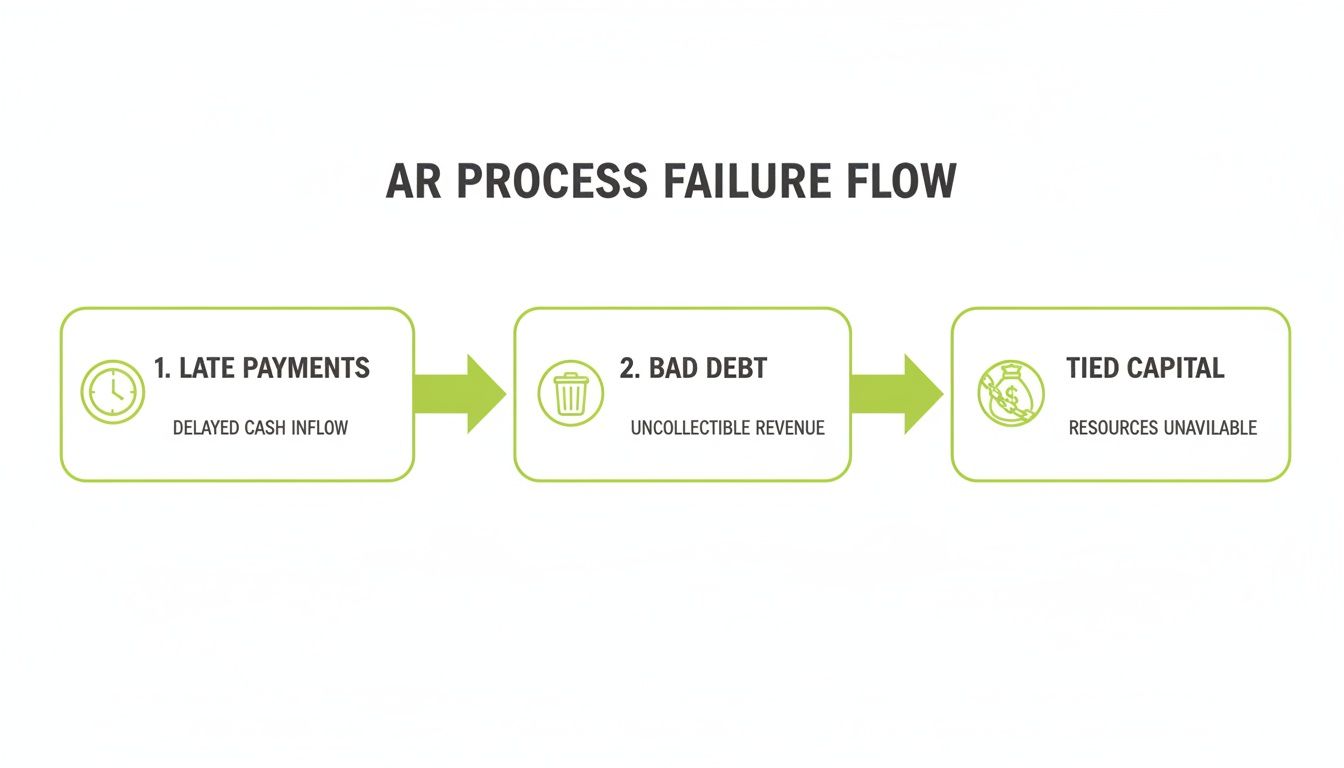
What begins as a "late payment" quickly snowballs into bad debt, trapping the working capital required to run the business.
Stage 3: Collections Management
Collections should not be a series of panicked fire drills. It must be a system. The goal is professional, consistent communication that prompts payment without damaging the client relationship.
The legacy method—relying on a controller’s memory and a spreadsheet—is a recipe for failure. It’s inconsistent and unscalable.
A structured collections process includes:
- Proactive Reminders: Polite notifications sent before an invoice is due.
- Segmented Outreach: Tone and frequency adapted based on invoice age and client profile.
- Clear Escalation Paths: Defined triggers for when an account moves from an automated reminder to a personal call.
This discipline ensures no invoice is forgotten and prevents senior staff from wasting time on routine follow-ups. This entire workflow is a critical piece of a much larger financial cycle. To see the bigger picture, check out our guide on the https://www.resolut.ai/blog/what-is-the-order-to-cash-process-a-guide-for-financial-operators.
Stage 4: Payment and Cash Application
Receiving payment is not the final step. The cash must be correctly applied to the open invoice in your ledger, a process known as cash application.
For firms using general accounting software like QuickBooks, this stage is a notorious bottleneck. Manual reconciliation is an error-prone time sink.
A modern accounts receivable process eliminates this friction. It provides clients a self-service payment portal and automates backend reconciliation. When a payment arrives, AR software for professional services should instantly match it to the correct invoice, close the item, and update your records. No manual data entry, just a clean, real-time view of your cash.
Stage 5: Reporting and Analysis
The final stage is turning AR data into operational intelligence. Good reporting provides a clear picture of cash flow, identifies payment trends, and assesses the health of your receivables.
It answers critical questions: Is our DSO improving or deteriorating? Which clients consistently pay late? Are our collection efforts effective?
This closes the loop, feeding insights back into your credit policy and collections strategy. It transforms AR from a back-office chore into a data-driven system that helps you make smarter decisions, improve cash flow, and build a more resilient firm.
The Essential AR Metrics Every CFO Must Track
You cannot manage what you do not measure. For a finance leader, the right AR metrics are diagnostic tools. They reveal the true story of your firm's financial health, providing the clarity needed to act with precision.
Real control comes from tracking a few core indicators that directly measure efficiency and expose risk. These metrics tell you everything you need to know about your process, your clients, and the effectiveness of your financial policies.

Days Sales Outstanding (DSO)
If there's one foundational metric in AR, it's Days Sales Outstanding (DSO). It measures the average number of days it takes your firm to collect payment after delivering a service. Think of it as your "collection velocity."
A low DSO signifies an efficient process and healthy cash flow. A high or rising DSO is a critical warning sign that working capital is trapped in unpaid invoices.
The formula is straightforward:
(Total Accounts Receivable / Total Credit Sales) x Number of Days in Period = DSO
For a professional services firm, a DSO under 45 days is strong; top performers often operate closer to 30. A DSO climbing above 60 indicates a breakdown in your credit terms, invoicing speed, or follow-up discipline. This is where accounts receivable automation can drive significant improvement by ensuring invoices are sent instantly and reminders are relentlessly consistent.
The Aged Receivables Report
If DSO is your speedometer, the aged receivables report is your GPS. It shows you exactly where the roadblocks are. This report sorts all outstanding invoices into buckets based on how long they've been past due—typically 0-30, 31-60, 61-90, and 90+ days.
Its power is in its granularity. A healthy aging report has the vast majority of its balance in the 0-30 day bucket. When a significant balance shifts into the 61-90 or 90+ day categories, you have a problem requiring immediate intervention.
A growing 90+ day balance is a direct threat to profitability. The probability of collecting that cash drops precipitously with each passing month. This is a clear indicator that standard collections have failed and escalation is required. Running this report automatically within your AR software for professional services provides a real-time view, not a stale month-end snapshot.
Collection Effectiveness Index (CEI)
While DSO measures time, the Collection Effectiveness Index (CEI) measures quality. It calculates the percentage of receivables you actually collected during a specific period. It answers the critical question: "How effective are we at collecting the money we are owed?"
The formula provides a clear picture of performance:
((Beginning Receivables + Monthly Credit Sales) - Ending Total Receivables) / (Beginning Receivables + Monthly Credit Sales - Ending Current Receivables) x 100 = CEI
A CEI score of 100% is ideal, but a consistent score above 80% demonstrates a strong collections function. A declining CEI means more of your revenue is aging out and becoming uncollectible. Tracked over time, this metric cuts through the noise of fluctuating sales to reveal the true efficiency of your collections engine.
AR Key Performance Indicators Dashboard
Tracking these metrics in isolation is useful, but viewing them together provides strategic insight. This dashboard view connects the data to the required operational response.
Metric | Formula | What It Measures | Strategic Action Trigger |
|---|---|---|---|
DSO | | The average number of days to collect payment after a sale. Your "collection velocity." | DSO rising above 45-60 days signals a need to review invoicing speed, credit terms, or follow-up consistency. |
AR Aging | | Which specific clients are paying late and for how long. Pinpoints risk. | Any significant amount moving into the 61+ day bucket requires immediate, targeted collection efforts. |
CEI | | The quality and effectiveness of your collections efforts over a specific period. | A CEI dropping below 80% indicates your collections process is losing effectiveness and needs reinforcement. |
Pairing CEI with your aging report allows for surgical precision. For firms using tools like QuickBooks AR automation, these metrics can be pulled into a dynamic dashboard, turning raw data into a financial command center that drives action.
Where Manual AR Processes Silently Fail
A healthy accounts receivable process should be a source of strength, converting work into predictable cash flow. For too many professional services firms, the manual reality is a constant drag on the business.
It is a system of silent failures—small, recurring breakdowns that compound into serious financial and operational pain.
These aren't dramatic, one-off disasters. They are the slow, costly leaks that drain capital and consume your team’s time. The manual process isn’t just inefficient; it’s unreliable and unscalable for a firm focused on growth.
Each failure adds friction, extends payment cycles, and traps your finance team in a reactive loop of chasing information and fixing errors. The damage extends beyond the balance sheet, straining client relationships and diverting focus from strategic work.
The High Cost of Human Latency
In professional services, the most common failure point is human delay—the natural lag in any manual workflow. Invoices aren't sent the moment a milestone is met; they wait for someone to pull hours, get approval, and generate the bill.
That initial delay alone can add 7–10 days to your collection cycle.
Then the follow-up begins. A controller juggling month-end close and financial reporting may only find a few hours a week for collections. An invoice due on Monday might not be addressed until Friday. These small delays accumulate, quietly stretching your DSO.
A senior partner spends two non-billable hours tracking down a client's AP contact to discuss a 60-day-old invoice. At a billing rate of $500/hour, that’s $1,000 in lost revenue just to collect a payment a system should have secured weeks ago. The relationship damage is worse; the conversation shifts from strategic value to transactional debt collection.
Inconsistency: The Enemy of Predictability
Manual AR processes are inherently inconsistent. The tone, timing, and persistence of collections depend entirely on the individual managing them. One person may follow up meticulously, while another lets things slide. This creates an unpredictable experience for your clients and erratic cash flow for your firm.
This lack of systemization creates several problems:
- Arbitrary Priorities: Without data, teams often chase the largest or oldest invoices, ignoring smaller, at-risk accounts that are quietly aging into bad debt.
- Accidental Client Training: Inconsistent follow-ups teach clients that your payment terms are suggestions, not requirements, reinforcing late payment behavior.
- Lost Intelligence: Every email and phone call is a data point. Without a central system, this valuable information is lost, making it impossible to analyze payment behaviors or identify process bottlenecks.
The QuickBooks Reconciliation Bottleneck
For firms running on systems like QuickBooks, cash application is a notorious time-waster. Manually matching incoming payments—especially checks or ACH transfers with vague memo lines—to open invoices is tedious and invites error.
This reconciliation bottleneck directly clouds your financial visibility.
When cash isn't applied promptly, your aged receivables report is inaccurate. It provides a false picture of who has paid and who is delinquent. This flawed data leads to wasted effort, such as chasing a client who has already paid, and makes accurate cash flow forecasting impossible. This is precisely where AI AR automation excels, using intelligent matching to eliminate hours of manual data entry and provide a real-time, accurate view of receivables.
This cycle of delay, inconsistency, and manual reconciliation sets the stage for a modern solution designed to restore control to financial operators.
Using Automation To Control Cash Flow
Manual AR processes don’t just fail; they place a hard ceiling on your firm's financial performance. To break through it, you must shift from a reactive, human-dependent workflow to a proactive, system-driven one. This is the purpose of accounts receivable automation.
It’s not about replacing your finance team. It is about equipping them with tools that execute repetitive tasks with perfect consistency. This frees them for high-impact work like managing client relationships and financial strategy. An automated system doesn't get distracted or forget to follow up. It executes the process as designed, every time.
This shift turns AR from an administrative burden into a strategic asset that strengthens your cash position.

From Manual Guesswork to Intelligent Action
Modern AI AR automation goes beyond simple reminders. It adds a layer of intelligence that transforms how you manage credit risk and collections. Instead of chasing the oldest or largest invoices, the system uses data to prioritize your team's efforts.
Key capabilities include:
- Predictive Risk Scoring: The system analyzes payment histories to flag at-risk accounts before they become a serious problem, allowing for early, targeted intervention.
- Personalized Outreach: Design and execute multi-channel communication plans that adapt based on client profile and invoice age, ensuring the right tone is always used.
- Automated Reconciliation: For firms wrestling with QuickBooks AR automation, intelligent systems automatically match incoming payments to open invoices, eliminating hours of manual work.
This systematic approach directly addresses the root causes of high DSO and weak cash flow: human delay and inconsistent follow-up.
Recent surveys show that 80–91% of businesses using automated AR systems report improved cash flow and accounting efficiency. Firms adopting these platforms see a 65% payback within 12 months, which helps explain why 75% of finance leaders say AR has grown in strategic importance.
Measuring the Impact on Your Bottom Line
The goal of automation is to produce measurable results that restore financial control. By systemizing collections and payment workflows, you can expect direct improvements in the core metrics that define your firm’s financial health.
A well-implemented automation strategy delivers tangible results:
- Accelerated Cash Flow: By ensuring timely invoicing and relentless, professional follow-up, firms can reduce DSO by 15–25% within the first six months.
- Reduced Manual Errors: Automated data entry and cash application eliminate the reconciliation mistakes that waste your team's time on detective work.
- Increased Team Productivity: By removing an estimated 10-20 hours of manual work per week, your finance team can pivot from administrative tasks to strategic analysis.
This isn’t just about efficiency; it’s about building a more resilient financial foundation. For a deeper dive, read our guide on the benefits of accounts receivable automation. To see the bigger picture, you can explore the overarching benefits of business automation.
Ultimately, automation provides what every finance operator requires: predictability. It creates a reliable system that converts earned revenue into cash with maximum velocity and minimal friction.
Building an AR System That Feels Human
When finance leaders hear “automation,” they often picture robotic, impersonal payment demands. That is a fundamental misunderstanding of a strategic system.
Strategic automation is about building a system that delivers the right message, through the right channel, with the right tone, every time. It brings discipline to an account receivable process that is often chaotic and dependent on individual effort.
For professional services, where relationships are the entire business, this system must feel human. A well-designed workflow doesn’t replace your team. It orchestrates their efforts, handling routine follow-ups flawlessly so your people can focus on the conversations that require a human touch.
The goal is to create a predictable, professional payment experience for every client. This is about using smart logic and multiple touchpoints to make paying you easy, not awkward.
* **Visual Idea: A clean, cinematic infographic showing a branching workflow. The central path is "Automated Outreach (Email/SMS)". It branches off to "Client Clicks Payment Portal" (leading to a "Paid" icon) or to an "Escalate to Team" icon if no payment is made after a set number of days. ***
Designing an Outreach Cadence That Works
Relying on email alone is a strategy for being ignored. A modern AR system layers its communication to ensure the message gets through without bombarding the client.
It’s about thoughtful sequencing. A typical cadence isn’t aggressive; it’s persistent and professional.
- Day -3: A polite, automated email: "A reminder that invoice #123 is due soon."
- Day 1 (Due Date): An SMS notification with a direct payment link.
- Day 7 Past Due: A second email, with a slightly firmer tone.
- Day 15 Past Due: The system flags the account and creates a task for a team member to place a personal phone call.
This is disciplined, professional follow-up, executed systematically. It is a core function of any effective AR software for professional services.
Remove Friction with a Client Payment Portal
The single biggest reason for late payments is friction.
If paying your firm requires a client to find a checkbook or navigate a clunky bank wire portal, you have made it a chore.
A dedicated, self-service payment portal solves this. It gives clients one secure place to view invoices, ask questions, and pay via their preferred method—credit card or ACH. This single change can drastically reduce DSO because it makes paying you the path of least resistance.
By centralizing billing information and offering one-click payment options, firms often see a 20-30% acceleration in payments from clients who use the portal. The experience shifts from a transactional headache to a simple, professional interaction.
* **Visual Idea: A side-by-side comparison. Left side: "The Old Way"—shows a jumbled mess of emails, checks, and phone icons. Right side: "The Modern System"—shows a clean interface of a client payment portal with a clear "Pay Now" button. ***
Stop Manually Matching Payments in QuickBooks
For controllers, the final step—cash application—is a significant bottleneck, especially in QuickBooks. Manually matching each incoming payment to the correct invoice is tedious and prone to error.
This is where QuickBooks AR automation becomes a game-changer.
An intelligent system connects to your bank feed and automatically matches deposits to the correct open invoices, even handling partial payments or bundled remittances. This not only saves hours of manual reconciliation but also ensures your aging report is always accurate, providing a real-time, trustworthy picture of your cash position.
Common Questions from Finance Operators
Even with a clear strategy, finance leaders still have practical questions before changing how their firm manages accounts receivable. Here are the most common ones.
What is the first step to improve our AR process?
Before implementing any new tool, run a diagnostic.
Pull your current Aged Receivables report and identify where your cash is trapped. Focus on the 61-90 and 90+ day buckets. Concurrently, calculate your current Days Sales Outstanding (DSO) to establish a hard baseline.
This is about achieving clarity. You must know where the bottlenecks are before you can design a solution.
How can we automate AR without sounding robotic?
Good automation enhances relationships; it does not replace them. The key is to implement a system that allows you to design workflows that feel human because you control the logic, tone, and timing.
Start by automating low-stakes communications: a pre-due date reminder or the first follow-up on a recently past-due invoice. Use the system's intelligence to flag high-value or high-risk accounts for a personal phone call from your team.
The objective is to ensure every communication is professional and on-brand, while reserving your team’s direct intervention for when it matters most.
How long does it take to see a reduction in DSO?
While every firm's starting point is different, most see a measurable drop in DSO within the first 60 to 90 days.
The initial wins come from systemization. No invoice is missed. Every follow-up is consistent. That discipline alone tightens the collection cycle.
The larger improvements—often a 15-25% reduction in DSO—materialize within the first six months as the system optimizes outreach and clients adopt easier payment methods. It creates a predictable rhythm that accelerates the entire cycle.
Resolut automates AR for professional services—consistent, accurate, and human.