Accounts Receivable Internal Controls: A CFO's Guide to Financial Stability
Master accounts receivable internal controls to safeguard revenue and improve cash flow. A practical CFO guide for professional services.
For a professional services firm, accounts receivable is more than an asset on the balance sheet. It is the monetized value of your team's expertise and intellectual capital. This makes your accounts receivable internal controls the operational architecture that protects your firm's primary revenue engine.
The Operational Case for Stronger AR Controls
In a professional services context, revenue isn't derived from inventory; it's from billable hours, project milestones, and client retainers. Without disciplined AR internal controls, this earned revenue is exposed to billing errors, collection delays, and potential fraud.
The objective is to move from reactive fire-fighting—chasing late payments or correcting invoices—to a predictable system. A robust control framework transforms the AR process into a stable source of cash that fuels growth, rather than a drain on administrative resources.
The Strategic Impact of Strong Controls
Effective controls create operational certainty, which has a direct, measurable impact on the financial health of the firm.
- Improved Cash Flow: Systematic controls accelerate cash conversion, providing the liquidity required for operations and strategic investment.
- Reduced DSO: A well-controlled collections process can materially reduce Days Sales Outstanding (DSO). For a $10M firm, shaving five days from DSO frees up nearly $140,000 in working capital.
- Enhanced Data Integrity: Controls ensure the AR aging report and general ledger are accurate. This allows for reliable financial planning and confident decision-making.
A disciplined AR process is not about rigidity with clients; it is about operational consistency. This consistency builds trust and predictability, both internally and with your clientele.
From Manual Effort to Automated Discipline
As a firm scales from $3M to $50M in revenue, manual AR processes become significant liabilities. A single overlooked invoice, a misapplied payment, or an unauthorized credit memo can create distortions in financial reporting. This is where accounts receivable automation becomes a core component of your internal control strategy.
Platforms leveraging AI AR automation do more than accelerate tasks; they enforce predefined rules. They create an immutable audit trail, systematize follow-ups, and ensure processes are executed consistently. For firms using QuickBooks, specialized QuickBooks AR automation can layer these critical controls without requiring a full system migration.

The goal is a system where the correct procedure is the path of least resistance. This builds a resilient financial operation that supports the firm's strategic objectives.
Mapping Core Risks in the AR Cycle
Effective accounts receivable internal controls are not theoretical; they are designed in direct response to the specific financial risks inherent in a firm's cash cycle. Identifying these vulnerabilities is the first step toward mitigating them.
For professional services firms, these weak points are often masked by the demands of client delivery. However, they carry significant financial consequences if left unaddressed.
High-Stakes Financial Vulnerabilities
These are not abstract risks but practical failures that drain working capital and distort the firm’s financial position. Each step, from client onboarding to final payment application, presents unique potential for loss.
Consider two common scenarios:
- Credit Risk: A high-value client is onboarded without a formal credit evaluation to expedite a project. If that client experiences financial distress, the firm is left with a substantial, uncollectible receivable.
- Invoicing Errors: An invoice for a complex milestone contains outdated rates or scope inaccuracies. This is not merely a clerical error; it delays payment, requires costly rework, and erodes client trust.
The Silent Threats of Misapplication and Fraud
Beyond unintentional errors are more deliberate risks that can quietly erode firm assets. A proactive fraud risk assessment is a critical tool for identifying where the AR process is most exposed.
These threats often manifest in two areas:
- Cash Misapplication: A client payment is applied to the wrong invoice or account. This single error creates a domino effect, making one account appear delinquent while another seems overpaid, requiring hours of administrative work to resolve.
- Fraudulent Write-offs: An employee with excessive system permissions could collude with a client, applying a payment and then issuing an unauthorized credit memo for the same amount while pocketing the cash. Without proper oversight, this can go undetected for months.
The most dangerous risks in AR are often the quietest. They are not catastrophic system failures but small, repeated process gaps that accumulate into significant financial losses over time.
Data supports this. Weak authorization and reconciliation are major contributors to these losses. One study found that 28% of companies had significant uncollectible receivables due to poor controls. More importantly, firms that segregated AR duties reported 50% fewer cases of misappropriation.
By methodically mapping these risks—from credit extension to billing errors and fraud—you create a precise blueprint of your firm's vulnerabilities. This blueprint is the foundation for building controls that deliver measurable results.
The Essential Controls for a Resilient AR Framework
A strong accounts receivable process is built on specific, non-negotiable accounts receivable internal controls. Each control acts as a layer of defense, protecting revenue from client engagement through cash collection. For a professional services firm, these controls are the bedrock of financial stability.
Implementing these controls transforms AR from a reactive, administrative function into a predictable and secure process. It creates an environment where errors are caught early, fraud is difficult to execute, and cash flow is protected by design.
Segregation of Duties
This is the most fundamental control. The individual who sends an invoice or extends credit should not be the same person who applies cash payments or approves write-offs. This is not about a lack of trust; it is about removing the opportunity for both error and fraud.
When one person controls the entire AR cycle, they can manipulate records to conceal theft, such as in a classic lapping scheme. By splitting key roles, you create a natural system of checks and balances where one employee's work is inherently verified by another's.
Credit Management and Invoicing Controls
Effective controls begin before the first invoice is issued. A formal credit management policy is the first line of defense, dictating who receives credit and under what terms. This prevents the sales function from making risky promises to close a deal. The policy must be documented, approved by leadership, and applied consistently.
Invoicing controls are equally critical. They ensure every bill is accurate and timely. This requires a clear process for verifying billable hours, project milestones, and pass-through expenses before an invoice is generated. An error at this stage damages client trust and consumes valuable team time in dispute resolution.
This infographic breaks down the core risks these controls are designed to mitigate.
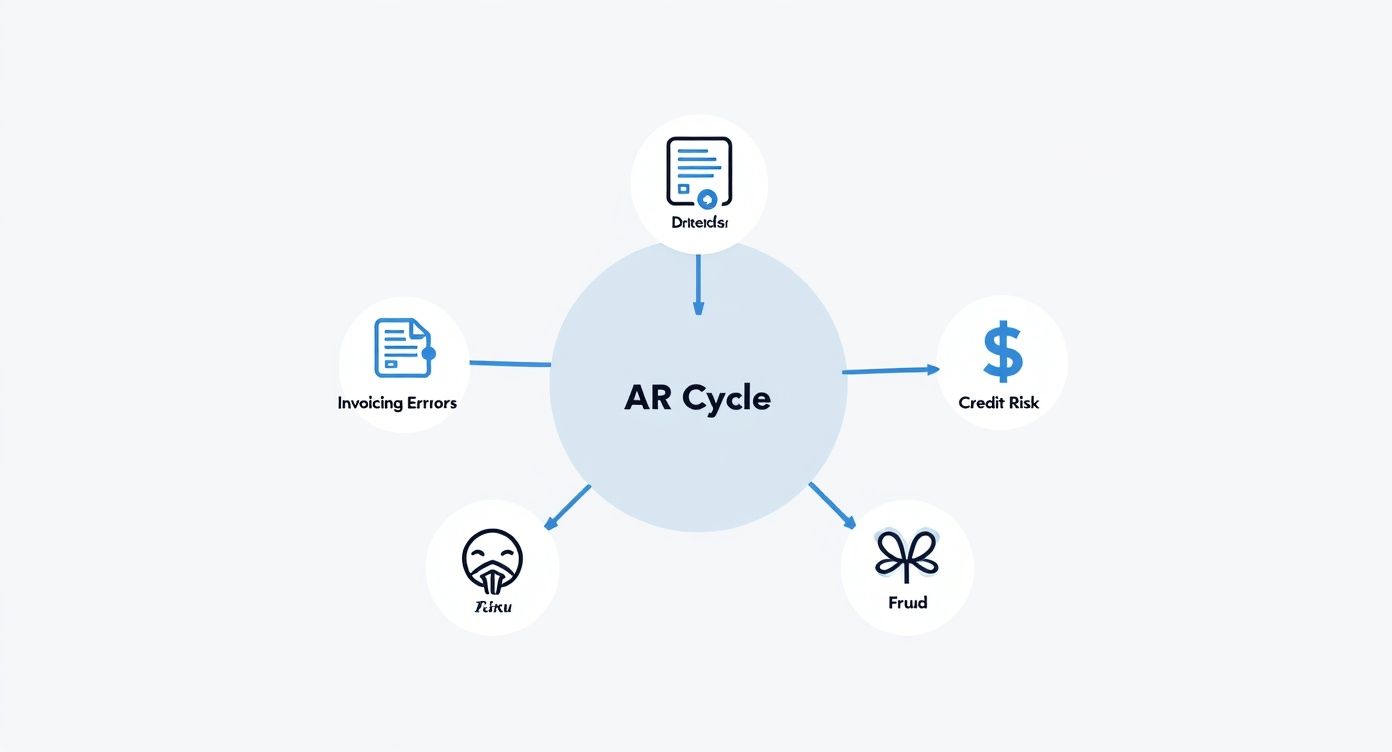
Each of these points—invoicing errors, credit risk, and fraud—represents a significant point of failure that a well-designed control framework addresses head-on.
Collections, Cash Application, and Reconciliations
A disciplined collections process is systematic, not aggressive. It starts with clear payment terms and includes automated reminders before an invoice is due, followed by a structured follow-up cadence for past-due accounts. This consistency is what improves cash flow and reduces DSO.
The objective of a collections protocol is predictability. When clients understand your process is consistent, they are more likely to adhere to payment terms, establishing a professional expectation.
Cash application must be meticulous. Payments must be applied to the correct invoices promptly and accurately. This simple step prevents misapplication of funds, which artificially ages receivables and wastes hours on reconciliation. It is also a critical chokepoint for preventing theft.
Finally, regular reconciliation is the master control that verifies all other controls are working. The AR aging report must be reconciled to the general ledger at least monthly. This process, ideally performed by someone independent of billing and cash application, confirms that the AR sub-ledger is accurate.
Access Controls and Monitoring
Not everyone on the finance team requires access to every function in the accounting system. System access controls limit user permissions to only what is necessary for their role. A collections specialist should not have the ability to issue a credit memo. This is a simple but powerful control, especially when using QuickBooks AR automation tools that allow for granular, role-based permissions.
These are not theoretical problems. A review of UN field operations found that in 58% of audit reports, a lack of clear guidance led to inconsistent monitoring of receivables. Worse, fundamental weaknesses like poor segregation of duties were specifically cited in 42% of the reports, showing just how critical these basic controls are. You can discover more insights about these systemic challenges in decentralized organizations.
AR Internal Control Matrix for Professional Services
This control matrix maps AR process stages to their primary risks, objectives, and key control activities. It provides a roadmap for turning theory into practice.
AR Process Stage | Primary Risk | Control Objective | Key Control Activity |
|---|---|---|---|
Client Onboarding | Extending credit to non-creditworthy clients, leading to bad debt. | Ensure credit is only extended to clients with the ability to pay. | Formal, documented credit approval process for all new clients. |
Invoicing | Inaccurate or delayed invoices, causing payment delays and disputes. | Ensure all invoices are accurate, complete, and sent on time. | Mandatory review of billable hours/deliverables before invoice generation. |
Collections | Inconsistent follow-up on overdue accounts, leading to high DSO. | Systematically collect all outstanding balances in a timely manner. | Automated, escalating reminder cadence for all past-due invoices. |
Cash Application | Misapplication of payments or theft of incoming cash. | Ensure all cash receipts are recorded promptly and accurately. | Daily reconciliation of bank deposits to cash postings in the AR sub-ledger. |
Reconciliation | Discrepancies between the AR sub-ledger and the general ledger. | Verify the accuracy and completeness of the accounts receivable balance. | Monthly reconciliation of the AR aging report to the GL by an independent party. |
System Access | Unauthorized or fraudulent transactions (e.g., fake credit memos). | Restrict system access and permissions to authorized personnel only. | Role-based access controls; periodic review of user permissions. |
This matrix is not a checklist; it is a framework for building a resilient AR function that protects your firm’s revenue and reputation.
How to Implement and Audit Your Internal Controls
Knowing which controls are necessary is different from implementing them effectively and verifying their performance.
Implementation is not a one-time project but the establishment of a sustainable system of financial discipline. It requires a clear roadmap that prioritizes the most critical controls.
Similarly, an audit should function as a proactive management tool to confirm that controls are operating as designed, not merely as a historical review of errors. This continuous loop of implementation and verification is what keeps the AR process resilient.
A Prioritized Implementation Roadmap
With limited resources, focus on the highest-risk areas first: cash handling and invoice accuracy. A phased approach prevents team overload and builds momentum.
A logical implementation sequence:
- Segregation of Duties: This is non-negotiable. Immediately separate the person handling cash application from the person who can approve credit memos. This is the single most effective defense against common fraud schemes.
- Cash Application and Reconciliation: Institute daily reconciliation of cash receipts to bank deposits. This simple procedure ensures all incoming cash is accounted for quickly, reducing the risk of misapplication or loss.
- Invoicing and Credit Controls: Formalize the invoicing process. Require a secondary review for any invoice over a specified threshold. Concurrently, document and enforce a clear credit policy for all new clients.
These initial steps secure the most vulnerable points in the AR cycle. Our guide on procedures for accounts receivable that work provides deeper insights into structuring these foundational processes.
The Proactive Audit Checklist
Shift your audit mindset from finding errors to confirming process integrity. An internal audit of accounts receivable internal controls should be a routine health check.
Frame it as a series of direct, binary questions to elicit clear, actionable answers.
Use this checklist quarterly to test your framework:
- Is the person applying cash payments different from the one approving credit memos?
- Are all new clients subject to a documented credit approval process before work commences?
- Is the AR aging report reconciled to the general ledger monthly by someone outside the AR team?
- Are user access rights in the accounting software reviewed at least semi-annually?
- Can we produce an audit log showing who created, sent, and modified a specific invoice?
A "no" answer is not a failure; it is an action item. It points directly to a weakness requiring immediate attention, transforming the audit from a compliance exercise into a valuable management tool.
Monitoring Performance with Key Metrics
Effective controls are often invisible. Their impact is measured through outcomes. Key Performance Indicators (KPIs) provide the hard data to assess how controls are affecting financial health.
KPIs are the scoreboard for your internal controls. They translate process discipline into measurable financial results, showing precisely where your system is strong and where it needs reinforcement.
Focus on these three essential metrics:
- Days Sales Outstanding (DSO): The ultimate measure of collection efficiency. A consistently low or declining DSO indicates that billing and collections controls are effective.
- Collection Effectiveness Index (CEI): This metric shows the percentage of receivables collected during a period. A CEI near 100% demonstrates that processes are successfully converting invoices to cash.
- Aged Receivables Percentage: Monitor the percentage of total AR over 90 days past due. An increasing percentage is a red flag, potentially signaling issues with credit policies or collection efforts.
By monitoring these KPIs, you gain an objective, data-driven view of your control environment. This helps prove the value of your efforts and enables intelligent adjustments to maintain the firm's financial health.
Using Automation to Strengthen Your AR Controls
Manual processes are the primary point of failure for internal controls. They rely on human memory and diligence, creating opportunities for error, inconsistency, and fraud.
Modern accounts receivable automation platforms are not just efficiency tools; they are powerful instruments for systematically enforcing controls.
An AR platform functions as a digital supervisor that enforces predefined rules without exception, building a robust framework that is difficult to bypass. It moves your controls from a static checklist to a dynamic part of daily operations.
This is a critical function. When controls are weakly enforced, uncollectible debt increases. One analysis found that major control gaps were the root cause for roughly 70% of an organization's uncollected receivables being past due. Worse, 60% were so old they were flagged as potentially uncollectible—all because of poor monitoring. You can read the full analysis on effective AR management to see the full impact.
Systematizing Segregation of Duties
True segregation of duties is challenging in a lean finance department. AR software for professional services addresses this by enforcing roles at the system level.
- User Roles: You can define exactly who can view, create, or approve transactions. A collections specialist may view overdue invoices but lack the permissions to issue a credit memo.
- Immutable Audit Trails: Every action—sending a reminder, applying a payment—is logged with a user ID and a timestamp. This creates a transparent, unchangeable record of all activities.
Digital enforcement is far more reliable than manual handoffs, making it nearly impossible to bypass established protocols.
Connecting Automation to Control Objectives
Automation directly supports specific control objectives, closing the gap between policy and practice. It transforms your ideal AR framework into the team's everyday workflow.
Automation hard-codes your best practices into the AR process. It ensures the right steps are taken at the right time, every time, transforming your internal control policies from a document on a shelf into a living, operational system.
Consider how specific features reinforce your controls:
- Automated Invoicing: When the system pulls data directly from your accounting platform, such as with QuickBooks AR automation, it eliminates manual data entry errors. Invoice accuracy is ensured from the outset.
- AI-Driven Collections: An AI AR automation platform executes your collections strategy flawlessly. It sends the right communication to the right contact at the right time, ensuring consistent follow-up that helps reduce DSO.
- Automatic Cash Application: The software matches incoming payments to open invoices, dramatically reducing the risk of misapplication and leaving a clean audit trail for reconciliation.
This level of precision is essential for maintaining a healthy cash cycle.
Ultimately, automation provides the real-time visibility required for effective oversight. Dashboards tracking KPIs like DSO and aged receivables allow for continuous monitoring of AR health, transforming control from a reactive audit function into a proactive, data-driven discipline.
Achieving Calm and Consistent Financial Control
Strong accounts receivable internal controls are the foundation of a predictable, resilient cash flow cycle. For a growing professional services firm, manual systems are no longer adequate.
Legacy processes—spreadsheets, manual follow-ups—invite inconsistency and human error. They create a drag on finances that impacts operational efficiency.
The objective is to move beyond reactive problem-solving and establish a state of calm control. This is a state where financial processes are consistent, data is reliable, and leadership can focus on strategic decisions rather than operational cleanup.
The Foundation of Financial Stability
A predictable cash cycle begins with an objective assessment of your current process. For actionable insights, review our guide on 8 real-world ways to clean up your accounts receivable. This visibility is the first step toward building a process that delivers consistent results.
The ultimate goal is a financial operation where the right action is the default action. Controls shouldn't be roadblocks; they should seamlessly guide your processes, making sure every single transaction strengthens your firm’s financial footing.
Integrating Control with Technology
This state of calm control is significantly enhanced by accounts receivable automation. Platforms using AI AR automation embed your controls directly into daily workflows. This enforces policies like segregation of duties and creates an immutable audit trail without manual intervention.
The result is improved cash flow and a stronger financial core for your firm.
Of course, consistent financial control also means keeping up with regulatory demands. For a wider view on how compliance supports financial stability, resources on Mastering Compliance in the Financial Services Industry are a great place to start.
By pairing disciplined controls with smart technology, your firm can build a financial engine that is not just efficient, but fundamentally more secure and predictable.
A Few Common Questions
For financial leaders at growing firms, practical application is key. Here are direct answers to common questions from CFOs and Controllers.
Our Finance Team Is Small. How Do We Actually Segregate Duties?
Perfect segregation is often not feasible in smaller firms. The goal is not textbook perfection but preventing one person from controlling a transaction end-to-end.
Implement simple splits: the person creating invoices should not be the one approving credit memos. The team member performing collections should not be the one applying cash. These small divisions create powerful checks and balances.
In a lean environment, rely on compensating controls. Examples include mandatory vacations for key finance staff (with another person covering their duties) or having a firm partner conduct periodic, unannounced spot-checks of bank reconciliations and aged credit memos.
This is also where accounts receivable automation provides significant value. The software can be configured to require different user logins for conflicting tasks, systemically enforcing separation of duties.
If We Can Only Focus on One Thing, What’s the Single Most Important AR Control?
While all controls work in concert, the most critical is the regular, independent reconciliation of the AR aging report to the general ledger. This single process acts as a safety net that catches a wide range of issues.
It will flag unrecorded payments, misapplied cash, and unauthorized write-offs. When performed consistently by someone not involved in billing or cash application, it provides a powerful verification that the numbers on your financial statements are accurate.
How Does AR Automation Actually Improve Internal Controls?
AR software for professional services embeds your control policies into daily operations, making best practices the path of least resistance.
- It forces consistency. The software sends collections communications based on predefined rules, ensuring every client interaction is standardized.
- It creates an undeniable audit trail. Every action is recorded with a user and a timestamp, providing total transparency for audits.
- It builds in access controls. Platforms, including QuickBooks AR automation tools, let you define user permissions. A collections specialist can be blocked from issuing a credit memo, systemically enforcing segregation of duties.
- It gives you real-time visibility. Dashboards tracking KPIs like DSO and aged receivables turn oversight into a continuous, data-driven function to improve cash flow.
We’re Growing Fast. Which AR Controls Should We Nail Down First?
During rapid growth, the highest-risk areas are cash handling and revenue recognition. These must be secured first.
Start with two non-negotiables:
- Segregation of Duties between cash application, billing, and credit memos. This is your primary defense against error and fraud.
- Daily or Weekly Reconciliation of cash receipts to bank deposits. This ensures every dollar is accounted for quickly, reducing the risk of loss or misapplication.
Once these are in place, formalize your credit policy and standardize invoice creation and delivery. Establishing these foundational controls early creates a strong financial precedent for future growth.
--- Resolut automates AR for professional services—consistent, accurate, and human. Learn more at https://www.resolutai.com.