Mastering the Accounts Receivable Process for Professional Services
Optimize your accounts receivable process to accelerate cash flow. Learn proven strategies for invoicing, collections, and AR automation.
The term “accounts receivable process” belongs in a dusty accounting textbook. But for financial leaders at professional services firms, it's the engine that powers cash flow.
A disciplined AR process is a strategic asset that fuels growth. An inconsistent one creates constant financial drag, tying up working capital and forcing reactive decision-making.
This guide provides a framework for building an AR system that delivers predictable financial results. The goal isn't just to get paid faster; it's to achieve control.
Why Your Accounts Receivable Process Is a Strategic Asset
Running a professional services firm in the $3M–$50M range means balancing client relationships with the need to get paid on time. An ad-hoc AR process throws that balance off.
It creates operational drag, ties up working capital, and burns hours your team could spend on high-value analysis. It's the difference between proactively managing cash and reactively chasing payments.
The Shift from Back-Office Task to Financial Control
Viewing AR as a purely administrative task is a trap. Every delayed invoice, manual error, and missed follow-up directly impacts your ability to forecast, invest, and operate with confidence.
A disciplined, well-oiled AR system gives you something invaluable: control over your cash.
For a firm with $10 million in annual revenue, reducing Days Sales Outstanding (DSO) by just 10 days frees up approximately $274,000 in working capital. That is cash available for immediate use.
This control comes from turning messy, manual tasks into a repeatable, measurable system. It allows you to build a function that delivers predictable financial outcomes.
Where Modern AR Creates Measurable Value
Implementing accounts receivable automation provides visibility and tight control over your firm's most critical asset: cash. The outcomes are tangible.
- Improved Cash Flow: A systematic process with frictionless payment options means money hits your bank account sooner.
- Reduced DSO: Automation ensures consistent, timely follow-up, shrinking the time it takes to convert receivables to cash.
- Stronger Client Relationships: Professional, consistent reminders replace awkward collection calls, preserving the goodwill you've built.
By optimizing the AR process, you transform it from a cost center into a strategic pillar of financial health.
--- Resolut automates AR for professional services—consistent, accurate, and human.
The Six Stages of an Effective AR Workflow
A disciplined accounts receivable process is a cycle, not a checklist. Each stage feeds the next. For professional services, mastering this flow is the difference between unpredictable cash flow and a healthy, growing business.
Think of it as six control points. Optimizing these allows you to spot weaknesses, build operational strength, and achieve payment predictability.
This diagram shows how the stages connect client relationships, cash flow, and financial decision-making.
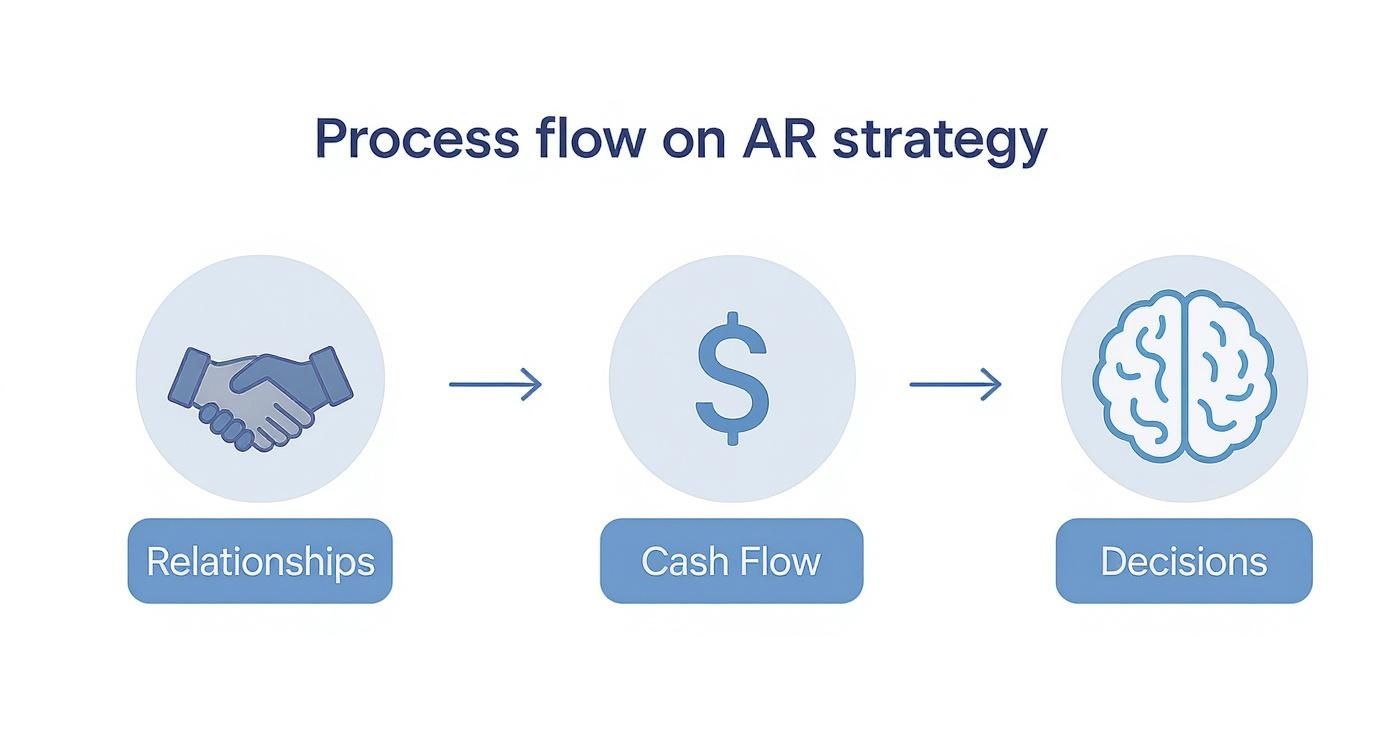
A strong AR workflow is a strategic system that builds client trust and provides the data needed for confident financial planning.
1. Client Credit Assessment
The AR process begins before any billable work is done. A data-driven credit assessment is the first line of defense against payment risk, especially with new clients or large projects.
This isn't about being confrontational; it’s about setting clear financial expectations from the start.
For a new client engagement worth $100,000, a simple credit check can prevent a six-figure write-off. It establishes a professional tone and protects the firm from unnecessary risk.
2. Accurate and Timely Invoicing
The invoice is the single most important document in this workflow. In professional services, small billing errors—wrong project codes, unapproved hours, vague descriptions—are the primary cause of payment delays.
Every invoice must be accurate, clear, and sent the moment a billing cycle ends or a milestone is hit. No exceptions.
An invoice sent just one week late can push its payment past the 30-day mark, directly increasing your Days Sales Outstanding (DSO). Using AR software for professional services that integrates with your project management tools eliminates manual errors and ensures timely delivery.
3. Structured Collections Communications
Collections should be a systematic, respectful process, not a series of reactive phone calls. A structured communication cadence, managed with accounts receivable automation, ensures every follow-up is consistent and professional.
A standard workflow might include:
- A polite reminder email sent 3 days before the due date.
- An automated follow-up on the day payment is due.
- A slightly firmer, but professional, notice at 7 days past due.
This consistency removes emotion and guesswork. The entire sequence is one component of the broader order-to-cash process, which governs the complete cycle from sale to payment.
4. Frictionless Payment Processing
The harder it is for clients to pay, the longer it will take. Offer multiple, simple payment methods—credit card, ACH, wire transfer—through a secure online portal.
The goal is to make paying your firm as easy as an online retail transaction. This reinforces your firm’s image as a modern, efficient partner.
5. Swift Cash Application
Once payment is received, it must be applied to the correct invoice in your accounting system immediately. When cash application lags, your books are inaccurate.
This is how collection reminders get sent to clients who have already paid, which erodes trust. Tools that offer QuickBooks AR automation can sync payments directly to your general ledger, providing a real-time, accurate financial picture.
6. Efficient Dispute Resolution
Disputes are inevitable. How you handle them defines the client relationship. A clear, documented process for investigating and resolving invoice issues is essential.
When a client raises a problem, it should trigger a specific workflow, not a frantic search through old emails and project files.
Handling a dispute quickly and transparently can turn a negative into a positive. It shows your firm values the partnership over simply collecting a payment, building long-term loyalty.
Resolut automates AR for professional services—consistent, accurate, and human.
Pinpointing Costly Leaks in Your AR Process
Even a well-defined accounts receivable process can have leaks. These aren’t dramatic failures but small, persistent gaps—a miscoded invoice, a missed follow-up—that quietly drain cash flow and inflate Days Sales Outstanding (DSO).
Over time, these minor issues compound into significant financial drag.
Identifying these failure points is the first step toward building a resilient system. The goal is to stop reacting to problems and start proactively sealing the cracks before they impact your firm’s financial health.

Common Failure Point 1: Manual Invoice Errors
For a professional services firm, the invoice is the product. A single mistake—the wrong project code, an unapproved line item, a missing PO number—brings the payment process to a halt.
This forces your team into a painful cycle of corrections and resubmissions, adding not days, but weeks to the payment timeline. This isn't just an administrative headache; it's a direct impact on your bottom line.
Common Failure Point 2: Inconsistent Follow-Up
An unstructured collections approach is a recipe for high DSO. When follow-up depends on someone's memory or a spreadsheet, invoices will fall through the cracks. Reminders are sent late, inconsistently, or not at all.
This inconsistency signals to clients that your payment terms are flexible suggestions, not requirements. It creates chaos in cash flow forecasts. You can explore the cost of AR inefficiency in professional services firms to understand the full financial impact.
A late payment is more than a delayed deposit; it represents a breakdown in process. For every day an invoice ages, the probability of collecting the full amount decreases. A systematic, automated cadence is the only reliable defense.
Common Failure Point 3: Ambiguous Payment Terms
Vague terms like "Net 30" without a clear due date, a stated late fee policy, or obvious payment methods create friction. They invite delays.
Clear, concise terms set a professional standard from the start.
- Explicit Due Date: Don't say "Net 30." Say "Due by October 31, 2024."
- Accepted Payment Methods: List exactly how clients can pay and include a direct link to a payment portal.
- Late Fee Policy: Reference your policy for overdue payments to create a sense of urgency.
Fixing these leaks is a strategic imperative. By plugging these common holes, you transform your AR function from a source of financial leakage into a well-oiled machine that powers predictable cash flow.
How to Measure AR Performance Accurately
You cannot control what you do not measure. To manage accounts receivable effectively, you must move beyond gut feelings and into a data-driven view of performance.
This isn’t about drowning in vanity metrics. It’s about focusing on a few core KPIs that provide a real-time diagnostic of your firm’s financial health. These numbers tell a story about collection efficiency and client payment behavior.

Days Sales Outstanding (DSO)
Days Sales Outstanding (DSO) is the most fundamental AR metric. It measures the average number of days it takes your firm to get paid after sending an invoice. A high DSO represents trapped cash.
The formula is: (Total Accounts Receivable / Total Credit Sales) x Number of Days in Period
If your firm has a DSO of 55 days, nearly two months of revenue is constantly tied up in receivables. Accounts receivable automation can reduce DSO by 10-20% simply by ensuring invoices are sent on time and follow-ups are never missed.
Aged Receivables Analysis
While DSO provides a high-level view, an aged receivables report offers the granular detail needed to spot trouble early. This report breaks down outstanding invoices into buckets based on how long they’ve been unpaid—typically 0-30, 31-60, 61-90, and 90+ days.
It is your early warning system.
An aging report reveals which client relationships need attention and which invoices are at the highest risk of becoming bad debt. An invoice that hits 90 days overdue has a significantly lower chance of being collected in full.
In a healthy report, most AR is in the 0-30 day column. A growing balance in the 61-90 day bucket is a red flag indicating a breakdown in your collections process that needs immediate attention.
Collection Effectiveness Index (CEI)
Collection Effectiveness Index (CEI) is a more nuanced metric. It measures how much of the money you could have collected in a period, you actually did. CEI compares what you collected to what was available, giving a truer picture of your team's performance.
The calculation is: ((Beginning Receivables + Credit Sales) - Ending Total Receivables) / ((Beginning Receivables + Credit Sales) - Ending Current Receivables) x 100
A CEI consistently above 80% is considered strong, but top-performing firms often push for 90% or higher. This KPI helps you understand the true efficiency of your collections engine, separate from the noise of sales fluctuations.
Essential AR Metrics and Their Strategic Implications
A breakdown of key performance indicators for the accounts receivable process, their calculation, and what they reveal about your firm's financial health.
Metric | Calculation Formula | What It Measures | Strategic Implication |
|---|---|---|---|
Days Sales Outstanding (DSO) | (Total AR / Total Credit Sales) x # of Days | The average number of days it takes to collect payment after a sale. | A high DSO indicates tied-up cash and potential collection issues. Lowering it directly improves working capital. |
Aged Receivables | Categorization of AR by due date (0-30, 31-60, 61-90+ days). | Which invoices are overdue and for how long. | Helps identify at-risk accounts and signals breakdowns in the collections process before they become write-offs. |
Collection Effectiveness Index (CEI) | ((Beg. AR + Sales) - End. Total AR) / ((Beg. AR + Sales) - End. Current AR) x 100 | The percentage of collectible receivables that were actually collected. | A true measure of the collection team's efficiency, independent of sales volume. A low CEI points to operational friction. |
Bad Debt to Sales Ratio | (Total Bad Debt / Total Credit Sales) x 100 | The percentage of revenue lost due to uncollectible invoices. | Reveals the effectiveness of your credit policies and collections efforts. A rising ratio is a major red flag. |
Together, these metrics provide a complete, actionable view of your AR health. They empower you to improve cash flow with precision and control.
Resolut automates AR for professional services—consistent, accurate, and human.
Using Automation to Achieve Control and Consistency
Manual accounts receivable is an operational drag. It is a source of inconsistency, errors, and wasted hours that your finance team could have spent on strategic analysis.
The goal isn't just faster payments. It's building a predictable, repeatable system for managing your firm’s cash flow.
This is where accounts receivable automation proves its worth. It augments human judgment, ensuring the right action happens at the right time, every time. That consistency is the bedrock of financial control. The market reflects this shift; financial leaders are turning to digital tools to reduce DSO and gain control over cash.
From Manual Tasks to Intelligent Workflows
Automation transforms the core parts of the accounts receivable process from reactive chores into proactive, intelligent workflows. For a primer, see the fundamentals of workflow automation.
Instead of relying on a spreadsheet and calendar reminders, an automated system executes your collections strategy with precision. It doesn't forget a follow-up or use the wrong tone with a Tier 1 client.
The core benefit of automation is the removal of variance. When follow-up is systematic and client communication is professional, on-time payments become the norm, not the exception.
Automating invoice delivery and reminders alone can cut payment times by 30-40%, which directly lowers DSO.
Practical Applications of AI AR Automation
Modern AI AR automation is more than a simple email scheduler. It brings a level of customization and intelligence that mimics, and in some ways surpasses, what a human can manage at scale.
High-ROI applications for professional services firms include:
- Customized Communication Cadences: Design different follow-up sequences based on client value, payment history, or invoice size. A high-value, long-term client can receive gentle, relationship-focused reminders, while a newer client gets a more assertive cadence.
- Integrated Payment Portals: Embedding payment links directly into every communication removes friction. A client can pay via ACH or credit card in two clicks, right from the reminder email. This simple step can speed up payments by an average of 8-10 days.
- Automated Cash Application: Systems offering QuickBooks AR automation can instantly match incoming funds to the open invoice in your ledger. This eliminates hours of tedious data entry and keeps financial records accurate in real time.
Gaining Real-Time Financial Visibility
Perhaps the most strategic benefit of dedicated AR software for professional services is real-time visibility. Manual processes obscure the truth with stale, fragmented data.
An automated platform pulls all AR activity into a single, dynamic dashboard. A Controller or CFO can see:
- Current DSO and its trend line.
- An up-to-the-minute aged receivables report.
- Which clients are most delinquent.
- The effectiveness of specific collection strategies.
This clarity lets leadership shift from looking in the rearview mirror to planning the road ahead. For more, explore the key benefits of accounts receivable automation. Technology transforms AR from a labor-intensive cost center into a strategic function that fuels predictable growth.
Building a Modern Accounts Receivable Function
Most firms treat their accounts receivable process like a chore. A modern AR function isn't about aggressive collections; it's about achieving clarity, consistency, and control.
It’s the shift from manual tasks to intelligent orchestration, where technology and human oversight protect cash flow. The principles seen in digital transformation in BFSI apply here: use smart tools to create efficiency and a better client experience.
From Cost Center to Strategic Pillar
The goal is to stop treating AR as a back-office cost center and start viewing it as a strategic pillar of your firm's financial health.
A firm with $15M in revenue that reduces its DSO by just 15 days can free up over $600,000 in working capital annually. This is the direct result of systematic invoicing, automated reminders, and frictionless payment portals.
Intelligent AI AR automation provides the data needed for better decisions. Your AR data becomes a leading indicator of client health and financial stability, not just a lagging report of who’s late.
Achieving this requires the right strategy married to the right tools.
- The Strategy: It starts with clear credit policies, consistent invoicing standards, and collection cadences tailored to different client types.
- The Tools: You need AR software for professional services that executes that strategy flawlessly and integrates with your existing systems, like QuickBooks, to create a single source of truth.
When you get this right, the benefits are immediate: lower DSO, predictable cash flow, and stronger client relationships built on clear, professional communication.
Resolut automates AR for professional services—consistent, accurate, and human.
Common Questions About Modernizing AR
We hear the same questions from CFOs and Controllers. Here are direct answers to help you evaluate what a modern, strategic AR function looks like for your firm.
How Can Automation Handle Delicate Client Communications?
This is a primary concern. Many associate "automation" with cold, robotic reminders. Modern systems are different.
Modern accounts receivable automation is about control. You define the communication workflows—the tone, frequency, and messaging—based on the client relationship. Your most important clients can receive a completely different, high-touch approach, while the system handles routine follow-ups with perfect consistency.
The goal is not to remove the human touch but to make it reliable, protecting client trust by removing the risk of sending the wrong message at the wrong time.
What’s the Right First Step to Improving Our AR Process?
Start by pinpointing your single biggest bottleneck. Use data, not guesswork.
Is it a lag between project completion and invoicing? A pile-up of unpaid bills in the 30-60 day bucket? Or a problem with applying cash once it arrives?
Your aged receivables report is your map. A bulge in the 31-60 day column points to a different problem than a spike in the 90+ day column. Find where the financial drag is most severe and focus all your energy there first.
Solving one core problem delivers the fastest ROI. If invoices go out 10 days late on average, automating invoice creation will provide an immediate win and build momentum for broader changes.
Will New AR Software Actually Work with QuickBooks and Our Other Systems?
Yes, but this is a critical detail. True AR platforms are designed to be the connective tissue for your financial stack. Top-tier AR software for professional services offers deep, two-way integrations with accounting systems like QuickBooks, NetSuite, and Sage Intacct.
This two-way sync creates a single source of truth for your receivables. It eliminates manual data entry, cuts down on costly human errors, and gives you a real-time view of your cash position.
This level of integration, often called QuickBooks AR automation, is what turns a pile of tools into a cohesive system. It bridges the gap between project work, billing, and your general ledger, helping you improve cash flow with confidence.
--- Resolut automates AR for professional services—consistent, accurate, and human. Learn more at https://www.resolutai.com.