A Guide to Accounts Receivable Processing for Financial Operators
Master accounts receivable processing to cut DSO and boost cash flow with practical automation and strategy for professional services CFOs.
Accounts receivable processing is the system that converts billable hours into operating cash. For professional services firms, this isn't a back-office function; it is a primary driver of financial stability and control.
When AR processing is inefficient, the impact is immediate: Days Sales Outstanding (DSO) increases, working capital is strained, and profit margins erode. The goal is to build a system that delivers clarity and control over your cash conversion cycle.
The Hidden Costs of Inefficient Accounts Receivable Processing
For many finance leaders, manual AR feels like a persistent drag on the firm. Manual data entry, inconsistent follow-ups, and invoice disputes create friction that constrains cash flow and absorbs your team’s time.
The cost is not just the time spent chasing payments. It's the opportunity cost of capital trapped in receivables. It's the client relationship damage from awkward collection calls. And it’s the forecasting uncertainty that hinders strategic planning.
The Widening Cash Conversion Cycle
Recent economic pressures have extended payment cycles. The global working capital cycle has stretched to its longest point since the 2008 financial crisis, now averaging 78 days.
In the United States, this means 44% of B2B invoices are paid late, with 3% ultimately written off. This is a direct hit to firms that rely on timely cash flow to fund operations and growth.
This drawn-out payment cycle ties up the capital needed to hire talent, invest in technology, or pursue new clients. The true cost of AR inefficiency in professional services rarely appears on a balance sheet, but its impact is felt in every strategic decision.
An optimized accounts receivable process does more than accelerate collections. It provides the financial control and predictability required to navigate economic uncertainty. It converts a reactive administrative task into a strategic asset.
Improving your firm’s approach begins by recognizing these hidden financial drains. The objective is to shift from simple collections to total process optimization. This requires implementing accounts receivable automation to modernize workflows, especially for firms managing systems like QuickBooks AR automation.
The goal is to build a system that is consistent, accurate, and professional—one that protects both your cash flow and your client relationships.
Deconstructing the Accounts Receivable Lifecycle
The accounts receivable process is not a series of transactions. It begins before an invoice is issued and ends long after cash is applied. Understanding each stage is critical to controlling your cash flow.
At its core, the process converts delivered value into usable cash. Each stage presents an opportunity for efficiency or a point of friction that delays payment. A minor failure in one stage creates a significant bottleneck in the next.
This diagram shows how small manual tasks compound into significant financial drag, turning operational friction into lost profit.
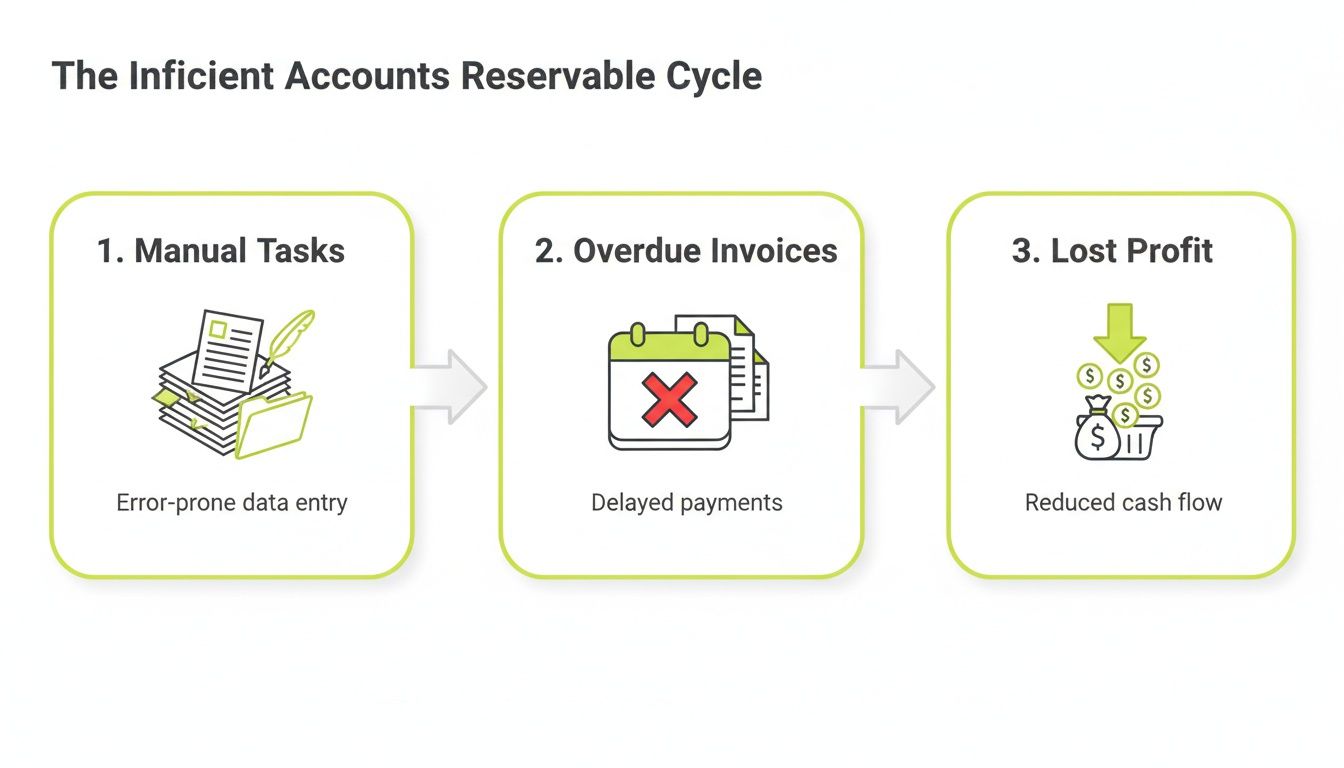
The path from manual work to negative financial outcomes is direct. A structured, consistent approach is essential.
Let's examine the five stages of the accounts receivable journey.
The table below breaks down each phase, its core objective, and the key activities involved. It is a roadmap for converting services into cash.
The 5 Stages of the Accounts Receivable Lifecycle
Stage | Objective | Key Activities |
|---|---|---|
1. Client Onboarding & Credit | Mitigate risk before work begins. | Set clear payment terms in the MSA, perform credit checks for new clients, and review existing clients' payment histories. |
2. Invoicing & Billing | Issue accurate invoices quickly. | Generate detailed invoices with correct PO numbers, rates, and expenses. Dispatch them immediately after the billing period closes. |
3. Collections Management | Proactively secure timely payment. | Send pre-due date reminders, follow up consistently on overdue invoices, and escalate communications based on invoice age. |
4. Payment & Cash Application | Accurately apply cash to open invoices. | Match incoming payments (checks, ACH, wire) to the correct invoices and reconcile payment discrepancies. |
5. Reconciliation & Reporting | Ensure financial accuracy and analyze performance. | Reconcile the AR sub-ledger with the general ledger and track key metrics like DSO to inform future strategy. |
Each stage builds on the last. A failure in one can halt the entire process. Let's look closer at each.
Stage 1: Client Onboarding and Credit Assessment
The AR lifecycle begins with the client relationship. Before any billable work starts, setting clear expectations is a critical, often overlooked, step. For a new client, this means defining net terms, payment methods, and late fee policies in the Master Service Agreement (MSA).
For larger projects, a formal credit check is not about mistrust; it is prudent financial management. A quick check can prevent a significant write-off. For existing clients, periodically review their payment history and adjust credit terms accordingly.
Stage 2: Invoicing and Billing
Speed and accuracy are paramount here. In professional services, invoices are complex—filled with billable hours, project milestones, and pass-through expenses. A single error, like an incorrect PO number, provides a valid reason for payment delay.
The goal is to issue a perfect invoice the moment the billing period closes. Manual invoice creation, especially in systems like QuickBooks, is prone to human error. This is where accounts receivable automation enforces consistency and timeliness.
An invoice is more than a bill. It is a reflection of your firm’s attention to detail. Every inaccuracy erodes client trust and complicates payment.
Stage 3: Collections Management
This stage is where process failures become visible. An effective collections process is proactive, not reactive. It follows a planned series of communications that are professional, persistent, and documented.
Many firms use calendar reminders and spreadsheets, a method that fails at scale. An automated system can send reminders before an invoice is due, adjust the communication tone based on invoice age, and maintain a central record of all touchpoints. This is detailed further in our guide to the order-to-cash process.
Stage 4: Payment and Cash Application
Receiving payment is not the final step. The funds must be correctly applied to the corresponding invoice in your accounting system. This process, cash application, is deceptively complex. A client may send a single payment to cover multiple invoices, requiring manual reconciliation.
Manual application is slow and high-risk. A misapplied payment can result in an erroneous overdue notice to a good client, damaging the relationship. AI AR automation excels here, using remittance data to match payments to open invoices with high accuracy, reducing manual work by over 80% for many firms.
Stage 5: Reconciliation and Reporting
The final stage closes the loop. You reconcile the accounts receivable sub-ledger with the general ledger to ensure financial statements accurately reflect collected cash and outstanding receivables.
This is also where performance is analyzed. By tracking metrics like Days Sales Outstanding (DSO), you measure the health of your AR cycle. This data provides the insight needed to forecast cash flow, improve cash flow, and maintain financial stability.
Measuring What Matters in Accounts Receivable

You cannot improve what you do not measure. In accounts receivable, this principle is the difference between managing cash flow and merely observing it.
The real story of your firm’s financial health is told not in the invoicing process, but in the performance that follows.
To gain a clear picture, you must track the right key performance indicators (KPIs). These metrics transform your AR function from a reactive cost center into a source of strategic insight. They show you precisely where your process is effective and where it is failing.
Days Sales Outstanding (DSO)
The primary metric for any AR team is Days Sales Outstanding (DSO). It measures the average number of days it takes to collect payment after an invoice is sent.
The formula is: (Total Accounts Receivable / Total Credit Sales) x Number of Days in Period
A high or rising DSO indicates it is taking longer to collect cash. For a professional services firm, this often points to inaccurate invoices, disputes over billable hours, or inconsistent follow-up. A DSO above 45 days is typically a red flag. The objective is always to reduce DSO.
Collection Effectiveness Index (CEI)
DSO can be misleading when sales fluctuate. For a more precise measure of collections performance, use the Collection Effectiveness Index (CEI). This metric compares the amount collected versus the amount that was available for collection in a given period.
CEI provides a pure measure of team performance, isolated from sales volume fluctuations. An index approaching 100% signifies a highly efficient collections engine.
Here's the formula: ((Beginning Receivables + Credit Sales) - Ending Total Receivables) / ((Beginning Receivables + Credit Sales) - Ending Current Receivables) x 100
A CEI score consistently above 85% is considered strong. If DSO is high but CEI is low, the problem lies within your collections process, not sales patterns. Use this metric to set team goals and measure the impact of improvements, such as implementing AR software for professional services.
Average Days Delinquent (ADD)
While DSO provides a broad overview, Average Days Delinquent (ADD) focuses on late payments. This KPI calculates the average number of days your invoices are past due, signaling the effectiveness of your credit and collections policies.
Calculate it by subtracting your best possible DSO (your payment terms) from your actual DSO. For example, if your standard terms are Net 30 and your actual DSO is 42, your ADD is 12 days.
A low ADD means clients are paying near the due date. A high ADD points to systemic issues, such as delayed reminders or no clear escalation plan. This is a metric that accounts receivable automation can impact directly and quickly.
These three KPIs form the foundation of an effective AR dashboard:
- DSO shows how long it takes to get paid.
- CEI shows how effective your team is at collecting.
- ADD shows how late your clients are.
Tracking these numbers provides the clarity to diagnose problems, implement solutions like QuickBooks AR automation, and take control of your firm’s cash.
Diagnosing the Root Causes of Late Payments
To fix your cash flow, you must become a good diagnostician. A late payment isn't the problem; it’s a symptom of a breakdown somewhere in your accounts receivable process. Identifying that specific point of failure is the only way to build a resilient financial operation.
For most professional services firms, the root causes are buried in manual workflows. An invoice with an incorrect PO number. A client dispute over unapproved hours. A missed follow-up. These are not isolated errors; they are systemic gaps that inflate your DSO.
Unpacking Common Operational Failures
The friction that delays revenue almost always stems from bad process, bad communication, or bad data. Each introduces delays into the payment cycle. The first step in diagnosis is a detailed review of your aged receivables. For more, see this guide on understanding and managing aged accounts receivable.
The most common failure points include:
- Inaccurate or Delayed Invoicing: Errors in rates, project codes, or client details cause immediate invoice rejection. Invoices sent weeks after work is completed signal that payment is not a priority.
- Lack of Proactive Communication: Waiting until an invoice is 30 days past due is too late. Without a pre-due date reminder, you miss the opportunity to confirm receipt and resolve issues before they become delinquencies.
- Inconsistent Collections Cadence: Manual follow-up is often sporadic. An AR specialist gets diverted, a call is missed, and the process breaks down. This teaches clients that your payment terms are flexible.
A late payment is rarely a surprise. It is the predictable outcome of a process that permits ambiguity, error, and inconsistent execution. The key is to eliminate these failure points before they impact cash flow.
Connecting Process Gaps to Financial Impact
The data reveals a clear story of process inefficiency. Across the US, 39% of B2B invoices are paid late. Much of this is due to operational friction, not a client's inability to pay. For example, 23% of late payments occur because customers "forget"—a direct result of weak follow-up.
This diagnostic approach sets the stage for a targeted solution. When you stop chasing individual late payments and start fixing root causes, you shift from reactive collections to a proactive financial strategy. This is where accounts receivable automation provides control, using systems like AI AR automation to enforce consistency and eliminate the human error inherent in manual accounts receivable processing.
Building the Business Case for AR Automation
Once you have diagnosed the failures in your manual accounts receivable processing, the next step is building the business case for a solution. This is not an operational tweak; it is a strategic investment with a clear, measurable return.
The goal is to stop treating AR as a cost center and start managing it as a cash flow engine.
Framing the investment this way is critical. You are not buying software; you are buying control over your firm's liquidity. For professional services firms, the cost of inaction—measured in high DSO, write-offs, and wasted team hours—far exceeds the cost of a modern platform.
From Bottlenecks to Measurable Outcomes
A strong business case connects specific problems to the results automation delivers. For every operational bottleneck, there is a corresponding, measurable improvement unlocked by an intelligent system. This shifts the conversation from abstract benefits to hard financial gains.
Consider the common failure points:
- Inconsistent Follow-Up: Manual reminders are inconsistent. Accounts receivable automation enforces a professional cadence so no invoice is overlooked.
- Invoicing Errors: Manual errors create disputes and delay payments. Automation syncs directly with your accounting software, eliminating errors and accelerating the payment cycle.
- Limited Visibility: Spreadsheets provide a historical view. A real-time dashboard offers foresight, enabling you to identify payment risks before they materialize.
By addressing these root causes, automation systematically drives down DSO. You can find more detail in our guide to the benefits of accounts receivable automation.
The Financial Justification for Modernization
The market's rapid move toward automation is driven by financial results. 75% of finance leaders now view accounts receivable as a core strategic function.
The outcomes are clear: 91% of adopters report better cash flow, and 80% achieve greater process efficiency. Mid-market firms using these systems often realize a 65-78% ROI payback in under 18 months, and automated platforms have been shown to reduce outstanding invoices by 25%. The full research about the AR automation market provides comprehensive data.
This data provides a clear financial mandate for investment. The question is no longer if a firm should automate, but how fast it can implement a solution to stop financial leakage.
An investment in AR automation is not an expense line item. It is a direct investment in your balance sheet, converting static receivables into dynamic working capital.
Modern platforms with AI AR automation do more than send reminders. They transform the entire function into a proactive, data-driven operation. This gives you the real-time visibility needed for confident financial planning and frees your team to focus on high-value analysis and client relationship management.
Whether you use QuickBooks AR automation or another ERP, the principles of control and efficiency are the same. Automation is the most direct path to reduce DSO and improve cash flow.
Putting an Intelligent AR System to Work
Implementing an intelligent system for accounts receivable processing is a strategic decision, not just a software installation. Success depends on aligning the technology with your financial goals. The aim is to create an orchestrated system that adapts to client behavior and protects your bottom line.

The process begins by defining success. Before implementation, know your baseline KPIs—especially Days Sales Outstanding (DSO) and Collection Effectiveness Index (CEI). Your primary objective should be measurable, such as a commitment to reduce DSO by 15% in the first six months.
Once targets are set, ensure the technology integrates with your existing systems. A modern AR software for professional services must create a single source of truth. This requires a two-way sync with your accounting ledger, whether it's a standard platform or a specialized QuickBooks AR automation.
Designing Workflows That Actually Work
Effective accounts receivable automation is not about sending generic emails faster. It is about building smart workflows that handle real-world scenarios. This means establishing communication cadences based on specific triggers and client data.
An intelligent AR system does not treat every client the same. It orchestrates communication, applying a soft touch for reliable clients and a more assertive, systematic approach for those with a history of late payments.
The setup should mirror your firm's credit policies. For example:
- Tier 1 (Good Standing): A gentle reminder three days before the due date, followed by a polite check-in one day after.
- Tier 2 (Occasional Delays): Pre-due date reminders, then a sequence of emails starting the day an invoice becomes overdue.
- Tier 3 (High-Risk/Chronic Late Payers): A more frequent and direct cadence that escalates quickly, looping in internal team members at specific thresholds.
This tailored approach achieves results without alienating valued clients. As businesses weigh their options, it’s helpful to explore the full range of essential business automations that can reshape operations.
The Difference AI Makes
Where basic automation follows a rigid script, AI AR automation introduces dynamic orchestration. An AI-driven system can analyze payment patterns to predict which invoices are most likely to become delinquent, allowing your team to intervene proactively.
It also ensures every interaction is consistent and professional. The system provides your team with the data and context needed for productive client conversations. This elevates your AR function from a back-office task to a strategic part of your financial operations, helping to improve cash flow and build client trust.
Questions Every Finance Leader Asks About AR
When considering a move away from spreadsheets and manual follow-ups, a few practical questions always arise. Here are direct answers for financial operators evaluating their accounts receivable process.
Where Do We Even Start Improving Our AR Process?
The first step is diagnosis, not software procurement. Map your current process from invoice to cash and calculate your key metrics—specifically Days Sales Outstanding (DSO) and Aged Receivables.
This baseline provides an objective assessment of where your process is broken. It gives you a clear picture of your bottlenecks and allows you to set realistic targets for improvement. Without it, the ROI of any change is purely speculative.
Can We Automate Collections Without Annoying Our Clients?
Yes, if implemented correctly. The goal of modern accounts receivable automation is not to replace your team with robots, but to make your firm's professional standards consistent and scalable.
Effective automation moves from generic reminders to intelligent, personalized outreach. The system can be configured to adjust tone, timing, and channel based on a client’s payment history and relationship value. This frees your team to manage relationships, not chase paperwork.
Good AR automation protects your two most important assets: your cash and your clients. It enforces your standards with precision, so every communication feels professional and on-brand.
Will This Work With Our Existing Accounting Software?
Yes. Seamless integration is a non-negotiable requirement. The best solutions, particularly those designed for professional services, offer deep, two-way integrations with common accounting systems, including robust options for QuickBooks AR automation.
A proper sync ensures invoice data flows from your accounting system to the AR platform, and payment data flows back to your general ledger. This eliminates manual entry, maintains a single source of financial truth, and ensures reporting accuracy.
What Kind of ROI Should We Actually Expect?
The return on AI AR automation is a mix of measurable financial, operational, and strategic outcomes.
- Financial ROI: A significant reduction in DSO, which immediately frees up cash. A 25% drop in outstanding invoices is a realistic outcome, unlocking capital for reinvestment.
- Operational ROI: A dramatic reduction in the hours your team spends on manual collections. It is common for firms to cut manual effort by over 80%.
- Strategic ROI: A real-time view of your cash position and the ability to predict payment issues. This clarity enables more confident financial planning.
This combination—more cash, a more efficient team, and smarter strategic foresight—delivers a clear and powerful return on investment.
--- Resolut automates AR for professional services—consistent, accurate, and human. Learn more at https://www.resolutai.com.