
Accounts Receivable Software for Professional Services Firms
Discover how accounts receivable software for small business can streamline invoicing, reduce overdue payments, and boost cash flow with practical tips.
For CFOs and controllers at professional services firms, accounts receivable isn’t an administrative task. It’s the operational control panel for your firm's cash flow and financial health.
An undisciplined AR process creates a drag on working capital. It turns the simple act of getting paid into a reactive, manual chore that erodes margins and introduces unpredictability.
This guide outlines a systematic approach to AR management, focused on implementing software to reduce Days Sales Outstanding (DSO), improve cash flow, and instill operational control.
Why Manual AR Management Is a Strategic Liability
In professional services, revenue is tied directly to expertise and time. Yet, the process for converting that delivered value into cash is often inefficient.
Manual AR is inherently reactive. Collections begin only after an invoice is past due, forcing your finance team into a constant cycle of follow-ups and reconciliation.
This isn’t just slow; it’s a direct drain on resources. It leads to inconsistent client communication, payment application errors, and, most critically, delayed cash receipts.
From Reactive Collections to Proactive Control
The core flaw in manual AR is its reactive nature. Action is triggered by delinquency, creating unpredictable cash flow that complicates forecasting and strategic planning.
Modern accounts receivable software for professional services shifts this paradigm. By implementing accounts receivable automation, the system executes a predefined collections strategy consistently.
For a professional services firm with $5M in annual revenue and a DSO of 60 days, an average of $822,000 is tied up in receivables. Reducing DSO by just 15 days unlocks over $200,000 in cash.
The True Cost of Manual Processes
The cost of inefficient AR extends beyond delayed payments. It creates significant operational drag.
If a finance team dedicates 20% of its time to manual collections, that is a 20% reduction in capacity for financial planning, analysis, and other high-value functions. This administrative burden is a direct tax on your firm’s growth potential.
This is where AI AR automation provides measurable leverage. It is not about replacing finance operators, but augmenting their capabilities. The system can:
- Execute defined dunning schedules with personalized reminders.
- Provide a client self-service portal for payments and inquiries.
- Deliver real-time visibility into outstanding invoices and cash forecasts.
This disciplined approach transforms AR from a source of financial friction into a controlled, predictable system. It provides the clarity required to make confident capital allocation decisions.
Resolut automates AR for professional services—consistent, accurate, and human.
Understanding Accounts Receivable Automation
Manual accounts receivable management is equivalent to navigating with a paper map. It provides a static snapshot but lacks real-time data and predictive capability. This forces finance teams into a reactive loop of chasing overdue invoices.
Accounts receivable automation functions as a GPS for your firm’s cash flow. It provides a real-time view of every invoice, maps the most efficient route to payment with automated workflows, and projects future cash positions. It converts a manual process into a predictable financial operation.
This shift is fundamental. Instead of discovering a cash flow shortfall at month-end, you are systemically preventing its occurrence.
Core Functions of AR Automation
At its core, accounts receivable software for professional services automates the repetitive, low-value tasks that consume a finance team’s bandwidth. This frees skilled operators to manage complex exceptions and high-value client interactions. For context, see this complete guide to workflow automation software.
A robust AR system executes several key functions:
- Automated Invoice Delivery: Ensures invoices are delivered instantly via preferred client channels with delivery confirmation.
- Intelligent Dunning: Executes scheduled, customizable follow-ups with messaging and timing that adapt based on invoice age or client history.
- Centralized Payment Portals: A secure, branded portal for clients to view all outstanding invoices and execute payments via ACH or card.
This is not about aggressive collections; it is about introducing discipline and professionalism into the process. For firms managing project-based billing or retainers, this consistency strengthens client trust.
Visual Idea: A cinematic split-screen. On the left, a controller manually highlights a long spreadsheet under dim office lighting. On the right, a calm finance leader views a clean, real-time cash flow dashboard on a tablet in a bright, modern office.
Shifting from Administration to Strategy
The objective of AR automation is not to replace finance staff, but to elevate their function. When software manages routine follow-ups and payment matching, your team can transition from administrative tasks to strategic analysis. They gain the capacity to analyze payment trends and manage exceptions.
This is a measurable industry shift. With AR's growing strategic importance, firms are recognizing its direct impact on working capital. The right system provides control, allowing you to define collections protocols—timing, messaging, escalation—and execute them flawlessly. A deeper analysis is available in our guide to accounts receivable automation software.
This consistency is what reduces DSO, stabilizes cash flow, and improves the payment experience for your clients.
Visual Idea: A simple, clean line chart titled "DSO Reduction Post-Automation." The x-axis shows six months, and the y-axis shows DSO in days. A blue line starts high (e.g., 65 days) and trends steadily downward, ending around 40 days, visually demonstrating a clear, positive outcome.
Resolut automates AR for professional services—consistent, accurate, and human.
The AR Software Features That Actually Matter
Evaluating AR software requires filtering for features that deliver tangible outcomes for professional services firms. The objective is not merely to accelerate invoicing but to gain control over cash flow.
The optimal platform focuses on core functions that reduce manual work, decrease DSO, and preserve client relationships. Generic software often fails to address the nuances of project billing, retainers, and professional communication.
Intelligent and Customizable Dunning Workflows
Effective collections are built on consistency, not aggression. This is the role of customizable dunning workflows. It extends beyond simple reminders to tailoring the timing, frequency, and tone of communications to match specific client relationships.
For example, a high-value, long-term client might receive a single, professional reminder five days post-due. A new client might be placed in a more structured cadence to establish payment expectations. This level of control maintains professionalism and strengthens trust.
Seamless QuickBooks AR Automation
For the majority of professional services firms, QuickBooks is the financial system of record. Any AR software lacking a deep, reliable integration is not viable. True QuickBooks AR automation requires a persistent, bi-directional sync.
When a payment is recorded in your AR platform, it must instantly sync to QuickBooks, marking the correct invoice as paid. This single feature eliminates hours of manual data entry, prevents reconciliation errors, and ensures the integrity of your financial reporting.
Without this seamless connection, you are merely substituting one manual task for another. The integration must be robust enough to handle complex invoicing and maintain real-time data integrity. This is the only way to achieve complete confidence in your financial data.
Robust Analytics and Reporting Dashboards
Effective management requires accurate measurement. A high-quality AR platform transforms raw payment data into actionable business intelligence. The dashboard must provide an immediate, at-a-glance view of the firm’s cash position.
Key metrics should include:
- Days Sales Outstanding (DSO): Calculated in real-time to measure the effectiveness of collections efforts.
- Cash Flow Forecasting: Uses historical payment behavior to project future cash receipts, enabling informed business decisions.
- Aging Reports: Dynamic, filterable reports to identify at-risk accounts before they become write-offs. A proper accounts receivable aging analysis is critical.
These are not vanity metrics; they provide the visibility needed to move from a reactive to a preventative posture on cash flow issues. For further detail, our guide on how to choose AR automation software that works for professional services firms offers a detailed checklist.
Centralized Client Payment Portals
Reducing friction in the payment process directly accelerates cash flow. A secure, self-service payment portal allows clients to view all outstanding invoices in one location, submit inquiries, and pay via their preferred method—ACH or credit card.
This improves the client experience and delivers significant time savings for your team. Portal payments are automatically matched to the corresponding invoices (cash application), eliminating the tedious task of reconciling bank deposits with open receivables.
The table below contrasts manual processes with an automated solution.
Essential AR Software Features for Professional Services Firms
Core AR Function | Manual Process (The Bottleneck) | Automated Software Solution (The Outcome) |
|---|---|---|
Invoice Reminders | Manual emails, calendar alerts; inconsistent tone and timing. | Smart, customizable workflows based on client history and invoice age. |
Payment Processing | Processing paper checks, manual card entry, logging payments. | Clients pay online via a self-service portal (ACH, credit card). |
Cash Application | Manually matching bank deposits to open invoices in QuickBooks. | Payments are automatically applied to the correct invoice, saving hours. |
Reporting & Analytics | Manual data extraction to spreadsheets for DSO and aging analysis. | Real-time dashboards provide instant visibility into cash flow and AR health. |
Client Communication | Disjointed email threads and phone calls with no central record. | A unified portal for clients to view invoices and communicate directly. |
Transitioning from manual AR to an automated system is fundamentally about regaining control and predictability over your firm’s primary revenue engine.
Resolut automates AR for professional services—consistent, accurate, and human.
Calculating the ROI of AR Automation
For any finance leader, investment decisions hinge on measurable returns. Implementing accounts receivable software for professional services is a capital allocation that must be justified by clear financial outcomes.
The ROI of AR automation is calculated through direct financial gains from accelerated cash flow and significant cost savings from operational efficiency.
The Hard ROI: Unlocking Trapped Cash
The most immediate return is generated by reducing Days Sales Outstanding (DSO). Each day shaved from DSO directly injects cash into the business.
Consider a professional services firm with $10 million in annual revenue:
- Current DSO: 60 days
- Target DSO with Automation: 45 days
- DSO Reduction: 15 days
The formula for calculating unlocked cash is: (Annual Revenue / 365 Days) x DSO Reduction
In this scenario, the firm’s daily revenue is $27,397 ($10M / 365). A 15-day DSO reduction frees up $410,955 in working capital previously trapped in receivables. This is a permanent improvement to the firm's liquidity position.
This new capital fundamentally alters a firm's financial flexibility. It can reduce reliance on credit lines, fund strategic hires, or be reinvested into the business—all without incurring new debt.
The Hard ROI: Slashing Administrative Costs
The second component of hard ROI is the reduction of administrative overhead. Manual AR is labor-intensive. AI AR automation targets these specific time sinks.
By automating reminders, payment matching, and reporting, firms often reclaim 10-20 hours per week for their finance team. For a finance professional earning $80,000 annually, this translates to $20,000–$40,000 in recovered productivity cost each year.
The payback period is typically short. Research indicates 65% of companies achieve a return on their AR automation investment within 12 months, with that figure rising to 78% after 18 months.
The Soft ROI: Stronger Client Relationships
Beyond quantitative metrics, there are qualitative returns that provide long-term strategic value. A chaotic collections process creates friction and can damage client relationships. An automated, professional system removes this tension.
This infographic shows how core AR software features work together to create a more controlled financial operation.
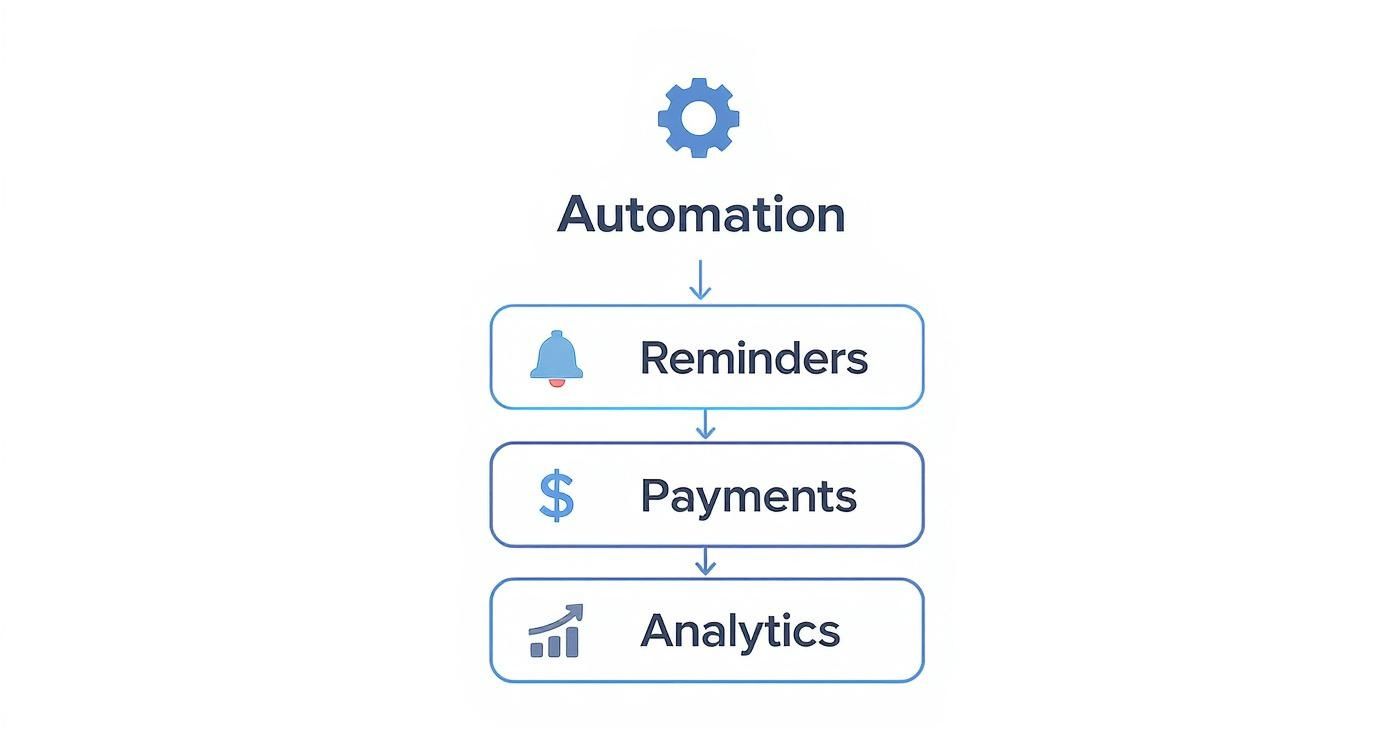
By structuring the AR process with systematic reminders and a convenient payment portal, every client interaction becomes consistent and professional.
Clients value the clarity and convenience. A self-service portal makes you easier to do business with, reinforcing your firm's professionalism and improving retention. A complete overview of accounts receivable automation benefits details this value.
Finally, reducing the repetitive, frustrating work of manual collections improves team morale and reduces burnout, helping you retain top finance talent.
Integrating AR Automation with Your Existing Systems

New technology should introduce clarity, not complexity. Implementing accounts receivable software must be a controlled upgrade to financial operations, not a disruptive overhaul.
The goal is to enhance existing systems. A methodical implementation process ensures operational continuity and builds confidence by integrating smoothly into your current financial stack.
The Bedrock of Integration: QuickBooks AR Automation
For most professional services firms, QuickBooks is the system of record. Therefore, any AR software for professional services must integrate deeply with it. A superficial, one-way data push is insufficient, as it creates new manual reconciliation tasks.
True QuickBooks AR automation requires a persistent, bi-directional synchronization. When an invoice is created in QuickBooks, it must appear instantly in the AR platform. When a client pays via the portal, the payment must automatically post back to QuickBooks, closing the correct invoice.
This seamless data flow is non-negotiable. It achieves three critical objectives:
- Eliminates manual data entry, reducing labor costs and human error.
- Guarantees data accuracy by removing discrepancies between the AR platform and the general ledger.
- Creates a single source of truth, with the AR platform as the collections command center and QuickBooks as the definitive accounting record.
This deep integration is the foundation upon which accounts receivable automation delivers its promised efficiencies.
A Structured Implementation Process
A successful rollout follows a predictable, structured path to ensure a smooth transition.
- Secure Data Migration and System Sync: The AR platform is connected to your accounting system. All historical and current invoice, client, and payment data is securely imported.
- Workflow Configuration: The system is configured to your firm's specifications. Dunning schedules, reminder templates, and escalation protocols are defined based on client type and invoice age.
- Team Training and Onboarding: The finance team is trained on using the new platform to manage collections, monitor dashboards, and handle exceptions before the system goes live.
The objective is not merely to "go live," but to launch a superior process. A phased rollout allows for fine-tuning before full deployment, ensuring the transition remains controlled and predictable.
This market is expanding because it addresses a fundamental business need. The market for accounts receivable automation is projected to grow significantly, with cash application automation alone expecting a 15.2% CAGR. You can discover more about the growing AR automation market.
Treating implementation as a managed project with clear milestones ensures the new technology strengthens your financial controls from day one.
Resolut automates AR for professional services—consistent, accurate, and human.
Getting Control of Your Cash Flow
Investing in accounts receivable software is not an expense; it is an investment in control. For professional services firms, where cash flow directly reflects delivered value, predictability is a strategic imperative.
The right AR software transitions a firm from a reactive collections process to a calm, data-driven operation. It allows you to move from chasing late payments to proactively managing the capital that fuels your business.
Shifting from Admin Work to Strategic Insight
When a system handles routine reminders and payment application, your finance team’s function is elevated. They are no longer consumed by the administrative tasks of chasing and reconciling payments.
Their time is reallocated to high-value work: analyzing payment trends, managing complex client situations, and providing financial guidance that informs strategic decisions.
This transition is increasingly accessible. Cloud-based accounts receivable software for small business has lowered the barrier to entry, eliminating the need for expensive on-premise infrastructure.
Connecting the Dots: From Daily Tasks to Real-World Wins
The operational gains from accounts receivable automation translate directly into strategic business outcomes.
- A lower DSO unlocks cash from unpaid invoices for strategic hires or debt reduction.
- Predictable cash flow provides the confidence to invest in growth initiatives.
- Improved operational efficiency reduces administrative costs and staff burnout.
- Stronger client relationships are built on a professional, frictionless payment experience, improving retention.
These outcomes build a sustainable business, supported by the reliable, real-time data from your AR software.
Resolut automates AR for professional services—consistent, accurate, and human.
A Few Common Questions
For finance leaders, moving from spreadsheets to a dedicated system is a significant operational change. Here are direct answers to common questions.
Will AR Automation Feel Robotic and Hurt Our Client Relationships?
This is a primary concern for relationship-driven firms. Properly implemented accounts receivable automation enhances, rather than replaces, the human element. It handles systematic follow-ups, freeing your team for high-touch intervention when a situation is sensitive.
You retain full control over the tone, timing, and frequency of all communications. The process becomes more professional and predictable, not less personal.
How Much Time Will This Actually Save My Team?
The time savings are quantifiable. Automation eliminates the administrative tasks of drafting reminders and manually applying cash, which can consume 10–20 hours per week for a small finance team.
The most significant efficiency gain often comes from a deep QuickBooks AR automation. A bi-directional sync automates cash application. Reconciliations that once took hours now take minutes, streamlining the month-end close.
This reclaimed time allows your team to focus on financial analysis, which helps to improve cash flow and drive strategic decisions.
Is My Firm Big Enough for Dedicated AR Software?
The decision should be based on complexity, not just revenue. If your DSO exceeds 45 days, your team is overburdened with manual follow-ups, or cash flow is unpredictable, the hidden costs of your current process likely exceed the software investment.
For most professional services firms with revenues over $3M, the financial drag of manual AR justifies the business case for automation. The right system pays for itself by helping you reduce DSO and instilling the financial discipline necessary for growth.
--- Resolut automates AR for professional services—consistent, accurate, and human. Learn more at https://www.resolutai.com.