A CFO's Guide to the Aging of Receivables Method
Master the aging of receivables method to improve cash flow and reduce DSO. A definitive guide for CFOs on calculation, analysis, and automation.
The aging of receivables method is a core accounting process that sorts outstanding invoices by age. Its premise is simple: the longer an invoice goes unpaid, the lower the probability of collection.
For financial operators, this method is more than a reporting exercise. It's a control mechanism for managing credit risk and forecasting cash flow with precision.
Why Aging Receivables is a Core Financial Control
For a professional services firm, managing accounts receivable is a critical financial control, not an administrative task. The aging of receivables method transforms a flat list of invoices into a dynamic tool for risk assessment.
It provides an immediate, honest snapshot of cash flow health, client payment behavior, and emerging credit risks.
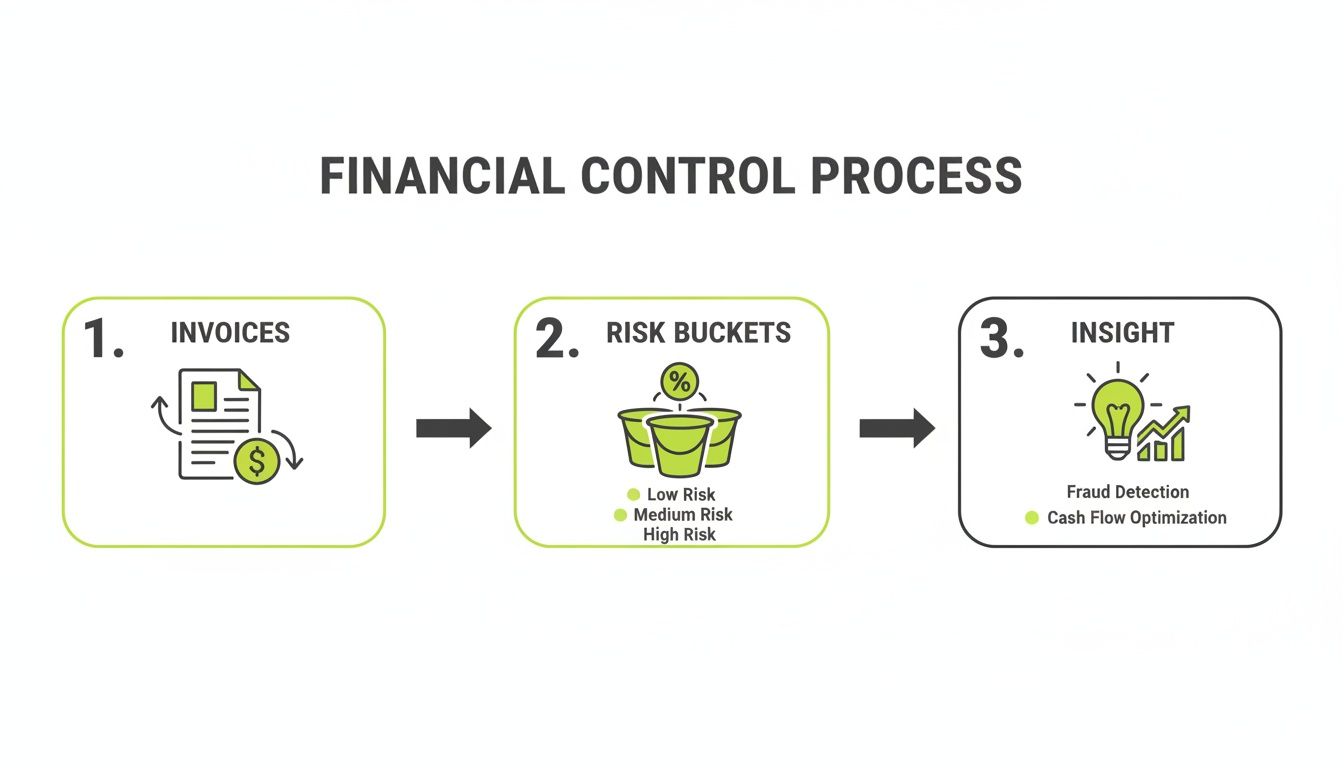
This isn't about the total AR balance. It’s about segmenting that balance into time-based risk buckets: Current, 1-30 days, 31-60 days, 61-90 days, and 90+ days past due.
A firm with $500,000 in AR where 95% is current is in a far healthier position than a firm where 30% is over 90 days old, even if the total AR is identical. This structured view is essential for forward-looking financial management.
How It Shapes Your Financials and Reporting
The analysis directly impacts your income statement and balance sheet. By applying historical collection rates to each aging bucket, you establish a defensible Allowance for Doubtful Accounts.
This isn't a guess. It’s a data-driven calculation that provides the evidence needed to accurately record bad debt expense, ensuring your financial statements reflect the true collectible value of your receivables.
An aging schedule is the primary source document for estimating your allowance for doubtful accounts. It aligns your financials with the principle of conservatism and provides auditors with a clear, logical basis for your figures.
This process is the backbone of reliable financial reporting. Since the aging of receivables method is such a core financial control, it’s helpful to understand how it fits into the bigger picture of external standards. Auditors, for instance, often review these controls to gain confidence in the financial statements. You can learn more about related topics like the intricacies of SOC 1 and SOC 2 compliance reports to see how these internal controls connect to broader compliance frameworks.
A disciplined approach to aging analysis gives leadership control. It allows you to:
- Isolate risk concentration: Identify which clients consistently pay late, exposing disproportionate threats to your cash flow.
- Improve cash forecasting: Predict collections with greater accuracy by modeling payment timing based on historical aging data.
- Strengthen credit policies: Use aging trends to make informed decisions about extending or modifying credit terms.
When your QuickBooks AR automation is driven by real-time aging data, your collections process becomes proactive. This is how you turn a standard accounting task into a strategic lever to reduce DSO and improve cash flow.
How to Build and Read Your AR Aging Schedule
The AR aging schedule is a diagnostic tool, not just a report. It segments outstanding invoices into time-based categories, providing a clear view of where your cash is—and where it might be getting stuck.
Building the schedule starts with defining your aging buckets. For most professional services firms, a standard structure provides the necessary detail.
- Current: Invoices not yet due. This should represent the vast majority of your receivables.
- 1–30 Days Past Due: Recently past due. Requires an initial, systematic follow-up.
- 31–60 Days Past Due: A growing concern. These invoices need a structured collection cadence.
- 61–90 Days Past Due: A clear red flag indicating a potential collections problem.
- 91+ Days Past Due: Carries a significant risk of becoming a write-off.
Each outstanding invoice is categorized based on its due date. While this can be done in a spreadsheet, modern accounting software and tools that offer QuickBooks AR automation generate this schedule instantly.
This process turns raw invoice data into actionable financial intelligence.
*Visual Idea: A clean, minimalist dashboard view showing the total AR balance broken down into color-coded aging buckets (e.g., green for Current, yellow for 1-30, orange for 31-60, red for 61+). The chart should be interactive, allowing a user to click a bucket to see the underlying client invoices.*
What a Healthy vs. Unhealthy Schedule Looks Like
A healthy AR aging schedule for a professional services firm will have 80-85% or more of its total balance in the "Current" bucket. The amounts in older buckets should decline sharply.
An unhealthy schedule shows a "bulge" in the older categories. If 15-20% or more of your total AR is in the 61+ day buckets, it signals mounting cash flow risk.
Sample AR Aging Schedule for a Professional Services Firm
Client Name | Invoice # | Invoice Amount | Current | 1-30 Days Past Due | 31-60 Days Past Due | 61-90 Days Past Due | 91+ Days Past Due |
|---|---|---|---|---|---|---|---|
Totals | $340,000 | $280,000 | $35,000 | $15,000 | $10,000 | $0 | |
Client 1 | INV-101 | $100,000 | $100,000 | ||||
Client 2 | INV-102 | $150,000 | $150,000 | ||||
Client 3 | INV-103 | $50,000 | $30,000 | $20,000 | |||
Client 4 | INV-104 | $40,000 | $15,000 | $15,000 | $10,000 |
In this example, the firm has a healthy distribution, with over 82% of its AR in the "Current" bucket. The older balances are small, though Client 4 requires immediate attention.
The Quantifiable Risk of Aging Invoices
The data is unequivocal: as an invoice ages, the probability of collection drops significantly. Research shows that once an invoice is over 90 days past due, the collection rate can fall to approximately 50%.
When receivables aged over 90 days exceed 5-10% of the total, it often signals future cash flow and write-off issues. You can learn more about the correlation between AR aging and write-offs to quantify this risk.
An aging schedule is a forward-looking risk assessment. A high concentration of aged receivables is a direct predictor of future write-offs and a strain on working capital.
This schedule is an active management tool. With clear visibility from an AR software for professional services, you can target high-risk accounts, adjust credit policies, and manage financial health before minor delays become material problems.
Figuring Out Your Allowance for Doubtful Accounts
An AR aging report is the foundation for a critical accounting estimate: the allowance for doubtful accounts.
This is a calculated reserve that ensures your balance sheet reflects the cash you realistically expect to collect, not just what you've invoiced. The aging of receivables method transforms this from a subjective estimate into a data-driven, defensible calculation.
By applying historical non-payment rates to each aging bucket, you build a logical and transparent basis for your bad debt provision.
Applying Historical Percentages to Aging Buckets
The logic is straightforward: the older an invoice, the higher the probability of non-collection. The most reliable percentages come from your firm's own collection history.
If historical data is limited, you can start with conservative industry benchmarks for professional services.
- Current: 1% uncollectible
- 1-30 Days Past Due: 3% uncollectible
- 31-60 Days Past Due: 10% uncollectible
- 61-90 Days Past Due: 25% uncollectible
- 91+ Days Past Due: 50% or higher uncollectible
These percentages should be reviewed and adjusted at least annually to reflect actual collection performance. This practice maintains the accuracy of your financial statements.
A Practical Calculation Example
Once you have the total receivables for each aging bucket, you calculate the required allowance.
An accurate allowance prevents negative financial surprises. It is a fundamental control that correctly matches bad debt expense to the revenue it relates to, a core tenet of accrual accounting.
The math is simple multiplication and addition, but it creates a clear audit trail. This approach is superior to using a flat percentage of sales, which ignores the time-based risk inherent in aged receivables.
The aging of receivables method is also a key input for estimating credit losses under the Current Expected Credit Loss (CECL) standard. For many private U.S. firms, this has been in effect since 2023. For a mid-market B2B firm, historical loss rates might be under 0.5% for current invoices but 10% or more for invoices over 90 days old. For more on this, you can find additional insights on why AR aging reports are a financial superpower.
Calculating Allowance for Doubtful Accounts from an Aging Schedule
This table demonstrates how to apply estimated uncollectible percentages to determine the total required allowance.
Aging Bucket | Total Receivables ($) | Estimated Uncollectible (%) | Required Allowance ($) |
|---|---|---|---|
Current | $280,000 | 1% | $2,800 |
1-30 Days Past Due | $35,000 | 3% | $1,050 |
31-60 Days Past Due | $15,000 | 10% | $1,500 |
61-90 Days Past Due | $10,000 | 25% | $2,500 |
Total | $340,000 | $7,850 |
Based on this, the firm requires an allowance of $7,850. If the current allowance is $5,000, a bad debt expense of $2,850 would be recorded to adjust the balance. This precise, bucket-by-bucket analysis ensures your financials are both accurate and defensible.
An AR software for professional services can automate this entire process, providing real-time calculations and eliminating the risk of manual spreadsheet errors.
Using Aging Data to Drive Collections and Reduce DSO
An aging schedule is not just an accounting tool; it's an operational playbook for managing cash flow. It provides the intelligence needed to prioritize collections, improve team effectiveness, and directly reduce Days Sales Outstanding (DSO).
Instead of treating all outstanding invoices equally, you apply a segmented approach. This prevents your team from wasting cycles on low-risk current invoices and focuses their efforts on accounts that pose a real threat to working capital.

*Visual Idea: A cinematic, slow-motion shot of a single drop of water falling, creating expanding ripples on a calm surface. The text overlay reads: "One late invoice creates ripples. Control your cash flow." This visual metaphor connects the small detail of an invoice to its larger impact on financial stability.*
Segmenting Collections for Maximum Impact
A tiered collections strategy, guided by your aging report, ensures the right pressure is applied at the right time.
A practical workflow:
- Current to 30 Days Past Due: Automated, gentle reminders. The goal is a simple nudge.
- 31-60 Days Past Due: A structured sequence begins, blending automated emails with a scheduled phone call.
- 61-90 Days Past Due: The account is flagged for direct follow-up from a senior team member or controller. Internal discussion about pausing service may begin.
- 91+ Days Past Due: Requires immediate, high-level attention. A formal demand letter or a final call from firm leadership is warranted before considering third-party collections.
This segmented process, powered by accounts receivable automation, ensures your team's time is allocated to the highest-risk accounts. This is the foundation of effective receivable management services.
Tracking Invoice Migration to Measure Success
The true measure of your collections strategy is the trend over time. Monitoring the "migration" of receivables between buckets from one month to the next provides a clear view of operational effectiveness.
Are balances consistently moving from older buckets back to "Current" upon payment? Or are they aging from 30 days to 60 and beyond? This flow is the ultimate KPI for your collections function.
For example, implementing a new automated reminder for the 31-60 day bucket should cause a measurable decrease in dollars rolling into the 61-90 day category the following month. If it doesn't, the strategy requires adjustment.
This data-driven feedback loop transforms the aging of receivables method from a static report into a dynamic management system. You can actively steer future cash flow rather than just report on past results.
The Hidden Costs of Manual Aging Analysis
A manually prepared aging of receivables report is an operational bottleneck. It begins with a raw data export from an accounting system, followed by hours of spreadsheet manipulation.
This process is slow, inefficient, and prone to error. A single formula mistake can corrupt the entire analysis, leading to flawed collection priorities and an inaccurate allowance for doubtful accounts.
By the time the report is complete, the data is already stale.
The True Operational Drain
The most significant cost is the misallocation of high-value talent. A Controller's time is better spent on strategic financial analysis, not data entry.
This manual drag means insights are always delayed. An invoice that was 55 days past due when the data was pulled may be 65 days past due by the time it is actioned, materially reducing the probability of collection.
Manual aging analysis creates a cycle of reactive fire-drills. Finance teams get stuck reporting on overdue invoices that could have been addressed weeks earlier with real-time visibility.
Relying on static, monthly reports is a significant blind spot. For a professional services firm with dynamic projects and client relationships, a monthly review cycle is inadequate. You can learn more about how this directly hurts your bottom line by exploring the true cost of AR inefficiency in professional services.
Moving Beyond Manual Limitations
The limitations of manual analysis underscore the need for an automated approach. The objective is to shift from periodic reporting to continuous financial visibility.
The consequences of manual processes include:
- Missed Collection Opportunities: High-risk invoices are flagged too late.
- Inaccurate Forecasting: Cash flow projections are based on outdated information.
- Reduced Team Efficiency: Time is spent building reports instead of analyzing them.
This is where AI AR automation provides a solution. By integrating with systems like QuickBooks, accounts receivable automation platforms eliminate manual work, delivering a live aging schedule that empowers leaders to improve cash flow with precision.
How AR Automation Makes the Aging Method Matter
A manually prepared aging report is a static snapshot of the past. It becomes outdated the moment it is created.
Modern accounts receivable automation transforms this analysis from a reactive, monthly task into a real-time system for controlling cash flow.
The first benefit is a live, dynamic view of your aging schedule. By connecting directly to accounting software, AI AR automation platforms eliminate manual data exports and spreadsheets. Your aging report is always current and accurate. It functions as a live pulse on your firm's financial health.

From Static Reports to Intelligent Workflows
The real value is realized when live aging data drives intelligent collection workflows. The system doesn't just show you what is overdue; it acts on that information with discipline.
Aging buckets become triggers for specific, pre-defined actions. This enables a segmented collections strategy without the manual effort. The system differentiates between client risk levels and invoice age, tailoring outreach to be effective while preserving client relationships. You can see how this ripples across the entire finance operation by exploring the full range of accounts receivable automation benefits.
For example, a low-risk client with an invoice in the 1-30 day bucket receives a gentle, automated reminder. A high-risk client whose invoice crosses the 61-day mark triggers a multi-step sequence: a personalized email, a task for a phone call, and an alert to the account manager.
Driving Real Financial Outcomes
The shift from manual analysis to automated action delivers measurable results. Firms that adopt this technology see a direct, material impact on key financial KPIs, most notably a sharp reduction in DSO.
By ensuring every overdue invoice receives timely and appropriate follow-up, automation closes the gaps where manual processes fail. Cash is collected faster, which directly lowers DSO and strengthens working capital.
Platforms that include AI workflow automation tools can reshape your entire AR process, leading to outcomes beyond a single metric:
- Improved Cash Flow Predictability: A consistent, data-driven collections schedule makes cash flow forecasts more accurate and reliable.
- More Efficient Teams: Finance teams are freed from manual data tasks to focus on strategic analysis, client relationship management, and financial planning.
- Reduced Bad Debt: Early intervention with aging invoices prevents small delays from becoming large write-offs, directly protecting profitability.
AR software for professional services builds a stronger, more predictable, and more efficient system to improve cash flow. It turns the aging of receivables method into the powerful operational tool it was designed to be.
A Few Common Questions
Here are straightforward answers to common questions from leaders at professional services firms.
How Often Should We Run an AR Aging Report?
Weekly. A weekly review acts as an early warning system.
It allows you to spot a client slipping from the 30-day to the 60-day bucket and intervene before the issue escalates.
Monthly reports are sufficient for closing the books but are inadequate for proactive collections. By the time a problem is identified, it is already a month old. Accounts receivable automation provides live dashboards, eliminating this lag.
What Are Good Percentages for Each Aging Bucket?
A healthy professional services firm should aim to have 80-85% of its receivables in the "Current" bucket. The strategic goal is to keep the older buckets as small as possible.
As a general guideline:
- 31-60 Days Past Due: Target less than 10%.
- 61-90 & 90+ Days Combined: Should be under 5%.
Any balance aged past 90 days is a direct threat to working capital. More important than the absolute numbers is the trend. A rising percentage in older buckets is a red flag that requires immediate attention.
Can AR Automation Integrate with Our Accounting Software?
Yes. Modern AR software for professional services is designed to enhance your accounting system, not replace it. Seamless integration is a core feature.
These platforms connect directly with systems like QuickBooks, NetSuite, and Xero. This QuickBooks AR automation link automatically pulls real-time invoice and customer data, ensuring your aging reports and collection workflows are always current.
This integration is the key to shifting from reactive reporting to proactive cash management and is essential to reduce DSO.
--- Resolut automates AR for professional services—consistent, accurate, and human. Learn more at https://www.resolutai.com.