A CFO's Guide to the Aging Receivable Method
Master the aging receivable method to improve cash flow and reduce DSO. A CFO's guide to analysis, calculating allowances, and leveraging AR automation.
The aging receivable method sorts unpaid invoices by age. You group them into time-based buckets—such as 0-30 days or 91+ days—to gain an immediate, clear view of cash flow health and potential bad debt exposure.
This process provides a disciplined framework for managing credit risk.
Why the Aging Receivable Method Is a Key Financial Control

For finance leaders at professional services firms, an accounts receivable aging report is more than a list of outstanding invoices. It’s a primary diagnostic tool for the business.
It provides a time-based snapshot of financial stability by revealing client payment behaviors.
This isn't about basic accounting; it's about strategic control. Each aging bucket is a critical performance indicator, enabling you to identify operational friction, mitigate risk, and make data-backed decisions.
The Core Purpose for Professional Services
At its core, the aging receivable method is an instrument for managing credit risk. The probability of collecting on an invoice declines sharply over time.
An invoice 90 days past due has a nearly 26% probability of becoming a write-off. At six months, that figure exceeds 50%. An aging report makes this escalating risk impossible to ignore.
This structured view of receivables allows for proactive, rather than reactive, management.
- Prioritize Collections: Your team can focus its efforts on the highest-risk accounts—those in the 61-90 and 91+ day buckets—before they become uncollectible.
- Refine Credit Policies: The data reveals which clients are consistently late, providing the objective evidence needed to adjust credit terms or require retainers for future work.
- Improve Cash Flow Forecasting: A clear aging schedule provides a realistic picture of expected cash inflows, which is essential for payroll, investment, and strategic growth initiatives. It's fundamental to the ways you can increase cash flow at your firm.
From Data to Strategic Insight
The value of an aging report lies not in the raw numbers, but in the operational patterns they reveal. A sudden increase in the "31-60 days" bucket is not just a collection issue.
It could signal a systemic problem, like a cumbersome invoicing process or project approval delays that hinder timely payment.
Visual Idea: A line chart showing three series: "30-60 days," "61-90 days," and "90+ days" receivables as a percentage of total AR. A sudden spike in the "30-60 days" line would visually represent the "bulge" and signal an operational issue.
Recent industry data shows that for many B2B sectors, over 10% of receivables are more than 90 days past due. This is precisely why sophisticated finance leaders leverage tools with AI AR automation. These systems monitor aging schedules in real-time, converting a static report into a proactive risk management dashboard.
Ultimately, this report provides the control necessary to maintain financial discipline. It is the tool that helps you preserve healthy client relationships while ensuring the firm remains financially stable.
How to Build and Interpret an AR Aging Schedule
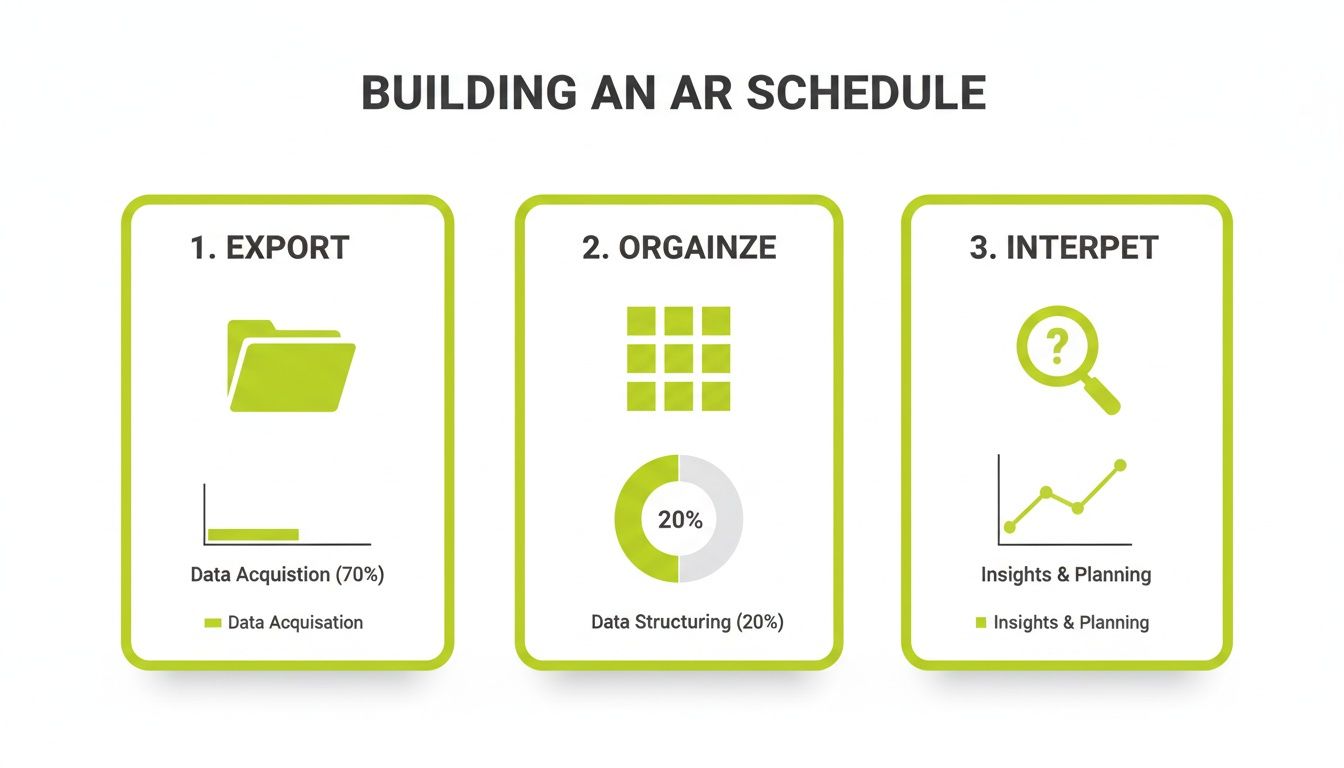
Building an accounts receivable aging schedule is a fundamental process, not a complex accounting exercise. It involves converting raw invoice data into a strategic tool for managing cash flow.
The initial step is data extraction. Export all open invoices from your accounting system, whether it's QuickBooks or a larger ERP. The export must include client name, invoice number, issue date, due date, and the outstanding amount.
With this data, you can organize each invoice into standard aging buckets. This is where the report begins to provide actionable intelligence.
Structuring Your Aging Report
An aging schedule's structure is standardized for at-a-glance clarity. You organize the exported data into a table, calculating how many days past due each invoice is to assign it to the correct bucket.
- Current: Invoices within their payment terms (e.g., Net 30) and not yet due.
- 1–30 Days Past Due: The first signal of a potential payment delay.
- 31–60 Days Past Due: Often points to a systemic issue requiring direct follow-up.
- 61–90 Days Past Due: Represents a material risk to your cash flow and demands immediate attention.
- 91+ Days Past Due: Has a high probability of becoming bad debt and requires focused collection efforts.
For professional services firms, maintaining low balances in the later buckets depends on clear and effective procedures for accounts receivable.
Here is a simplified example of an AR aging schedule.
Sample Accounts Receivable Aging Schedule
Client Name | Total Due | Current (0-30 Days) | 31-60 Days Past Due | 61-90 Days Past Due | 91+ Days Past Due |
|---|---|---|---|---|---|
Alpha Associates | $12,500 | $12,500 | $0 | $0 | $0 |
Beta Consultants | $25,000 | $10,000 | $15,000 | $0 | $0 |
Gamma Group | $8,000 | $0 | $0 | $8,000 | $0 |
Delta Dynamics | $18,000 | $0 | $5,000 | $3,000 | $10,000 |
Totals | $63,500 | $22,500 | $20,000 | $11,000 | $10,000 |
This table immediately tells a story. Alpha is current, Beta needs attention, while Gamma and Delta pose a significant risk to near-term cash flow.
From Data Points to Strategic Interpretation
Once the schedule is built, your role shifts from data compilation to diagnosis. You are no longer looking at what is owed, but analyzing the patterns the numbers reveal.
A well-interpreted aging report helps you identify systemic issues early. A consistent concentration of receivables in the ‘31-60 days’ bucket might indicate unclear invoice details, project approval bottlenecks, or an inefficient reminder process.
This is a significant challenge for many firms, as 39% of B2B invoices are paid late. The aging receivable method is your primary tool for spotlighting delinquencies before they escalate.
Interpreting an aging schedule is about moving from observation to action. It provides the empirical evidence needed to justify a strategic review of your credit policies or collections workflow.
Identifying High-Risk Clients and Trends
Your aging schedule is the optimal tool for identifying high-risk clients. A single client with invoices distributed across multiple aging buckets is a clear warning sign.
This data enables objective, proactive decisions. You can adjust credit terms for specific clients, require retainers, or implement a more assertive follow-up cadence. AR software for professional services can automate these reminders and escalations based on your aging data.
This proactive stance, driven by clear data, is the hallmark of disciplined financial management. The goal isn't just to collect old debt; it's to improve your overall cash conversion cycle and methodically reduce DSO.
Calculating Your Allowance for Doubtful Accounts
An aging schedule is not just a collections tool; it is the foundation for accurate financial reporting. The aging receivable method provides a data-driven process for calculating your allowance for doubtful accounts.
This allowance is a contra-asset account on your balance sheet that reflects the portion of your receivables you realistically do not expect to collect. This is not pessimism; it is financial precision.
As a core component of accrual accounting, this process ensures compliance with GAAP by matching bad debt expense to the corresponding revenue period. It replaces subjective estimates with a defensible, systematic calculation.
Assigning Probabilities to Each Aging Bucket
The logic is straightforward: the older an invoice, the lower the probability of collection. An invoice 10 days past due is a low risk; one that is 100 days past due is a significant problem.
To calculate the allowance, you assign an estimated uncollectible percentage to each aging bucket based on your firm’s historical collection performance. A firm with disciplined collections and strong client relationships will have lower percentages than one with inconsistent follow-up.
For a typical professional services firm, these percentages might be:
- Current: 1% uncollectible
- 1–30 Days Past Due: 3% uncollectible
- 31–60 Days Past Due: 10% uncollectible
- 61–90 Days Past Due: 25% uncollectible
- 91+ Days Past Due: 50% uncollectible
These are not static figures. They should be reviewed annually and adjusted to align with your actual write-off history.
A Worked Example of the Calculation
Let's apply these percentages to our sample aging schedule. The objective is to determine the required ending balance for the allowance for doubtful accounts.
The calculation is direct: multiply the total receivables in each bucket by its estimated uncollectible percentage.
Calculating Allowance for Doubtful Accounts - Worked Example
Aging Bucket | Amount Receivable | Estimated % Uncollectible | Required Allowance |
|---|---|---|---|
Current | $22,500 | 1% | $225 |
1-30 Days Past Due | $20,000 | 3% | $600 |
31-60 Days Past Due | $11,000 | 10% | $1,100 |
61-90 Days Past Due | $10,000 | 25% | $2,500 |
91+ Days Past Due | $10,000 | 50% | $5,000 |
Totals | $73,500 | $9,425 |
Based on this analysis, the firm's allowance for doubtful accounts should have a target balance of $9,425. This figure represents the most accurate estimate of potential credit losses within the current AR portfolio.
Recording the Journal Entries
The final step is the adjusting journal entry. This ensures your bad debt expense is stated correctly on the income statement and the allowance account is accurate on the balance sheet.
A common error is to expense the entire $9,425. The correct procedure is to book only the adjustment needed to reach the new target balance.
Assume the allowance for doubtful accounts has a pre-existing credit balance of $4,000. The adjustment is calculated as follows:
Required Ending Balance - Existing Balance = Bad Debt Expense $9,425 - $4,000 = $5,425
The journal entry to book an expense of $5,425 is:
Date | Account | Debit | Credit |
|---|---|---|---|
[Date] | Bad Debt Expense | $5,425 | |
Allowance for Doubtful Accounts | $5,425 | ||
To record bad debt expense for the period |
This entry increases bad debt expense on the income statement and brings the allowance account to the required $9,425 on the balance sheet. This disciplined process is critical for any initiative to improve cash flow.
The accuracy of this entire process hinges on clean data. Using accounts receivable automation eliminates the manual errors common in spreadsheets, ensuring both your aging schedule and your allowance calculation are consistently reliable.
Resolut automates AR for professional services—consistent, accurate, and human.
Turning Aging Data into Strategic Action
An aging report's value is realized only through action. Building the schedule and calculating the allowance are merely the starting points. The real work lies in using the analysis to improve cash flow.
The objective is to shift from a reactive, fire-fighting collections model to a proactive, data-driven strategy. This protects your firm's cash flow without damaging client relationships.
From Report to Actionable Strategy
Your aging schedule should function as a diagnostic tool that triggers predefined actions. It must transform from a monthly reporting task into a command center for your cash flow management.
For example, a high concentration of receivables in the ‘61-90 days’ bucket is a critical alert. It should trigger an immediate review of credit terms for those specific client segments.
An aging report provides the evidence to justify policy changes. Instead of stating, "I feel we're waiting too long to get paid," you can report, "Our DSO has increased by 12% this quarter, driven by a 20% rise in invoices aging past 60 days in the X practice group."
This data-driven approach removes subjectivity from strategic conversations, focusing the team on solving a measurable problem.
Implementing Data-Driven Tactics
With a clear view of your receivables, you can deploy precise tactics that address the problems your aging report uncovers. These are targeted interventions designed to prevent small issues from escalating.
- Automated Reminders: For invoices entering the ‘31-60 day’ category, an automated, personalized reminder is highly effective. It is a low-effort way to address the 23% of late payments caused by simple oversight.
- Credit Limit Reviews: Any client who consistently pays late should be flagged for a credit policy review. The aging data justifies requiring a retainer or shortening payment terms from Net 30 to Net 15.
- Prioritized Collections: The aging report directs your team's finite time to the largest invoices in the oldest buckets, maximizing the impact of their efforts on your cash flow.
The key is to systematize these responses. A well-managed AR process is not about heroic, one-off collection efforts; it is about disciplined, repeatable actions triggered by data. This is where accounts receivable automation provides a decisive advantage.
The Role of AR Automation
Executing these tactics manually is inefficient and prone to human error. Invoices are missed, and follow-ups are forgotten. Modern AR software for professional services provides a significant operational edge.
Platforms that offer AI AR automation can execute these strategies with perfect consistency.
- They automatically segment clients based on payment history.
- They trigger personalized reminder sequences without manual intervention.
- They flag high-risk accounts for your team's attention in real-time.
This frees your team to move from managing spreadsheets to managing strategy. Instead of chasing individual invoices, they can analyze trends, refine credit policies, and handle high-value client relationships that require a human touch. The objective is to methodically reduce DSO without increasing finance team headcount.
Resolut automates AR for professional services—consistent, accurate, and human.
How AR Automation Transforms the Aging Method

The manual aging report has inherent limitations. It is a static snapshot, and its production is labor-intensive. A report generated on Monday is outdated by Tuesday.
This forces your finance team into a reactive posture, constantly working with stale data.
The modern solution is to transform the static aging receivable method into a real-time command center. Accounts receivable automation platforms are designed to eliminate the gaps in manual processes, directly improving cash flow and team efficiency.
Instead of a weekly report, you get a live, dynamic view of your receivables. This allows you to act on a 31-day-old invoice the moment it becomes delinquent, not weeks later.
Visual Idea: Cinematic shot of a controller calmly observing a real-time AR dashboard on a large screen. The dashboard displays key metrics like DSO, cash forecast, and an interactive aging report, projecting an image of control and clarity.
From Static Report to Intelligent Command Center
True AI AR automation does more than send reminders. It applies a layer of predictive intelligence that is impossible to replicate manually. The system analyzes historical payment patterns and client behavior to identify risks before they materialize.
It is a shift from a historical ledger to a forward-looking dashboard.
The platform might flag an account that, while current, exhibits payment habits that historically precede delinquency. This enables a proactive, low-friction intervention long before that invoice reaches the 90+ day bucket.
A manual aging report tells you what happened. An automated, intelligent aging system tells you what is likely to happen next—and provides the tools to change the outcome.
This shift directly impacts key performance indicators. Firms that adopt AR automation typically achieve a 10-25% reduction in Days Sales Outstanding (DSO) within the first year.
The Real-World Impact of Automation
Automating the aging method reallocates your team's intellectual capital. When your controller is not bogged down compiling reports and sending manual reminders, they can focus on high-value strategic work.
- Reduced Manual Reporting: This can free up 5-10 hours per week for a senior finance team member, eliminating time spent on data export and spreadsheet manipulation.
- Improved Accuracy and Consistency: Automation eliminates human error in calculations and ensures follow-ups are sent precisely on schedule, maintaining a professional tone with every client.
- Data-Driven Client Segmentation: The platform automatically segments clients by payment behavior, allowing for tailored communication strategies. A fast-paying client gets a gentle nudge; a chronically late one receives a more structured reminder sequence.
This strategic application of technology directly serves the primary goals of any finance leader: improve cash flow and maintain control. The benefits of accounts receivable automation are not just about speed; they create a more resilient and predictable financial operation.
A Practical Shift in Workflow
Consider a typical automated workflow. The system syncs with your accounting data in real-time. Based on your predefined rules, it triggers a personalized email when an invoice becomes 15 days past due. If another week passes without payment, it sends a second, firmer reminder and flags the account for a direct call from your AR manager.
This entire sequence operates autonomously, ensuring no invoice is overlooked.
Exploring modern workflow automation tools can further refine your AR process, providing the backbone for scalable financial operations that support firm growth without adding headcount.
This is the power of converting a static report into an active system. It enforces discipline, improves client communication, and accelerates cash conversion. Your finance team is no longer just reporting on the past; they are actively shaping the firm’s financial future.
Resolut automates AR for professional services—consistent, accurate, and human.
Common Questions
As you refine your firm's financial processes, several practical questions typically arise. Here are the most common inquiries from CFOs and controllers at professional services firms.
What’s the Difference Between the Aging Method and the Percentage of Sales Method?
The primary difference is precision. The percentage of sales method is an income statement approach that applies a flat percentage to total credit sales to estimate bad debt. It is simple but lacks accuracy.
The aging receivable method is a balance sheet approach. It analyzes the specific age and collectibility of each outstanding invoice, tying bad debt expense directly to the actual risk within your AR portfolio. This provides a far more accurate representation of your firm's financial health.
How Often Should a Professional Services Firm Run an AR Aging Report?
For active cash flow management, an AR aging report should be reviewed weekly.
A weekly review allows your team to identify overdue invoices before they move into higher-risk aging buckets. While monthly reports are sufficient for financial closing, a weekly cadence enables proactive intervention.
This is where accounts receivable automation provides a distinct advantage. Instead of manual report generation from systems like QuickBooks AR automation, a dedicated platform provides live aging data on demand, eliminating the reporting lag.
Can Automation Work for a Firm Where Client Relationships Are Everything?
Yes. This is a critical concern for professional services firms. The fear is that automation will deploy impersonal, robotic demands that damage client relationships.
This concern is valid but based on an outdated perception of automation.
Modern AR software for professional services facilitates "human-in-the-loop" automation. You design the outreach, set the tone, and define the rules. The system executes your strategy with perfect consistency.
You can automate gentle reminders for invoices in the 1-30 day bucket while ensuring a team member intervenes in sensitive client situations. The goal is to let technology manage the routine follow-up so your team can focus on the strategic conversations that preserve key relationships. It allows you to improve cash flow and lower DSO without compromising the high-touch service your clients expect.
At What Point Does AR Automation Make Financial Sense?
The tipping point is typically reached when a controller or senior finance professional spends several hours each week on manual AR tasks like running reports, checking spreadsheets, and sending follow-up emails.
If your team spends more time chasing cash than analyzing financial performance, the ROI on automation is already clear.
For most firms in the $3M–$50M revenue range, the cost of a senior team member's time dedicated to manual AR work far exceeds the subscription cost of an automation platform. This is before factoring in the direct financial benefits, such as a reduced DSO, fewer write-offs, and more predictable cash flow.
--- Resolut automates AR for professional services—consistent, accurate, and human. Learn more at https://www.resolutai.com.