How to Master Your Average Collection Period and Control Cash Flow
Master the average collection period: calculate, interpret, and shorten this cash-flow bottleneck for CFOs.
The average collection period isn't just a metric on a dashboard. It's the measure of how long it takes for your firm's expertise to become cash in the bank.
For a professional services firm, a high average collection period (ACP) means revenue is trapped on the balance sheet. It’s capital you can't deploy.
This guide provides a framework for CFOs, controllers, and firm owners to measure, analyze, and systematically reduce their collection cycle.
Why Your Average Collection Period Is a Critical Control
In a services business, cash flow dictates operational capacity. ACP is the direct measure of your firm's efficiency in converting billable hours into working capital.
Consider a $10M consulting firm. Every day added to the collection cycle ties up over $27,000.
If your target of 45 days stretches to 65, you've just frozen over half a million dollars of capital. That's cash unavailable for strategic hires or growth initiatives.
From Metric to Operational Imperative
Monitoring ACP is not a reporting exercise; it's a strategic necessity. A high or volatile collection period signals operational friction in your accounts receivable process.
The common points of failure include:
- Vague Invoicing: Ambiguous line items that invite questions and stall payment.
- Inconsistent Follow-up: An undefined collections cadence that lets overdue invoices drift.
- Manual Bottlenecks: Reliance on spreadsheets and memory, which guarantees errors and missed follow-ups.
These issues don't just delay payments. They strain client relationships and consume your finance team's capacity, disrupting the entire order-to-cash process.
External economic pressures amplify these internal weaknesses. According to the Corporate Finance Institute's analysis, shifts in payment terms require firms to be more proactive than ever.
Controlling your ACP provides the predictability needed for accurate forecasting and confident investment. It transforms AR from a reactive chore into a controlled, strategic function.
How to Calculate Your Firm's ACP
To manage a financial metric, you must measure it consistently. Calculating your average collection period provides the clarity to move from chasing payments to architecting a reliable cash flow strategy.
The formula is straightforward, but its output is a powerful indicator of operational health.
Average Collection Period = (Average Accounts Receivable / Net Credit Sales) * Number of Days in Period
Let's deconstruct this formula for a professional services context. This is about converting invoiced expertise into usable cash.
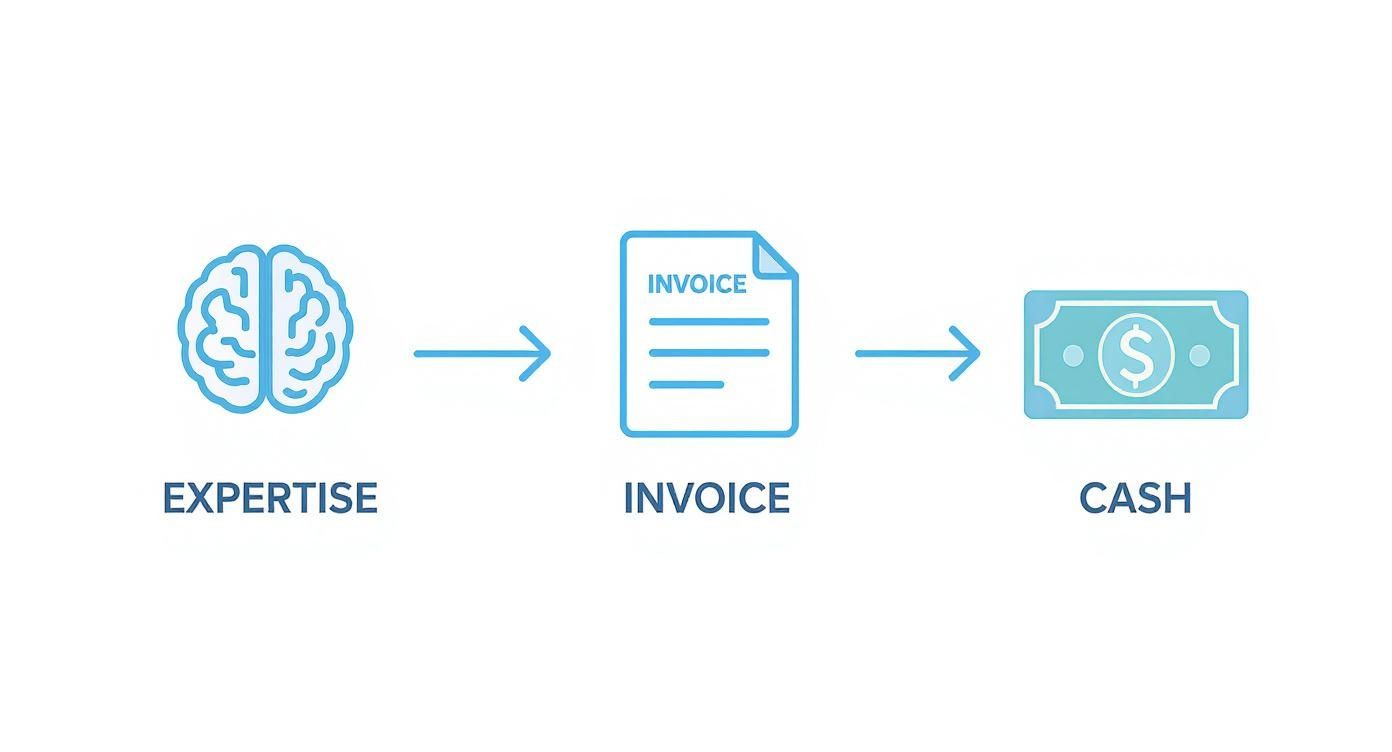
The infographic above visualizes the cycle—from work delivery to cash receipt. Your ACP is the scorecard for this entire process.
Deconstructing the Formula
Accurate inputs are critical for a meaningful calculation.
- Average Accounts Receivable: This smooths out billing cycle fluctuations. Sum the AR balance at the start and end of the period, then divide by two. This provides a more stable baseline than a single point-in-time figure.
- Net Credit Sales: For most service firms, this is your total revenue billed during the period, less any credits or write-offs. It is the total amount you reasonably expect to collect.
- Number of Days in Period: This must align with your analysis timeframe: 365 for annual, 90 for quarterly, or 30 for monthly.
These components, whether extracted from QuickBooks or another accounting system, yield an actionable metric.
Applying the ACP Formula in Practice
Let's apply this to two common professional services models.
Example 1: Architecture Firm with Milestone Billing
An architecture firm invoices clients upon reaching project milestones. Their trailing twelve-month (365 days) figures are:
- Beginning Accounts Receivable: $850,000
- Ending Accounts Receivable: $950,000
- Net Credit Sales (Total Billings): $5,000,000
The calculation proceeds as follows:
- Calculate Average AR: ($850,000 + $950,000) / 2 = $900,000
- Divide Average AR by Net Credit Sales: $900,000 / $5,000,000 = 0.18
- Multiply by the Number of Days: 0.18 * 365 = 65.7 days
This firm's ACP is nearly 66 days. This number is now the benchmark against which all efforts to reduce DSO and improve collections will be measured.
Example 2: Law Firm with Hourly Billing
A law firm bills clients monthly for hourly work. Their last quarter (90 days) financials are:
- Beginning Accounts Receivable: $400,000
- Ending Accounts Receivable: $480,000
- Net Credit Sales (Quarterly Billings): $1,200,000
The calculation is the same:
- Calculate Average AR: ($400,000 + $480,000) / 2 = $440,000
- Divide Average AR by Net Credit Sales: $440,000 / $1,200,000 = 0.367
- Multiply by the Number of Days: 0.367 * 90 = 33 days
The law firm's ACP is 33 days. The value for the firm's partners is in tracking this metric. A sudden jump to 45 days next quarter signals an issue—a key client payment delay or a broken internal process.
Knowing your ACP is the first step. The next is to use that data to drive operational improvements through refined processes and technology like accounts receivable automation.
Benchmarking Your Average Collection Period
You've calculated your firm's ACP. The number is 48 days. The question is, "Is this good?"
The answer depends entirely on context. What is efficient for a SaaS business would be a serious problem for an engineering firm managing large, complex projects.
Industry Benchmarks Provide Context
Professional services firms—architects, engineers, consultants—operate on different timelines. The nature of high-value, multi-stakeholder projects inherently extends payment cycles.
This is not a process flaw; it is a business reality that must be managed.
While a global average might be around 50 days, this figure is not a useful benchmark. A more precise comparison is required.
Average Collection Period Benchmarks for Professional Services
Industry Sector | Average Collection Period (Days) |
|---|---|
Architectural & Engineering | 74 |
Legal Services | 71 |
Accounting & Tax Services | 65 |
Management Consulting | 58 |
VISUAL IDEA: A simple, clean bar chart visualizing the data in the table above. Each bar represents an industry, with the y-axis showing the number of days.
An engineering firm with a 68-day ACP is, in fact, outperforming its industry average. Context is critical. It's also wise to view your ACP alongside other key financial ratios to get a complete snapshot of your firm's financial health.
Moving from a Number to a Health Spectrum
With industry context, you can establish an internal performance scorecard. This turns a simple metric into a diagnostic tool.
Consider this framework:
- Healthy (e.g., 45-60 days): Collections are operating efficiently. Cash flow is predictable, and your AR process is functioning as designed. Performance is likely above the industry median.
- At-Risk (e.g., 61-80 days): Performance is lagging. This indicates friction in your process, such as unclear invoicing or inconsistent follow-up, which is tying up working capital.
- Critical (e.g., 81+ days): This is a red flag. An ACP this high signals a systemic breakdown in collections. It puts liquidity at risk and makes accurate forecasting impossible.
The goal is to set a target ACP that aligns with your firm's financial model and then build the systems to achieve it with consistency.
Why Predictability Beats Speed
The instinct is to drive the collection period as low as possible. However, the primary operational win is not speed, but predictability.
A volatile ACP is more disruptive to financial planning than a consistently high one.
The primary goal is not just a low number, but a predictable and stable one that aligns with your firm’s financial model and cash flow forecasts. An ACP that swings from 45 days one quarter to 80 the next makes strategic planning impossible.
A reliable collection cycle enables confident cash flow forecasting. Predictability is the foundation of financial control.
Achieving this stability requires a defined, repeatable collections cadence. Technology like accounts receivable automation provides the structure needed to manage every invoice with precision, transforming a reactive process into a controlled, predictable operation.
Finding the Friction in Your AR Process
A high average collection period is a symptom, not the root cause. It’s an indicator of friction within your accounts receivable workflow.
To gain control, you must identify where and why your cash flow is getting stuck.
For most professional services firms, the friction points are predictable, manual gaps in the process.
Ambiguous Invoicing and Scope Creep
The fastest way to delay payment is to send an invoice the client cannot easily approve.
Vague line items like "Project Consulting" invite scrutiny and questions, creating payment stalls.
This is particularly true when project scope has drifted. If an invoice doesn't align with the client's memory of the SOW, it will be set aside for clarification, adding weeks to your collection period.
An Undefined Collections Cadence
What is the procedure when an invoice becomes 31 days past due? Or 60? If the answer is "It depends," you don't have a process.
Without a systematic, documented follow-up schedule, invoices will be missed. It is inevitable.
This inconsistency signals that payment deadlines are not firm. It trains clients that your invoices are not a priority.
An inconsistent collections process guarantees inconsistent cash flow. Predictability is only achieved through a defined, repeatable system where every invoice is managed with the same level of discipline.
Manual Workflows and Human Error
Reliance on spreadsheets, calendar reminders, and manual emails is not scalable and is prone to human error.
These manual systems create bottlenecks that directly inflate collection times.
Common failure points include:
- The Approval Bottleneck: An invoice requires partner sign-off. The partner is traveling and misses the email. The invoice sits in draft for ten days before the collection clock even starts.
- The Data Entry Error: An invoice's due date is mistyped in a tracking spreadsheet. The system now shows the invoice as current when it is 30 days past due, eliminating any chance of timely follow-up.
These small, preventable delays compound across hundreds of invoices, pushing your average collection period higher.
The solution is not more manual effort; it's a better system. This is where accounts receivable automation tools, including AI AR automation and QuickBooks AR automation, eliminate friction points and systematically reduce DSO.
How to Systematically Lower Your Average Collection Period
Knowing your average collection period is the diagnosis. The following steps are the treatment plan.
Reducing your ACP requires building a disciplined, repeatable system. Control comes from optimizing process, technology, and communication.
This creates a predictable cash flow engine for forecasting and investment, steadily driving down your ACP and unlocking working capital.
Fortify Your AR Process
The foundation of a low ACP is a standardized, non-negotiable process that eliminates ambiguity.
Start with invoicing. Each line item must be clear, detailed, and tied directly to the client's SOW. A shift from "Consulting Services" to "Phase 2: Geotechnical Analysis" removes confusion and accelerates approval.
Next, establish a firm, documented collections cadence. This is your operational playbook.
A standard cadence might look like this:
- Day -3: Proactive reminder that an invoice is due soon.
- Day 15: Polite but firm follow-up on the past-due invoice.
- Day 30: Escalated notice, copying a senior client contact.
- Day 45: Formal communication outlining next steps.
This structure removes guesswork and ensures every invoice receives consistent attention.
Bring in Technology for Control
Manual processes are destined to fail at scale. Accounts receivable automation provides a decisive operational advantage.
Modern AR software for professional services acts as an orchestration layer over your accounting system, such as a QuickBooks AR automation. It executes your collections cadence with perfect consistency.
A well-designed automation platform doesn't just send emails. It manages the entire workflow, escalating high-value overdue accounts for human intervention while handling routine follow-ups.
This technology transforms AR from a reactive, manual function into a proactive, managed system. No invoice is forgotten. More tactical approaches are available in our guide on real-world methods for cleaning up accounts receivable.

Master Your Client Communication
Direct conversations about payment are unavoidable. The goal is to secure payment while strengthening the client relationship. This requires a shift from confrontation to collaboration.
Frame the conversation around alignment, not accusation.
For example: “I’m calling to ensure our records are aligned on invoice #1234, which appears to be 30 days past due. I wanted to confirm you have everything you need from us for processing.”
This collaborative approach assumes oversight, not intent, and maintains goodwill. It is a critical detail that helps improve cash flow without damaging client relationships.
Combining a rigid process, intelligent AI AR automation, and professional communication allows you to systematically reduce DSO and take control of your firm's financial health.
Taking Control with AR Automation
Systematic improvements are the foundation for a shorter average collection period. However, perfect manual execution is impossible.
Human error and competing priorities will always create friction. Technology is the final step in moving from manual effort to intelligent orchestration. Before diving into AR specifics, it's useful to understand what workflow automation entails as a concept.
VISUAL IDEA: A cinematic, slow-motion shot of a single drop of water hitting a still surface, creating perfectly expanding concentric circles—symbolizing the control and order automation brings to a chaotic process.
From Manual Reminders to Intelligent Orchestration
Modern accounts receivable automation platforms solve this problem by integrating with accounting software to create a smart workflow that executes your collections strategy.
This is not about generic email blasts. True AI AR automation is about orchestration.
A smart system can:
- Personalize Communication: Tailor reminder sequences based on client payment history or invoice value.
- Automate Escalations: Route high-risk overdue accounts to the right person for human intervention.
- Provide Centralized Visibility: Give your team a single dashboard to see the status of every invoice, eliminating duplicate efforts.
For a deeper dive, our guide to accounts receivable automation software breaks down how these systems operate.
Augmenting Judgment, Not Replacing It
The purpose of AR software for professional services is to augment financial judgment, not replace it. Automation handles the high-volume, repetitive 80% of follow-ups that consume your team's time.
This frees your finance leaders to focus on the critical 20%: negotiating payment plans, resolving complex billing disputes, and analyzing cash flow trends. It ensures every invoice is managed with precision and predictability.
Embedding your collections strategy into an automated system creates a consistent, accurate, and scalable process. You gain control over your average collection period, turning a reactive task into a calm, managed financial operation designed to improve cash flow.
Frequently Asked Questions
As a leader in a professional services firm, your questions are tactical. Here are a few common points on the average collection period.
How Is Average Collection Period Different From DSO?
Functionally, for a professional services firm, it isn't.
Average Collection Period (ACP) and Days Sales Outstanding (DSO) are two labels for the same metric: how long it takes to convert an invoice into cash.
Technically, ACP uses only credit sales, while DSO might use total sales. Since nearly all revenue in a services firm is on credit, the distinction is academic.
Pick one term, calculate it consistently, and focus on the trend.
How Often Should We Be Calculating Our ACP?
For strategic review and leadership meetings, a monthly calculation aligned with your close process is optimal.
For active operational management—especially when implementing new tools like accounts receivable automation—a rolling 30-day calculation updated weekly provides faster feedback on what is working.
Can Early Payment Discounts Actually Reduce Our ACP?
Yes, but it is a strategic trade-off. A "2/10, net 30" discount can be a powerful incentive.
You are weighing the cost of the 2% discount against the value of receiving cash 20 days sooner. For firms with tight working capital, the improved liquidity is often worth more than the margin reduction.
Model the financial impact before implementation. If the discount can reliably shorten your collection cycle by 15-20 days, it is a smart lever for cash management.
--- Resolut automates AR for professional services—consistent, accurate, and human. Learn more about our approach.