
A CFO's Guide to Billing for Professional Services
Optimize your firm's cash flow with this CFO's guide to billing for SaaS. Learn how to reduce DSO and leverage AR automation for measurable financial control.
For financial leaders at professional services firms, the ground has shifted. The legacy model of unpredictable, project-based work creates revenue volatility and obstructs clear financial control.
Adopting a billing model inspired by SaaS is not a trend. It is a strategic necessity for building predictable revenue, stabilizing cash flow, and enabling scalable growth.
The Financial Operator's Playbook for Predictable Revenue
The primary challenge for financial leaders in professional services is the volatility of project pipelines. One quarter is strong; the next requires scrambling for cash. This unpredictability creates cash flow gaps and makes forecasting an exercise in guesswork.
The solution is a change in perspective: package services as products with recurring billing cycles.
This pivot provides the structure to move from financial reaction to confident orchestration. It delivers the visibility and control needed for strategic decisions based on data, not intuition. You can find further insights on modern CFO strategies that expand on this playbook.
From Projects to Products
Thinking of services as "products" is the key to creating recurring revenue streams. This is not about changing your deliverables—it is about changing how you package, price, and bill for them.
- Standardize Deliverables: Create clear service tiers with defined scopes and set pricing, similar to a software subscription.
- Establish Recurring Billing Cycles: Transition clients from project-based invoices to monthly or annual retainers.
- Focus on Long-Term Value: Evolve the client relationship from a series of transactions into an ongoing partnership.
This approach establishes a foundation for Monthly Recurring Revenue (MRR) and Annual Recurring Revenue (ARR)—the core metrics of any stable, high-growth business. It also simplifies the entire financial workflow.
When you collect annual payments upfront, you gain significant clarity into the financial health of the company. This enables smarter long-term planning and stability. Predictability is driving firms to embrace subscription models.
Automating the Order-to-Cash Cycle
Once recurring billing is established, the next imperative is to systematize collections. A manual accounts receivable process is a significant drag on efficiency and cash flow, prone to human error, delayed invoices, and inconsistent follow-up.
Effective accounts receivable automation unlocks the full potential of a recurring revenue model. It ensures invoices are sent on time, reminders are consistent, and payments are collected without manual intervention. This is how you can materially reduce DSO and improve cash flow. A detailed breakdown of this workflow can be found in our guide to the order-to-cash process for financial operators.
This operational discipline transforms the finance function from a cost center into a strategic engine for growth.
Adopting SaaS Billing Models for Your Firm
Thinking in terms of recurring revenue is not about changing your core services. It is about repackaging expertise into a predictable structure that provides stability and control over your firm's financial future.
This is a deliberate shift away from the feast-or-famine cycle of project-based billing.
Instead of chasing one-off invoices tied to milestones, you create a steady rhythm of regular, predictable payments. This change transforms how you manage cash flow and forecast revenue, moving you from a reactive to a proactive position.
The infographic below shows how this predictability is built on a foundation of Annual and Monthly Recurring Revenue.
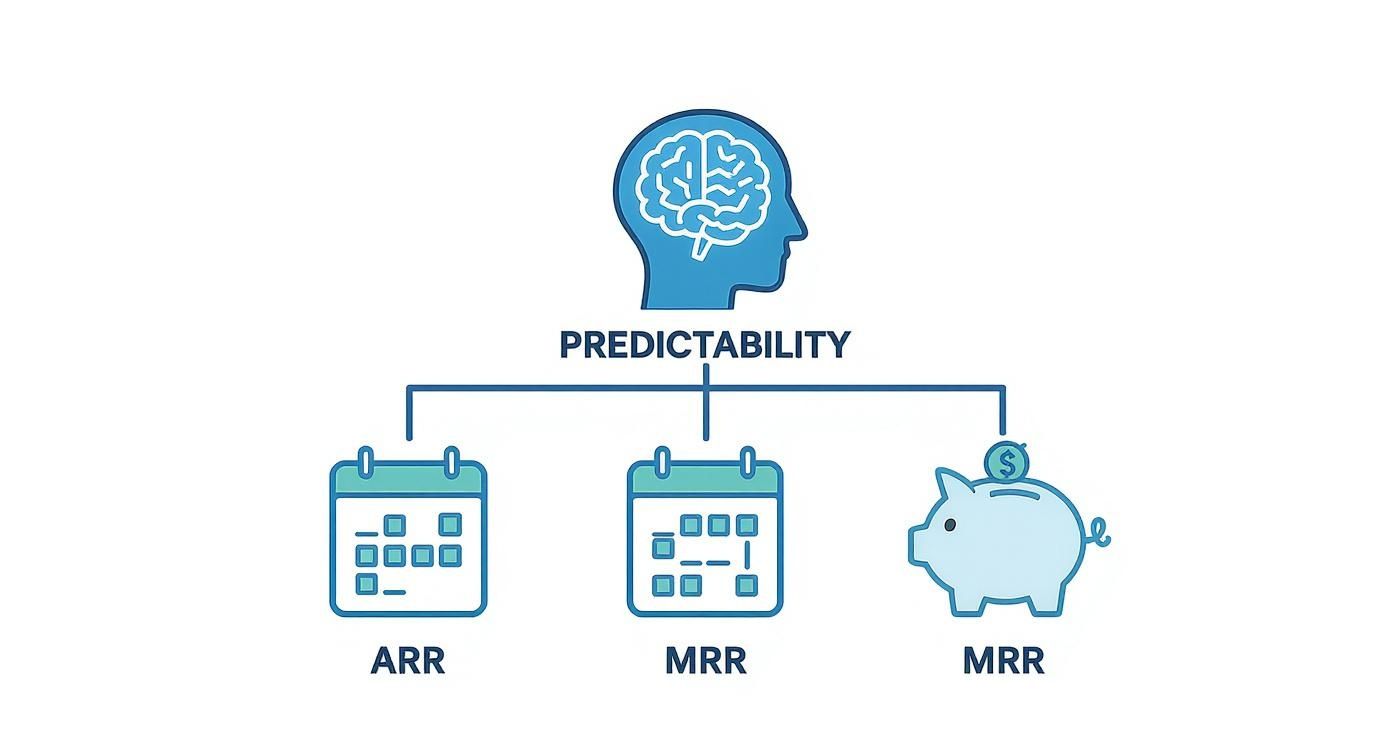
This hierarchy is clear: consistent MRR builds a solid ARR foundation, giving financial leaders the clarity needed for strategic decisions instead of reacting to the bank balance.
Core Billing Models for Services
For professional services, two SaaS billing models are particularly relevant: tiered and usage-based. These are not mutually exclusive; hybrid models that combine them often align best with how value is delivered.
A tiered model is straightforward. You package services into distinct levels—'Bronze, Silver, Gold.' Each tier offers a clear set of deliverables for a fixed monthly or annual fee, simplifying sales and making revenue highly predictable.
A usage-based model ties billing directly to consumption, such as support hours, reports generated, or users served. This model aligns costs directly with the value received, fitting clients with fluctuating needs.
The key is selecting a model that mirrors how clients benefit from your expertise. For ongoing strategic counsel, a tiered subscription is logical. For transactional work, a usage-based approach may be a better fit.
Modernizing operations begins with understanding the imperative of cloud adoption. This is the essential first step to implementing systems that can effectively manage recurring revenue.
The Rise of Hybrid and AI-Driven Models
The way SaaS companies handle billing is a significant lever for growth, with hybrid pricing models now leading. Recent data shows that companies using hybrid models—blending subscription and usage elements—report a median growth rate of 21%.
Furthermore, 44% of SaaS companies have already started monetizing AI-powered features, opening new revenue streams.
For a professional services firm, a hybrid model is highly practical:
- Base Subscription Fee: A fixed monthly retainer covering core advisory services and team access.
- Usage-Based Overage: Additional charges for high-value work beyond the base scope, like specialized reports or extra workshops.
This structure provides the revenue predictability of a subscription with the flexibility to capture additional revenue from high-demand services.
Impact on Financial Operations
Adopting these models has an immediate, measurable impact on financial operations. It standardizes invoicing, which is the bedrock of effective accounts receivable automation. Once invoices are consistent, AR software for professional services can manage the entire collections workflow.
This operational discipline is especially powerful for firms on systems like QuickBooks. Layering QuickBooks AR automation on a recurring billing structure can significantly reduce DSO. Automating invoice delivery, payment reminders, and cash application removes the manual friction that delays payments.
The objective is to build a system where revenue is not just earned, but reliably collected. This creates the stable financial foundation needed to focus on business growth instead of managing cash crises.
Adapting SaaS Billing Models for Professional Services
Translating SaaS billing concepts to a services context can be abstract. This table breaks down how these models work for firms like yours, highlighting where each one is most effective.
Billing Model | How It Works for Services | Best Suited For | Impact on Key Metrics |
|---|---|---|---|
Tiered Subscription | Fixed monthly fee for a predefined scope (e.g., "Basic Compliance," "Strategic Advisory"). | Firms with standardized packages like accounting, legal retainers, or managed IT services. | High MRR/ARR predictability; simplifies forecasting and sales. |
Usage-Based | Billed based on consumption (e.g., support hours, consultations, reports generated). | Consultants, creative agencies, or any firm where work volume fluctuates. | Revenue directly tracks client value; can increase LTV for high-use clients. |
Hybrid Model | A base retainer for core services plus overage fees for work beyond the agreed scope. | Most professional services firms—offering stability and capturing upside from extra project work. | Balances predictable MRR with the flexibility to grow revenue from active clients. |
Per-User/Seat | A fixed fee per user or "seat" with access to your services or platform. | Firms offering training, advisory platforms, or services where value is tied to the number of people served. | Simple to scale; closely ties cost to the client's team size. |
The right model makes it easy for clients to buy from you and even easier for you to get paid. It removes friction from the relationship, turning billing into a smooth, predictable process.
The New Financial KPIs You Need to Master
Switching to a subscription model requires an overhaul of your financial dashboard. Traditional metrics like P&L are rearview mirrors. To steer a recurring revenue business, you need forward-looking KPIs that measure health and momentum.
These are the new language of value for any firm built on long-term client relationships. Mastering them is critical for making informed decisions on pricing, client retention, and sustainable growth.

MRR and ARR: The Bedrock of Predictability
The first shift is from tracking project-based revenue to recurring revenue. This is measured by two primary KPIs.
- Monthly Recurring Revenue (MRR): Your normalized, predictable monthly income. It smooths out the peaks and valleys of projects, providing a stable baseline for operational planning.
- Annual Recurring Revenue (ARR): MRR multiplied by 12. ARR gives a high-level view of your firm’s scale and year-over-year growth, which is critical for long-term valuation.
Focusing on these figures changes the financial outlook. The question shifts from, "What did we bill last month?" to, "What is our committed revenue for the next twelve months?" This leads to better strategic decisions.
Churn Rate: Your Silent Revenue Killer
In a recurring model, losing a client is far more damaging than losing a single project. Churn Rate is the percentage of clients or revenue lost over a given period, directly reflecting client satisfaction.
High churn is a significant leak in your revenue bucket. A seemingly small monthly churn of 3% can eliminate over a third of your client base in a year. Controlling churn is paramount; it is almost always cheaper to retain a client than acquire a new one.
Your billing strategy is a powerful tool here. Early-stage companies often find monthly billing accelerates growth. Top-performing startups under $1M ARR have seen 131% YoY growth when over 75% of their revenue is billed monthly. As you scale, a mix of monthly and annual plans provides flexibility to both acquire clients and lock in long-term revenue. You can discover more about how billing frequency impacts growth and retention.
CLV: The True North of Client Value
Customer Lifetime Value (CLV) is the total revenue you can expect from a client over the entire relationship. It is a powerful metric that connects pricing, retention, and service delivery.
When you understand your CLV, you can make precise, data-backed decisions about client acquisition costs. If a typical client is worth $150,000, spending $10,000 to acquire them is a sound investment. Without that insight, you are operating blind.
CLV forces a long-term perspective, putting focus on partnerships that drive higher recurring revenue and lower churn.
DSO: The Final Litmus Test
While MRR, Churn, and CLV are leading indicators of business health, Days Sales Outstanding (DSO) is the critical lagging indicator. It measures how efficiently you convert revenue into cash. A high DSO means cash is trapped in accounts receivable, choking liquidity.
The goal is not just predictable revenue, but predictable cash flow. A well-designed billing process backed by accounts receivable automation is the only way to drive down DSO. By ensuring invoices are accurate, timely, and consistently followed up on, you close the loop between earned revenue and collected cash.
This is the operational excellence that separates a growing firm from one that is truly scaling with control.
Using AR Automation to Improve Cash Flow
Switching to a recurring revenue model is only half the battle. The other half is ensuring that revenue lands in your bank account on time.
This is where manual accounts receivable processes fail. They create operational drag that directly hurts cash flow. This is a real, measurable cost that appears as late invoices, inconsistent payment reminders, and wasted team hours on administrative follow-ups.
Every manual touchpoint on an invoice introduces a chance for error.

The Hidden Costs of Manual AR
The drag from manual AR is more than lost time; it is a steady leak of capital and a source of risk. When your finance team is buried in paperwork, they cannot focus on strategic work that moves the business forward.
This reactive cycle creates predictable problems:
- Human Error: A typo, the wrong contact, or a missed billing date leads to disputes and delays.
- Inconsistent Follow-up: Collections become driven by personality and memory, training clients that deadlines are negotiable.
- Delayed Cash Application: Manually matching payments to invoices is slow, leaving books out of date and obscuring your cash position.
These inefficiencies accumulate, leading to a higher DSO and tighter working capital. The root problem is a lack of process control.
AI AR Automation as the Solution
This is where AI AR automation becomes a critical partner to modern billing models. This is not about sending automated emails; it is about orchestrating the entire collections workflow—from invoice creation to intelligent follow-ups and cash application without manual entry.
The primary benefit is regaining control. Automation brings consistency, accuracy, and timeliness to every client interaction, turning a manual process into a predictable system. You can explore the full range of accounts receivable automation benefits to see the depth of impact.
By systematizing collections, you remove emotion and inconsistency. The system handles the routine 80% of follow-ups, freeing your team to focus their expertise on the complex 20% of accounts that require a human touch.
Quantifying the Impact of Automation
The data is clear. Moving from manual to automated AR delivers tangible results.
Industry analysis shows the average firm spends 65 hours per month on manual billing tasks, with a 23% error rate. This contributes to revenue leakage of 4% of ARR and a DSO of 52 days.
With billing automation, these numbers improve dramatically. Firms typically save 45 to 55 hours per month and cut revenue leakage to 0.5% of ARR. Most importantly, automated follow-ups shorten the average DSO by 17 days, accelerating cash flow.
Orchestrating Client Communications
Modern AR software for professional services does more than send reminders. It enables intelligent orchestration, tailoring the tone, timing, and frequency of communications based on payment history, invoice size, and contract terms. This level of precision is impossible to achieve manually.
For example, a system can be configured to:
- Send a polite reminder email five days before an invoice is due.
- Trigger an automated SMS notification on the due date if payment is not received.
- Automatically schedule a personalized follow-up call from a team member for invoices over 15 days past due.
This methodical approach ensures persistence without being abrasive, maintaining client relationships while systematically reducing your DSO. It is especially powerful for firms using QuickBooks, where QuickBooks AR automation can integrate directly to streamline the entire cycle.
The goal is a collections process that is both persistent and professional. Replacing manual effort with intelligent workflows doesn't just improve cash flow—it builds a more resilient and scalable financial operation.
Your Implementation Plan for AR Automation
Adopting new technology is a calculated operational upgrade that demands a plan. Implementing accounts receivable automation requires a tactical rollout to minimize risk, ensure team adoption, and deliver measurable results from day one.
The objective is to move from a reactive, manual process to a proactive, automated system without disrupting operations. A successful rollout hinges on a clear, step-by-step process understood by your finance and collections team.
Phase 1: Audit and Define Success
Before improving a process, you must map its current state. Audit your existing AR workflow, from invoice creation to cash application, to identify every point of friction and delay.
Pinpoint specific bottlenecks. Is it the three-day lag between work completion and invoicing? Or inconsistent follow-ups on past-due accounts? Documenting these issues provides a clear baseline for measurement.
Once you know what is broken, define what success looks like in hard numbers. These must be specific, measurable KPIs.
- Primary Metric: Reduce DSO by 15% within the first 90 days.
- Secondary Metric: Decrease the average number of follow-up touches per invoice by 40%.
- Operational Metric: Cut time spent on manual cash application by 75%.
These metrics become the proof points for your project's ROI, providing the data needed to justify the investment.
Phase 2: Select and Configure the Right System
With objectives set, select the right AR software for professional services. The most important criterion is seamless integration with your existing financial stack, especially your accounting software.
For many firms, QuickBooks AR automation is non-negotiable. A platform with a direct, two-way sync prevents manual data entry, eliminates reconciliation errors, and ensures books are always accurate. Our **guide to accounts receivable automation software** offers a framework for making the right choice.
The best technology feels like a natural extension of your existing process. The goal is to augment your team's capabilities, not force them into a rigid, unfamiliar workflow.
Configuration is where strategy becomes operational. Set up automated dunning schedules—the cadence and content of payment reminders. A well-configured system orchestrates communication with precision.
- Early Stage (Pre-Due): A polite reminder email 5 days before the due date.
- Mid Stage (Just Past Due): An automated SMS and a firmer email on day 3 past due.
- Late Stage (15+ Days Past Due): An alert flagging the account for a personal phone call from your collections specialist.
Phase 3: Train and Monitor
The final phase is empowering your team and tracking performance. Train finance staff not just on software functionality, but on interpreting the data it provides. They should know when to let automation run and when to intervene with a human touch.
After launch, shift focus to monitoring the KPIs established in phase one. Your AR automation dashboard is your new command center. Track DSO, collections effectiveness, and aging receivables in real time. This data allows you to fine-tune dunning strategies and continuously optimize for better cash flow.
***
AR Automation Implementation Checklist
This checklist provides a practical roadmap from manual processes to automated control for finance and collections teams.
Phase | Key Actions | Team Responsible | Success Metric |
|---|---|---|---|
1. Discovery & Planning | Audit current AR workflow, identify bottlenecks. Define specific, measurable KPIs (e.g., target DSO). Secure executive buy-in. | Finance Lead, CFO/Controller | Documented process map and approved KPI targets. |
2. System Selection | Research vendors, prioritize integrations (e.g., QuickBooks). Request demos focused on your specific use cases. Finalize selection. | Finance Lead, IT | Signed contract with a vendor that meets integration needs. |
3. Configuration | Set up dunning schedules (email/SMS cadence). Define user roles and permissions. Sync historical data from accounting system. | Finance Team, Vendor Support | Dunning sequences are live and tested. |
4. Training & Launch | Conduct hands-on training for all users. Run a small pilot with a select group of clients. Announce official go-live date. | Finance Lead, All Users | Team demonstrates proficiency with the new platform. |
5. Monitoring & Optimization | Monitor KPIs daily/weekly via the new dashboard. Gather feedback from the team. A/B test reminder messaging and timing. | Finance Team | DSO reduction and other KPIs are trending toward goal. |
A structured implementation ensures you are not just buying software, but building a better collections process. This transforms the project from a technical task into a strategic win.
When executed correctly, you achieve a state of complete financial control, where billing and AR systems work in harmony to deliver reliable cash flow.
This is the purpose of modernizing your approach: building a system that provides the clarity to scale with confidence, turning the finance function into the team that guides strategic growth.
What Real Financial Control Looks Like
The outcome is tangible. Predictable cash flow becomes the norm, not a quarterly surprise. The operational drag from chasing payments and manual reconciliation disappears, freeing up your team and capital for value-additive work.
Financial leadership in a modern professional services firm is not about chasing payments. It is the ability to forecast accurately, manage working capital with intent, and empower your team to focus on analysis, not administration.
When your firm reaches this state, you have moved beyond the tactical grind of collections to managing a finely tuned revenue engine. This requires the right billing models, a focus on the right KPIs, and the operational muscle of accounts receivable automation.
From Short-Term Fixes to a Long-Term Edge
This process is about shifting from fixing immediate problems—like a high DSO—to building a durable strategic advantage. The clarity from a predictable revenue model, combined with the efficiency of AI AR automation, provides a stable platform for growth.
Your team gains the capacity to analyze pricing, model growth scenarios, and identify new opportunities. They are no longer bogged down by manual follow-ups and can apply their expertise where it truly matters. This is what unlocks scalable, profitable growth.
Questions We Hear All The Time
Shifting to a new billing model always brings practical questions. As a finance leader in a professional services firm, you are likely considering these same issues.
Will Automation Make Us Sound Like Robots to Our Best Clients?
This is a common and valid concern. The fear is that automation feels impersonal, especially for high-touch relationships built over years.
However, good automation is about consistency, not rigidity. You set the rules, the tone, and the timing; the platform executes your plan perfectly, every time.
This allows you to automate routine reminders for the majority of your invoices—often 80% or more. The system then intelligently flags high-value or historically difficult accounts for personal review. It does not replace your team; it frees them to apply a human touch where it matters most.
The goal is not to remove your team from the conversation. It is to handle the repetitive work so they can focus on strategic relationships and the conversations that count.
Is This Going to Complicate Our Revenue Recognition?
It is easy to assume a new process means more complexity, but with recurring billing, the opposite is often true. While there is an initial adjustment, this model ultimately simplifies and standardizes revenue recognition.
It naturally aligns your firm with ASC 606 principles for subscription-based income, moving away from lumpy, project-based recognition.
Modern AR software for professional services is built to manage these schedules automatically. This removes the risk of manual error and provides a cleaner, more predictable picture of recognized revenue each month. It is about more control, not less.
How Quickly Can We Realistically Expect to See a Lower DSO?
You will see an impact within the first 60 to 90 days. The initial wins come from eliminating invoice delivery delays and establishing a consistent follow-up schedule.
As clients adapt to the new, predictable cadence, their payment cycles shorten. For most firms, a 15-25% reduction in DSO within the first six months is a realistic and achievable target. That is a direct injection of cash back into the business.
--- Resolut automates AR for professional services—consistent, accurate, and human.