Solving Cash Flow Problems in Business: A Guide for Financial Leaders
A definitive guide for CFOs on solving cash flow problems in business with strategic AR automation and operational finance tactics that work.
Cash flow problems in professional services aren't about a lack of revenue. They're about operational friction—the drag between invoicing and cash collection that ties up working capital.
For CFOs and firm owners, this isn't news. It's a daily operational reality. The challenge is moving from reactive fire-fighting to engineering a predictable financial system.
This guide provides a framework for diagnosing, stabilizing, and ultimately solving the root causes of cash flow inconsistency.
The Hidden Costs of Unmanaged Cash Flow

Inconsistent cash flow is more than a balance sheet headache. It’s an operational tax that quietly erodes a firm's momentum.
These operational gaps create expensive side effects. When cash is unpredictable, you’re forced to play defense. You delay a strategic hire. You put off a technology investment. You pass on a growth opportunity you know you should take.
Over time, this defensive posture doesn't just protect you; it erodes your competitive edge.
Quantifying the Operational Drag
The direct cost of poor cash management is steep. For stable firms, it’s a major risk. Aon’s Global Risk Management Survey ranked cash flow and liquidity risk among the top 10 global threats, with 29% of companies reporting a loss from it in the previous year alone.
This isn't just a small business problem. Unmanaged receivables are a direct leak in your working capital.
Unmanaged cash flow is the equivalent of an operational tax. It forces you to operate with less capital than you have actually earned, directly limiting your ability to invest, scale, and innovate.
The true cost is more than delayed payments. It’s the team hours spent on manual follow-ups, mounting bad debt risk, and the opportunity cost of having your best financial minds chasing cash instead of managing it. Understanding this is the first step. The next is to implement smart strategies to reduce operational costs.
When you treat cash flow problems in business as an operational challenge, the goal shifts. You stop chasing payments and start engineering a more resilient financial system.
*Visual Idea: *A split-screen image. Left side shows a team in a chaotic, paper-strewn office, looking stressed. Right side shows the same team in a clean, modern office, calmly reviewing a financial dashboard. Caption: "From Reactive Chaos to Proactive Control."
Diagnosing Your Cash Flow Gaps with Precision
Effective financial management starts with a precise diagnosis. You must move past the vague feeling that payments are "slow" and quantify where the friction exists in your cash cycle.
A gut feeling is not an actionable insight. A data-backed understanding of where and why delays happen is the foundation for control.
For professional services firms, where every project has unique billing complexity, this diagnostic precision is non-negotiable.
Moving Beyond Standard DSO
Days Sales Outstanding (DSO) is a staple metric, but it only tells part of the story. It provides an average but hides critical details. A few large, on-time payments can easily mask the damage done by dozens of chronically late accounts.
To understand your firm’s financial health, you need a dashboard of interconnected metrics. This multi-faceted view reveals not just what is happening, but why.
The goal is to shift from reacting to cash shortages to proactively engineering cash predictability. This is only possible when you can measure and manage the entire cash conversion cycle with accuracy.
Cash stuck in long payment cycles is a massive operational drag. In the U.S. alone, an estimated $1.7 trillion in excess working capital is tied up in company operations. Much of it is locked in overdue B2B invoices. You can explore more data on the state of accounts receivable to see the full picture.
Key Diagnostic Metrics for Cash Flow Analysis
An effective diagnosis relies on a balanced scorecard of KPIs. Together, they create a comprehensive picture of your firm's liquidity and efficiency.
Here are the essential KPIs to track for a clear view of your financial operations.
Metric | Formula | What It Measures | Ideal Trend for Professional Services |
|---|---|---|---|
Days Sales Outstanding (DSO) | (AR / Total Credit Sales) * Days in Period | Average time to collect payment after a sale | Decreasing; aligns with payment terms |
Cash Conversion Cycle (CCC) | DSO + DIO - DPO | Time to convert resource inputs into cash flow | Decreasing; ideally negative |
AR Turnover Ratio | Net Credit Sales / Average AR | How many times AR is converted to cash per period | Increasing |
Collection Effectiveness Index (CEI) | ((Beginning AR + Credit Sales) - Ending AR) / ((Beginning AR + Credit Sales) - Ending Total AR) * 100 | Effectiveness of collections against what was available to collect | As close to 100% as possible |
Using these metrics transforms how you address cash flow problems in business. A dropping AR Turnover Ratio might signal a weak credit policy. A low CEI could point to an inefficient collections process. This is the difference between guessing and knowing.
Short-Term Tactics for Immediate Liquidity
When diagnostics show a pending cash crunch, the first order of business is stabilization. This requires surgical, high-impact moves designed to generate cash within the quarter.
The goal is simple: pull the right levers to unlock the cash you already own. This buys the breathing room needed to engineer a long-term solution.
Prioritize and Pursue High-Value Delinquencies
Not all overdue invoices are equal. The Pareto principle is nearly always at play: roughly 80% of your outstanding cash is tied up in about 20% of your overdue accounts.
Focus your team’s energy accordingly. Pull a detailed AR aging report and flag the five largest invoices over 30 days past due.
These accounts don’t need another automated email. They require a direct call from a senior team member to secure a firm payment commitment and date.
A single conversation about a six-figure invoice can inject more immediate cash into the business than a month of low-level collection activities. This is about leverage.
This targeted strategy maximizes your team’s impact and is the fastest way to address significant cash flow problems in business.
Implement a Tiered Dunning Strategy
While you handle high-value accounts, a system must address the rest. A tiered dunning strategy applies escalating communication based on invoice age and value.
This prevents alienating good clients while ensuring smaller balances don't fall through the cracks.
A simple, effective structure:
- Tier 1 (1–15 Days Past Due): Automated, polite email reminders. The tone is helpful, confirming receipt and offering assistance.
- Tier 2 (16–45 Days Past Due): More direct communication. Combine another email with an initial call from your AR specialist.
- Tier 3 (46+ Days Past Due): A formal letter and a call from a finance manager, outlining a clear deadline before further escalation.
This segmented approach provides a predictable playbook and demonstrates a professional, well-defined process. For a deeper dive, explore other expert ways to increase cash flow.
Building a Resilient Long-Term AR System
Short-term fixes are bandages. Real financial stability is engineered with a durable system designed to prevent cash flow gaps before they occur.
This means rethinking Accounts Receivable. It's not a final step; it's a strategic engine integrated from the first client conversation through the final payment.
Financial discipline must be part of the entire client lifecycle, aligning sales, project management, and finance.
Establishing a Dynamic Credit Policy
A clear, consistently enforced credit policy is the bedrock of a healthy AR system. This is about defining the financial rules of engagement from the start.
This document must be a living policy. Tier your terms, giving more flexibility to reliable clients while requiring shorter payment cycles or retainers from new or higher-risk engagements. This is proactive risk management and your first line of defense against future cash flow problems in business.
A credit policy isn’t a barrier to sales. It’s a framework for profitable relationships. It ensures you're winning the right clients who strengthen your firm’s financial footing.
Optimizing Billing and Invoice Clarity
In professional services, an invoice is a key project communication. Vague line items or confusing project codes invite payment delays. Every day spent answering questions adds to your DSO.
Invoices must be clear, accurate, and timely. This requires tight coordination between project and finance teams.
- Timeliness: Bill as soon as a project milestone is complete. Don't wait for month-end.
- Clarity: Use plain language. Itemize work and connect it directly to the original scope.
- Accessibility: Embed a simple, one-click online payment portal on the invoice. Removing payment friction is critical.
These adjustments directly reduce DSO by eliminating the most common reasons for payment delays.
Architecting a Proactive Collections Process
A resilient AR system relies on optimizing debt collection strategies that are proactive, not reactive. The goal is to prevent delinquencies with consistent, professional communication that begins before an invoice is due.
This is critical for mid-sized firms. Research shows 82% of SMEs struggle with cash flow, typically triggered by late payments. Most apply short-term fixes instead of addressing the root cause. The full research on SME cash flow challenges highlights this dangerous gap.
Using AR software for professional services, including tools for QuickBooks AR automation, allows firms to build proactive playbooks. The right accounts receivable automation, especially AI AR automation, ensures communication is persistent, professional, and helps improve cash flow systemically.
*Visual Idea: *A clean, minimalist flowchart showing the "Client Lifecycle." Stages: Proposal (Credit Terms Set) -> Project Execution (Milestone Billing) -> Invoice Delivery (Clear & Actionable) -> Proactive Follow-up (Automated Cadence) -> Cash Collected (Reduced DSO). Arrows create a continuous loop.
Using AI Automation for Predictable Cash Flow
Executing a resilient AR system manually is operationally intensive. Consistency across hundreds of invoices is nearly impossible without the right technology.
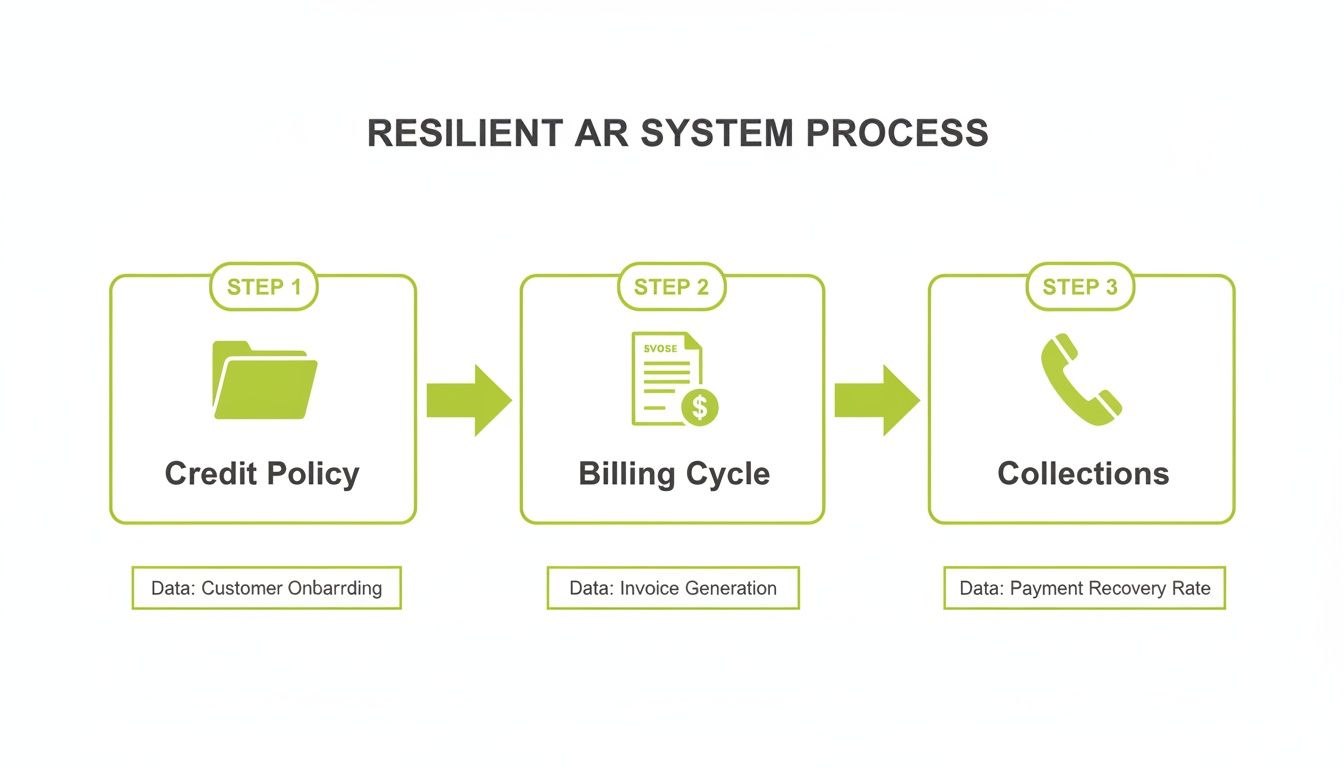
The goal isn’t just to automate tasks. It’s to orchestrate the entire AR lifecycle. Basic automation sends robotic reminders. Intelligent orchestration uses data to make smart decisions, adapting its approach for each client.
From Robotic Reminders to Intelligent Orchestration
Simple accounts receivable automation is a one-way street. It sends the same generic reminder to a new client as it does a 10-year partner, creating noise rather than results. This approach fails to solve systemic cash flow problems in business.
Intelligent orchestration is different. It uses AI to analyze payment history, communication habits, and invoice details to build a dynamic, multi-channel strategy that works.
A smart system can:
- Segment communications based on client tier, invoice value, or past payment behavior.
- Adapt outreach channels, shifting from email to SMS or flagging an account for a human call.
- Personalize messaging at scale, so the tone always feels appropriate for the relationship.
This is the leap from rigid tasks to a responsive system that lets firms reduce DSO without damaging client relationships.
The measurable outcomes of an automated AR system
An effective AI-driven platform weaves credit, billing, and collections into a unified workflow, creating a single source of truth for your cash flow.
Firms implementing intelligent AR automation see quantifiable results. On average, businesses reduce DSO by 10-25% within the first six months. They also report a 50-75% reduction in manual AR-related tasks, freeing up finance teams for higher-value analysis.
Intelligent AR orchestration isn't about replacing your team. It's about equipping them with a system that handles the 90% of routine work, freeing them to focus on the 10% of high-value exceptions requiring human judgment.
Basic tools like QuickBooks AR automation are fine for small operations but lack the sophistication to manage complex client portfolios. A true orchestration system delivers capabilities that directly improve cash flow.
- Unified Credit Risk Assessment: Dynamically assess risk based on real-time payment behavior, flagging high-risk accounts proactively.
- Omnichannel Collections: Run outreach playbooks across email, SMS, and automated calls, learning which channels are most effective for each client.
- Instant Cash Application: Automatically match incoming payments to outstanding invoices, providing a real-time, accurate cash position.
By transforming manual, error-prone tasks into an efficient, intelligent workflow, you can build a predictable cash flow engine. You can discover more about the specific accounts receivable automation benefits firms are achieving.
Your Executive Checklist for Cash Flow Control
Controlling cash flow is a continuous rhythm of diagnosis, decisive action, and system improvement, supported by the right technology.
Use this roadmap to identify gaps in your current process and move from reactive fire-fighting to building a more predictable business.
Diagnosis and Monitoring
- Track the Right Metrics: Monitor Cash Conversion Cycle (CCC), AR Turnover Ratio, and Collection Effectiveness Index (CEI) weekly.
- Segment Your AR Aging: Analyze overdue accounts by client tier, project type, and invoice size to find the source of delays.
- Set Measurable Targets: Define an acceptable DSO and aim to reduce DSO by a specific percentage, such as 10-15%, in the next two quarters.
Short-Term Liquidity Actions
- Target High-Value Delinquencies: Assign a senior resource to the top 10 overdue invoices by dollar amount for immediate cash injection.
- Implement a Follow-Up Cadence: Establish a multi-step collections process that escalates from automated reminders to direct calls.
Short-term tactics create breathing room. They stabilize your cash position, providing the capital and headspace to build a system that prevents these issues from recurring.
Long-Term Systemic Improvements
- Codify Your Credit Policy: Document and enforce your payment terms, credit-granting process, and handling of high-risk accounts.
- Systematize Your Billing: Ensure invoices are simple, accurate, and sent immediately upon work completion. Include a one-click payment link.
- Deploy the Right Technology: Evaluate how accounts receivable automation can make your processes repeatable. The right AI AR automation platform is what enables you to improve cash flow without increasing headcount.
Frequently Asked Questions
How can we improve cash flow without damaging client relationships?
The key is to shift from aggressive, one-size-fits-all demands to proactive, professional communication. An AR automation platform enables customized outreach based on the client relationship. This systematic approach strengthens relationships by ensuring clarity and predictability.
What is the first step in diagnosing a cash flow problem?
Start with data. Calculate your current Days Sales Outstanding (DSO) and Cash Conversion Cycle (CCC). Then, segment your AR aging report by client, project type, and invoice size. This data-driven diagnosis focuses your efforts where they will have the greatest impact and help improve cash flow.
Is QuickBooks AR automation enough for our firm?
While QuickBooks offers basic reminders, it often falls short for firms in the $3M–$50M range managing complex client work. It typically lacks dynamic omnichannel outreach, intelligent risk identification, and automated cash application needed for strategic cash flow management.
What is the typical ROI from AR automation software?
Firms typically see a 10-25% reduction in Days Sales Outstanding (DSO). The qualitative ROI is equally significant: hundreds of finance team hours are reclaimed from manual tasks, reducing human error and enabling a focus on high-value strategic analysis instead of administrative work.
--- Resolut automates AR for professional services—consistent, accurate, and human.