
A Finance Leader's Guide to Collecting Accounts Receivable
A practical guide for collecting accounts receivable. Implement proven automation strategies to reduce DSO, improve cash flow, and gain financial control.
Collecting accounts receivable is a core driver of your firm's cash flow and operational stability. An inconsistent collections process creates a direct drag on profitability, consumes high-value team resources, and can erode client relationships.
The issue is not just delayed cash—it is the operational cost of financial uncertainty.
The True Cost of Inefficient AR Management
For a CFO or Controller, the most visible symptom of a collections problem is high Days Sales Outstanding (DSO). But the true operational burden is far greater, manifesting in ways that don't appear on a standard balance sheet.
The cost is the diverted focus of senior team members chasing invoices instead of executing strategic initiatives. This administrative friction makes cash flow forecasting unreliable, undermining your ability to plan for new hires, investments, or expansion with any degree of confidence.
Late payments are systemic. Thirty-nine percent of B2B invoices in the United States are paid late, a trend that 81% of businesses report is worsening. Annually, enterprises lose an estimated $200B to AR administration alone. Explore more data on accounts receivable trends.

Quantifying the Hidden Expenses
Beyond top-line metrics, the secondary costs of a manual AR process create a ripple effect that constrains growth. Consider the operational drag in these areas:
- Degraded Client Relationships: Manual, inconsistent follow-ups feel abrasive. A simple payment reminder can become a point of friction, putting a long-term partnership at risk.
- Reduced Team Productivity: Your finance team’s time is a finite, high-value asset. Every hour spent manually tracking invoice statuses or sending one-off emails is an hour not spent on financial planning and analysis.
- Inaccurate Financial Forecasting: When a significant portion of revenue is tied up in aging receivables, cash position projections become unreliable. This uncertainty directly inhibits strategic decisions.
The real cost isn't just the uncollected cash; it's the operational drag and strategic paralysis that stems from an unpredictable collections process. An optimized system transforms AR from a liability into a source of control and clarity.
The objective is to reframe how you approach collecting accounts receivable. It’s not about pressuring clients. It is about designing a predictable, professional system that ensures the cash you've earned is in your bank account when expected.
This operational discipline is the foundation of a financially resilient firm. You can learn more about the true cost of AR inefficiency in professional services.
Building a Collections Framework for Predictable Cash Flow
Predictable cash flow is the result of a well-designed framework, not aggressive collection tactics. The process of getting paid begins at client onboarding, not when an invoice becomes delinquent. A strong framework is built on proactive policies and clear operations that prevent late payments.
For professional services firms in the $3M–$50M range, this structure is the difference between reactive scrambling and strategic control. It establishes clear rules for clients and internal teams, creating a system that operates with precision. The goal is to make timely payment the path of least resistance.
Establish Unambiguous Credit and Billing Policies
Your credit and billing policies are the foundation of your entire AR process. They must be documented, applied consistently, and communicated to every client from day one. Any ambiguity is a direct cause of future payment delays.
These policies are operational guardrails. Instead of a vague "Net 30" term, define it: payment is due 30 calendar days from the invoice date. Specify the consequences for late payments, such as a 1.5% monthly service charge, and outline when work on an active project might be paused for a delinquent account.
A well-defined policy acts as a filter. It signals that your firm operates with financial discipline, which attracts clients who share that same operational maturity.
This is not about rigidity; it is about setting clear, professional boundaries. It ensures that when your team must follow up, they are enforcing a standard everyone has already agreed to. Explore these concepts further in our guide to creating effective procedures for accounts receivable that work.
Design Invoices for Action, Not Just Information
An invoice should be a tool that prompts immediate action. Too often, they are cluttered documents that force a client's AP department to search for necessary information. That friction is a self-inflicted delay.
An effective invoice for a professional services firm must include:
- A Clear "Pay Now" Button: If you accept online payments, this should be the most prominent element.
- Itemized Services: Detail the work performed to answer questions before they are asked and build trust.
- Multiple Payment Methods: List every way a client can pay (ACH, card, check) with clear instructions. Firms that accept online payments get paid 39% faster on average.
- Prominent Due Date: Place it in large, bold text at the top. Remove any possibility of confusion.
Analyze the invoice from your client’s perspective. Can they easily find the required PO number? Is your contact information obvious? Every element should be designed to remove a potential roadblock to payment.
This foundational work—setting firm policies and designing clear invoices—is the most critical, highest-leverage activity for optimizing collections. It transforms AR from a reactive chase into the logical conclusion of a well-managed engagement.
When you engineer clarity and remove friction from the start, you create a system where most invoices are paid on time, freeing your team to focus on true exceptions.
Designing a Professional, Multichannel Outreach Cadence
A single invoice reminder is insufficient. In a world of overflowing inboxes, one email is easily ignored.
To get paid on time, you need a professional, persistent, and orchestrated outreach cadence. This is not about aggression; it is about systematic communication that guides clients toward payment. It requires sending the right message, through the right channel, at the right time.
Orchestrating Touchpoints for Maximum Impact
An effective cadence is a choreographed sequence of interactions. It begins before the due date with a proactive reminder and escalates in tone only as an invoice ages. This approach respects the client relationship while making payment expectations clear.
For professional services firms, this means blending automated emails with timely SMS notifications and, when necessary, targeted phone calls. Email provides a formal record. SMS cuts through the clutter for busy clients. A phone call adds a human touch for complex situations.
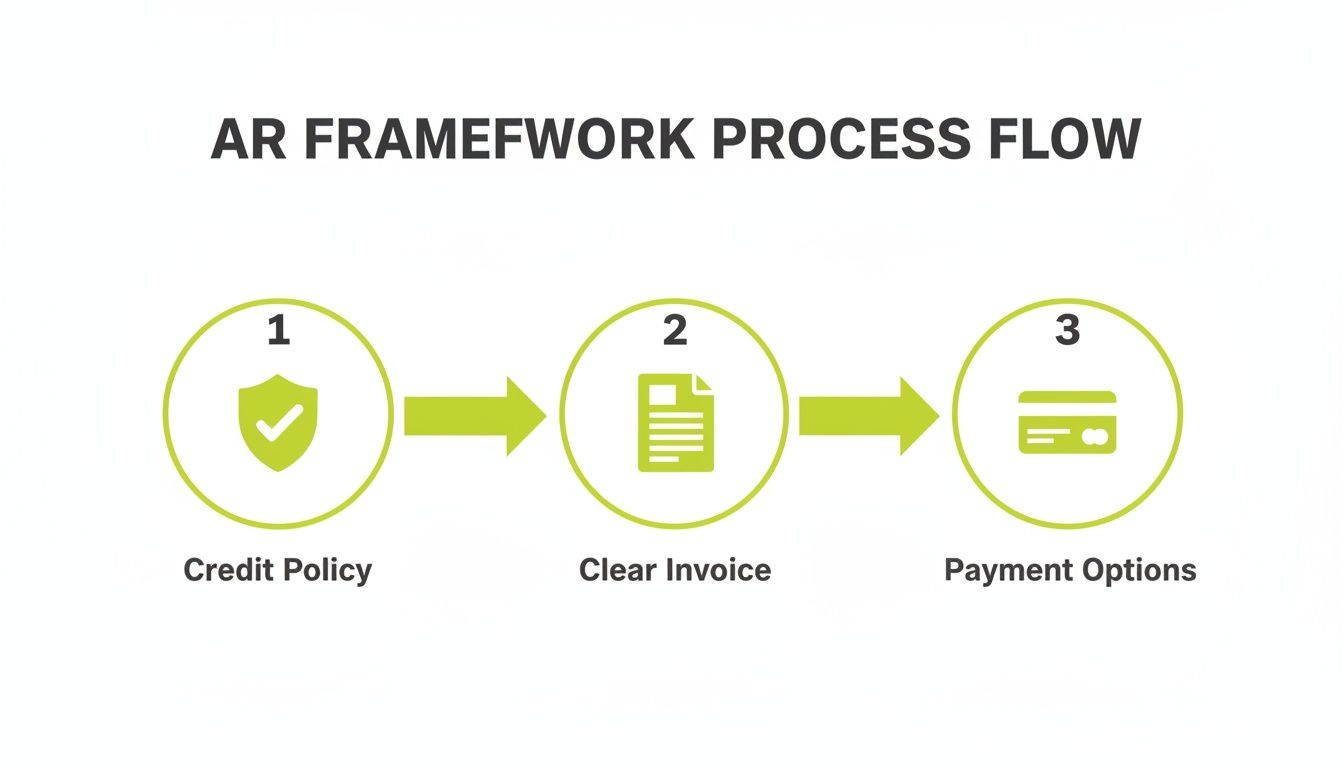
Successful outreach is built on solid credit policies, clear invoices, and simple payment options. Get these right, and you will find you need to "collect" far less often.
A Sample Cadence for Professional Services
A structured cadence provides your team with a clear playbook, standardizing your AR process and making it predictable. Below is a baseline model you can adapt for your firm.
Timing | Channel | Message Focus | Tone |
|---|---|---|---|
D-7 (Before Due) | Automated Email | Friendly reminder with a direct link to the invoice & payment portal. | Helpful, Proactive |
D+1 (1 Day Past Due) | Automated Email & SMS | First official overdue notice, confirms the due date has passed. | Professional, Direct |
D+15 (15 Days Past Due) | Email & Phone Call | Direct follow-up to confirm receipt and uncover any issues. | Concerned, Inquisitive |
D+30 (30 Days Past Due) | Email & Phone Call | Assertive communication referencing past attempts and next steps. | Firm, Serious |
This multi-channel approach ensures a single missed email does not become a severely delinquent account. Each step increases the likelihood of engagement.
A well-orchestrated cadence using accounts receivable automation feels less like chasing and more like good client service. You are providing helpful reminders and making it easy to pay.
Leveraging Automation with a Human Touch
This entire system is enhanced with AI AR automation. The right software can run this D-7 to D+30 sequence for every client without manual intervention, personalizing messages and ensuring nothing is missed. It frees your team from administrative work.
Dedicated AR software for professional services can automatically pause the cadence the moment a payment is received, preventing awkward follow-ups on a paid invoice. This is a significant improvement over basic tools like QuickBooks AR automation, which often lack intelligent orchestration.
Your team’s role shifts from chasing payments to managing exceptions. When an account hits D+15, automation can flag it for human intervention. Your controller can then make a call with full context, ready to resolve a dispute or arrange a payment plan.
This blend of automated persistence and targeted human intervention is the most effective way to reduce DSO. It lets you scale collections capacity without increasing headcount.
Make Paying Easy and Automate Reconciliation
In professional services, the payment experience matters as much as the work delivered. A clunky, confusing process creates friction, and friction leads to delays. To get paid on time, you must make the process exceptionally easy for your clients.
Firms that implement a modern client portal not only appear more professional but also see a tangible impact, cutting their Days Sales Outstanding (DSO) by an average of 5 days.
A portal that accepts ACH, credit cards, and digital wallets is now standard. Adding self-service features like invoice history and recurring payment schedules further reduces administrative workload.

What an Effective Client Portal Delivers
A good portal is a central hub for your financial relationship with a client. Key features include:
- Unified Payment Options: Allow clients to pay via ACH, card, or wallet in a single click.
- Transparent Invoice Archive: Access to a full invoice history builds trust and can reduce queries by 30%.
- Configurable Reminders: Automated reminders are proven to lower late balances by 40%.
- A Branded Experience: Your logo and colors reinforce professionalism and client trust.
- Mobile-Friendly Design: Clients who can pay from their phone contribute to a 20% lift in early payments.
The Impact of Automated Reconciliation
Manual reconciliation is tedious, error-prone, and a significant time sink. Automation excels here, freeing up a mid-sized team by as much as 50 hours per month.
A consulting firm with $25M in revenue reclaimed over 130 manual hours monthly after implementing AI-driven AR automation. That is time now spent on strategy, not spreadsheets.
"Automation gave us real-time visibility into cash positions and reduced manual work by 85%.” — Controller, $30M Professional Services Firm.
The results speak for themselves:
- 7-day reduction in DSO
- 90% drop in matching errors
- 120 hours reclaimed every month
- Real-time visibility into cash on hand
Connect Systems for a Single Source of Truth
To realize the full benefit, your AR system must integrate with your ERP or accounting software, like QuickBooks. This ensures cash application updates the general ledger automatically.
Basic automation in QuickBooks may send a reminder, but it stops there. True accounts receivable automation software designed for professional services instantly ties payments to the correct revenue accounts, providing a clear financial picture.
Aspect | Manual Process | Automated Process |
|---|---|---|
Error Rate | 15% mismatches | <2% with AI matching |
Processing Time | 3–5 days | Minutes |
Staff Hours / Month | 100 | 10 |
Cash Visibility | Weekly reports | Real-time dashboard |
When payments populate your ERP in real time, finance leaders can make decisions with confidence, knowing the daily cash position is accurate.
Keep the Human in the Loop
Even the best automation requires human oversight. Your system should flag exceptions—like a missing remittance detail—for your team to handle. This hybrid approach maintains client rapport while maximizing speed and accuracy.
It transforms the process from chasing payments to providing attentive support.
Handling Disputes and Escalations
Even with an optimized process, invoice disputes and unresponsive clients are inevitable. The key is to have a defined playbook ready before these situations arise.
Treat a dispute not as a conflict, but as a communication problem that requires a clear resolution path. When a client questions billable hours or scope, a decisive, consistent process is critical.
A Clear Workflow for Dispute Resolution
The moment a dispute is raised, log it in your AR system. This creates a single source of truth for finance, sales, and service delivery, preventing the client from having to explain their issue multiple times.
Once logged, the path should be automatic:
- Acknowledge Immediately: An automated email confirming receipt tells the client they have been heard.
- Assign an Owner: Route the issue to the person with the most context—typically the project manager or account executive.
- Set an Internal Clock: Establish a clear internal Service Level Agreement (SLA), such as a 48-hour window for the owner to connect with the client and identify a solution path.
The goal is not just to solve the problem, but to do so quickly and transparently. A slow, disorganized response can damage trust more than the original issue.
A structured approach demonstrates operational control, which reinforces client confidence in your firm.
A Measured Path for Escalations
For accounts that are unresponsive, a measured escalation path is necessary to prevent them from becoming bad debt. The objective is to increase urgency without damaging the relationship.
Your internal escalation plan needs a clear hierarchy. After standard automated reminders, the first human touch should come from the account owner. If that fails, the next step is contact from a senior finance leader, such as the Controller. Their title alone signals increased seriousness.
If internal efforts are exhausted, the final step before sending an account to collections is often a formal "demand letter." This communication, from your legal counsel or based on a legal template, outlines the debt and a final payment deadline. This step frequently produces payment when others have not.
Documenting this entire playbook is critical. It gives your team the confidence to act decisively and ensures every client receives consistent, professional treatment.
Measuring Success with the Right AR KPIs
You cannot improve what you do not measure. For most finance leaders, Days Sales Outstanding (DSO) is the primary metric. But relying on DSO alone provides an incomplete picture.
DSO is a useful but lagging indicator, easily skewed by sales volume fluctuations. It reveals the average but can mask underlying issues in collections health.
To effectively manage cash flow, you need a dashboard of key performance indicators (KPIs) that reveal the efficiency of your entire accounts receivable process.
Beyond DSO: The Core Metrics That Matter
A cluttered dashboard is counterproductive. True insight comes from a few KPIs that tell a story about how well you collect, not just how fast.
These three metrics provide a clear, actionable view of AR performance:
- Collections Effectiveness Index (CEI): The purest measure of team performance. It shows how much cash was collected compared to what was available to be collected. A top-tier firm consistently achieves a CEI of 95% or higher.
- Average Days Delinquent (ADD): This metric measures how late your overdue accounts are. A 40-day DSO might not seem alarming, but an ADD of 15 days indicates a systemic delinquency problem. The goal should be an ADD under 10 days.
- Aged Receivables Percentage: This is your risk indicator. It tracks the portion of total AR that is over 90 days past due. If this number exceeds 10%, it signals a need for immediate action.
An effective AR dashboard is not about data overload. It is about having three to four core metrics that provide an immediate, accurate signal on the health of your cash flow engine.
Building Your AR Performance Dashboard
Your AR software for professional services should make tracking these KPIs effortless. The goal is to create a clean dashboard you can review weekly to identify problems before they become crises.
This is where you shift from reporting data to driving outcomes.
A declining CEI for two consecutive months is a clear sign to evaluate team workload or outreach effectiveness. A rising ADD may indicate a bottleneck in your dispute resolution process.
This focused, data-driven approach elevates AR management from a reactive, manual task to a strategic operation. It provides the visibility needed to fine-tune policies, coach your team, and improve cash flow with precision.
Common Questions About AR Automation
CFOs and Controllers often ask the same questions when considering AR process improvements. They seek to balance tighter cash flow with strong client relationships. The two are not mutually exclusive.
Will Automation Make Us Sound Robotic and Harm Client Relationships?
This is the biggest myth about AR automation. Done correctly, AI AR automation improves client relationships.
Manual follow-ups are often inconsistent. One person may be firm, another apologetic. Reminders can be sent late. Automation replaces this unpredictable process with professional, scheduled communication. It is polite, timely, and consistent.
Good AR software also allows for client segmentation. A high-value, long-term partner can receive a much softer touch than a new client with a history of late payments. It removes human emotion from the process and preserves goodwill.
The goal is to make communication about payments a standard, professional part of business—not a confrontation. Automation enforces that consistency at scale, which clients respect.
We Already Use QuickBooks. How Is This Different?
QuickBooks AR automation is a starting point for very small firms. It can generate an invoice and send a basic email reminder.
A dedicated platform is a complete system designed to improve cash flow. It offers multi-channel outreach (email, SMS), intelligent risk scoring, a modern client payment portal, and automated cash application. It consolidates the entire collections process, providing far more control than a basic accounting add-on.
What Is the First Step to Get Started?
Before evaluating software, the most critical first step is to document your current collections process from start to finish.
Map out your playbooks for invoicing, reminders, dispute handling, and escalations. Honestly identify bottlenecks.
Automation is a powerful tool for executing a good process, but it cannot fix a broken one. If your current strategy is disorganized, automating it will only create disorganization faster. Define your ideal workflow first, then leverage technology to amplify that strategy.
--- Resolut automates AR for professional services—consistent, accurate, and human.