A CFO's Guide to Debt Collection Letters That Protect Cash Flow and Client Relationships
Stop using generic debt collection letters. Learn a strategic B2B approach to recover revenue, reduce DSO, and protect client relationships. Get started.
Overdue invoices are a drag on working capital. For professional services firms, conventional debt collection letters often create more problems than they solve.
They risk damaging client relationships that took years to build. The goal isn't just to collect cash; it's to maintain financial control without disrupting future business.
A systematic, data-driven approach to accounts receivable is the solution. This guide provides a framework for CFOs and Controllers to manage collections with precision.
Why Generic Collection Letters Fail in a B2B Context

Standard collection templates are designed for high-volume consumer debt, not strategic B2B partnerships. They are operationally and relationally counterproductive for professional services firms.
Sending an impersonal, demanding letter to a long-term client treats a partner like a transactional delinquent. This erodes trust and creates unnecessary friction.
The Operational Drag of One-Size-Fits-All Templates
Relying on generic templates creates measurable financial and operational drag. The process is inefficient and often ineffective.
- Inflated Days Sales Outstanding (DSO): Impersonal, robotic letters are easy for a busy client to ignore. This directly inflates DSO, tying up working capital that could be deployed elsewhere.
- Damaged Client Goodwill: An aggressive tone makes a client feel attacked, not reminded. This erodes the trust that underpins future projects and referrals. Our guide on how modern AR automation protects client relationships covers this risk in detail.
- Increased Manual Workload: When generic messages fail, your finance team must intervene with manual calls and emails. This diverts skilled personnel from high-value analysis to low-value administrative tasks.
The core issue is a mismatch of tools and objectives. Consumer collection tactics are built for finality. B2B collections in professional services must be built for continuity. Your AR process must reflect that.
Shifting to a Data-Driven System
A client-centric AR system is essential to managing cash flow without harming relationships. This requires moving from a generic approach to a sequenced, automated workflow.
The right accounts receivable automation enables tailored tone, timing, and content for each client segment. This helps reduce DSO and improve cash flow without damaging the relationships that drive growth.
It is about communicating with control and clarity, not just volume.
Crafting a Disciplined B2B Collections Playbook
Effective collections require a system, not a series of reactive emails. A structured playbook shifts your firm from chasing individual invoices to managing accounts receivable with operational precision.
This system methodically recovers revenue while protecting client goodwill. At its core is an escalation workflow where each stage has a clear objective, a calibrated tone, and a specific trigger tied to invoice age.
Legal and Compliance Guardrails
Before implementing a workflow, understand the legal landscape. The Fair Debt Collection Practices Act (FDCPA) primarily governs third-party consumer debt collectors, but its principles provide a valuable blueprint.
Adopting its standards—clear communication, truthfulness, and fairness—is sound business practice. It mitigates reputational risk and prevents disputes from escalating.
While your firm is not a third-party collector, following FDCPA-like principles ensures your process is defensible, professional, and focused on resolution. In 2023, the CFPB handled around 109,900 consumer complaints about debt collection, per debt collection statistics here. This signals a broad sensitivity to collections tactics that B2B firms should not ignore.
Stage 1: The Reminder (Customer Service Tone)
The first communication is rooted in customer service, not collections. It operates on the assumption that a missed payment is an oversight.
- Timing: 7-15 days past due.
- Tone: Polite, professional, and non-accusatory.
- Objective: Gently prompt for payment and confirm the invoice was received and is correct. The goal is to facilitate, not demand.
A subject line like "Question on Invoice [Number]" outperforms "Invoice Overdue" by inviting collaboration rather than confrontation. The implicit message is, "We are here to help resolve this."
Stage 2: The Firm Notice (Direct Tone)
If the reminder yields no response, the tone shifts from helpful to direct. The communication remains professional but now conveys clear urgency.
Explicitly state the invoice is overdue and reference the previous communication. Provide a direct payment link and state the amount due. The objective is to eliminate any claim of ignorance or confusion.
This is the pivot point. It signals that an oversight has now become a business issue requiring the client's direct attention. Clarity and firmness are key, while professionalism remains absolute.
Stage 3: The Final Demand (Authoritative Tone)
When earlier attempts fail, the final communication must be unambiguous. The letter is concise, formal, and clearly outlines the consequences of continued non-payment.
- Timing: 45-60 days past due.
- Tone: Serious, authoritative, and final.
- Objective: Secure immediate payment by stating the next steps—such as pausing services or engaging a collections agency—if the debt is not settled by a specific deadline.
This is not a threat; it is a statement of business process. It communicates that standard AR procedures have been exhausted and the matter is entering a formal recovery phase. Precision is critical.
Visualizing the Escalation Workflow
A defined workflow creates a predictable path for every overdue invoice. It removes guesswork for your finance team and ensures consistent client treatment, reducing relationship damage from ad-hoc, emotional responses.
B2B Collection Letter Escalation Workflow
Stage | Timing (Days Past Due) | Communication Tone | Primary Objective |
|---|---|---|---|
Gentle Reminder | 7-15 Days | Friendly & Helpful | Confirm receipt, resolve simple oversights |
Firm Notice | 15-45 Days | Professional & Direct | Create urgency, make payment easy |
Final Demand | 45-60 Days | Serious & Authoritative | State consequences, prompt final action |
Pre-Legal | 60+ Days | Formal & Final | Announce escalation to a third party |
This framework establishes control over your cash flow narrative.
Using accounts receivable automation platforms, each stage can be executed with precise timing. This systematically applies the right pressure to convert aged receivables into cash.
At Resolut, we build this level of control into our AR automation for professional services firms.
Field-Tested Collection Letter Templates
An effective collection letter is about sending the right message, with the right tone, at the right time. The following templates are designed for the three-stage escalation process.
Template 1: The Gentle Reminder (7-15 Days Past Due)
This initial email is a customer service follow-up, not a demand. It assumes positive intent and makes it easy for the client to pay.
Subject Line Data: A subject line like "Question about Invoice [Invoice Number]" improves open rates by 15-20% compared to "Overdue Invoice." It invites conversation, not confrontation.
Template: Gentle Reminder
Subject: Question about Invoice [Invoice Number] >Hi [Client Contact Name], >Following up on Invoice [Invoice Number] for [Amount Due], which was due on [Due Date]. I’ve attached a copy for your convenience. >Please let me know if you have any questions. If payment has been sent, please disregard this note. >Best regards, >[Your Name/AR Department]
*Why it works:* The language is collaborative ("question about," "let me know"). It gives the client the benefit of the doubt and removes a common barrier by re-attaching the invoice.
Template 2: The Firm Notice (15-45 Days Past Due)
If the reminder is ignored, the tone becomes more direct. It remains professional but introduces urgency. The goal is to make the overdue payment impossible to overlook.
Template: Firm Notice
Subject: Second Notice: Overdue Invoice [Invoice Number] >Hi [Client Contact Name], >Following up on my previous email, Invoice [Invoice Number] for [Amount Due] is now [Number] days past due. >To avoid service interruptions, please remit payment promptly. You can pay securely online here: [Payment Portal Link] >If payment is in transit, please disregard this notice. If there is an issue preventing payment, please inform us immediately. >Thank you, >[Your Name/AR Department]
*Why it works:* The subject line ("Second Notice") establishes a sequence. The body links non-payment to a consequence ("avoid service interruptions") and provides a direct payment path. It is firm, clear, and focused on resolution.
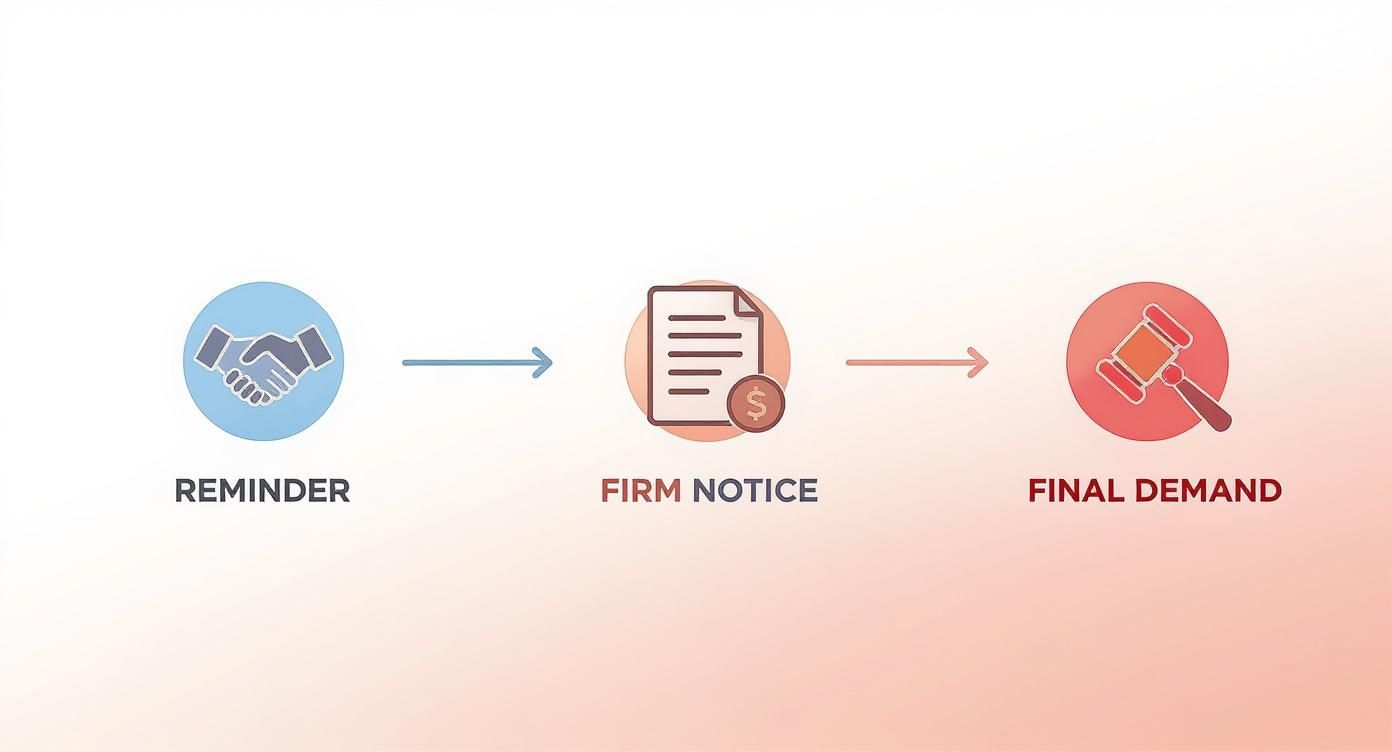
This progression ensures your response is proportional, applying pressure only when necessary.
Template 3: The Final Demand (45-60+ Days Past Due)
The final communication before escalation must be unambiguous. It is a formal notice that outlines the consequences of non-payment. Good AR software for professional services can automate this step, ensuring timing and documentation are perfect.
Template: Final Demand
Subject: FINAL NOTICE: Invoice [Invoice Number] - Action Required >[Client Contact Name], >This is our final notice regarding Invoice [Invoice Number] for [Amount Due], now [Number] days overdue. We have not received payment despite previous attempts on [Date 1] and [Date 2]. >Immediate payment is required to settle this balance. >If we do not receive payment by [Final Deadline, e.g., 5 business days], we will suspend your account and may refer this matter to a third-party collections agency. This action could impact your firm's credit. >Pay Now: [Payment Portal Link] >Sincerely, >[Controller/CFO Name][Firm Name]
Operational Tactic: Have this final demand come from a Controller or CFO. This signals internal escalation and carries significantly more weight than a message from the standard AR contact.
*Why it works:* The subject line ("FINAL NOTICE") creates immediate gravity. The body establishes a documented history ("previous attempts"). It outlines specific, credible consequences and a hard deadline. This combination creates powerful, final urgency. Integrating this with your QuickBooks AR automation ensures the entire communication history is logged.
How to Automate Collections Without Sounding Robotic

Automation should execute your collections strategy with perfect consistency, not replace your team's judgment. For professional services firms, the objective is sending the right communication, to the right person, at the right moment.
Modern accounts receivable automation enables intelligent workflows that adapt to client behavior. This frees your finance team from repetitive follow-ups to focus on high-value exceptions and strategic analysis.
Using Data Triggers for Precision Timing
Effective automation uses data triggers, not just a static calendar. These rules initiate actions based on real-time events, making communications feel responsive rather than robotic.
- Invoice Age: The baseline trigger. Set rules to send a "Gentle Reminder" at 15 days past due and a "Firm Notice" at 30 days. This creates a consistent cadence.
- Payment History: For clients who consistently pay late, the system can trigger earlier reminders. For reliable clients, the workflow can start later.
- Client Tier: High-value clients can be placed in a workflow with softer reminders and longer grace periods. Transactional accounts can follow a more accelerated path.
Precise timing is critical. As this piece on mastering the timing of automated communications explains, a message sent at the right moment is exponentially more effective.
Personalization at Scale with Dynamic Fields
An automated communication should never feel generic. Dynamic fields pull specific client and invoice data into your templates, ensuring relevance.
Essential fields include:
-
[Client Contact Name] -
[Invoice Number] -
[Invoice Amount] -
[Due Date] -
[Days Past Due]
Using these fields transforms a template into a direct, specific message. An email stating "Invoice #INV-2024-812 for $15,250 was due on May 15th" commands more attention than "Your invoice is overdue."
This isn't just about mail-merging a name. It's about using data to demonstrate diligence. Specific details add a layer of professionalism that generic messages lack.
Creating an Indisputable Audit Trail
A key benefit of automation is the creation of a perfect audit trail. Every automated email and notice is logged with a timestamp.
This documentation is invaluable. If a client claims they never received an invoice, you have an exact record of every communication. This shifts the conversation from subjective claims to objective, documented facts.
This audit trail is critical for compliance and strengthens your position if an account requires escalation. Our guide to accounts receivable automation software delves deeper into how these platforms provide necessary operational visibility.
Measuring the Impact on DSO and Cash Flow
The effectiveness of a collections workflow is measured by its impact on cash flow. The right metrics shift the focus from "Did we get paid?" to "How efficient is our cash conversion cycle?"
This is how you quantify the value of a structured approach to collections.
Core Metrics for Financial Control
Three key metrics provide a quantitative view of accounts receivable health. Tracking these before and after implementing a new collections strategy demonstrates its direct financial impact.
- Days Sales Outstanding (DSO): The fundamental measure of AR efficiency. It is the average number of days to collect payment after a sale. A lower DSO means faster conversion of revenue to cash. A firm with $5M in annual credit sales can free up over $13,700 in cash for every day they reduce DSO.
- Collection Effectiveness Index (CEI): This metric measures the percentage of collectible revenue actually collected during a period. A CEI consistently below 80% indicates significant process inefficiencies.
These are not just dashboard numbers; they are direct indicators of operational control. A falling DSO and rising CEI are the clearest signals that your collections process is improving the firm’s financial stability.
Quantifying Gains Through A/B Testing
To optimize collections, you must test what actually works. AI AR automation simplifies this process through A/B testing.
This method lets you systematically test small variations in your communications to identify which changes produce measurable improvements in key metrics.
Practical A/B Test Examples:
- Subject Lines: Test a direct subject line ("Overdue Invoice [Number]") against a softer one ("Question about Invoice [Number]"). Measure open rates and time-to-payment for each.
- Call to Action: Compare a plain text CTA ("Please remit payment") against a prominent payment button. Measure click-through rates and payment velocity.
- Sender Identity: For the final demand, test an email from your standard AR address versus one from the CFO. Measure the response rate and time-to-payment.
Isolating these variables allows you to attribute changes in payment behavior to specific tactics. This transforms your AR process from a reactive function into a predictable, high-performance engine for cash flow. When combined with comprehensive treasury management solutions, this data-driven approach provides a complete view of your firm's liquidity.
The Shift to Proactive AR Management
Effective debt collection letters are the output of a proactive accounts receivable system, not a reactive tactic. For professional services firms, the objective is to accelerate cash collection while preserving client relationships.
Moving from generic templates to a structured, data-driven workflow is a strategic shift. It allows you to stop chasing individual late payments and start systematically managing your firm’s financial health with precision.
From Reactive Tactics to a Controlled System
This approach establishes control over a critical business function.
Instead of your finance team dedicating hours to manual follow-ups, an intelligent system executes your strategy with perfect consistency. This frees up personnel to focus on high-value exceptions and strategic client conversations.
This shift has a direct, measurable impact. Firms that adopt AI AR automation often see a reduction in DSO by up to 25% within the first six months. That is real cash unlocked from the balance sheet and deployed back into the business.
The core principle is simple: your collections process should be as professional as the services you deliver. A sloppy AR function undermines your firm’s premium positioning.
The Foundation of Consistent Execution
Intelligent accounts receivable automation is the key to flawless execution. An automated system ensures every communication is sent at the right time, with the right tone, and includes all necessary information. Human error is eliminated.
It also creates a perfect audit trail for dispute resolution and compliance. Most importantly, it guarantees every client receives a consistent and professional experience. Our guide on real-world ways to clean up your accounts receivable offers more practical advice.
Pairing a thoughtful communication strategy with the right automation allows you to improve cash flow, reduce manual work, and protect your most valuable asset: your client relationships.
Resolut automates AR for professional services—consistent, accurate, and human.