
How to Ask for Payment: A Finance Operator's Guide for Professional Services Firms
Learn how to ask for payment politely with proven scripts and strategies for professional services firms. Improve cash flow and reduce DSO.
Getting paid is not about finding the right words. It’s about building the right process.
A polite request is the final step in a system that begins with clear terms, moves through a predictable follow-up cadence, and uses technology for consistency.
This is how you protect client relationships and your cash flow.
Why a System Matters More Than an Email
For any professional services firm, cash flow is the operational lifeblood. Delayed payments increase your Days Sales Outstanding (DSO) and strain working capital.
This guide is not about collection tactics. It’s about creating a framework for financial control that is professional from start to finish.

We will reframe payment collection. It's not a confrontation; it's the professional conclusion to the value you delivered.
The Real Cost of Inconsistent Collections
When follow-up is manual—relying on someone’s memory or available time—invoices fall through the cracks. This extends payment cycles directly to the balance sheet.
A polite, firm, and systematic process protects both your revenue and client relationships. The goal is to build a system that brings predictability to your accounts receivable.
This lack of a system introduces chaos where there should be discipline, making it difficult to reliably ways to increase cash flow.
Navigating a Complex Payment Environment
The global payments industry generated $2.5 trillion in revenue, and with projected growth slowing, competition for timely payment is increasing.
A disciplined process, supported by accounts receivable automation, ensures every client receives the same professional treatment.
This operationalizes your firm’s standards, whether you’re using basic QuickBooks AR functions or more advanced AI AR automation.
The objective is simple: create a predictable financial outcome for every engagement.
Build a Framework for On-Time Payments
Effective collections do not start when an invoice is 30 days past due. They start before the work is scoped.
A proper foundation makes asking for payment a simple, procedural step. The key is establishing a predictable payment cycle from the beginning.
This foundation is built into your contractual documents—the Master Service Agreement (MSA) and individual Statements of Work (SOWs).
Codify Expectations in Agreements
Vague payment terms are the single largest source of collection friction. To prevent this, your MSAs and SOWs need explicit clauses with zero room for interpretation.
This is a non-negotiable step to reduce DSO and take control of your cash flow.
Your agreements should specify:
- Payment Due Dates: Be precise. "Net 15" or "Net 30"? State whether the clock starts from the invoice date or receipt date.
- Accepted Payment Methods: List every option—ACH, wire, corporate card. More options mean fewer excuses.
- Late Payment Protocols: Clearly state the consequence of a late payment. A typical late fee is 1.5% per month on the outstanding balance.
- Point of Contact: Identify the specific person or department alias (e.g., accounts.payable@clientcompany.com) from day one.
This level of detail changes the dynamic. A future payment request becomes a simple reminder of a pre-agreed obligation. Our guide on procedures for accounts receivable that work provides a deeper analysis.
Embedding unambiguous payment terms into your MSA is the single most effective action a firm can take to reduce payment cycle times. It creates a shared understanding of financial responsibilities before work is delivered.
Operationalize Terms During Client Onboarding
A signed contract must be operationalized. Client onboarding is the time to do it.
This is a finance-led conversation, not a task for the sales team.
During onboarding, your finance lead should walk the client's financial contact through the payment-related clauses. This confirms their understanding and uncovers process roadblocks early.
The Role of AR Software for Professional Services
Manual processes break down as a firm grows. This is where AR software for professional services becomes essential.
Platforms offering QuickBooks AR automation or more advanced AI AR automation execute your framework with consistency.
An automation platform can:
- Flag new clients who have not completed their financial onboarding checklist.
- Automatically route invoices to the correct, pre-verified contact.
- Schedule and send polite reminders based on the agreed-upon net terms.
This technology ensures the system you designed is executed, removing human error and administrative drag from the equation to improve cash flow.
Execute a Polite Follow-Up Cadence (with Scripts)
With clear payment terms established, the real work is disciplined follow-up. A smart, multi-channel communication plan removes emotion and guesswork from collections.
This can be managed by your team or through accounts receivable automation. The goal is a predictable sequence of professional touchpoints.
This is not about a single "ask." It is the result of a system—contract, terms, and onboarding—that sets the stage for payment as a natural next step.
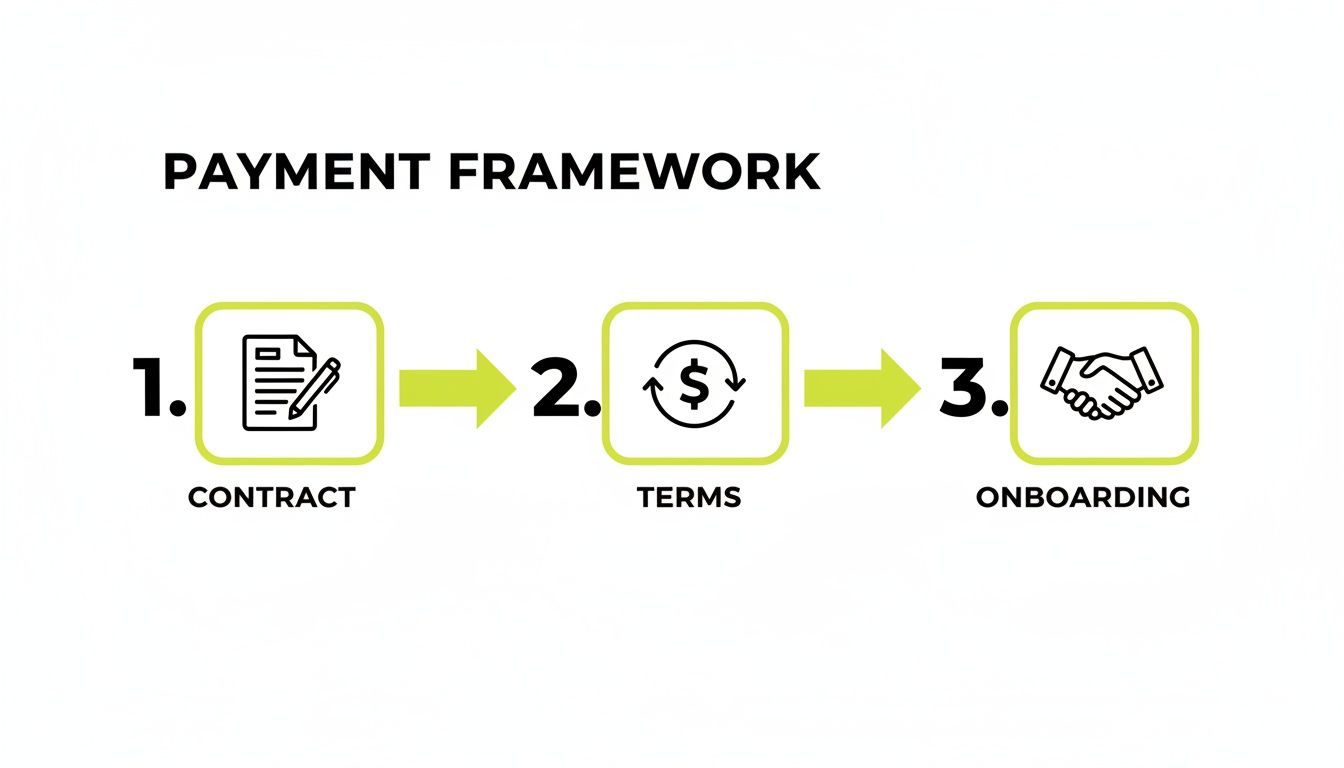
Here is how to structure the follow-up cadence.
The Gentle Nudge: 7 Days Before Due Date
The best time to ask for payment is before it is due. A reminder sent seven days before the due date is a professional courtesy, not a demand.
This helps your client stay organized and uncovers potential problems early, such as a missing PO number or a question about a line item.
Subject: Invoice [Invoice Number] due on [Due Date] >Hi [Client Contact Name], >A quick reminder that invoice [Invoice Number] for [Amount] is due next week on [Due Date]. >A copy is attached. Please let us know if you need anything to process this payment.
This task is ideal for AR software for professional services. It ensures no invoice is missed and frees your team from manual administrative work.
The Due Date Reminder
On the due date, a second professional touchpoint is appropriate. The tone assumes the client is busy and simply needs a prompt.
Firms that skip this step often see payment times drift by an extra 5-8 days.
- Channel: Email or Client Portal Notification
- Objective: Remind that payment is due today and make it easy to pay.
- Script: "Hi [Client Contact Name], a note that invoice [Invoice Number] is due today. You can pay online here: [Link to Payment Portal]."
The message is purely informational and provides a clear path to action.
The First Follow-Up: 7 Days Past Due
If the invoice remains unpaid after one week, the tone shifts slightly. It remains professional but becomes more direct. The goal is to get a direct response on payment status.
A phone call is often more effective than another email at this stage, but an email should follow to maintain a written record.
Phone Script (7 Days Past Due): "Hi [Client Contact Name], this is [Your Name] from [Your Firm Name]. I’m calling about invoice [Invoice Number], which was due last week. I want to confirm you received it and ask for an ETA on payment."
Email Script (7 Days Past Due): "Subject: Overdue Invoice [Invoice Number] Hi [Client Contact Name], I am following up on invoice [Invoice Number], which is now one week overdue. Please provide a status update. A copy is attached for your reference."
The Multi-Channel Payment Request Cadence
A documented communication plan ensures consistency. This table illustrates a blended approach as an invoice ages.
<br>
Timing | Channel | Objective | Key Language Snippet |
|---|---|---|---|
7 Days Before Due | Proactive, helpful reminder | "A quick reminder that invoice...is due next week." | |
Due Date | Email / Portal | Inform and make payment easy | "A note that invoice...is due for payment today." |
7 Days Past Due | Phone Call + Email | Get a direct response | "Calling about invoice...which was due last week. What is the status?" |
15 Days Past Due | Increase urgency, reference terms | "This invoice is now 15 days past due. As per our terms..." | |
30 Days Past Due | Email from Senior Contact | Escalate and state consequences | "Our records show your account is 30 days overdue..." |
45+ Days Past Due | Formal Letter / Call | Final demand before escalation | "Final notice before this matter is escalated for collections." |
<br>
This structured approach removes emotional labor from collections.
Escalating at 15 and 30 Days Past Due
As an invoice ages, communication must reflect the increased urgency while remaining professional.
- 15 Days Past Due: The message should be firm and reference the payment terms in your agreement. Mention any applicable late fees. Platforms offering QuickBooks AR automation can be configured to add these fees automatically.
- 30 Days Past Due: Communication should now come from a senior contact, such as a Controller. The message should state that the account is significantly behind and that resolution is required to avoid service interruptions, per your contract.
A structured cadence turns accounts receivable from a reactive headache into a predictable system. Tools like AI AR automation ensure these steps are followed every time, providing the polite persistence needed to improve cash flow.
Leverage Automation for Consistent Collections
Manual follow-up is inherently inconsistent. It depends on an individual's available time, memory, and even their comfort level with the task.
A systematic collections cadence only works if it is executed flawlessly, every time. This is a task for technology, not people.
Accounts receivable automation becomes a core operational component. It brings machine-like consistency to the collections process.

From Manual Drag to Automated Discipline
Manual AR is an operational liability. A controller or AR specialist can spend hours moving between spreadsheets, email, and the phone. Each step is a point of potential failure.
AI AR automation platforms eliminate this vulnerability. They execute the polite, persistent cadence without distraction, error, or hesitation.
Technology enforces the polite, persistent process that human teams struggle to maintain at scale. It removes inconsistency and emotion, ensuring every client interaction aligns with the firm’s financial policies.
This does not replace your team; it arms them. Automating repetitive tasks allows finance professionals to focus on analyzing payment trends and managing exceptions.
A Professional Services Firm Example
Consider a $10M management consulting firm with Net 30 terms. Their DSO was 58 days. The process was manual, and follow-ups were inconsistent, especially for invoices under $10,000.
By implementing AR software, they automated the entire follow-up cadence: a pre-due date reminder, a due-date notification, and tiered escalations for past-due invoices.
Within six months, their DSO dropped from 58 to 43 days. This 15-day reduction unlocked over $410,000 in working capital.
The controller’s time spent chasing payments fell by 80%, creating bandwidth for higher-value financial analysis.
Meeting Modern Client Expectations
Automation also addresses evolving client expectations. Globally, 75% of adults now use digital payments. Clients expect seamless, digital-first interactions.
Effective AR software for professional services provides a branded, self-service portal where clients can view invoices, pay instantly, and ask questions. This improves their experience and accelerates your payments. Adding tools like automated text message reminders can further enhance convenience.
Beyond QuickBooks AR Automation
While native QuickBooks AR automation can send basic reminders, dedicated AR platforms offer superior control and intelligence.
They allow for custom workflows based on client risk, invoice value, or specific contract terms. They provide a single dashboard to track KPIs like DSO in real time.
This is the control required to shift from reactive collections to proactive cash flow management.
Manage Escalations Without Damaging Relationships
Even with a robust process, some invoices will require senior-level intervention. This is a predictable part of accounts receivable.
The goal is twofold: get paid and, if possible, preserve the client relationship. A clear escalation framework removes guesswork.
Defining Internal Escalation Triggers
An escalation plan removes emotion from high-stakes financial conversations. It maps out when an account moves from the standard AR process to senior management.
- Trigger 1 (60 Days Past Due): The Controller reviews the account history. If the client is responsive, the Controller can authorize a payment plan. If they are unresponsive, this outreach is the final warning before CFO involvement.
- Trigger 2 (75 Days Past Due): The CFO is notified for visibility, ensuring leadership is not surprised by a major collections issue.
- Trigger 3 (90 Days Past Due): The CFO or a Partner contacts their counterpart at the client's business. The conversation shifts from "When will you pay?" to "How do we resolve this?"
Modern AR automation can manage these internal alerts, ensuring triggers are never missed.
Scripts for Senior-Level Conversations
When a CFO or partner gets involved, the tone must be direct, non-accusatory, and solution-focused.
Here is an approach for a CFO contacting a non-responsive client’s finance lead:
Subject: Urgent Matter: Account [Client Name] / [Your Firm Name] >Hi [Client Finance Lead], >I am writing regarding several outstanding invoices totaling [Total Amount], which are now over 90 days past due. Our team has attempted to connect several times without success. >We must find a path to resolution to avoid a hold on services and further escalation. Are you available for a 15-minute call this week to discuss a plan?
The message is firm and professional. It states the facts, consequences, and a collaborative next step.
When the Goal Shifts to Collection
There is a point where the objective must shift from relationship management to debt collection. This line is typically crossed after direct, senior-level outreach receives no response or a broken promise.
A finance leader’s critical job is to distinguish between accommodating a valuable client and enabling a non-paying one. A clear escalation policy draws that line, protecting the firm’s financial health.
Once this line is crossed, the priority is recovering the funds. This is when you issue a final demand letter, suspend work, or engage a third-party collections agency, as allowed by your MSA. Understanding how modern AR automation protects client relationships can offer perspective on balancing these priorities.
Measure What Matters: Is Your AR Process Working?
You cannot improve what you do not measure. A systematic approach to collections is only effective if its impact is visible.
Tracking key metrics turns AR from a reactive chore into a strategic tool for managing and improving cash flow.
Go Beyond DSO: Two Critical AR Metrics
Days Sales Outstanding (DSO) is a blunt instrument. To get a complete picture, track these two additional metrics.
- Average Days Delinquent (ADD): ADD measures the average number of days your invoices are past due. Unlike DSO, it isolates the performance of late payments. For professional services, an ADD under 15 days is a strong benchmark.
- Collection Effectiveness Index (CEI): CEI calculates the percentage of receivables collected during a specific period. A score near 100% indicates an effective process. Tracking it monthly demonstrates if new strategies are working.
These metrics are diagnostic tools. Is your ADD increasing? It may signal that your escalation triggers are too slow or your follow-up cadence lacks firmness.
A collections process without measurement is guesswork. By tracking DSO, ADD, and CEI, you create a feedback loop where operational data informs financial strategy, turning your AR process into a predictable engine for cash flow.
Using Data to Refine Strategy
With this data, you can connect actions to outcomes. AR software for professional services provides real-time dashboards that eliminate manual spreadsheet work.
For example, if your CEI drops for invoices over $25,000, it signals that larger engagements require a more hands-on approach. If a new client segment consistently increases your ADD, it's time to reassess their payment terms.
Data from your QuickBooks AR automation or AI AR automation platform provides the insights to refine your strategy. You can test different communication tactics and see the direct impact on payment cycles.
The challenge of asking for payment politely becomes a solved, measurable system.
Common Questions from Finance Leaders
When implementing a formal collections process, several key questions arise.
At What Point Is It No Longer "Polite"?
Politeness should remain, but the tone must evolve from a request to a statement of fact.
At 60-90 days past due with no response, the conversation is no longer a reminder. The message shifts to a professional declaration of next steps, such as a service hold or engaging a third party, as outlined in your agreement.
How Do You Handle “The Check Is in the Mail”?
Acknowledge the statement, then request details. "Thank you for the update. Do you have the check number and mail date for our records?" This verifies the information and holds the client accountable.
Then, offer a faster alternative. "While we wait for that to arrive, I can also send a direct link for an ACH payment to clear this today, if that’s easier." This can turn a week of waiting into immediate payment.
Should a Small Firm Invest in AR Software?
Yes. Automation is about process efficiency, not firm size. Manual AR management is a significant operational risk for a smaller business.
AR software for professional services, including systems with QuickBooks AR automation, creates consistency that a single person cannot. It ensures timely follow-up, standardizes communication, and frees up leadership for growth-focused work. The ROI from helping to reduce DSO is typically fast and measurable.
The Goal: From Chasing to Control
Politely asking for payment is not about finding the perfect words. It is about building a system so reliable that the "ask" becomes a procedural formality.
When you establish clear upfront agreements, create a predictable communication cadence, and leverage accounts receivable automation, the entire dynamic shifts.
You move from a reactive collections scramble to proactive financial control. This is not just about getting paid faster; it's about protecting cash flow, reducing write-offs, and preserving client relationships.
You transform a manual, error-prone task into a strategic financial function. With technology like AI AR automation, you gain the consistency and data required for continuous improvement.
Resolut automates AR for professional services—consistent, accurate, and human.