How to Calculate Net Credit Sales for Financial Clarity
Learn how to calculate net credit sales with precision. A guide for CFOs on using this key metric to improve cash flow and reduce DSO with AR automation.
To gain control over your firm’s revenue, you must look past the top-line invoice figure. The calculation is direct: subtract returns, allowances, and discounts from your gross credit sales.
The formula is: Net Credit Sales = Gross Credit Sales – (Sales Returns + Sales Allowances + Sales Discounts).
This equation provides a precise, operator-focused measure of the cash your firm will collect from services delivered on credit. It is the foundation for reliable cash flow forecasting.
Why Net Credit Sales Matter More Than Gross Sales
Gross sales are a vanity metric. A high gross sales figure appears strong on a P&L statement, but it fails to account for operational realities.
It ignores billing adjustments, client concessions, or early-payment incentives. It represents what was billed, not what will be collected.
For financial operators at professional services firms, focusing on net credit sales is about control. This figure provides a true measure of revenue integrity and informs working capital strategy.
Deconstructing the Formula
Each component of the net credit sales formula reveals something about your firm's operational and client dynamics. Precision here is critical to measuring collectible revenue.
Here is a breakdown of the components in a services context.
Components of the Net Credit Sales Formula
Component | Definition | Example in Professional Services |
|---|---|---|
Gross Credit Sales | The total value of all invoices issued for services delivered on credit during a specific period. This is the starting point. | A marketing agency bills $50,000 in a month for retainer fees and project work. |
Sales Returns & Allowances | In services, this is almost always an allowance—a credit memo issued to adjust a bill for a scope change, client concession, or billing error. | The agency issues a $2,500 credit memo because a project deliverable was delayed, adjusting the original invoice. |
Sales Discounts | Incentives offered for prompt payment. A common example is "2/10, n/30," offering a 2% discount for payment within 10 days. | A client with a $10,000 invoice pays within the 10-day window, taking a $200 discount. |
Breaking down the formula this way clarifies where revenue is adjusted post-invoice.
Let's apply this. A consulting firm invoices $250,000 in gross credit sales. During that period, it issues $10,000 in credit memos for scope adjustments and clients take $3,000 in early-payment discounts.
Its net credit sales are: $250,000 - ($10,000 + $3,000) = $237,000.
That $237,000 is the operational reality. It's the revenue you can build forecasts on. If you're looking for more detail, you can discover more details on these calculations and their impact on your business's financial health.
Understanding net credit sales allows you to make strategic decisions based on reality, not on vanity metrics. It forms the bedrock for accurate cash flow forecasting and is the essential input for calculating your Days Sales Outstanding (DSO).
A disciplined approach to calculating net credit sales is fundamental. It ensures that key metrics, especially those managed with accounts receivable automation, are built on clean, reliable data. This clarity is the first step to effectively reduce DSO and improve cash flow.
Getting to Your Real Revenue: How to Calculate Net Credit Sales
Let's move from theory to practice. Calculating net credit sales is about isolating the true revenue earned from work delivered on credit. This requires meticulously stripping away cash sales and post-invoice adjustments.
This requires a solid grasp of basic accounting principles, like the difference between cash basis and accrual basis accounting. Without this foundation, your financial analysis is built on unstable ground.
Isolating Credit Sales and Making Adjustments
Your general ledger, particularly in software like QuickBooks, often combines cash and credit sales. The first step is to filter sales data for a specific period and isolate invoices issued with payment terms. This total is your Gross Credit Sales.
Next, track and sum all related deductions from the same period. In professional services, these typically appear as:
- Sales Allowances: Credit memos issued for billing corrections, scope reductions, or service concessions.
- Sales Discounts: The total value of early-payment discounts clients have taken, such as a 2% discount on a net-30 invoice.
This infographic breaks down the flow from the initial gross number to the final, actionable net credit sales figure.
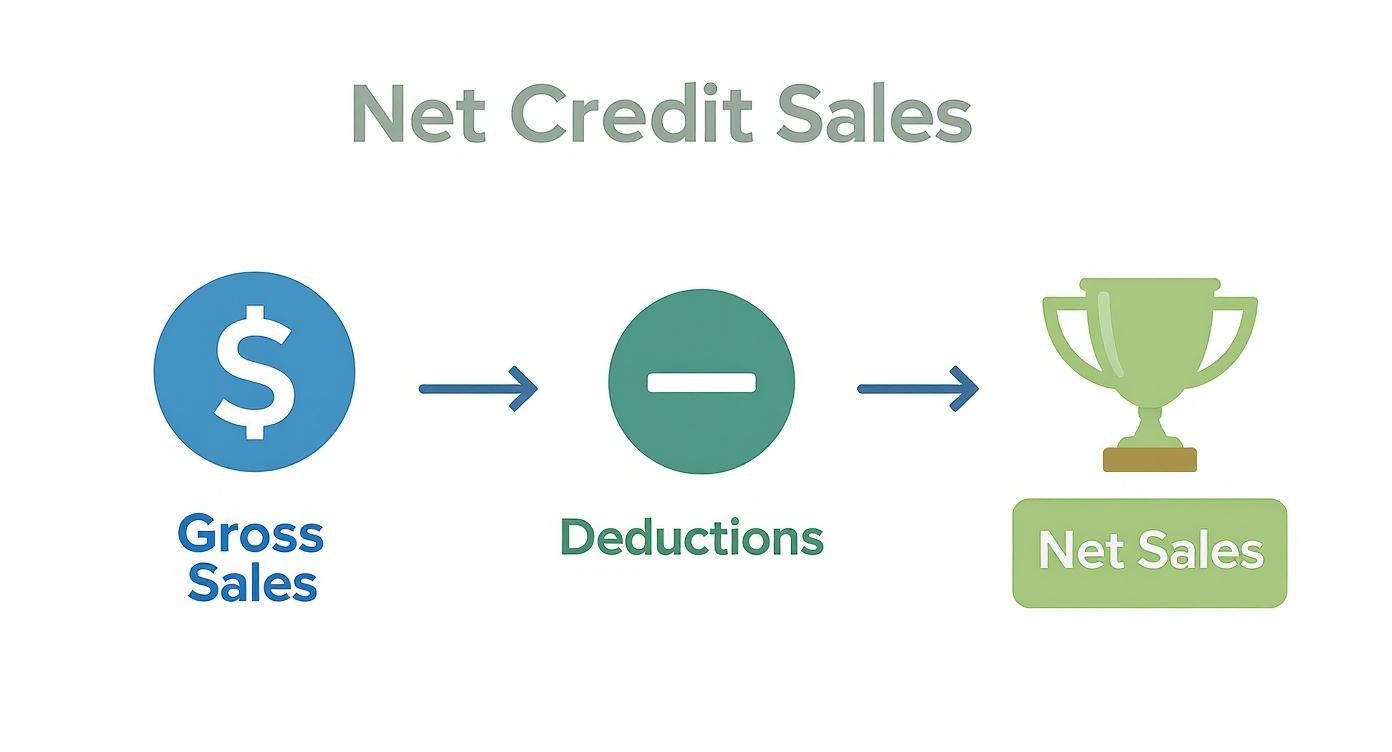
As you can see, arriving at net sales is a deliberate process of refinement, not a simple report pull.
A Worked Example for a Consulting Firm
Let's make this concrete. An engineering consultancy is reviewing its Q3 numbers:
- Gross Invoiced Billings (Credit): $850,000
- Credit Memos Issued (Allowances): $35,000 (for a major scope change on a key client project)
- Early-Payment Discounts Taken: $8,200
The calculation is: $850,000 - ($35,000 + $8,200) = $806,800.
That $806,800 is the firm’s actual net credit sales for the quarter. It is the only number that should be used for calculating metrics like Days Sales Outstanding (DSO) because it reflects what is truly collectible. This calculation is a vital part of the financial workflow, which is why understanding the order-to-cash process is a guide for financial operators provides critical context.
If a firm bills $10,000 in credit sales but processes $600 in returns and grants $100 in allowances, its net credit sales drop to $9,300. That adjusted figure is the only reliable number for measuring cash conversion efficiency.
Clean records are non-negotiable. A standard journal entry for a sales allowance involves a debit to Sales Allowances and a credit to Accounts Receivable. This immediately reduces the client's balance and maintains accuracy. This is where AR software for professional services, including QuickBooks AR automation, can manage these entries systemically.
Using Net Credit Sales to Sharpen Key Financial Ratios
An accurate net credit sales figure is not just another line item. It is the bedrock for measuring your firm's financial health. An incorrect figure renders KPIs like Days Sales Outstanding (DSO) useless, providing a distorted view of cash flow.
When you use net credit sales instead of gross sales, you get a clear signal of operational performance. You measure the time it takes to collect revenue you will actually keep, not an inflated number that includes discounts and adjustments.
Calculating Your Accounts Receivable Turnover Ratio
The Accounts Receivable Turnover Ratio directly measures collection efficiency. It answers a simple question: How many times per period does your firm collect its average AR balance? A higher number indicates better performance.
The formula: AR Turnover Ratio = Net Credit Sales / Average Accounts Receivable
Using the engineering consultancy example, they had $806,800 in net credit sales for Q3. Assume their average accounts receivable for that quarter was $225,000.
Their AR Turnover Ratio is $806,800 / $225,000 = 3.59. This means the firm collected its entire AR balance 3.6 times during the quarter.
From Turnover to Days Sales Outstanding (DSO)
DSO translates the turnover ratio into time. It reveals the average number of days it takes to collect payment after a sale. For a services firm, this is a critical liquidity metric.
The formula: DSO = (Average Accounts Receivable / Net Credit Sales) x Number of Days in Period
Using the same firm’s data for the 91 days in Q3: DSO = ($225,000 / $806,800) x 91 = 25.4 days
The firm’s average collection cycle is just over 25 days. Tracking this provides leadership with a direct measure of collection effectiveness. A reduction of just five days in a 45-day DSO, on $10 million in annual credit sales, frees up over $137,000 in working capital.
This is why precision is non-negotiable. Firms with inconsistent tracking of net credit sales can see bad debt write-offs increase by up to 15%. You can find more insights on financial statement reliability at AccountingTools.
This discipline is vital in B2B environments where credit sales are standard. The clarity these ratios provide enables confident cash flow management. This is where accounts receivable automation becomes an operational tool that delivers the clean data needed for real-time metrics.
Common Mistakes That Skew Your Net Credit Sales Data
Precision in financial reporting is non-negotiable. An incorrect net credit sales calculation distorts the metrics your firm relies on, masking collection issues and leading to flawed strategic decisions.
The integrity of your financial analysis rests on the quality of your input data.
Even small errors compound, skewing DSO and AR turnover ratios over time. A seemingly minor error, like failing to exclude cash sales, can create a false sense of security around your cash conversion cycle.
Conflating Cash and Credit Sales
This is the most common error: failing to isolate credit sales from total revenue. Many accounting systems, including QuickBooks, do not automatically separate these transaction types.
Including cash sales in the calculation artificially inflates the numerator in the DSO formula, making the collection period appear shorter than reality.
Mixing in just 10% cash sales can make a 45-day DSO appear to be 41 days. This can mask an underlying collections problem. The solution is process discipline: always filter your general ledger for credit sales only before calculating financial ratios.
Mishandling Service-Related Adjustments
Professional services firms issue credit memos for scope adjustments, project delays, or billing corrections. These are sales allowances and must be deducted from gross credit sales.
Failure to account for these adjustments overstates collectible revenue. A $5,000 credit memo that is not logged correctly creates a direct inaccuracy in your reporting.
A clean accounts receivable ledger is the bedrock of reliable financial metrics. Consistent application of proper accounting treatments for every adjustment is about operational control.
Misclassifying Discounts and Fees
Early-payment discounts are a direct reduction of net credit sales. However, other fees are often misclassified, compromising data integrity.
Credit card processing fees, for instance, are an operating expense, not a sales discount. They should not be subtracted from gross credit sales.
Establish clear guidelines for your finance team:
- Early Payment Discounts: A contra-revenue item, always subtracted from gross credit sales.
- Credit Memos/Allowances: Logged immediately to reduce the gross credit sales figure for the period.
- Bank or Processing Fees: Operating expenses, booked separately on the income statement.
Implementing these practices is fundamental to a healthy AR process. For a deeper look into maintaining ledger hygiene, see our guide on 8 real-world ways to clean up your accounts receivable.
How AR Automation Protects Data Integrity
Manual calculations introduce unacceptable risk. A single misplaced decimal or an unrecorded credit memo can distort your entire financial picture, from DSO to cash flow projections.
The integrity of your net credit sales figure depends on systemic accuracy.
This is where technology provides control. Accounts receivable automation platforms make precise, real-time calculations a core part of your process, ensuring data reliability without manual intervention.

From Manual Risk to Automated Precision
Modern AR software for professional services, particularly systems designed for QuickBooks AR automation, acts as a guardrail for your financial data. These platforms integrate directly with your general ledger, creating a single source of truth for all receivables data.
This direct connection eliminates data re-entry, a primary source of errors. The system automatically logs and categorizes every transaction, ensuring each component of the net credit sales formula is recorded correctly at the moment of occurrence.
Automation does not replace financial expertise. It provides reliable data, allowing you to focus on strategy and collections instead of manual reconciliation.
For many firms, the data integrity from AR automation supports a larger security framework, such as an Information Security Management Systems (ISMS), ensuring financial data is both accurate and secure.
How AI-Powered AR Fortifies Your Data
AI AR automation elevates this by intelligently managing transaction details. For a professional services firm, this provides a significant operational advantage.
Here is how this functions in practice:
- Automated Logging: A credit memo for a scope change is issued. The system instantly logs it as a sales allowance, adjusting the net credit sales figure for the period without a manual journal entry.
- Discount Tracking: The software recognizes when a client takes an early payment discount and applies it correctly, preventing revenue overstatement.
- Transaction Categorization: It differentiates between credit and cash sales, ensuring only credit transactions are used in DSO and turnover calculations.
This level of precision eliminates the risk of small manual errors that accumulate over a reporting period. For a deeper analysis of these platforms, our guide to accounts receivable automation software provides further detail.
Common Questions About Net Credit Sales
Here are common questions from finance leaders focused on accurately tracking net credit sales at professional services firms.
"Why Can't I Just Use Total Sales to Calculate My DSO?"
Using total sales, which includes cash sales, will make your Days Sales Outstanding appear artificially low. Cash sales have a DSO of zero; including them dilutes the metric and masks the true time it takes to collect from credit clients.
It creates a false sense of security. Net credit sales provide the unvarnished data required to see the firm's actual cash conversion cycle.
"How Should We Handle Credit Memos?"
A credit memo is a sales allowance. It must be subtracted from gross credit sales in the period it was issued.
Failure to do so overstates collectible revenue and skews dependent financial ratios. An AI AR automation system ensures every credit memo is logged and applied correctly, systemically preserving data integrity.
"Does the Timing of Sales Returns Affect the Calculation?"
Yes, timing is critical. While the matching principle dictates that allowances should be recorded in the same period as the original sale, this is not always operationally feasible. A concession for a Q1 project may be issued in Q2.
In that case, record the allowance in Q2, reducing that period's net credit sales. The most important factor is consistency in your accounting policy to ensure a true and fair view of collectible revenue.
Your goal is a true and fair representation of collectible revenue. Inconsistent timing of adjustments is one of the fastest ways to undermine the reliability of your financial data, impacting everything from cash flow forecasts to performance metrics.
"How Does Automation Really Help With This?"
Accounts receivable automation software connects directly with your accounting system (like QuickBooks) to manage all components of the calculation. It automatically isolates credit sales, applies credit memos for allowances, and logs payment discounts without manual entry.
This eliminates human error and provides a constantly updated, accurate net credit sales figure. It allows your finance team to shift from data reconciliation to strategic analysis of DSO trends to improve cash flow.
***
Resolut automates AR for professional services—consistent, accurate, and human.