How to Calculate the Average Collection Period and Improve Cash Flow
Learn how to calculate the average collection period with this practical guide for CFOs and Controllers. Unlock cash flow and reduce DSO at your firm.
The first step to improving cash flow is knowing exactly how long it takes to turn an invoice into cash. That number is your average collection period.
To calculate it, you divide your average accounts receivable by your total net credit sales, then multiply that by the number of days in the period.
This metric is a vital sign for your firm's financial health. Mastering this calculation is the first step toward taking control of your working capital.
The Metric That Governs Your Firm's Cash Flow
For a professional services firm, the average collection period isn't just another KPI. It’s a direct reflection of operational efficiency, client payment habits, and the strength of your financial controls.
A high collection period signals that cash is trapped in receivables. This directly constrains your ability to invest, hire, and grow.
CFOs and Controllers live by this metric. It offers a clean, quantitative measure of how quickly work converts into usable cash. But to be useful, it has to be accurate.
Understanding Industry Benchmarks
Context is critical. A 60-day collection period may be standard for an engineering firm billing against major project milestones. For a marketing agency on monthly retainers, that same number would be a red flag.
Comparing your ACP to industry benchmarks provides an immediate, actionable perspective on performance.
Professional Services Collection Period Benchmarks
This table provides a starting point for what’s considered normal in your sector.
Industry Sector | Average Collection Period (Days) | Implication |
|---|---|---|
Architectural & Engineering | 74 Days | Long project cycles and milestone billing often extend collection times. |
Legal Services | 71 Days | Complex billing and client fund management can create payment delays. |
Management Consulting | 62 Days | Typically faster than legal/engineering but still subject to corporate payment cycles. |
Marketing & Advertising | 55 Days | Retainer-based work can shorten cycles, but project work can extend them. |
This data helps you stop asking "Is our collection period good?" and start asking "Is it competitive for our market?"
A consistently high collection period is often the earliest indicator of future cash flow problems. It’s a direct measure of risk to your working capital and operational stability.
Monitoring this metric lets you spot negative trends before they become a crisis. An increase of just a few days can lock up significant capital, affecting everything from payroll to strategic projects.
Analyzing this metric naturally points toward other ways to strengthen your finances. Explore more in our guide on practical ways to increase cash flow.
Resolut automates AR for professional services—consistent, accurate, and human.
How to Calculate Your Average Collection Period Step by Step
To calculate your average collection period, you need a repeatable process that pulls the right data. Getting this right prevents flawed analysis later.
The calculation requires two key figures from your financial statements: Average Accounts Receivable and Net Credit Sales for the same period.
Accurate calculation requires a solid grasp of your financials, including understanding accounts payable and receivable. This is about knowing what the numbers represent.
Gathering Your Core Data
First, define the timeframe for analysis, typically a quarter or fiscal year. Then, extract two figures from your accounting system, whether it's an ERP or QuickBooks.
- Net Credit Sales: Total revenue from sales made on credit, found on your income statement. It is critical to exclude cash sales to avoid distorting the calculation.
- Average Accounts Receivable: This smooths fluctuations in your receivables balance. Add your beginning and ending AR for the period, then divide by two. Both figures come from your balance sheet.
A Worked Example with an Engineering Firm
Let's apply this to a fictional engineering firm, "Apex Structural," analyzing its performance over the last fiscal year (365 days). The controller pulls the following data:
- Total Net Credit Sales for the Year: $8,000,000
- Beginning Accounts Receivable (Jan 1): $950,000
- Ending Accounts Receivable (Dec 31): $1,250,000
First, calculate the average accounts receivable.
Average AR = (Beginning AR + Ending AR) / 2 >Average AR = ($950,000 + $1,250,000) / 2 = $1,100,000
This $1.1 million figure represents the typical amount owed to Apex by its clients at any point during the year. It provides a more stable baseline than a single point-in-time balance.
Completing the Calculation
Now, plug the Average AR and Net Credit Sales into the final formula.
Average Collection Period = (Average Accounts Receivable / Net Credit Sales) x Number of Days in Period
For Apex Structural, the math is:
($1,100,000 / $8,000,000) x 365 = 0.1375 x 365 = 50.18 days
Apex Structural takes, on average, just over 50 days to collect payment after invoicing. This number is their baseline—the metric to track, manage, and reduce.
This flowchart breaks down the essential inputs for the process.
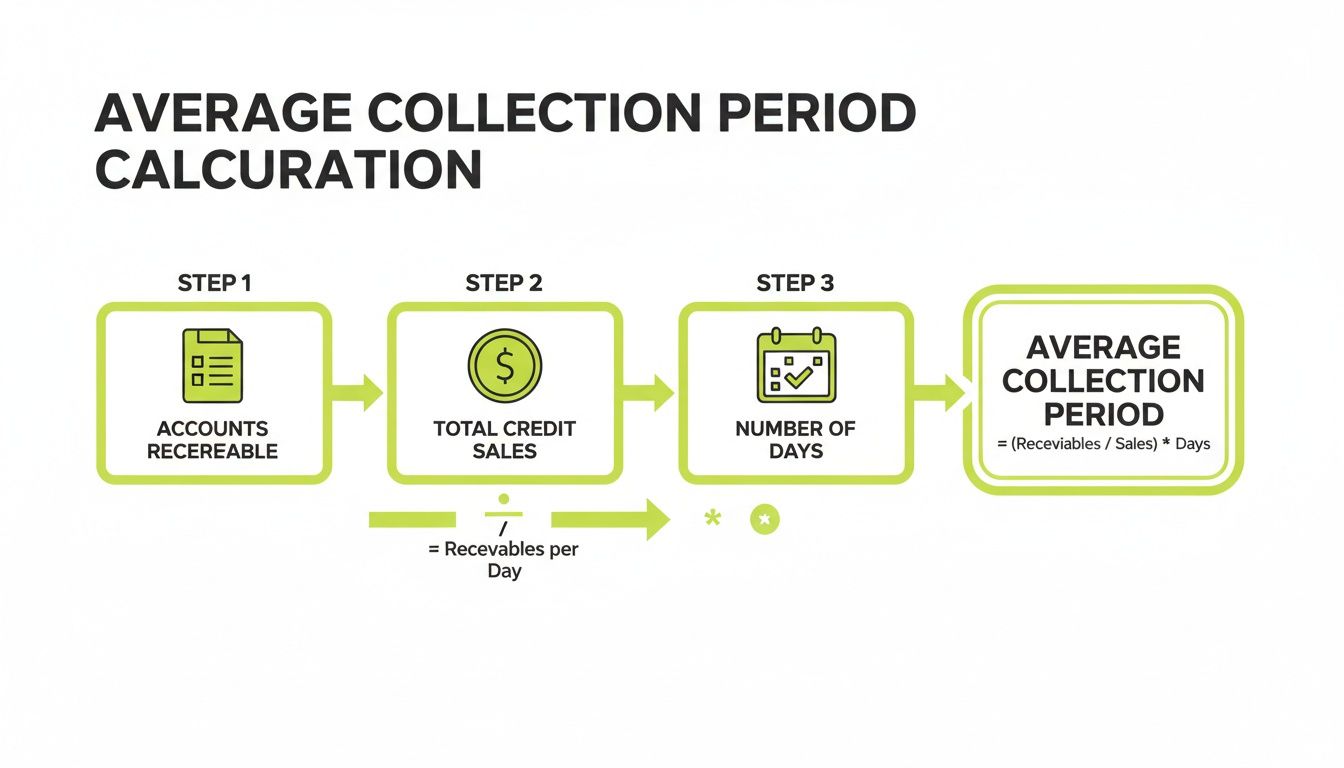
This repeatable process, whether done manually or in a spreadsheet, provides the clarity needed to manage working capital effectively. It moves the conversation from guessing to knowing.
What Your Collection Period Is Trying to Tell You
Calculating your average collection period is the easy part. The real work is interpreting what that number means for your firm’s financial health.
This metric is often grouped with Days Sales Outstanding (DSO). While related, the average collection period typically uses annual figures for a high-level, strategic view. DSO is often calculated quarterly or monthly to track operational performance.
Are You Normal? Benchmarking Against Your Industry
A 70-day collection period might be a five-alarm fire at one firm but business as usual at another. Context comes from knowing how you compare to your peers.
Globally, the typical collection period is around 50 days, but it varies widely. Architecture and engineering firms average 74 days, while law firms are at 71 days. Dig into more of these statistics on payment collections for business.
If your engineering firm takes 90 days to collect against a 74-day industry average, you’ve uncovered a measurable problem. The conversation shifts from "Are we fast enough?" to "Why are we 16 days slower than our competition?"
A high or rising collection period is a direct drag on your working capital. Every day you wait for cash is a day you can't use it for payroll, new hires, or investing in growth. It’s an anchor holding your firm back.
Think of this metric as an early-warning system. A slow upward creep is a red flag. It might point to an inefficient invoicing process, a shift in client mix, or vague payment terms.
The Hidden Link to Bad Debt
A long collection cycle doesn't just squeeze cash flow; it increases your risk of write-offs. The longer an invoice ages, the less likely you will collect.
When you actively monitor your collection period, you can spot at-risk accounts before they become delinquent. It allows you to be surgical—tightening credit terms for one client or adjusting the follow-up cadence for another.
This is how you turn a simple calculation into a powerful tool for financial control.
Resolut automates AR for professional services—consistent, accurate, and human.
Avoiding Common Data Pitfalls for an Accurate Calculation
An accurate calculation hinges on clean data. A flawed metric is worse than no metric at all—it leads you to fix problems you don’t have and ignore the ones you do.
Small data entry errors can completely distort the final number, creating a false sense of security or triggering unnecessary panic.

Isolating True Credit Sales
The most common mistake is pulling total revenue instead of net credit sales. Including cash sales will always make your collection period look better than it is.
A consulting firm with $5M in total revenue but only $4M from invoiced work would see its calculated ACP drop by 20% if it used the wrong sales figure. Ensure your chart of accounts in a system like QuickBooks clearly separates these revenue streams.
Accounting for Seasonality
Most professional services firms have uneven revenue. An architecture firm may have strong Q2 and Q3 results, followed by a slowdown. Analyzing a single strong quarter will inflate your average receivables and your collection period.
A rolling 12-month average for both net credit sales and accounts receivable smooths out peaks and valleys, giving you a more stable and strategically useful number.
This approach prevents overreactions to a single month's performance, providing a true picture for smarter credit and collections strategy.
Excluding Non-Trade Receivables
Your accounts receivable balance should only reflect money owed by clients for services. However, other receivables can sneak in.
Be on the lookout for:
- Loans to employees or subsidiaries
- Interest receivable
- Insurance claims
Including these inflates your AR balance and your average collection period. A periodic audit of your AR ledger is good practice. Dedicated AR software for professional services can automatically keep client receivables separate and clean.
Data Integrity Checklist for Accurate ACP Calculation
Use this checklist to validate your data sources before calculating your Average Collection Period.
Data Point | Verification Step | Common Pitfall |
|---|---|---|
Net Credit Sales | Confirm the figure excludes all cash sales, upfront payments, and retainers paid in advance. | Using total revenue instead of only sales made on credit, which artificially lowers the ACP. |
Accounts Receivable | Review the AR aging report to ensure it only contains outstanding client invoices for services. | Including non-trade receivables like employee loans or insurance claims, which inflates the AR balance. |
Time Period | Use a consistent and sufficiently long period (e.g., rolling 12 months) for both sales and AR data. | Calculating based on a short, seasonal period (like one quarter), which skews the result. |
Data Consistency | Ensure the start and end dates for both Net Credit Sales and Average Accounts Receivable are identical. | Mismatching the time periods for the numerator and denominator, making the calculation invalid. |
A quick check against these points can save you from making decisions based on faulty data.
Resolut automates AR for professional services—consistent, accurate, and human.
Actionable Strategies to Shorten Your Collection Period
Knowing your average collection period is the diagnosis. Shortening it is where you create value.
When you bring that number down, you improve cash flow, reduce borrowing needs, and build a stronger balance sheet. This isn't about aggressive collection calls; it's about process precision.
The best strategies are systematic. They begin before an invoice is sent and continue through a professional, predictable collections process.

Foundational Process Improvements
Before implementing new software, get your core processes in order. Small tweaks here can deliver significant results by reducing friction.
- Set Firm Payment Terms Upfront: Ambiguity is the enemy of prompt payment. Ensure engagement letters and contracts clearly state payment terms (e.g., Net 30), late fee policies, and payment methods.
- Refine Invoice Clarity: Your invoice should be a tool that helps you get paid. Each one needs a clear description of work, a PO number if required, a prominent due date, and simple payment instructions.
The Strategic Role of Accounts Receivable Automation
Manual payment chasing is expensive and inconsistent. This is where accounts receivable automation becomes a strategic lever to systematically reduce DSO.
Before automation, firms saw collection periods of 60-70 days, with staff spending nearly 40% of their time on manual follow-ups. Modern AI AR automation cuts this period by over 25% by predicting at-risk invoices and orchestrating adaptive outreach, reducing manual work by 80%.
AI AR automation platforms manage the entire collections lifecycle with precision and a human touch. This is a game-changer for firms on QuickBooks, where native tools are basic. An integrated QuickBooks AR automation solution powers a far more intelligent process.
How AR Software Drives Measurable Outcomes
Modern AR software for professional services orchestrates a workflow that manual processes cannot match. It connects operational problems with measurable solutions that directly improve cash flow.
- Intelligent Follow-Up Cadences: Create personalized, multi-channel outreach sequences (email, SMS, calls) that adapt based on client payment history and invoice risk level.
- Frictionless Client Payment Portals: A simple, self-service portal for clients to view invoices and pay via ACH or credit card removes significant barriers and can speed up payments by days.
- Proactive Risk Identification: The system can flag invoices showing early signs of trouble, allowing your team to intervene effectively when the conversation is still collaborative.
Optimizing AR is one piece of a larger financial puzzle. For a more holistic view, understanding practical strategies to reduce operational costs is key. To dig deeper, learn about the benefits of accounts receivable automation.
Resolut automates AR for professional services—consistent, accurate, and human.
A Few Common Questions
When finance leaders analyze their average collection period, a few operational questions always come up. Here’s what we hear most often.
What Is a Good Average Collection Period for a Professional Services Firm?
Aim for a collection period no more than 1.3x to 1.5x your stated payment terms. If you invoice at Net 30, a range of 39 to 45 days is a strong, realistic goal.
However, context is key. The benchmark for legal services is around 71 days, while engineering firms often see 74 days. The goal is to measure against your industry and focus on consistent, incremental improvement.
How Often Should We Calculate Our Average Collection Period?
For strategic oversight, CFOs and Controllers should review this metric monthly as part of the standard financial reporting package. This is the only way to spot negative trends early.
For the AR team, weekly calculations can provide much faster feedback, especially when testing new collection strategies to reduce DSO.
Can Automating Accounts Receivable Hurt Client Relationships?
Not with a thoughtful implementation. The fear of automation sounding impersonal is valid, but modern accounts receivable automation is built for intelligent orchestration. Good AR software for professional services lets you customize the tone, timing, and channel for every communication.
Think of it this way: providing a convenient payment portal and sending clear, professional reminders improves the client experience. It removes the friction and awkwardness of manual follow-up, preserving the core relationship.
This shift toward smarter, consistent communication protects your firm's reputation while accelerating payment. It’s a key function of effective AI AR automation.
--- Resolut automates AR for professional services—consistent, accurate, and human. Learn more at https://www.resolutai.com.