
How to Find Average Collection Period and Improve Cash Flow
Learn how to find average collection period using simple formulas. A clear guide for finance leaders to reduce DSO and master accounts receivable management.
To calculate your average collection period, divide your average accounts receivable by your net credit sales for a specific timeframe. Then, multiply that result by the number of days in that period (typically 365).
The output, in days, measures precisely how long it takes your firm to convert services into cash.
Why Average Collection Period Is a Critical Finance Metric
For a professional services firm, the average collection period—also known as Days Sales Outstanding (DSO)—is a direct measure of operational efficiency and cash flow velocity.
It is a key indicator of your firm's financial control.
A low DSO signifies a healthy, efficient accounts receivable process. Cash returns to the business quickly, available for payroll, operational expenses, or strategic investment.
A high or increasing collection period is a clear warning sign. It signals a breakdown in the process between delivering value and capturing it as cash.
The Strategic Importance of Monitoring This KPI
Systematic DSO monitoring provides a real-time assessment of your firm's liquidity. It shifts financial oversight from revenue and profitability alone to the actual cash available to operate.
When the collection period extends, it creates tangible operational strains:
- Constricted Working Capital: Delayed payments tie up cash that is essential for funding growth or covering immediate liabilities.
- Increased Financial Risk: The longer an invoice remains unpaid, the higher the probability it becomes bad debt, directly impacting your bottom line.
- Strained Client Relationships: Persistent follow-up on overdue invoices can erode trust and damage the strategic partnerships you have built.
For firms billing on project milestones or retainers, a lengthening collection period can indicate deeper issues, such as client dissatisfaction or their own financial instability.
Understanding the true cost of AR inefficiency is critical. A late payment is not just a ledger entry; it represents a direct cost in time, resources, and missed opportunities.
Let’s examine the core components.
Average Collection Period At a Glance
This table breaks down the elements and their strategic importance for professional services firms.
Component | Definition | Strategic Importance |
|---|---|---|
Average Accounts Receivable | The average value of unpaid client invoices over a specified period. | Quantifies the amount of working capital tied up in receivables and potential credit risk. |
Net Credit Sales | The firm's total revenue from services delivered on credit, less any returns or allowances. | Represents the total sales value awaiting collection. |
Number of Days in Period | The timeframe for the calculation, typically 365 days for an annual view. | Provides the context for measuring the average time required to convert sales into cash. |
The Result (in Days) | The average number of days it takes for clients to pay their invoices. | A direct measure of cash flow velocity and AR process efficiency. |
Mastering this metric enables predictable financial planning and operational control.
Accurate cash flow forecasting allows you to make strategic decisions from a position of strength, not reaction. This is where tools like accounts receivable automation are essential, converting AR from a reactive, manual function into a strategic, data-driven operation.
Getting Your Average Collection Period Right
If you cannot measure your cash cycle accurately, you cannot manage it effectively. Calculating your average collection period provides an unfiltered view of how quickly your firm converts work into cash.
There are two primary methods for this calculation. Let's walk through both using a realistic scenario for a professional services firm to ground the numbers.
The Direct DSO Formula
The most direct method is the Days Sales Outstanding (DSO) formula. It provides a straightforward measure of the average number of days it takes to collect payment after a sale.
The formula is:
(Average Accounts Receivable / Net Credit Sales) x Number of Days in Period
To execute this, you need three figures from your financial records: beginning AR, ending AR, and total net credit sales for the period.
Let's apply this to a consulting firm over one fiscal year:
- Beginning Accounts Receivable (Jan 1): $400,000
- Ending Accounts Receivable (Dec 31): $500,000
- Annual Net Credit Sales: $4,500,000
- Number of Days: 365
First, calculate your average accounts receivable: ($400,000 + $500,000) / 2 = $450,000
Now, apply the DSO formula: ($450,000 / $4,500,000) x 365 = 36.5 days
This result indicates the firm takes, on average, just over one month to convert its services into cash. This provides a clear baseline for performance analysis. Consistency in the period length is key for accurate historical comparison.
The Accounts Receivable Turnover Ratio Method
An alternative method, which provides additional context, involves first calculating your Accounts Receivable Turnover Ratio. This ratio measures how many times the firm collects its average receivables during a period. A higher number indicates greater collection efficiency.
This is a two-step process.
- Calculate AR Turnover Ratio: Net Credit Sales / Average Accounts Receivable
- Calculate Average Collection Period: 365 / AR Turnover Ratio
Using the same data from our consulting firm:
First, the turnover ratio: $4,500,000 / $450,000 = 10
This means the firm's receivables turn over, or are collected, 10 times per year. This is a valuable KPI for your finance team.
Now, calculate the collection period in days: 365 / 10 = 36.5 days
Both methods yield the same result, serving as a useful validation. The turnover ratio simply offers an additional layer of insight into collection frequency.
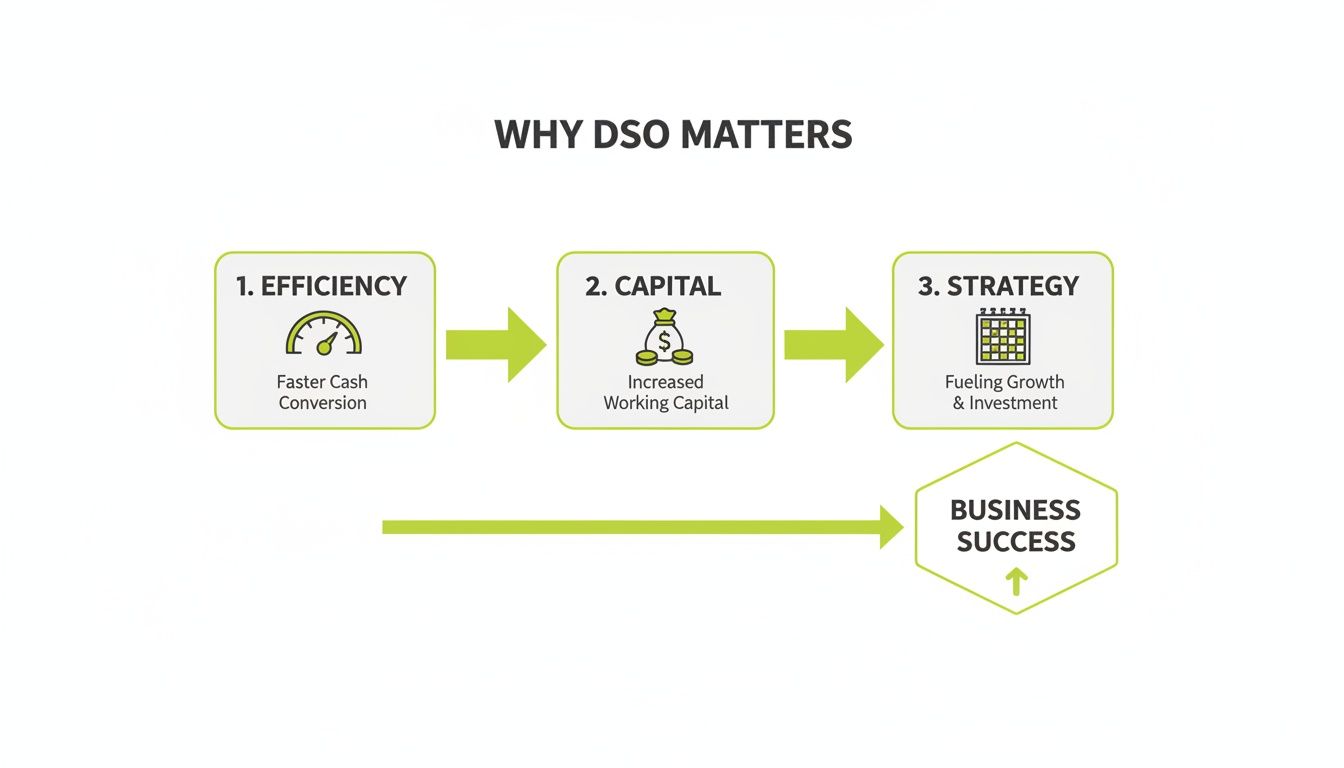
This demonstrates that disciplined DSO management is not just a bookkeeping exercise. It is a strategic tool that directly impacts your firm's operational capacity and ability to self-fund future growth.
Practical Formulas for Your Spreadsheets
The most effective way to track this KPI is to build it directly into your financial dashboards. The formulas for Excel or Google Sheets are straightforward.
- For Average AR (cell C1):
=AVERAGE(A1, B1)where A1 is beginning AR and B1 is ending AR. - For Direct DSO (cell C2):
=(C1/D1)*365where C1 is average AR and D1 is net credit sales.
These simple formulas create a repeatable, error-resistant process. This is the first step toward systemic financial oversight. Integrating this into your reporting, perhaps through QuickBooks AR automation, provides real-time visibility.
Common Pitfalls That Corrupt the Calculation
A reliable calculation depends on clean data. Several common errors can distort your collection period, leading to poor decisions based on flawed metrics.
- Including Cash Sales: The calculation must only include net credit sales. Including cash sales will artificially reduce your DSO and mask underlying collection issues.
- Mismatched Time Periods: Comparing a 90-day DSO to a 365-day DSO is invalid. Ensure your timeframes for receivables and sales are always aligned.
- Ignoring Seasonality: For firms with seasonal revenue fluctuations, an annual average can obscure problems in slower months. Calculating DSO on a quarterly or monthly basis provides a more actionable view.
The B2B average collection period is approximately 50 days, but this varies significantly by industry. For instance, legal services can average 71 days, while insurance averages a more rapid 29 days, as shown in **B2B payment statistics**.
Avoiding these fundamental errors ensures the metric accurately reflects performance. From there, you can implement strategies to improve cash flow with confidence.
The objective is to establish a calculation process so reliable it becomes a trusted input for major financial decisions. Systems built with AI AR automation or dedicated AR software for professional services are designed to eliminate these manual errors, ensuring every calculation is precise.
Interpreting Your Numbers: What a Good Collection Period Looks Like
Calculating your average collection period is only the initial step. The real value is derived from interpreting what that number signifies for your business.
A metric without context is just data. Is a 45-day DSO good or bad? For one firm, it could represent operational excellence. For another, it might signal an impending cash flow crisis.
For finance leaders, the goal is to convert this data point into an action plan. This requires benchmarking the number against three critical measures: your contractual payment terms, your firm's historical performance, and industry norms.
Your Payment Terms Are the Primary Benchmark
The most important yardstick is your own payment terms. If your standard client agreement is Net 30 but your collections consistently average 48 days, you have a clear performance gap.
That 18-day variance is a direct reduction in your available cash.
It also indicates a process failure. Invoices may be delayed, payment instructions may be unclear, or follow-up may be inconsistent. Closing this gap is the most direct way to improve cash flow.
A DSO that aligns closely with your terms demonstrates process control. A significant gap is a clear signal that an element of your AR cycle requires immediate attention.
A collection period that consistently exceeds your stated terms is a direct drain on working capital. The first goal should always be to bring your actual collection days as close as possible to your contractual payment terms.
Comparing Against Your Own History
Your firm's historical data provides the next layer of context. A stable DSO of 50 days may not be ideal, but its predictability allows for effective cash management.
The primary alarm is a DSO that is trending upward—for example, increasing from 50 days last quarter to 58 this quarter.
An upward trend is often a leading indicator of deeper issues:
- Invoice Accuracy: A rising DSO can point to an increase in invoice disputes, suggesting billing errors or scope-of-work ambiguity.
- Client Financial Health: A few large clients facing their own financial difficulties can significantly inflate your firm's overall DSO.
- Internal Process Friction: Delays in issuing invoices or inconsistent follow-up will invariably lengthen your cash cycle.
Tracking this metric over time—monthly or quarterly—provides the visibility needed to identify and address these issues before they escalate.
Industry Benchmarks Provide a Sanity Check
Finally, comparing your performance to industry averages helps you understand your position in the market. While not absolute targets, these benchmarks offer valuable perspective.
Professional services sectors exhibit wide variation. A marketing agency might target a DSO under 40 days. In contrast, a law firm handling complex litigation with milestone billing might find a 70-day period to be standard.
To illustrate, here is a breakdown of typical collection periods across different professional services sectors.
Industry Benchmark Collection Periods
Industry Sector | Typical Average Collection Period (Days) | Key Influencing Factors |
|---|---|---|
Marketing & Advertising Agencies | 35-50 | Shorter project cycles, retainer models, and media buy-throughs. |
IT & Software Consulting | 45-60 | Mix of project-based and managed services billing; can be slowed by integration milestones. |
Management Consulting | 50-65 | Larger enterprise clients with complex payment approval processes often extend terms. |
Legal Services | 60-75 | Contingency fees, milestone payments in litigation, and detailed invoice reviews can cause delays. |
Architectural & Engineering | 65-80 | Long project timelines, dependency on construction milestones, and retainage practices. |
This data shows how much a "good" DSO can vary. For example, architectural and engineering firms average 74.4 days, while building contractors average 67.5 days. For these firms, a number that seems high elsewhere is simply standard operating procedure.
Understanding these norms helps set realistic performance goals. If your engineering firm is collecting in 65 days, you are outperforming your peers. If your IT consulting firm is at 65 days, you likely have a significant opportunity to reduce DSO.
Interpreting your average collection period requires triangulation—comparing it against your terms, your history, and your industry. This provides the control to make informed decisions, supported by accounts receivable automation that ensures consistency and accuracy.
Common Process Flaws That Inflate Your Collection Period
Knowing your DSO is one thing. Understanding the root causes of a high DSO is another.
Cash flow is rarely impacted by a single major error. More often, it is eroded by small, consistent process flaws that quietly add days to your collection cycle.
For professional services firms, where revenue is tied to billable hours or project milestones, these "minor" delays have a material impact. A one-week delay in sending an invoice instantly adds 7 days to that receivable and inflates your firm's aggregate metric.

Correcting this begins with identifying the primary operational deficiencies.
Delayed or Vague Invoicing
The collection clock starts the moment work is completed, not when the client receives the bill.
Any delay between work completion and invoice issuance is a self-inflicted wound to your cash flow. It is often the single largest contributor to an unnecessarily high collection period.
Vague invoices compound the problem. Invoices lacking clear project codes, PO numbers, or detailed service descriptions invite questions and disputes, giving clients a valid reason to delay payment.
Absence of a Structured Collections Process
Many firms treat collections as a reactive, ad-hoc task, only initiating contact when an invoice is significantly overdue. This signals to clients that payment deadlines are not firm.
A structured process is about predictability, not aggression.
A disciplined collections cadence should be systematic. It might include:
- Invoice Receipt Confirmation: An email confirming invoice delivery and noting the due date.
- Pre-Due Date Reminder: A professional reminder sent a few days before payment is due.
- Day 1 Overdue Notice: A notification sent the day after an invoice becomes past due.
- Scheduled Escalations: A clear protocol for follow-up calls and involving senior contacts.
Without this structure, follow-up is inconsistent. The most effective procedures for accounts receivable that work are systematic and repeatable.
Inconsistent Follow-Up and Lack of Accountability
A documented process is ineffective without consistent execution and clear ownership.
When accountability for collections is diffuse—split between project managers and the finance team—invoices are often neglected.
The moment an invoice is created, a single point of contact must be responsible for its journey to 'Paid.' Without clear ownership, your AR process will inevitably suffer from delays and oversights.
The solution is to assign clear roles. Finance should own the collections process, while project managers are accountable for providing timely billing information and resolving client disputes related to service delivery.
Actionable Strategies to Reduce Your Collection Period
Shortening your collection period is not about aggressive tactics. It is about implementing disciplined process improvements that provide clarity to clients and predictability to your firm.
Effective reduction of DSO depends on optimizing internal processes and applying technology strategically. This begins with fundamentals like credit management and invoicing before leveraging automation for consistent execution.

Tighten and Clarify Credit Policies
Your collection period is anchored to your credit terms. If your standard agreement is Net 60, you cannot expect a 35-day DSO. Ensure your terms are clear and support your firm's cash flow requirements.
For new clients, a formal credit application should be standard procedure. This provides the data needed to set appropriate credit limits and payment expectations from the outset.
For existing clients, periodically review payment history. If a client consistently pays 15-20 days beyond your Net 30 terms, a direct conversation or an adjustment to future agreements may be necessary. This is about re-aligning the financial relationship with observed behavior.
Optimize Invoice Clarity and Delivery
Your invoice should be a tool that facilitates payment, not an obstacle. Every question a client has about a bill adds days to your collection period.
Ensure every invoice includes:
- A unique invoice number for reference.
- A clear, prominent payment due date.
- Detailed line items matching the scope of work.
- The client's purchase order (PO) number, if applicable.
- Multiple, straightforward payment options, including a direct link for online payment.
It is also crucial to maintain accurate contact information for the client's accounts payable department. Using programmatic methods for finding email addresses can help ensure your communications reach the correct decision-maker.
An invoice that requires a phone call to be understood has already failed. The goal is zero-friction billing, where a client can validate and pay in a single session without ever needing to contact your team.
Implement Accounts Receivable Automation
Manual follow-up is inconsistent, prone to error, and inefficient. Accounts receivable automation transforms collections from a sporadic, manual task into a systematic, data-driven operation. This is how firms achieve calm, consistent control over cash flow.
Modern AR software for professional services orchestrates a sophisticated, customized communication cadence. A high-value client with a perfect payment history might receive a single, polite reminder. A client who is habitually late could be placed on an automated sequence with earlier reminders and escalations.
Platforms offering QuickBooks AR automation sync directly with your accounting system, eliminating manual data entry and ensuring follow-ups are based on real-time payment status.
Leverage AI for Proactive Intervention
The next evolution is AI AR automation, which can identify at-risk invoices before they become a problem. AI models analyze payment histories and communication patterns to flag accounts with a higher probability of late payment.
This allows your finance team to intervene proactively with a strategic, relationship-focused check-in rather than a reactive collections call. This technology elevates AR from a collections function to a proactive cash flow management center.
Remove Payment Friction with a Self-Service Portal
Make it as simple as possible for clients to pay you. A self-service payment portal is a core component of an efficient AR process.
A client portal should allow clients to:
- View all open and past invoices.
- Pay multiple invoices at once via ACH or credit card.
- Set up recurring payments for retainer agreements.
- Securely store payment information.
By removing the friction of manual payments, you can often reduce DSO by several days. It provides clients with control and transparency, which strengthens the relationship while accelerating your cash conversion cycle and helping to improve cash flow.
Getting to Predictable Cash Flow
Understanding your average collection period is a core financial discipline for a professional services firm. It shifts focus from merely tracking revenue to managing the velocity of cash through your business.
It begins with an accurate calculation, providing an unbiased baseline of operational efficiency. Without this metric, you cannot distinguish between a healthy cash cycle and one that is straining working capital.
The number itself is only half the story. The power comes from context—measuring performance against your payment terms, historical trends, and industry benchmarks. This is how data becomes financial intelligence.
From Measurement to Management
The ultimate objective is to shorten the collection window. Every strategy, from clarifying invoices to implementing accounts receivable automation, is about closing the gap between delivering value and capturing it as cash. This is achieved through smart process improvement, not aggressive tactics.
A well-managed collection period leads directly to predictable cash flow—the foundation of a growing firm. It enables confident strategic investment, reduces leadership stress, and improves resilience. You can also explore other ways to increase cash flow to build a stronger financial base.
Achieving predictable cash flow isn't a one-time project. It's a continuous operational rhythm—the result of disciplined measurement, sharp analysis, and the strategic use of process and technology.
While a shorter collection period boosts immediate liquidity, long-term predictable cash flow also depends on broader financial health. This includes building a more sustainable revenue base through effective strategies to increase customer lifetime value and grow profits.
The Path to Calm Control
This entire process—from calculation to action—is about building a financial operation that supports growth with clarity. Tools like AI AR automation and integrated AR software for professional services are no longer optional; they are critical for replacing inconsistent manual work with precise, reliable systems.
The outcome is a state of calm financial control, where decisions are driven by data, not cash flow emergencies. This discipline transforms your finance function from a reactive cost center into a strategic driver of firm value.
--- Resolut automates AR for professional services—consistent, accurate, and human. Learn more.