
Improving Accounts Receivable: A Guide for Financial Leaders
Learn how to improve accounts receivable: proven strategies to reduce DSO, automate AR, and boost your cash flow.
Improving accounts receivable isn't about chasing payments harder. It's about building a system that prevents them from becoming late in the first place.
For financial leaders at professional services firms, AR is more than an administrative task—it’s a direct lever for managing cash flow and funding growth. The goal is to move from a reactive, manual process to a predictable, automated one.
This guide outlines the operational steps to achieve that control. It focuses on measurable outcomes, not abstract theories.
Establishing Your Accounts Receivable Baseline

Before implementing changes, a clear diagnostic of your current AR performance is essential. While Days Sales Outstanding (DSO) is a common metric, it often masks underlying issues. A deeper analysis reveals why payments are delayed, not just that they are.
This data-driven baseline provides the objective foundation for every subsequent action. All improvements must be measured against it to validate their effectiveness.
Key Metrics Beyond DSO
A granular view of the invoice-to-cash cycle requires tracking a few core operational KPIs. These metrics pinpoint specific weaknesses in your AR process.
Here are the essential indicators to monitor:
- Average Days Delinquent (ADD): This measures the average number of days invoices are past due. Unlike DSO, ADD isolates the performance of your collections process. A high ADD signals ineffective follow-up.
- Collections Effectiveness Index (CEI): This calculates the percentage of collectible receivables you secured in a given period. A CEI consistently below 80% indicates significant cash leakage and an inefficient collections strategy.
Consider a consulting firm with a DSO of 45 days—seemingly healthy. However, an ADD of 28 days revealed that while most clients paid on time, overdue accounts were severely delinquent.
This insight shifted their focus from general invoicing to targeted, automated collections for at-risk accounts. You can learn more about these operational drains in our article on the true cost of AR inefficiency in professional services.
The following table summarizes the indicators for an actionable view of your AR health.
Key Accounts Receivable Performance Indicators
Metric (KPI) | Formula | What It Measures |
|---|---|---|
Days Sales Outstanding (DSO) | (Total AR / Total Credit Sales) x Number of Days | The average number of days it takes to collect payment after a sale. |
Average Days Delinquent (ADD) | DSO - Best Possible DSO | The average number of days payments are overdue, isolating collection delays. |
Collections Effectiveness Index (CEI) | ((Beginning Receivables + Monthly Credit Sales) - Ending Total Receivables) / ((Beginning Receivables + Monthly Credit Sales) - Ending Current Receivables) x 100 | The percentage of receivables collected in a given period. A direct measure of collection efficiency. |
Aged Receivables Percentage | (AR in an Aging Bucket / Total AR) x 100 | The proportion of your receivables that are severely overdue (e.g., 90+ days). |
These KPIs should form the core of a simple dashboard, reviewed regularly.
Building Your KPI Dashboard
Your analysis should feed into a live dashboard, not a static quarterly report. This is your control panel for managing AR performance and tracking trends over time.
A clear view of AR metrics transforms collections from a series of disjointed tasks into a managed, strategic function. It allows you to anticipate cash flow gaps and make decisions backed by data.
Recent data shows that 75% of business leaders believe accounts receivable has gained strategic importance. This shift demands better tools and clearer metrics.
Once this baseline is established, you can methodically address the root causes of payment delays. The objective is to build a resilient financial operation.
--- Resolut automates AR for professional services—consistent, accurate, and human.
Building Proactive Credit and Invoicing Policies
Effective AR management begins before the engagement letter is signed, not when an invoice is 30 days past due.
Many professional services firms treat credit and invoicing as an afterthought, leading to predictable cash flow struggles. A proactive approach is required to prevent payment delays.
This is about setting clear, upfront expectations that protect the firm’s working capital. It's a shift from a collections mindset to a preventative one.
Set Your Credit Policies Before You Need Them
A one-size-fits-all credit policy is inefficient. A simple, risk-based policy allows you to extend appropriate terms without impeding new business.
For a large, multi-month retainer, a basic credit check is prudent. A report from a service like Dun & Bradstreet provides the data needed to set fair net terms or require a deposit.
- Low-Risk Clients: Standard Net 30 terms are appropriate.
- Medium-Risk Clients: Consider a 25-50% deposit or tying payments to specific project milestones.
- High-Risk Clients: Require payment in full upfront or a significant deposit to mitigate risk.
Your engagement letter is your first control. It must specify due dates, late payment penalties, and dispute resolution procedures without ambiguity. Integrating comprehensive contract lifecycle management (CLM) practices can further strengthen these policies.
Your Invoice Is a Critical Control Document
An invoice that is vague, incorrect, or confusing provides a valid reason for non-payment. Every invoice must be a model of clarity.
A functional invoice for a professional services firm includes:
- Precise Descriptions: Replace "Consulting Services" with "Phase 1: Discovery & Scoping - Week of 09/16."
- A Prominent Due Date: Make it large, bold, and impossible to miss.
- Multiple Payment Options: Include direct links for ACH and credit card payments to reduce friction.
- A Human Contact: List the name and direct contact information for billing inquiries.
Firms using accounts receivable automation for follow-ups often report improved client sentiment. Data shows 21% see better relationships by removing manual "chasing" from the process.
An invoice is a reflection of your firm's operational discipline. A clear, professional invoice signals competence and facilitates timely payment.
By establishing these credit and invoicing policies upfront, you build the foundation for healthy cash flow.
--- Resolut automates AR for professional services—consistent, accurate, and human.
Designing Your Automated Collections Workflow
Manual collections are inefficient and reactive. The process often strains client relationships and drains team resources.
An effective collections process is a structured, automated communication system designed for precision. The goal is to secure timely payment while protecting client trust.
This proactive approach uses accounts receivable automation to prevent late payments before they occur.
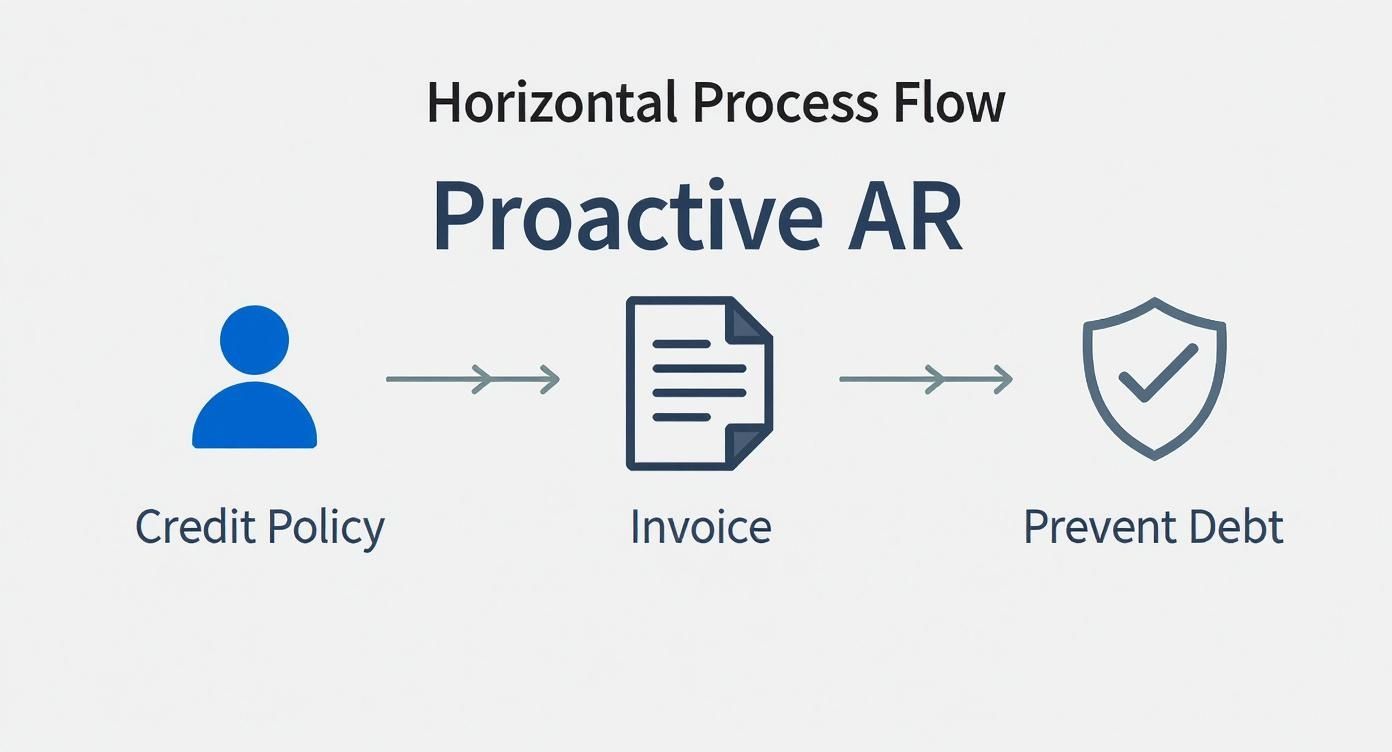
As shown, strong AR management is a continuous cycle. Clear invoicing and credit terms are the foundation.
Mapping a Multi-Stage Cadence
An effective collections workflow unfolds in stages. The tone and channel shift as an invoice ages, from helpful nudges to firm demands.
A manual process cannot execute a multi-stage, multi-channel workflow with consistency. A system is required to trigger the right message at the right time.
Firms can also leverage AI in accounting to reduce manual work, minimize errors, and accelerate financial reporting.
The Anatomy of an Effective Workflow
Your workflow must be documented, creating a clear playbook for your team. This ensures every client receives the same professional treatment.
Here is a sample cadence balancing persistence and professionalism:
- Stage 1: Pre-Due Date Nudge (Day -7): An automated email reminds the client their invoice is due next week, with a direct payment link. The tone is helpful.
- Stage 2: Day-Of Reminder (Day 0): A second automated email on the due date. The message is simple: "Invoice #1234 is due today."
- Stage 3: First Overdue Notice (Day +7): The tone becomes more direct, noting the invoice is a week past due.
- Stage 4: Firm Follow-Up (Day +15): A second channel, like an automated call or personalized email from an account manager, signals escalation.
- Stage 5: Final Demand (Day +30): A formal, non-automated email from a finance leader states the account is seriously delinquent.
A structured, automated cadence removes emotion and inconsistency from collections. It ensures every follow-up is persistent and professional, lowering DSO without damaging goodwill.
Modern AR software for professional services is built for this purpose. These platforms manage client-specific workflows beyond the capabilities of general accounting systems. Our guide to accounts receivable automation software details what to look for in a platform.
Sample 60-Day Collections Cadence
This staged dunning cadence provides a playbook for consistent execution.
Timing (Relative to Due Date) | Channel | Action / Message Focus |
|---|---|---|
Day -7 | Automated Email | Friendly reminder: "Your invoice is due next week." Include payment link. |
Day 0 | Automated Email | Gentle reminder: "Your payment is due today." |
Day +7 | Automated Email | Professional but firm: "Invoice is now one week past due." |
Day +15 | Automated Call & Email | Escalation notice: "We haven't received payment. Please contact us." |
Day +30 | Personal Email (Controller) | Formal demand: "Your account is seriously delinquent. Immediate action required." |
Day +45 | Personal Call (Account Lead) | Relationship check-in: "Is there an issue we can help resolve?" |
Day +60 | Formal Letter | Final notice: "Payment must be made within 10 days to avoid further action." |
This structured approach methodically increases pressure while providing multiple opportunities for payment.
Intelligent Segmentation and Escalation
Advanced systems use AI AR automation to segment accounts based on payment history and invoice value. A high-value, historically prompt client receives a softer touch. A chronically late account is placed on a more assertive cadence.
This intelligence also powers escalations. An automated system can manage the first 80% of the workflow—the routine reminders that consume staff time. It knows when to escalate to a human.
When a client dispute arises or a high-risk account hits 30 days past due, the system flags it for direct intervention. This frees your team to focus on complex negotiations and high-value client relationships.
Making Payments Easy and Applying Cash Instantly

Every obstacle in your payment process adds days to your DSO. When a client receives an invoice, paying it should be frictionless.
The goal is to architect a payment experience as efficient as the services you deliver. This is a critical component for accelerating your invoice-to-cash cycle.
Give Clients a Self-Service Way to Pay
A secure client portal is a fundamental tool for a modern AR team. It reduces the administrative load on your staff by allowing clients to manage their accounts independently.
A well-designed portal should provide:
- Multiple Payment Options: Allow clients to pay via ACH, credit card, or digital wallets.
- Complete Invoice Visibility: Offer a central location to view, download, and review all invoices.
- Automated Payments: Provide an autopay option for recurring retainers or payment plans.
This self-service model improves your team's efficiency. Staff can focus on high-value work instead of administrative inquiries. For more on this, see our guide on 8 real-world ways to clean up your accounts receivable.
Why Automated Cash Application is Non-Negotiable
Applying cash to the correct open invoice is the final step. For many firms, this remains a manual process prone to error.
Manual reconciliation is slow and introduces risk. A single error can create hours of remedial work and distort cash position reports.
This is where AR software for professional services provides significant value. The global accounts receivable software market is projected to reach nearly $3.5 billion by 2025.
Manual cash application creates an artificial delay between receiving and recognizing funds. Automation closes that gap, providing a real-time, accurate view of your cash position.
Modern AI AR automation platforms eliminate this manual step. By integrating with bank feeds and accounting systems, the software automatically matches payments to open invoices with high accuracy.
For firms using QuickBooks, layering on a specialized tool for QuickBooks AR automation transforms its capabilities. The system handles complex scenarios:
- One-to-Many Matching: A single payment is automatically applied across multiple invoices.
- Remittance Advice Processing: The software scans remittance documents to apply payments correctly.
- Short-Pay Identification: The system flags partial payments for immediate follow-up.
This automation delivers a measurable impact, reducing time spent on cash application by over 80%. It frees senior finance talent to focus on analysis and strategy, resulting in a faster, more accurate close.
Resolut automates AR for professional services—consistent, accurate, and human.
Managing Escalations and Measuring ROI
Even with a disciplined AR process, exceptions will occur. A robust system must account for this reality. Handling escalations with precision is as critical as any automated workflow.
The objective is to prevent problem accounts from consuming your team’s resources. A data-driven framework allows you to manage risk, make objective decisions about third-party collections, and prove the strategic value of your AR improvements.
Developing a Client Risk Score
Manual prioritization is inefficient. A dynamic client risk score directs your team's expertise where it will have the greatest financial impact.
Modern AI AR automation platforms like Resolut build these scores by processing multiple data points in real time. It is a live assessment of risk.
- Payment History: Consistent late payments or frequent disputes increase a client's risk score.
- Invoice Age and Value: A high-value, 60+ day past-due invoice is a greater threat than a small, recent one.
- Communication Patterns: A sudden lack of responsiveness can be an early indicator of financial trouble.
This scoring changes collections from a reactive task to a proactive strategy. Your team can start each day with a prioritized queue of high-risk, high-value accounts requiring intervention.
When to Engage a Third-Party Agency
The decision to send an account to collections should be a calculated one. The collection rate for B2B debt drops to just 20% after six months. Waiting too long reduces the probability of recovery.
Your internal policy should define this trigger point. A common practice is to initiate the handoff when an invoice is 90 to 120 days past due, after internal collections efforts have been exhausted.
Sending an account to collections is not a failure. It is the logical final step in a structured process to protect the firm from a total loss on delivered work.
Ensure documentation is complete before engaging an agency. This includes the engagement letter, all invoices, and a log of all communications. This preparation improves the agency's effectiveness and provides legal protection.
Calculating the True ROI of Your AR Initiatives
Operational improvements must deliver a financial return. The ROI of better AR is quantified by connecting process changes to bottom-line results.
A simple model to calculate this value includes:
- Gains from Reduced DSO: Calculate the cash freed by faster payments. A 10-day DSO reduction on $12M in annual revenue unlocks an additional $328,767 in working capital (($12M / 365) x 10).
- Lower Financing Costs: Quantify savings from reduced reliance on credit lines. If that capital avoids a draw on a credit line with a 7% interest rate, the annual savings is $23,013.
- Increased Team Productivity: Estimate the value of time recovered through accounts receivable automation. If automation saves 20 hours per week at a blended rate of $75/hour, you recover $78,000 in productivity annually.
This is how operational improvements translate to strategic value. You are no longer just collecting invoices; you are strengthening the firm’s financial position.
--- Resolut automates AR for professional services—consistent, accurate, and human.
Questions We Hear in the Field
Here are common questions from CFOs, controllers, and firm owners about implementing AR improvements, with direct, operational answers.
How Can We Automate AR Without Damaging Client Relationships?
This is the most critical question. Effective accounts receivable automation protects client relationships, it doesn't harm them. The goal is consistency and clarity, not aggression.
Start with low-impact automations, like pre-due date reminders. Provide clients a self-service portal for viewing and paying invoices. A well-designed system makes your communications professional and timely, removing the risk of human error.
A thoughtful automation strategy replaces awkward, inconsistent follow-up with a predictable, professional system that makes it easier for clients to do business with you.
AR ceases to be a point of friction and becomes another smooth, professional interaction.
What's the Very First Step to Lowering Our DSO?
Before implementing solutions, diagnose the problem. The first step is to establish a clear, data-driven baseline of your current performance.
Analyze your core AR metrics—DSO, CEI, and ADD—for the last six months.
Next, examine your aged receivables report for patterns. Identify chronically late clients or service lines with consistent delays. Often, the quickest win is improving the invoicing process itself. Ensure every invoice is 100% clear, accurate, and issued promptly.
Do We Really Need a Dedicated AR Platform if We Already Use QuickBooks?
QuickBooks is an excellent accounting system, but it is not a collections engine. It is a system of record, not a tool for proactive receivables management.
Dedicated AR software for professional services is purpose-built to handle collections, dispute management, and cash application at scale.
These platforms integrate with your general ledger, using QuickBooks AR automation to pull invoice data and post payments. This adds a layer of intelligence and workflow automation that a general accounting package cannot provide, giving your team the tools to improve cash flow with precision.
--- Resolut automates AR for professional services—consistent, accurate, and human. Learn more.