How to Write a Collection Letter That Protects Cash Flow
Learn how to write a collection letter that preserves client relationships. Get templates and tips to improve cash flow and reduce DSO with a clear process.
Writing a collection letter is not a reactive task. It is a financial control. For professional services firms, it’s a staged process that escalates with calm precision, protecting both cash flow and client relationships.
The process begins with a proactive reminder, shifts to a direct notice once an invoice is past due, and concludes with a final demand that clearly states consequences. Throughout, the focus is on providing precise data and removing all friction from the payment process.
Shifting Collections from Reactive to Strategic

For a professional services firm, a collection letter is a critical control for the entire financial operation. This process should not be an inconsistent chore handled ad-hoc. It must be a strategic, data-informed system for managing working capital.
For CFOs and Controllers, the objective is not to chase individual invoices. It's to implement a system that communicates with calm confidence and absolute clarity. A well-executed system directly impacts Days Sales Outstanding (DSO), stabilizes cash flow, and protects client goodwill.
The Operational Impact of a Defined Process
An improvised collections process introduces operational risk. Inconsistent timing and tone from staff emails confuse clients, delay payments, and create unnecessary friction.
A defined, repeatable process, by contrast, produces measurable outcomes.
By implementing a structured, four-stage dunning process, firms can reduce DSO by 10-20% within the first two quarters. This is not an accounting abstraction; it is a direct improvement in cash flow and working capital.
Such a system is built on predictability. Your team knows when to communicate and what to say. Your clients understand the process and perceive your firm as organized and professional—not confrontational.
Core Principles for Strategic Collections
To transition from reactive to strategic, your collections process must be built on non-negotiable principles. These are what drive results and protect the firm's reputation.
- Clarity Above All: Every communication must be unambiguous. Include specific invoice numbers, due dates, outstanding amounts, and a direct payment link. Remove every obstacle to payment.
- Consistency is Key: The timing, tone, and format of outreach must be standardized. This is where accounts receivable automation becomes indispensable, removing human variability.
- Preserve the Relationship: Early-stage language should be collaborative. Frame it as a service reminder to keep their account current, not an accusation.
- Data-Driven Execution: Track metrics beyond DSO. Analyze email open rates, payment link click-throughs, and average days-to-pay after each communication. This data reveals process effectiveness.
Ultimately, knowing how to write a collection letter is less about wording and more about building a reliable financial control. For firms using tools like QuickBooks, AR automation can integrate directly to execute this strategy flawlessly.
What Every Collection Letter Needs to Succeed
An effective collection letter is an instrument of operational clarity, not persuasion.
For CFOs and Controllers, each letter is a tool designed to remove friction from the payment process. If a client must search for an invoice number or question an amount, you have introduced a delay. That delay directly impacts cash flow.
The structure must be ruthlessly efficient. A client should scan the communication and understand the required action in under ten seconds. This signals that your firm operates with precision, reinforcing the value you provide.
The Non-Negotiable Information
Every letter, from the first reminder to the final demand, requires a core set of facts. Omission of any one item provides the client a valid reason for inaction.
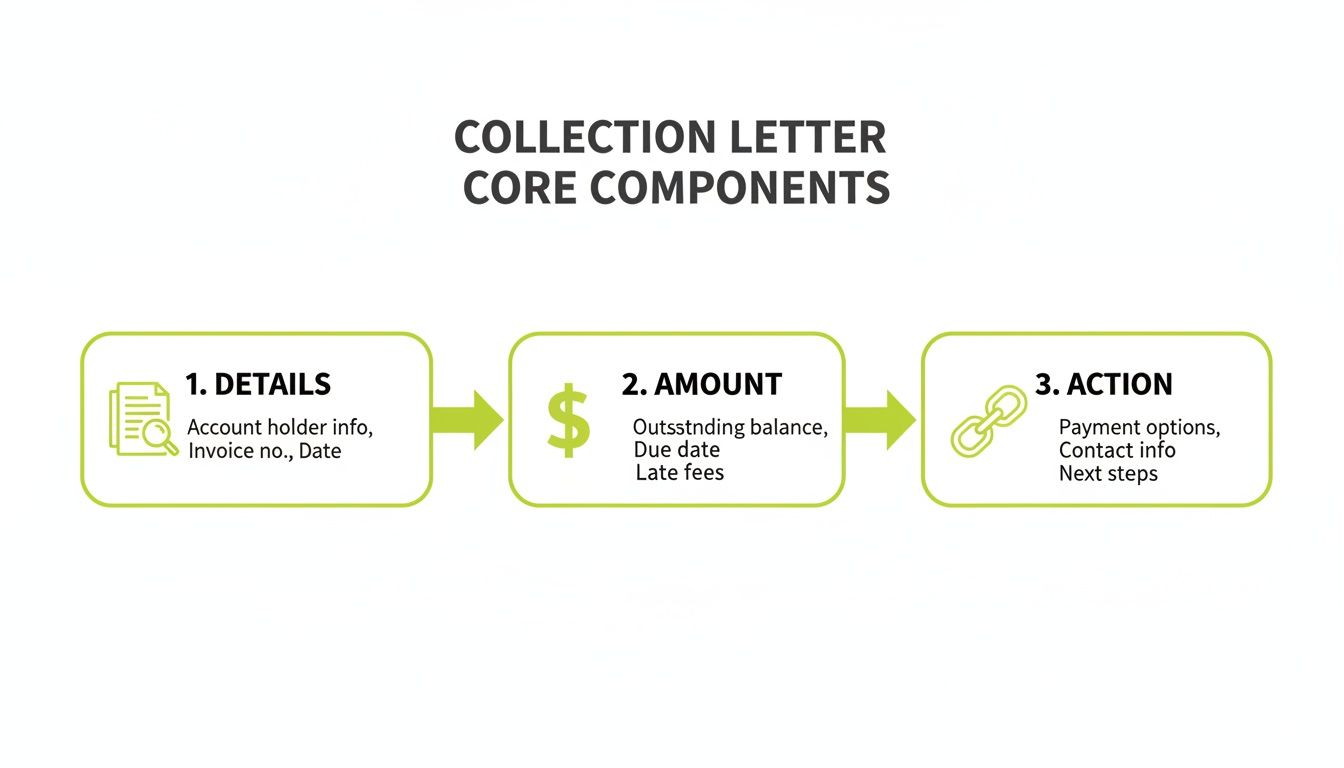
- Client Name and Contact Information: Address the correct person at the correct legal entity.
- Your Firm's Name and Address: Clearly identify the sender.
- Date of the Letter: Establish a documented timeline.
- Precise Invoice Number(s): This is the critical key for their finance team to locate the payable in their system.
- Original Invoice Date: This adds context and documents the aging of the debt.
This information must be clean and prominent. Ambiguity is the enemy of collections.
Financial Clarity and the Call to Action
Once the basics are covered, the financial details must be equally precise. Do not bundle multiple services under a vague description. The goal is a number their team can immediately reconcile against their records.
State the outstanding balance plainly. If an invoice is over 30 days past due, specify any late fees, referencing the governing clause in your master service agreement. Firms using AI AR automation can apply these rules automatically for consistent, unbiased execution.
A B2B payments study found that 47% of late payments are due to incorrect invoice information. Accuracy is a direct strategy to improve cash flow.
Finally, every letter requires a single, unmistakable call to action. Vague requests like "Please remit payment at your earliest convenience" are invitations to be ignored.
Provide a direct path forward.
Example of an effective call to action:
"To settle the outstanding balance of $15,250.00 for invoice #4812, please use the following secure payment link: [Insert Direct Payment Link Here]."
This removes all guesswork. For firms managing hundreds of invoices with QuickBooks AR automation, embedding unique payment links is a standard, high-impact feature of modern AR software for professional services.
Maintaining Professional Tone and Compliance
The tone of your collection letter must remain professional as urgency escalates. While internal communications are not governed by the Fair Debt Collection Practices Act (FDCPA), adopting its principles of clarity and professionalism is sound business practice.
Avoid emotional or accusatory language. "You have failed to pay" is personal and defensive.
Use neutral, fact-based statements: "The payment for invoice #4812, due on June 1, remains outstanding." This maintains focus on the business transaction, not a personal failing, which is crucial for preserving the client relationship.
The Four-Stage Collection Communication Cadence
A robust collections strategy is not a single action but a deliberate, escalating sequence. It is a playbook that provides your AR team a clear path and your clients predictability. The objective is to apply the right pressure at the right time, systematically moving an account toward payment.
Each stage has a distinct goal, tone, and action designed to resolve the delinquency without unnecessary friction. This is the operational backbone of any strategy to reduce DSO.
* **Visual Idea: A linear timeline chart showing the four stages of collection (Reminder, Notice, Firm Reminder, Final Demand) plotted against "Days Past Due." Each stage has a small icon (e.g., an envelope, an exclamation point) and a one-line descriptor of the tone. ***
The Four-Stage Collection Letter Cadence
Stage | Timing (Days Past Due) | Tone | Example Subject Line | Core Message |
|---|---|---|---|---|
1. Proactive Reminder | 3-5 days before due | Helpful, Professional | Reminder: Invoice #6034 Due Next Week | "A reminder that your invoice is due soon. For your convenience, here is a link to pay online." |
2. First Past-Due Notice | 1-15 days past due | Direct, Professional | Regarding Overdue Invoice #6034 | "This is a notice that your invoice is now past due. Please remit payment or contact us if there is an issue." |
3. Firm Reminder | 16-45 days past due | Assertive, Urgent | URGENT: Invoice #6034 is 30 Days Overdue | "Your account is seriously past due. Payment is required immediately to avoid further action." |
4. Final Demand | 45+ days past due | Authoritative, Final | Final Notice: Action Required for Invoice #6034 | "This is our final attempt to collect. Failure to pay by [Date] will result in escalation to [Agency/Counsel]." |
Stage 1: The Proactive Reminder (Pre-Due Date)
The most effective collection action occurs before an invoice is late. A professional reminder, sent 3–5 days before the due date, functions as a customer service touchpoint, not a demand.
Its purpose is to prevent oversight. Most initial late payments are not due to unwillingness to pay, but administrative delays. This communication keeps your invoice top-of-mind for the client’s AP team during their next payment run.
Stage 2: The First Past-Due Notice (1-15 Days Past Due)
Once an invoice passes its due date, the tone shifts but remains professional and collaborative. This notice, sent 1–15 days after the due date, operates under the assumption of a simple mistake.
The goal is to formally notify the client of the overdue status and provide a simple resolution path. You are flagging a deviation from terms without accusation. This is a critical moment for preserving goodwill.
Data Point: Approximately 75% of recoverable invoices are collected within the first 15 days of being overdue. A clear, professional first notice is your most powerful tool.
Stage 3: The Firm Reminder (16-45 Days Past Due)
An invoice unpaid after 15 days is likely not an oversight. The firm reminder, sent between 16 and 45 days past due, introduces urgency. The tone becomes more direct and assertive while remaining professional.
This message should explicitly state the number of days the invoice is overdue and reference previous contact attempts. This is the appropriate time to cite late fee clauses from your service agreement. You are signaling process escalation and consequences for inaction.
The debt collection software market was valued at USD 4.92 billion in 2023 and is projected to reach USD 9.27 billion by 2030. Firms are investing heavily in platforms to automate and track these communications with precision. This is not a task for a CRM Specialist Virtual Assistant alone; it requires integrated financial software.
Stage 4: The Final Demand (45+ Days Past Due)
This is the final communication from your internal collections process. Sent when an invoice is over 45 days late, this letter signals that the account is severely delinquent and will be escalated to a third party.
The tone is authoritative and unambiguous. It must clearly state the total amount due, including all accrued fees, and provide a final, non-negotiable payment deadline. It must also specify the consequences of non-payment, such as assignment to a collections agency or legal counsel. Relationship preservation is now secondary to communicating the serious financial and legal reality. This is where AI AR automation provides a clean, documented audit trail for any subsequent actions.
This simple flow shows why combining precise details with a clear call to action is so important. It removes any excuse for inaction. A structured, four-stage cadence replaces chaotic manual follow-ups with a predictable, professional system. That operational discipline is fundamental to improving cash flow.
Don't Just Send Another Email: Why a Multi-Channel Approach Wins
Your four-stage communication plan is the strategy. How you deliver it is the execution.
Email is efficient but relying on it exclusively is a strategic error. As client inboxes become saturated, your digital reminders become noise.
A physical letter, delivered at a strategic point, cuts through that noise. It carries a different weight and signals a seriousness an email cannot match. For high-value accounts or those entering Stage 3, a multi-channel approach is not optional; it is essential.
* **Visual Idea: A cinematic still of a single, crisp business envelope sitting on an otherwise empty, polished boardroom table. The lighting is focused and dramatic, emphasizing the letter's importance and isolation. ***
Weaving Physical Mail into Your Automated Cadence
Combining digital and physical outreach creates a powerful sequence. The key is orchestration. You augment email at critical moments to escalate urgency and demonstrate methodical follow-through.
This is where true accounts receivable automation demonstrates its value. It's not just scheduling emails. It’s about triggering the right action, on the right channel, at the right time, without manual intervention.
- Stages 1 & 2: Email is sufficient. It is low-cost, instant, and allows for embedded payment links.
- Stage 3 (Firm Reminder): This is the trigger point. As an invoice hits 30 days past due, the system should automatically generate and mail a physical letter mirroring the firm's email. The client now has a tangible document.
- Stage 4 (Final Demand): This message must be sent as a physical letter, preferably via certified mail to create a formal record of receipt. It removes any doubt about the finality of the notice.
We have observed firms achieve a 20-30% lift in payment responses from previously unresponsive accounts by layering in a single, strategically timed physical letter. The impact is often seen within 10 business days of delivery.
This blended strategy is not aggressive; it is organized. It communicates serious intent and a process that will be followed to its conclusion. While you can discover more insights about the role of letter writing, its modern application is in targeted, high-impact scenarios.
Let Software Handle the Logistics
Managing a multi-channel approach manually is operationally inefficient and prone to error. Your finance team’s time is too valuable for mail merge and envelope stuffing.
This is precisely what modern AR software for professional services is designed for. It orchestrates the entire workflow.
When an account in your QuickBooks system hits a trigger—like 30 days overdue—an intelligent platform executes three actions automatically:
- Sends the Stage 3 "Firm Reminder" email.
- Transmits the letter content to a mail-house partner for printing and delivery.
- Logs both actions in the client's communication history, creating a complete audit trail.
This level of AI AR automation transforms a complex manual process into a reliable, hands-off function. It guarantees flawless strategy execution, directly helping to reduce DSO and improve cash flow.
Moving from Manual Follow-Up to Intelligent AR Automation

If your firm’s accounts receivable process is manual, you are not just wasting time—you are actively constraining cash flow. Every minute a finance professional spends tracking payments in a spreadsheet is a minute not spent on high-value analysis. This is an operational drag that introduces inconsistency and error.
The purpose of accounts receivable automation is not to replace your team. It is to elevate them from tactical clerks to strategic operators managing the firm's financial health.
A collection cadence is only effective if executed with perfect consistency. Automation guarantees every communication is sent at the correct interval, without fail. This systematic approach removes the guesswork that erodes client trust and delays payments.
The Real-World Benefits of Automated Execution
Migrating from spreadsheets to an automated platform yields immediate, measurable results that extend beyond timely emails.
An automated system becomes the single source of truth for all AR activity. It logs every communication and every payment action, creating a clear, auditable trail for each account. This documentation is invaluable for performance analysis or justifying actions on a delinquent account.
Firms that adopt AR software for professional services typically see a 10-15% reduction in DSO within the first six months, a direct result of consistent follow-up and the removal of manual friction.
Automation also enables personalization at scale. A system can instantly populate specific invoice numbers, due dates, and custom payment links for every communication, making payment simple for the client.
Leveraging AI for Smarter Collections
The next evolution is AI AR automation, which moves beyond scheduling to predictive, adaptive outreach. The system analyzes client payment histories—identifying patterns in email opens and payment processing days—to optimize timing for maximum impact.
This data-driven approach transforms collections into a high-performance engine for cash flow.
- Optimized Timing: AI can identify that a client's controller processes payments on Wednesday mornings and adjust reminder delivery accordingly.
- Predictive Risk Scoring: The system flags accounts exhibiting payment patterns similar to past defaults, enabling proactive intervention.
- Message Personalization: Based on historical interactions, AI can suggest tonal adjustments or highlight payment options that have proven effective with a specific client.
With QuickBooks AR automation, this level of sophistication integrates with existing accounting software. You can find out more about streamlining these functions in our guide to receivable management services.
An Integrated Communication Strategy
An intelligent AR platform orchestrates outreach across multiple channels in a way no manual process can. As noted, a physical letter can achieve response rates around 9%, far exceeding email’s typical 1%.
An automated system can trigger a physical letter via a mail-house partner the moment an account hits a critical age, reinforcing digital reminders. It can even integrate with services like automated phone answering services to manage inbound responses.
This frees your finance team to focus on high-value work: analyzing payment trends, managing exceptions, and engaging clients on complex billing issues. They cease being clerks and become strategic operators.
Your Path to Controlled and Predictable Cash Flow
Writing an effective collection letter is not about applying pressure. It is about executing a process.
By installing a staged, professional, and consistent communication strategy, you transform accounts receivable from an operational drag into a predictable asset. The goal is to eliminate manual guesswork and implement a system that protects both client relationships and the balance sheet.
This systematic approach provides CFOs and firm owners the financial control and clarity required to scale the business with confidence, knowing the revenue cycle is managed with precision.
From Process to Asset
A well-executed collections process, powered by accounts receivable automation, does more than just reduce DSO. It stabilizes your financial footing by standardizing every client interaction. Each communication reinforces your firm's professionalism and simplifies settlement.
By systematizing outreach, you are not just collecting debt; you are managing a key financial asset. This control over receivables directly impacts your ability to forecast, invest, and grow.
This disciplined strategy is the difference between reactive follow-up and strategic financial management.
The Impact of Clarity and Control
The primary benefit of a structured collection cadence is clarity—for your team and your clients. Your team knows which steps to take and when. Your clients understand the process and see your firm as organized. This operational discipline is the most direct path to healthier financials.
This is where AR software for professional services delivers significant value, particularly solutions that integrate with existing systems like QuickBooks AR automation. It executes your strategy flawlessly, every time.
Knowing how to write a collection letter is the first step. Automating its delivery ensures the process is followed, turning a manual task into a reliable machine to improve cash flow. You can learn more in our guide on ways to increase cash flow. This shift from manual effort to intelligent execution is what separates firms that struggle with collections from those that have mastered them.
--- Resolut automates AR for professional services—consistent, accurate, and human.