Legal Letter of Demand for Payment: A Guide to Recovering Overdue Invoices
Legal letter of demand for payment: Discover a concise, compliant template to recover overdue invoices, reduce DSO, and protect client relationships.
Unpaid invoices aren't just a ledger entry. They are a direct drag on your firm's cash flow, stability, and operational focus.
Standard reminders eventually become background noise in a client's inbox. They lack the weight to force a decision. This is where polite follow-ups fail, and a more structured, formal approach becomes necessary to protect your firm’s financial health.

Shifting from Reminders to Formal Demands
Chasing payments pulls your finance team away from high-value analysis and into administrative quicksand. It is an operational drag. The objective isn’t just to get paid; it's to do so efficiently while preserving salvageable client relationships.
A legal letter of demand for payment is the tool that makes this shift official.
This isn’t about aggression. It's about clarity and control. The letter accomplishes three critical things:
- It formally documents the outstanding debt in unambiguous terms.
- It signals a serious escalation, cutting through routine follow-ups.
- It creates a clear paper trail, a non-negotiable step if legal action becomes the only path forward.
The Financial Imperative for a Formal Process
Ineffective collections don't just delay revenue; they actively shrink it. Research indicates that poor contract and payment management can cause businesses to lose an estimated 9.2% of their annual revenue.
That number highlights a critical operational gap. Without a systematic escalation process, you're letting cash bleed out, straining client communication, and eroding your team's efficiency.
A structured process moves your collections from reactive to proactive. When you define a clear trigger for when a reminder becomes a formal demand, you remove emotion and guesswork. This shift is fundamental to reducing DSO and securing your firm's financial footing.
An overdue invoice isn't just the principal amount. It's the lost opportunity cost of capital that could have been invested in growth, technology, or talent. A demand letter is a lever to unlock that trapped capital.
To understand the shift in gravity, it helps to see the two approaches side-by-side.
Standard Reminder vs Legal Demand Letter
Attribute | Standard AR Reminder | Legal Letter of Demand |
|---|---|---|
Tone | Friendly, helpful, assumes oversight. | Formal, firm, direct. |
Legal Standing | Informal, part of routine communication. | A formal precursor to potential legal action. |
Perceived Urgency | Low to moderate. Often ignored or delayed. | High. Signals the end of informal requests. |
Typical Outcome | Payment from organized clients; no effect on chronic late payers. | Compels a response or payment to avoid escalation. |
Relationship Impact | Minimal. Preserves a casual, friendly tone. | Can be firm but professional; signals the relationship is at risk. |
The demand letter is not just another email; it's a strategic escalation with clear intent and legal weight.
Automating the Escalation Point
Manually tracking every invoice to decide when to send a formal demand is a recipe for inconsistency and human error. This is where accounts receivable automation creates a significant advantage.
Instead of relying on a controller's memory, you can build this escalation directly into your AR workflow.
For example, AI AR automation can trigger a formal demand letter once an invoice hits 90 days past due, especially after automated reminders at 30 and 60 days went unanswered. This removes the manual burden and ensures every overdue account follows the same disciplined process. You can explore other strategic ways to increase cash flow through similar operational improvements.
Crafting a Demand Letter That Gets Results
A demand letter isn't just another email. It's a calculated, formal step that signals the end of polite reminders and the beginning of a more serious process. Its power comes from its tone and clarity—it should make it easier for the client to pay than to ignore you.
This is not the time for emotion or vague language. Every word must be deliberate. The goal is to present the facts so clearly that the only logical next step for your client is to settle their account.
State the Facts, Cold and Clear
The foundation of a strong demand letter is an undeniable summary of the debt. You want to leave zero room for debate. This part should read like a ledger, not an accusation.
Start with the basics: your firm's legal name and the client's. Then, list the specific invoice numbers, service dates, and the associated project. This detail shows you’re organized and the debt is well-documented.
Your breakdown should include:
- Principal Amount: The exact original amount outstanding.
- Accrued Interest/Fees: If your contract allows for late fees, calculate and list them as a separate line item.
- Total Amount Due: A final, bolded number that is impossible to miss.
Getting the facts straight from the start sets a professional, no-nonsense tone.
A demand letter should read like a financial report, not a complaint. By sticking to verifiable data—invoice numbers, service dates, outstanding amounts—you shift the conversation from subjective disagreement to an objective financial obligation.
Give Them a Firm Deadline
Without a deadline, a demand letter is just paper. A specific date creates urgency and forces a decision. For most professional services, a deadline of 7 to 14 business days from receipt is the sweet spot.
This is enough time to seem reasonable, but not so much that they can delay. Be direct. Use language like, "Payment must be received in full no later than [Date]." A hard date cuts through ambiguity.
This simple addition turns a passive notice into an active demand. It sets a clear expectation and shows you are serious.
Outline Consequences, Don't Make Threats
This is where many firms err. The letter must be clear about what happens if the deadline is missed, but without sounding aggressive or making illegal threats. You are simply stating the next logical step in your process.
Calmly explain the business or legal actions that will follow non-payment. This shows you have a plan and are ready to execute it.
Here are two examples:
- "If we do not receive payment by the specified deadline, we will have no alternative but to refer this matter to our collections agency."
- "Failure to remit payment by [Date] will compel us to pursue all available legal remedies to recover the outstanding debt, including but not limited to initiating legal proceedings."
What you don't do is threaten to ruin their credit, call their other clients, or do anything you are not legally entitled to do. The goal is to inform, not intimidate. This measured approach keeps you compliant and shows you are in control.
Tie It into Your AR Automation
Drafting and sending these letters manually is a drain on your team's time. This is where modern finance teams use the demand letter as a key trigger in their accounts receivable automation workflow.
Using AR software for professional services, you can create a rule that automatically generates and sends a pre-approved demand letter once an invoice hits a certain age, like 90 days past due. For firms on common platforms, QuickBooks AR automation tools handle this seamlessly.
This systematic approach, often driven by AI AR automation, ensures every overdue account gets the same professional treatment. It’s a predictable way to reduce DSO and improve cash flow without the manual headache.
Strategic Timing for Maximum Impact
Sending a formal letter of demand is a calculated move. Timing is everything.
Act too early, and you risk damaging a relationship with a client who just had a chaotic week. Wait too long, and your odds of recovery plummet with each passing day. The goal is not aggression; it's disciplined, predictable pressure that takes control of your firm's cash flow.
Establishing an Escalation Cadence
A consistent escalation process removes emotion and guesswork from collections. It means every overdue account gets the same professional treatment, ensuring fairness and predictability. A solid, data-backed workflow is key to shrinking your Days Sales Outstanding (DSO).
Industry data shows a clear pattern for recovery. A formal notice at 30 days past due is effective, but by 90 days, a much firmer hand is required.
The 30-60-90 Day Framework
For professional services, a simple 30-60-90 day framework is highly effective. It starts soft to preserve the relationship but ramps up intensity for delinquent accounts.
- 30 Days Past Due: First formal notice. The tone is firm but professional, assuming an oversight. Recovery rates are highest here, often around 50%.
- 60 Days Past Due: An urgent follow-up. The language becomes more direct. You are clearly stating the invoice is overdue and further action is being considered. Success dips to about 30%.
- 90 Days Past Due: The final demand letter. This is the official legal trigger, spelling out consequences. This letter alone can jolt 20-25% of clients into paying immediately.
This structured approach can recover 80-90% of debts under $50,000. This is significant, considering businesses waste over $200 billion annually managing accounts receivable. You can learn more about debt collection timelines from industry experts.
Delay is the enemy of cash flow. An invoice that is 90 days old has less than a 50% chance of ever being collected. A systematic, automated escalation process isn't just good practice—it's a necessary defense against bad debt.
Automating Triggers for Consistency
Manually tracking this cadence for dozens of clients is inefficient and prone to human error. This is where accounts receivable automation becomes a game-changer.
By setting up a system, you guarantee perfect timing without manual intervention.
With AR software for professional services, you can build rules that automatically send the right communication at the 30, 60, and 90-day marks. Integrating a tool for QuickBooks AR automation provides the same power and consistency.
The flowchart below breaks down the three core elements of an effective demand letter: the facts, a hard deadline, and the consequences.
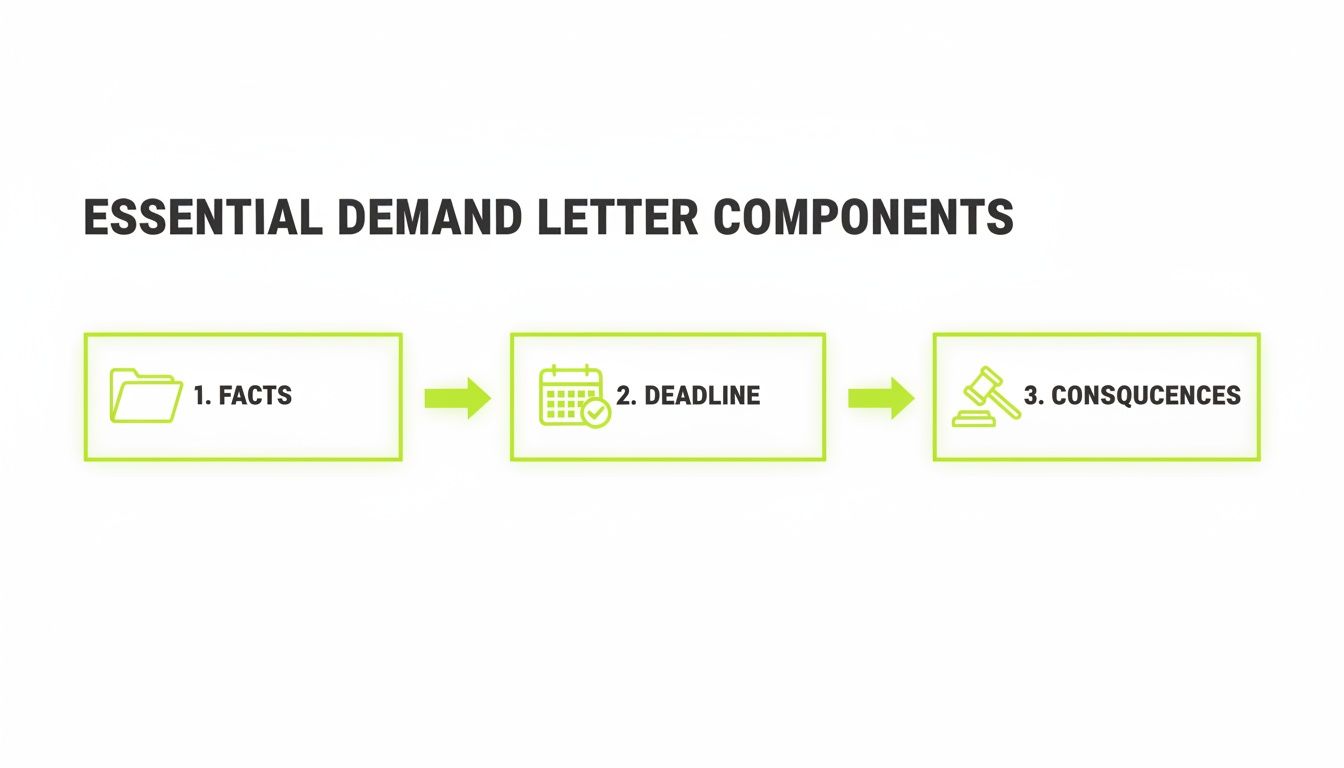
Each piece builds on the last, creating a document that is legally sound and difficult to ignore.
This structured process, often powered by AI AR automation, is how you consistently reduce DSO and improve cash flow. It turns collections from a stressful, reactive firefight into a smooth, predictable part of your finance operations.
Using AR Automation to Systematize Collections
Chasing invoices manually burns out your finance team. It is inefficient, inconsistent, and highly prone to error.
For a modern finance operation, a legal letter of demand for payment should not be a reactive, last-ditch effort. It should be an automated, predictable trigger within a larger accounts receivable system. This is how you shift from chasing debt to systematically managing cash flow.
Time spent manually tracking invoice aging, debating escalation, and drafting demand letters is a significant operational drag. It pulls senior finance talent away from strategic work.
Worse, a manual approach creates inconsistency. One client might get a demand letter at 90 days, while another slips to 120 because the controller was focused elsewhere that week.

Defining the Automated Escalation Trigger
Effective collections are built on a systematic, unemotional workflow. This is where accounts receivable automation excels. Instead of relying on calendar reminders and gut feelings, you establish firm rules that govern the entire collections process.
The system can be set to automatically generate and send a legally sound demand letter the moment an account hits a specific threshold, like 90 days past due. This removes the human hesitation that often delays critical collections activity and ensures every client receives the same professional, firm treatment.
Improving Recovery Rates with Systemized Authority
Modern AR software can escalate authority without immediately hiring expensive legal counsel. Some platforms can inject the "voice of a lawyer" into communications, signaling a serious, pre-litigation step.
This is a measured move that carries real weight. Data shows that adding this layer of authority can increase recovery rates by over 50% on severely delinquent accounts. It's a final, powerful nudge before an account is passed to a third-party agency or law firm.
The goal is to build a collections engine that improves cash flow and systematically reduces DSO without constant manual intervention. Automation ensures every step is documented, every communication is timed for maximum impact, and every escalation is justified by data.
By automating this critical step, you create a buffer that protects your team's time. The process becomes a standard operating procedure, not a stressful, last-resort fire drill.
Integrating with Your Existing Financial Stack
For most professional services firms, the accounting system is the source of truth. The key is to augment it, not replace it. Solutions providing QuickBooks AR automation can pull invoice data seamlessly and initiate collections workflows based on preset rules.
This creates a clean, closed-loop system where:
- Invoices are created in your accounting software.
- AR software for professional services monitors invoice aging.
- Automated reminders are sent at predefined intervals (e.g., 30 and 60 days).
- At 90 days, the system automatically triggers the legal letter of demand for payment.
This workflow turns manual chores into a single, cohesive process. Your finance team shifts from reactive administrators to strategic overseers. See our guide on the core benefits of accounts receivable automation.
Using AI AR automation, the system can even adapt, flagging at-risk clients earlier based on payment patterns. This allows for proactive intervention, long before an account becomes critically delinquent.
The focus is on building a system that scales. As your firm grows from $3M to $50M, your collections process should not break; it should scale with you. This is the operational control that automation delivers.
Common Mistakes and Legal Landmines
A perfectly worded demand letter can backfire if you stumble over common legal or operational tripwires. For any finance leader, the goal is compliance and control. You need a collections process that is effective and defensible.
Think of a demand letter as a financial tool operating within a legal framework. One wrong move can invalidate your claim or create new problems. The key is to operate from a position of documented control, not emotional reaction.
Errors That Can Sink Your Claim
Some mistakes instantly weaken your legal footing and give a debtor the upper hand. These are not minor administrative slips; they are strategic blunders.
Here are the most common pitfalls:
- Inventing Interest Charges: If your original contract does not explicitly allow interest on overdue invoices, you cannot invent a rate. This can be seen as attempting to collect more than is legally owed.
- Making Empty or Illegal Threats: Threatening to report a debt to credit agencies without the right to do so is a serious overstep. Any consequence you mention must be legitimate and within your legal rights.
- Using Aggressive or Harassing Language: Any language that could be seen as harassing or abusive poisons the well. The tone must remain firm and factual, focused entirely on the debt.
A demand letter is a formal business communication, not a venue for frustration. Every statement must be factual, verifiable, and directly related to the money owed. Any deviation adds risk.
Why Verifiable Delivery Is Non-Negotiable
How you send the letter is as important as what it says.
An email is often not enough to create a defensible legal record. If the matter escalates, you must prove the debtor received your demand.
This is why certified mail with a return receipt remains the gold standard. It provides timestamped, third-party proof of delivery. That single document closes the most common loophole debtors use: "I never got the letter."
The high-profile case of a lawyer's ChatGPT debacle serves as a stark reminder of why careful human oversight is critical, especially when new technology is involved in legal documents.
Staying on the Right Side of the Law
Weak contract enforcement is a massive drain on revenue. Globally, businesses lose 9.2% of annual revenue to it.
A firm, legally sound approach works. In the US, well-executed demand letters have a 55-75% resolution rate, often within 7-14 days. Final, more assertive letters have been shown to recover 25-35% more than a simple reminder.
The data is clear. This is not legal advice, but practical, operational guidance. Avoiding these mistakes protects your firm’s legal standing and significantly boosts your chances of getting paid.
Common Questions About Sending a Demand Letter
Moving to a formal demand letter can feel like a big step. It raises practical questions for finance leaders trying to protect cash flow without burning bridges.
Here are straight answers to the most common questions.
Can I Send a Demand Letter Myself, or Do I Need a Lawyer?
You can, and for the first formal notice, you probably should.
Sending a letter of demand on your own letterhead is standard business practice. It officially documents the debt and your attempt to resolve it, keeping you in control of the client conversation and saving legal fees.
However, a letter from a law firm carries more weight. It signals you have engaged legal counsel and are prepared for the next step. That perceived risk is often enough to get a response.
A letter from a law firm changes the conversation. It’s no longer just a billing issue; it’s a pre-litigation matter. That alone can break through the noise.
Some AR software for professional services offers a smart middle ground. It can integrate a formal notice from a legal partner directly into your automated workflow, providing legal weight without the typical expense.
What Is the Typical Success Rate of a Demand Letter?
A well-timed, well-written demand letter is highly effective. Industry data suggests you can resolve a delinquent account without going to court in up to 70-80% of cases.
Success depends on timing and tone. Too early seems aggressive. Too late, and the odds of collecting have already dropped.
The sweet spot is usually around the 90-day past-due mark. The demand letter acts as a final, professional notice that the informal stage is over. It creates urgency and demonstrates you have a process—a critical step to improve cash flow.
Will Sending a Demand Letter Ruin My Client Relationship?
Not if handled correctly. A legal letter of demand for payment is an instrument of clarity, not a declaration of war. The relationship is already strained by non-payment. Your letter is a formal, professional response to their inaction.
Tone is everything. Keep it firm, factual, and focused on the business problem. It is not a personal attack.
In larger companies, invoices get lost. A direct, formal letter often cuts through red tape to the person who can approve payment. A clear, documented request is more professional than a string of emotional emails.
How Does This Fit into AR Automation?
A demand letter should not be a manual panic button. It is most powerful as a planned, automated trigger in your accounts receivable automation system.
With AI AR automation, you can set rules that automatically escalate an account when it hits certain criteria, like invoice age. For instance, the system can generate and send a pre-approved demand letter template the moment an invoice hits 90 days overdue.
This removes hesitation and human error. Every account is treated consistently, which systematizes collections and is key to sustainably reduce DSO. When integrated with tools like QuickBooks AR automation, you get a seamless process from invoice to final demand.
Bringing Consistency to Your Collections Process
Chasing overdue invoices without a system is exhausting. One week you send polite nudges; the next you debate how firm to be. It is an unpredictable process that drains your finance team.
A well-timed legal letter of demand for payment is a powerful tool, but its strength comes from being part of a disciplined, predictable system. It should be a calculated step in a defined workflow.
This is where accounts receivable automation changes the game.
By building a systematic workflow, you create a consistent experience for every client. The right triggers ensure nothing falls through the cracks, which is key to reducing DSO. Your team can shift focus from chasing payments to strategic work. We dive deeper in our guide on effective **procedures for accounts receivable that work**.
The goal is not just to collect faster. It's to build a collections engine that runs with precision, protecting cash flow while preserving client relationships. It is about control—calm, reliable, and repeatable.
--- Resolut automates AR for professional services—consistent, accurate, and human. Learn more at https://www.resolutai.com.