
A CFO's Guide to Net Credit Sales
Master net credit sales to improve cash flow and reduce DSO. A definitive guide for CFOs on calculation, key metrics, and AR automation for service firms.
Net credit sales is not an academic accounting term. For a professional services firm, it is the true measure of collectible revenue.
It provides a clear, unvarnished view of your firm’s financial performance by stripping out fee adjustments, project cancellations, and other concessions. Understanding this metric is fundamental to managing your firm’s working capital and cash flow.
What Net Credit Sales Reveals About Your Firm
In professional services, most revenue is earned on credit. This makes the net credit sales figure the starting point for critical metrics like your accounts receivable turnover ratio and Days Sales Outstanding (DSO).
Unlike gross sales, which can present an overly optimistic picture, net credit sales reflects the revenue you can actually expect to collect. It cuts through the noise of total billings to reveal the firm's true performance.

Why This Metric Demands Your Attention
Monitoring the gap between gross and net credit sales provides a diagnostic tool for your operations. A widening gap can be an early indicator of service delivery issues leading to increased fee reductions or client disputes.
This figure is also the foundation for accurate cash flow forecasting. It removes the distortion of total billings to focus on the actual, collectible revenue that fuels day-to-day operations.
For a CFO or Controller, net credit sales is the true starting point for cash flow forecasting. It strips away the noise of total billings to reveal the actual, collectible revenue that fuels the business day-to-day.
A precise understanding of this figure is the first step toward improving cash flow and reducing DSO. As we've detailed before, AR process inefficiencies carry significant financial weight, a topic covered in our guide on the true cost of AR inefficiency in professional services. Mastering net credit sales enables a shift from reactive financial management to proactive control.
How to Calculate Net Credit Sales Accurately
The accuracy of your net credit sales figure is foundational to your firm’s financial analysis. This number dictates the reliability of every subsequent AR metric.
The formula is straightforward, designed to isolate the revenue earned from invoiced work after accounting for any downward adjustments.
Net Credit Sales = Gross Credit Sales – (Sales Returns + Sales Allowances)
Each component requires meticulous and consistent tracking. Minor, recurring errors in data capture can compound, distorting your view of the firm’s performance and masking underlying issues in your order-to-cash process for financial operators.
The Components of the Calculation
To apply the formula correctly, each term must be clearly defined and recorded systematically within your accounting system.
- Gross Credit Sales: The total value of all invoices issued for services rendered on credit during a specific accounting period.
- Sales Returns: A full project cancellation, resulting in a credit memo for the entire invoice amount. This effectively nullifies the original sale.
- Sales Allowances: A partial credit or fee reduction granted to a client, often to address minor scope discrepancies or project delays.
Net Credit Sales Calculation Example
Consider a consulting firm’s Q3 financial data. The adjustments provide a much clearer picture of earned revenue.
Component | Description | Amount |
|---|---|---|
Gross Credit Sales | Total invoices issued for services rendered on credit in Q3. | $850,000 |
Sales Returns | Credit memo issued for a fully canceled project. | ($25,000) |
Sales Allowances | Fee reduction granted for a minor project delay. | ($10,000) |
Net Credit Sales | Gross Credit Sales - Returns - Allowances | $815,000 |
The firm’s net credit sales of $815,000 is the correct figure for calculating key metrics, not the gross billings of $850,000. It is based on what the firm actually expects to collect. For a deeper look at the accounting discipline required, certain Vibe Accounting principles can be instructive.
Disciplined data capture is the key. Modern AR software enforces this discipline by ensuring every credit memo and adjustment is logged correctly, providing a reliable data foundation.
Turning Data Into Strategic Insight
An accurate net credit sales figure is the primary input for analyzing how efficiently your firm converts services into cash. This analysis is not a historical exercise; it is about gaining control over future cash flow.
The data must be refined from total billings down to a clean, usable number for analysis.
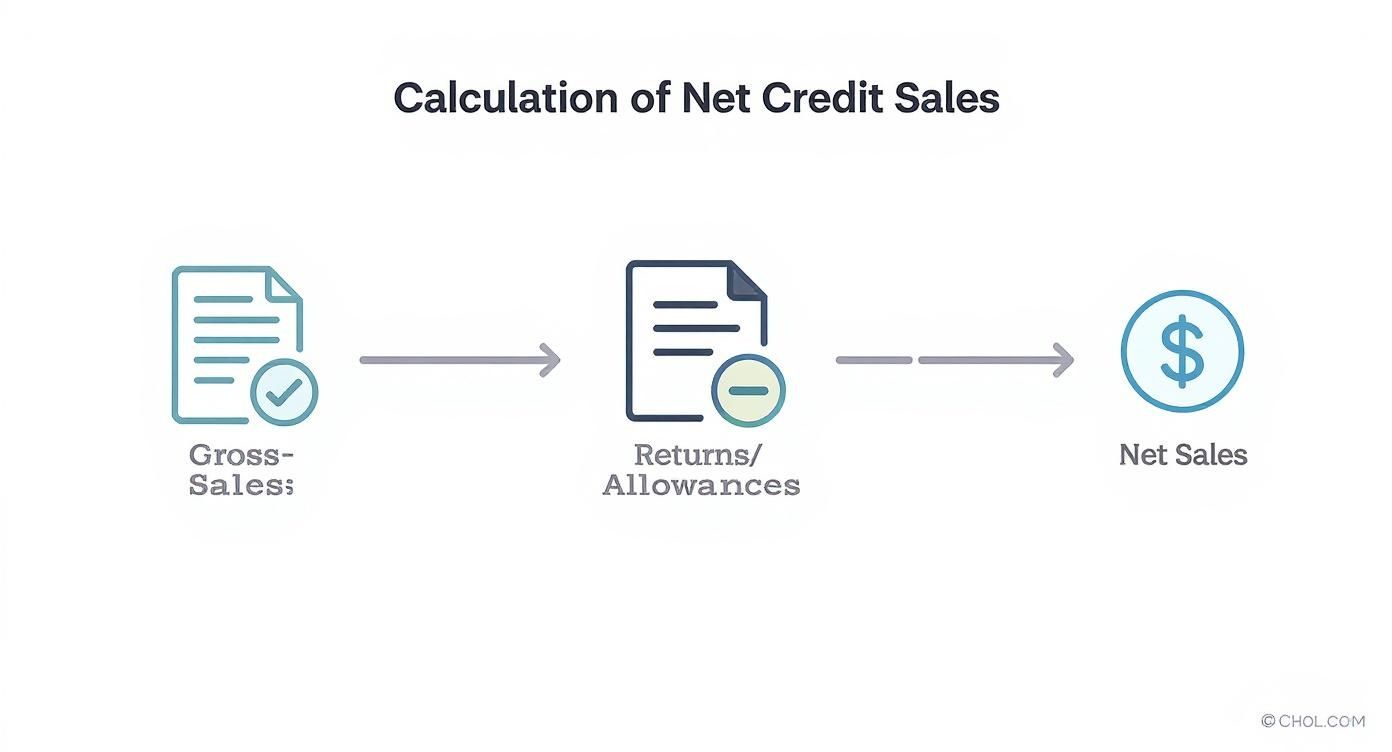
This refined metric unlocks two critical performance indicators: the Accounts Receivable Turnover Ratio and Days Sales Outstanding (DSO).
Accounts Receivable Turnover Ratio
The AR Turnover Ratio measures the number of times per year a firm collects its average accounts receivable. It is a direct measure of collections efficiency.
A high ratio indicates a streamlined AR process. A declining ratio is a leading indicator of future cash flow constraints.
AR Turnover Ratio = Net Credit Sales / Average Accounts Receivable
A firm with $3.2M in annual net credit sales and an average AR of $400,000 has a turnover ratio of 8. This means receivables are turned over eight times per year, or approximately every 45 days. Tracking this trend provides a clear view into the health of your collections cycle.
Days Sales Outstanding (DSO)
While AR Turnover provides a high-level view, DSO measures the average number of days it takes to collect payment after an invoice is sent. Minimizing DSO is a primary objective for any professional services firm.
The formula is derived directly from the turnover ratio:
DSO = 365 Days / AR Turnover Ratio
Using the previous example, the DSO would be 365 / 8 = 45.6 days. This KPI provides direct feedback on the effectiveness of your firm’s credit and collections policies.
These metrics depend on precise inputs. Firms are increasingly using tools for AI for financial analysis to gain deeper insights from financial data. The value of such analysis is contingent on the accuracy of the underlying data.
This is where accounts receivable automation becomes a strategic asset. Platforms with seamless QuickBooks AR automation, for example, ensure that the data feeding your net credit sales calculation is captured correctly from the start. This produces DSO and turnover calculations that are reliable, forming the basis for sound financial control.
The Small Leaks That Sink Big Ships: Common Pitfalls in Reporting Credit Sales
An accurate net credit sales figure is the bedrock of your financial metrics. Your AR turnover and DSO calculations are useless if the foundational number is flawed.
Small, persistent process gaps can erode data integrity, masking cash flow issues until they become critical. The most common failure is inconsistent data entry.
A project manager agrees to a fee adjustment but delays reporting it. The credit memo that should have been processed in Q2 isn't recorded until Q3. The result is an artificially inflated Q2 revenue figure and a false sense of security.
This simple delay directly skews your most important health metrics. A DSO calculation based on that inflated sales number will appear healthier than reality. Your AR turnover ratio will hide growing inefficiencies in collections. You're operating with flawed data.
The Downstream Impact of Tiny Errors
Small reporting errors compound, creating significant distortions in financial analysis. The primary risks stem from delays and misclassifications common in manual processes.
- Delayed Credit Memos: The sales allowance from Q2 entered in Q3 deflates Q3's performance while having artificially boosted Q2's. This creates volatility in period-over-period analysis and makes it nearly impossible to spot genuine performance trends.
- Misclassified Sales: A cash sale mistakenly logged as a credit sale, or vice versa, subtly throws off all AR-dependent metrics. This is less common in services but can occur with upfront retainers.
These are not just bookkeeping issues; they lead to flawed strategic decisions. A management team reviewing an artificially low DSO may fail to address a worsening collections problem.
The real danger of poor data discipline isn't the immediate accounting error. It's the flawed operational strategy it inspires. A skewed DSO can mask a collections problem that is quietly draining your firm’s working capital.
How to Regain Control with Process and Automation
Auditing your credit-to-cash cycle is essential to enforce consistency and ensure every adjustment is captured in the correct period. This is where accounts receivable automation provides a structural solution.
Dedicated AR software for professional services, particularly systems offering seamless QuickBooks AR automation, ensures data flows from your accounting system in real-time. This eliminates manual lag and human error in processing credit memos and adjustments.
This systematic approach ensures the net credit sales figure is always clean and reliable. It allows you to actually reduce DSO and improve cash flow because you are making decisions based on data you can trust.
Using Automation to Improve Collections
Inconsistent data entry and delayed credit memos are symptoms of a manual, disconnected process. For firms managing millions in revenue, reliance on spreadsheets and manual follow-ups is an operational risk. The solution is a better system, not more oversight.
Accounts receivable automation provides a structural fix. It shifts the finance function from a reactive posture—chasing information—to a proactive one where data integrity is embedded in the workflow.

From Manual Errors to Systemic Accuracy
Specialized AR software for professional services eliminates the manual touchpoints that introduce errors. Instead of waiting for an email to flag a fee reduction, the system provides a central point to issue, track, and apply credit memos in the correct accounting period.
This systematic approach directly improves the accuracy of your net credit sales calculation. When every adjustment is captured as it occurs, the data used for analysis is reliable and current. That precision is the foundation for any meaningful effort to improve cash flow. Our guide to accounts receivable automation software explores the mechanics in greater detail.
Driving Measurable Outcomes
The objective of automation is not just accuracy; it is improved performance. Automating invoicing, payment reminders, and collections workflows has a direct, tangible impact on key financial metrics.
- Reduce DSO: Automated, intelligent reminders prompt clients to pay faster. This systematic follow-up can reduce DSO by 10-20% or more.
- Improve AR Turnover: Faster collections mean the AR balance turns over more frequently, freeing working capital from outstanding invoices.
- Enhance Data Integrity: With QuickBooks AR automation, data syncs seamlessly. This eliminates duplicate entry and ensures all financial reports are based on a single source of truth.
An automated AR system transforms collections from an administrative burden into a data-driven function. It ensures every dollar of your net credit sales is collected as efficiently as possible, protecting your firm's most critical asset: cash.
The financial services sector provides a powerful example. Global payments revenue has grown by an average of 7% annually, with the market projected to reach $3.0 trillion by 2029. As you can discover in McKinsey's global payments report, mastering the credit-to-cash cycle is a core driver of financial performance.
AI AR automation takes this further by predicting payment behaviors and helping prioritize collections on at-risk accounts. This allows your team to focus its efforts where they will have the greatest impact.
Putting It All Together: From Numbers to Control
Mastering net credit sales is about taking control of your firm’s financial reality.
An accurate, real-time understanding of this number allows you to direct cash flow rather than react to it. It is the difference between managing from the rearview mirror and steering with a clear view of the road ahead.
The objective is to build systems that deliver both accuracy and predictability.
True financial control isn’t about just having the data. It’s about trusting your data enough to move from reactive management to proactive strategy. It’s making decisions based on what’s actually happening, not what you hope is happening.
When you master the calculation and use it to sharpen metrics like DSO, you gain a powerful lever for growth. This is where accounts receivable automation becomes a strategic advantage.
Automation ensures the numbers are real. It removes the manual errors and lag that create uncertainty, providing a reliable foundation for every financial decision.
The result is a more resilient firm, one that can manage working capital with confidence and plan for the future without guesswork.
A Few Common Questions
What’s the Difference Between Net Sales and Net Credit Sales?
Net sales includes all revenue from both cash and credit sales, minus returns and allowances. It is a comprehensive measure of total revenue.
Net credit sales isolates only the revenue from sales made on credit.
For professional services firms where nearly all work is invoiced with payment terms, the two figures are often similar. However, the distinction is critical. Metrics like DSO and AR turnover must be calculated using net credit sales to be accurate.
So, What’s a Good AR Turnover Ratio for a Service Firm?
A "good" ratio is relative to your industry and standard client payment terms. A higher number is always better, indicating an efficient collections process.
If your standard terms are Net 30, an AR turnover ratio of around 12 is a strong benchmark, as it implies collections occur roughly once per month.
The most important practice is not hitting a specific number, but tracking your own ratio over time. A stable or rising trend indicates control. A dip is an early warning of impending cash flow issues.
Can AR Automation Actually Work With QuickBooks?
Yes. Leading accounts receivable automation platforms are designed for seamless integration with accounting software like QuickBooks. This is a core function, not an add-on.
This QuickBooks AR automation ensures that data flows between systems instantly and accurately. It eliminates manual data entry, reduces the risk of human error, and provides a real-time view of your net credit sales and receivables without disrupting existing workflows.
--- Resolut automates AR for professional services—consistent, accurate, and human. Learn more at https://www.resolutai.com.