Gary Amaral

A receivable management system isn't just software. It’s a strategic decision to control your firm’s financial health.
For finance leaders at professional services firms, it’s the framework that transforms accounts receivable from a manual, unpredictable process into a data-driven operation that improves cash flow and reduces risk.
Why Professional Services Firms Move Beyond Spreadsheets
If you're a CFO or Controller, you know the drag of managing receivables with spreadsheets and the basic functions in QuickBooks. This disconnected, manual approach is the root cause of high Days Sales Outstanding (DSO) and volatile cash flow.
This process creates operational friction. Every invoice is tracked by hand. Reminders are inconsistent. Reconciling payments is a time-consuming exercise where errors are common. Without a central system, you have no single source of truth for your firm's most critical asset: cash.
The Hidden Costs of Manual AR
The real price of outdated processes goes beyond wasted hours. It creates financial friction that erodes profitability.
Delayed Revenue: Inconsistent follow-up delays payments. This directly impacts working capital and your ability to invest in growth.
Increased Bad Debt: Without systematic tracking of at-risk accounts, they are more likely to become uncollectible write-offs.
Strained Client Relationships: Awkward, emotional collection calls can damage the goodwill your delivery teams have built.
Late payments are a systemic problem. In the United States, a staggering 39% of B2B invoices are paid late, and many firms report that 81% of their payments are delayed. This isn't an inconvenience—it’s a direct hit to your expected revenue. Discover more insights about B2B payment delays.
Manual AR vs. Automated Receivable Management System
The gap between a manual approach and an automated one isn’t just about efficiency—it's about fundamentally changing how you manage your firm's financial future.
Process | Manual Approach (Spreadsheets & QuickBooks) | Automated System Approach |
|---|---|---|
Invoice Follow-Up | Inconsistent, manual emails and calls. Relies on human memory and calendar reminders. | Automated, personalized reminders sent based on preset schedules and client behavior. |
Cash Flow Forecasting | Guesswork based on historical data and gut feelings, leading to frequent surprises. | Accurate, real-time projections based on payment trends and invoice statuses. |
Client Communication | Ad-hoc and often reactive. Tone can vary, potentially damaging relationships. | Consistent, professional, and on-brand communication for every client interaction. |
Reporting & Visibility | Fragmented data across multiple spreadsheets. Difficult to get a clear, up-to-date picture. | Centralized dashboard with a single source of truth. Real-time visibility into DSO and AR aging. |
Payment Processing | Manual reconciliation of checks and bank transfers. Time-consuming and prone to errors. | Integrated online payment portals. Automated cash application and reconciliation. |
The table makes it clear: one path leads to constant firefighting, while the other creates a predictable, scalable financial operation.
A Strategic Shift Toward Financial Control
Viewing a receivable management system as just another software expense is a mistake. It represents a fundamental shift toward operational control and financial predictability.
The right system, especially one offering robust QuickBooks AR automation, doesn’t just send reminders. It provides the framework to manage your collections strategy from end to end.
A proper system transforms accounts receivable from a purely administrative function into a strategic asset. It provides the visibility needed to forecast cash flow accurately and make informed decisions about growth, hiring, and investment.
By implementing dedicated AR software for professional services, you standardize your communication and ensure every invoice is managed with a clear workflow. This approach doesn't just reduce DSO; it builds a far more resilient financial foundation for your firm.
The Core Components of an Effective AR System
A modern accounts receivable system is a set of connected modules that work together to bring order to your cash flow. For a professional services firm, understanding these components is key to making your revenue cycle predictable.
Think of it as an operating system designed for getting paid. Each part tackles a specific point of friction that slows down the manual AR process, from client onboarding to cash application. This structure replaces guesswork with data, letting your finance team focus on strategy.
Credit and Risk Management
The AR cycle begins the moment you extend credit to a client, not when you send an invoice. A smart system brings credit and risk management to the forefront, preventing collection issues before they begin.
Instead of relying on a gut feeling, this module helps you set and enforce standard credit policies. It can pull external data to check a new client's payment history, helping you set appropriate terms from day one. This proactive approach is your first line of defense to improve cash flow and minimize write-offs.
A strong credit management function acts as a filter. It ensures the clients you bring on are a good fit for your firm's financial health, starting the relationship on solid, transparent ground.
Billing and Invoicing Automation
In professional services, billing is rarely simple. Invoices must be accurate and timely, reflecting complex project work or retainer agreements. A single manual error—a wrong PO number or an outdated contact—is a common reason for payment delays.
Billing and invoicing automation ensures every invoice is sent correctly and on time. For firms running on QuickBooks, a dedicated system adds a layer of precision that is difficult to achieve manually.
Accuracy: It pulls data directly from your accounting software, eliminating manual entry errors.
Timeliness: Invoices are sent automatically based on schedules, removing human memory from the equation.
Delivery: It confirms invoices reached the right person, so nothing gets lost in transit.
This turns billing into a reliable, machine-driven process—the bedrock of an efficient collections cycle.
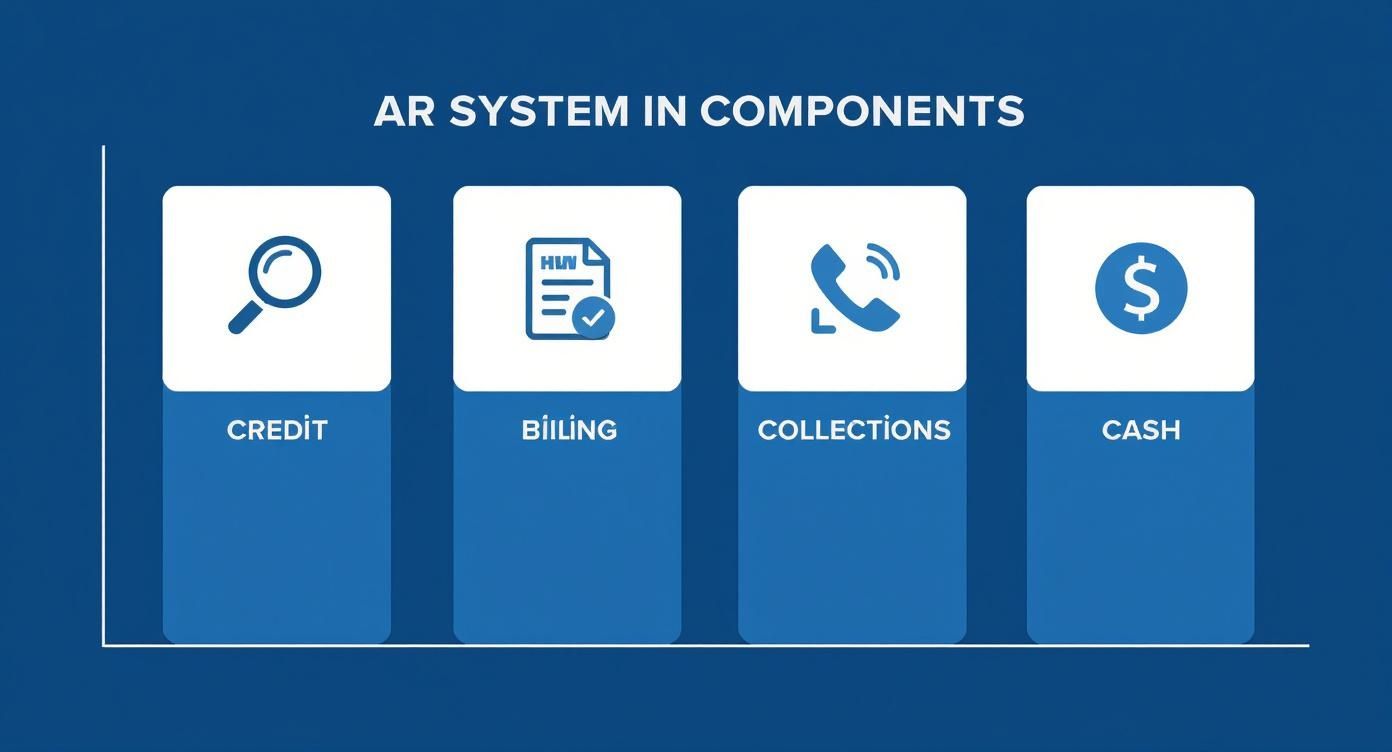
Omnichannel Collections Outreach
This is the engine of accounts receivable automation. Once an invoice is sent, a structured, persistent follow-up process is what separates firms that get paid quickly from those that don't. Manual collections are inconsistent by nature.
An automated outreach module replaces that chaos with a smart, pre-defined strategy. This isn't about sending robotic emails. A good system lets you build personalized communication workflows that adapt to the client.
You can design a sequence of touchpoints across email, SMS, and even automated calls, with timing and tone that escalate as needed. This quiet persistence keeps your invoice top-of-mind and systematically works to reduce DSO.
Automated Cash Application
The final component is matching payments to the right invoices. Doing this by hand is a time-consuming recipe for errors. This bottleneck means cash sits unapplied in your account, distorting your true AR position.
Automated cash application, often powered by AI AR automation, solves this. The system intelligently matches payments to open invoices, even with partial payments or messy remittance details. It eliminates hours of manual reconciliation, freeing up your team for more valuable analysis. For firms seeking true QuickBooks AR automation, this is essential for maintaining accurate, up-to-date books.
Quantifying the Impact on DSO and Cash Flow
For any finance leader, a new system must produce measurable results. A receivable management system must directly and positively impact the balance sheet, primarily through Days Sales Outstanding (DSO) and overall cash flow.
Implementing accounts receivable automation is a strategic move to unlock the working capital trapped in a slow collections cycle. By systemizing outreach and simplifying payment for clients, you can predictably shorten your cash conversion cycle.
Visual Idea: A simple line graph showing DSO trending downwards over two quarters post-implementation, with a callout box highlighting the dollar value of unlocked working capital.
From proactive credit checks to automated cash application, each component is designed to systematically reduce the delays and friction that slow you down.
Modeling the Financial Impact of DSO Reduction
Let's use a tangible example. For a professional services firm with $10 million in annual revenue, each day is worth approximately $27,397 in revenue ($10M / 365). If your current DSO is 60 days, $1,643,820 of your capital is tied up in receivables.
A modern AR software for professional services can realistically reduce DSO by 10 days within the first few quarters.
The Calculation: 10 days x $27,397/day = $273,970
That $273,970 isn't a one-time gain. It is permanent working capital injected back into your business. It's cash that is now available for investment or operational needs.
This improvement comes from two powerful drivers:
Consistency: Automated reminders ensure no invoice is forgotten. This simple action eliminates a common cause of late payments: human oversight.
Accessibility: Providing clients an online portal to view and pay invoices removes friction, often speeding up payments by several days.
This is a conservative estimate. Many firms see DSO reductions of 15-25% within the first year. To dive deeper, see other ways to increase cash flow.
Quantifying Labor Savings and Strategic Redeployment
The second return is the reallocation of your team's time. A finance team member at a $10M firm might spend 15-20 hours per week on manual collections: pulling aging reports, drafting emails, making calls, and matching payments.
AI AR automation eliminates the majority of this administrative work. With automated dunning and cash application, that team member’s time is freed. Instead of chasing money, they can manage it.
They can now focus on high-value work:
Identifying clients with deteriorating payment habits early.
Analyzing profitability by project or client.
Building more accurate cash flow forecasts.
Recovering 15 hours per week adds up to 780 hours a year that can be redirected from administrative tasks to strategic financial management. This isn't just a cost saving; it's an upgrade to your finance function's capabilities without adding headcount.
How AI Transforms Accounts Receivable Automation
Artificial intelligence is shifting accounts receivable from a reactive, rules-based task to a proactive, intelligent function. For finance operators, this is about gaining a real grip on cash flow and risk.
The value of AI AR automation is its ability to learn from your data. Instead of sending reminders on a fixed schedule, an AI-powered system analyzes payment histories and communication patterns to make smarter decisions. It elevates the process from task execution to financial strategy.

This shift is why the accounts receivable automation market is growing. Valued at roughly USD 3.4 billion, it's expected to reach USD 5.95 billion by 2030. The engines behind this growth are AI-driven cash application and real-time payment systems.
Predictive Analytics for Prioritized Collections
AI enables predictive analytics, scoring each outstanding invoice on its probability of being paid on time. It analyzes dozens of factors—client payment history, invoice size, industry trends—to flag high-risk accounts before they become a serious problem.
This allows your finance team to stop treating every overdue invoice the same way. Instead of working down an aging report, they can focus their energy on the accounts AI has flagged as most likely to default. It's a surgical approach that makes collections far more efficient.
AI doesn't replace your team's expertise; it amplifies it. The system handles repetitive, high-volume work, freeing your people to manage the complex, high-stakes client relationships that require a human touch.
Intelligent Cash Application and Reconciliation
For firms wrestling with manual processes or basic QuickBooks AR automation, cash application is a significant time sink. Matching incoming payments to the right invoices is tedious and error-prone.
AI-powered cash application solves this with near-perfect accuracy. It uses machine learning to read remittance data from various sources, automatically matching payments to open invoices. This capability slashes unapplied cash and provides a clear, real-time picture of your cash position.
A smooth rollout depends on solid AI solution integration, ensuring data flows seamlessly without disrupting core financial operations. Ultimately, AI turns a receivable management system into a forward-looking tool, enabling more accurate cash forecasting and strategic planning.
A Practical Checklist for Choosing the Right System
Selecting a receivable management system is a capital decision. The right choice provides control over your cash flow. The wrong one creates operational friction with zero return.
For finance leaders in professional services, this goes beyond feature lists. You need a system that understands the nuances of project-based billing, retainers, and the high-touch client relationships your firm is built on.
The market for accounts receivable software was valued at USD 2.36 billion in 2021 and is on track to hit USD 7.7 billion by 2033. This reflects a clear signal that firms are moving away from inefficient processes. You can read more on these market trends here.
Core Integration and Scalability
First, technical fit. If a system can’t integrate with your general ledger, it’s a non-starter. For most professional services firms, the quality of its QuickBooks AR automation is paramount.
Demand a live demo of the integration. It must be a true two-way sync, where invoice data, payments, and customer records flow between systems automatically. This eliminates reconciliation headaches.
Scalability is just as critical. The system that works for your $3M firm today must perform equally well when you reach $15M or $50M, without a painful migration. Ask vendors how their platform handles increased transaction volume and users.
A receivable management system should adapt to your firm, not the other way around. Scalability and deep integration are the foundations of a long-term solution.
Customization of Dunning and Workflows
Professional services is not a one-size-fits-all business. Your collections strategy shouldn't be, either.
A solid AR software for professional services must allow precise configuration of dunning workflows. You need control to adjust the timing, tone, and channel of reminders based on the client, invoice age, or project terms.
Non-negotiable features include:
Workflow Logic: Can you build different reminder cadences for strategic accounts versus smaller clients?
Communication Templates: Can you fully customize email and SMS templates to reflect your firm's voice?
Exclusion Rules: Can you easily pause automation for an invoice or client when a human conversation is needed?
This level of control ensures your accounts receivable automation reinforces your professionalism, rather than damaging client relationships with generic reminders. See our guide on how to choose AR automation software that works for professional services firms.
Security, Support, and Partnership
Finally, look past the software to the company behind it. You’re entrusting them with sensitive financial data; confirm the platform meets recognized security standards like SOC 2.
Then, evaluate the human element. What is their implementation process? Who is your point of contact for support? A true partner provides expert guidance to ensure you realize the platform's full value.
Vendor Evaluation Checklist for AR Automation Software
Evaluation Criteria | Key Questions to Ask | Why It Matters |
|---|---|---|
Integration Quality | Does it offer true, bi-directional sync with QuickBooks? Can you show me a live demo? | A clunky sync creates manual reconciliation work, defeating the purpose of automation. |
Scalability | How does the system handle a 5x increase in invoice volume? What are the pricing tiers? | You need a system that grows with your firm, not one you’ll outgrow in 18 months. |
Workflow Customization | Can we create different reminder schedules and tones for different client segments? | Generic reminders can damage high-value relationships. Nuance is essential in professional services. |
Ease of Use | How intuitive is the dashboard? What’s the learning curve for our finance team? | If the system is too complex, your team won’t use it, and you won’t see an ROI. |
Client Payment Experience | What does the payment portal look like for our clients? Is it simple to use? | A clunky payment process for your clients creates friction and delays payment. |
Reporting & Analytics | What KPIs can we track? Can we see real-time cash flow projections? | You cannot improve what you do not measure. Good data drives smarter financial decisions. |
Security & Compliance | What security certifications do you hold (e.g., SOC 2)? How is our data protected? | Financial data is sensitive. Non-negotiable security protects your firm and your clients. |
Implementation & Support | Who will manage our onboarding? What does ongoing support look like? | A strong partnership with the vendor is crucial for long-term success. |
Asking the right questions ensures you focus on the operational realities that determine whether a platform becomes a true asset.
Gaining Financial Control and Predictability
Ultimately, implementing a receivable management system is about taking back control over your firm’s financial future. The move from manual AR to an automated system is a foundational shift toward building a resilient financial operation.
This isn’t just about collecting cash faster. It’s about gaining the clarity you need to lead with confidence. An automated system provides clean, real-time data to make smarter decisions on cash flow forecasting and resource allocation. It turns your finance function from a reactive cost center into a proactive, data-driven asset.
Building a Resilient Financial Operation
When you systematize outreach, you also strengthen client relationships. Professional, consistent communication replaces awkward, ad-hoc follow-ups, improving the payment experience and reinforcing your firm’s brand.
Visual Idea: Cinematic shot of a calm, confident CFO looking out a window over a cityscape, representing foresight and control.
This also frees your finance team for high-value work. They can stop reconciling payments and start analyzing client payment trends, identifying credit risks, and contributing to strategic growth. Explore the full range of accounts receivable automation benefits to see how this changes the game.
A receivable management system turns your AR from an unpredictable variable into a reliable operational asset. It provides the financial predictability needed to plan, invest, and grow with a clear view of the road ahead.
You move from a state of constant reaction—chasing aging invoices and patching cash flow gaps—to a state of control. With tools like AI AR automation, you can anticipate payment behaviors and manage risk before it hits your bottom line. That control over your cash conversion cycle is the objective.
Frequently Asked Questions
When finance leaders at professional services firms evaluate a new receivable management system, the questions are practical and direct. The answers should be as well.
Here are the questions we hear most from CFOs, Controllers, and firm owners.
How Does a Receivable Management System Integrate with QuickBooks?
A modern system must integrate seamlessly with QuickBooks. This is a baseline requirement, not a feature.
The integration must be bi-directional. Invoice data, client information, and payment records flow from QuickBooks to the AR platform. Critically, when a payment is reconciled, that data must flow back to QuickBooks automatically. This keeps your general ledger clean without creating new manual work.
This two-way sync establishes a single source of truth. Always request a live demo of the QuickBooks AR automation. Make vendors prove it works as described.
Will Automating Collections Damage Our Client Relationships?
No. In practice, the opposite occurs.
Good accounts receivable automation professionalizes client financial relationships. It replaces inconsistent, sometimes emotional human follow-ups with predictable, on-brand communication.
You can configure personalized, tiered strategies that match the tone to the client and situation. Early reminders can be light and helpful; later notices can be direct but professional. This consistency improves cash flow by removing the awkwardness and misunderstanding common in manual collections.
A disciplined, automated process shows clients your firm is organized and professional in all aspects of its business—including how you manage finances.
What Is a Realistic Timeframe for Reducing DSO?
You should see a measurable drop in your Days Sales Outstanding (DSO) within the first 60 to 90 days. This initial result comes from automating reminders for every invoice, which captures payments that were simply overlooked.
More significant improvements occur over the next three to six months as you use system analytics to refine your collection strategies. For most professional services firms, a 15-25% reduction in DSO within the first year is a reasonable target. This represents a permanent increase in available working capital.
Can an AR System Handle Our Firm's Unique Billing?
This is where diligence is required. Standard software often fails to handle the complexities of professional services billing, such as project-based invoices, milestone payments, or retainers.
A system built for professional services must be flexible. Look for the ability to customize collection workflows based on service type, client history, or contract terms. The ability to easily pause automated messages for a specific invoice or client is non-negotiable for managing delicate relationships.
Pressure-test any system you consider. Bring your most complex billing scenarios to the demo and confirm it can handle them.
Resolut automates AR for professional services—consistent, accurate, and human.