What Are Aging Reports? A CFO's Guide to Cash Flow Control
Discover what are aging reports and learn how to use them to reduce DSO, forecast cash flow, and drive financial strategy with AR automation.
An accounts receivable aging report is a diagnostic tool. It segments all unpaid client invoices by the number of days they are outstanding.
For a professional services firm, this isn't just an accounting ledger. It's a direct reflection of operational efficiency and cash discipline.
The AR Aging Report Through an Operator's Lens
For CFOs and Controllers at growing firms, the AR aging report is a predictive tool, not a historical record.
It reveals client payment behaviors, signals potential cash flow gaps, and exposes weaknesses in the billing and collections cycle long before they become emergencies.
A well-maintained aging report shifts the finance function from reactive cash collection to proactive working capital management. It translates abstract data into actionable intelligence.
Core Components of an Aging Report
The report organizes data into key columns, providing a snapshot of who owes money and for how long. Understanding these components is the first step toward strategic decision-making.
Below is a breakdown of a standard AR aging report and why each element is critical for financial control.
Anatomy of an AR Aging Report
A breakdown of the essential columns in a standard accounts receivable aging report and their function for strategic financial analysis.
Component | Description | Strategic Importance for CFOs |
|---|---|---|
Customer/Client Name | Identifies which client accounts have outstanding balances. | Helps identify payment patterns with specific clients. Are high-value clients also your slowest payers? |
Invoice Number & Date | The unique identifier and issue date for each transaction. | Critical for clear communication during follow-ups and essential for resolving disputes efficiently. |
Invoice Amount | The total dollar value owed on each specific invoice. | Provides a clear view of total outstanding balances and the concentration of risk. |
Aging Buckets | Columns that segment invoices into time-based intervals (e.g., 0-30, 31-60 days). | This is the core of the report. It enables prioritized collections and accurate risk assessment. |
These components create a clear financial picture, but the aging buckets tell the story. They reveal not just what is owed, but how at-risk that revenue has become.
Here is a typical breakdown of the aging buckets:
- Current: Invoices not yet past due. This reflects a healthy, on-track process.
- 1–30 Days Past Due: Recently overdue. These accounts require an initial, professional reminder.
- 31–60 Days Past Due: The warning zone. Collection efforts must become more systematic.
- 61–90 Days Past Due: Moderate-risk territory. These accounts pose a tangible threat to cash flow.
- 90+ Days Past Due: High-risk. The probability of collecting these balances is diminishing daily.
For a professional services firm, any invoice moving past the 60-day mark indicates a process breakdown. The probability of collecting a B2B invoice drops to just 74% after 90 days. Reactivity is not a strategy.
This structured view allows leadership to focus collection efforts where they will have the greatest impact. Instead of applying uniform pressure, resources are directed at the aging buckets that pose the greatest risk to liquidity. This systematic approach is fundamental to effective accounts receivable automation and is essential for firms looking to reduce DSO and improve cash flow.
*Visual Idea: *A clean bar chart titled "Collection Probability vs. Invoice Age," showing a declining curve. X-axis: 0-30, 31-60, 61-90, 90+ days. Y-axis: Probability of Collection (98%, 90%, 74%, 50%).
*Visual Idea: *Cinematic shot of a finger tracing across a printed aging report, pausing on a large dollar amount in the "90+ Days" column, creating a sense of focused concern.
Translating Aging Buckets into Business Intelligence
An aging report tells a story about your business operations. Every column—Current, 1-30, 31-60, 61-90, and 90+ days—is a signal. Treating them as mere data points is a missed opportunity. They are diagnostics for revenue cycle health.
A sudden increase in the 31-60 day bucket is not a random event. It often points to a systemic issue, like misaligned project milestones and billing dates, or invoices lacking the detail clients require for approval. It’s an early warning to fix the system, not just chase the payment.
Interpreting the Signals from Each Bucket
Understanding what each column signifies allows for proactive financial management. Each bucket requires a different response.
- Current & 1-30 Days: This is the baseline for a healthy cash cycle. A high percentage of AR in this category means your invoicing and client payment habits are strong.
- 31-60 Days: The critical intervention window. Invoices here are aging, and client inertia is a factor. This is where accounts receivable automation provides maximum value with consistent, timely reminders.
- 61-90 Days: A red flag. The issue is likely more than a simple late payment. It could be a dispute, client dissatisfaction, or financial distress. A human-to-human conversation is required.
- 90+ Days: A direct threat to profitability. Balances here often lead to write-offs, impacting net income and distorting financial forecasts.
This diagram breaks down how an AR report connects what you're owed, your collection timeline, and the overall health of your cash flow.
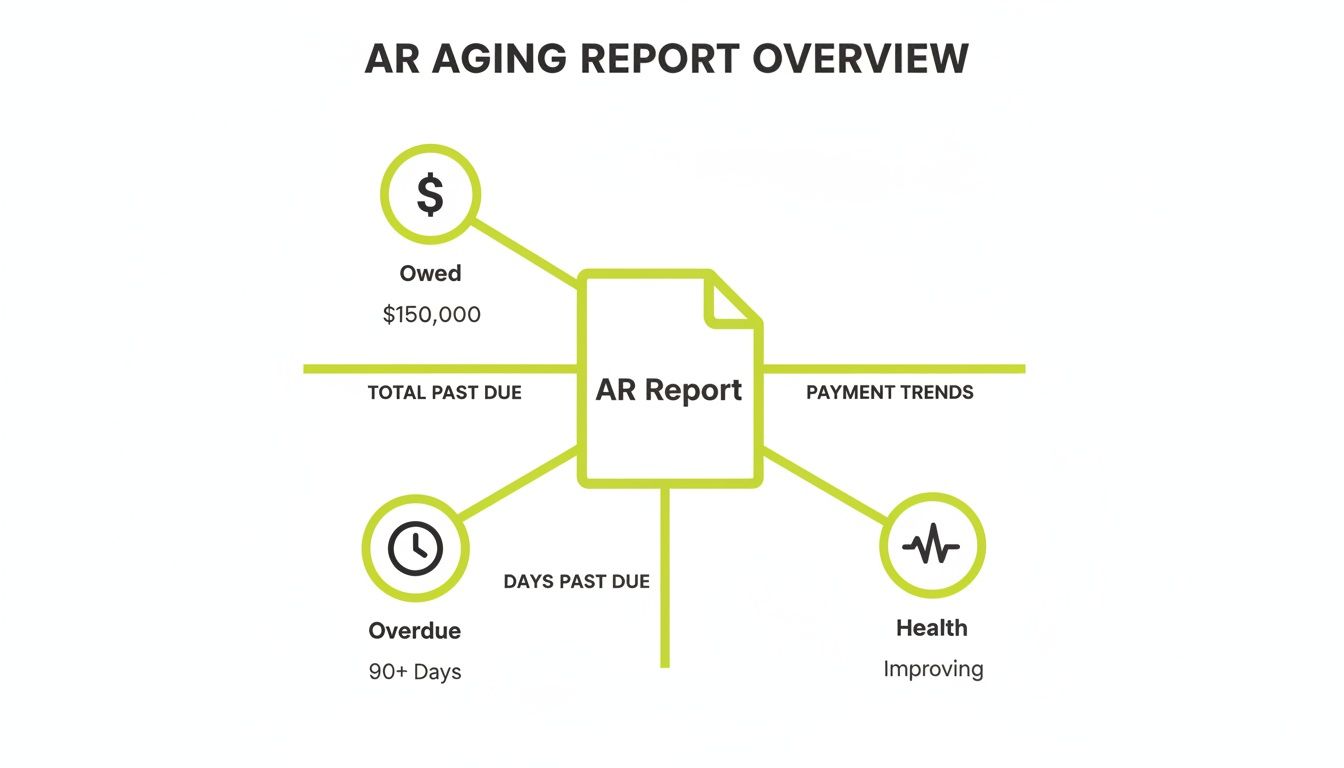
It’s not a static ledger. It is a dynamic tool for monitoring overdue accounts and managing the vitality of your cash flow.
A Practical Example in a Professional Services Firm
Consider a consulting firm with $10M in annual revenue. Their aging report shows $1.5M in total AR, with $250,000 in the 90+ day bucket. That represents a significant portion of their quarterly operating cash.
Upon analysis, they discover a single client accounts for $150,000 of that aged debt. The problem becomes specific and actionable. Is there a service dispute? Is the client facing insolvency? This insight, derived from the aging report, shifts the strategy from generic "collections" to a targeted recovery effort on a high-value, at-risk account.
An aging report converts abstract financial data into a precise roadmap. It tells you where to focus resources—whether it’s fixing a process flaw affecting the 31-60 day bucket or escalating a high-risk account in the 90+ day column.
This analysis is fundamental to improve cash flow and maintain control. Without it, you cannot differentiate between a minor delay and a serious threat to working capital.
Leveraging Automation for Clarity and Control
Manual tracking across hundreds of clients is inefficient and prone to error. This is where modern AR software for professional services provides leverage. A platform with QuickBooks AR automation delivers a real-time dashboard that surfaces these trends automatically.
For example, AI AR automation can flag accounts with a historical pattern of slipping from 30 to 60 days past due, predicting late payments. This enables proactive intervention before an account becomes a high-risk liability. It's about using technology to build a more predictable revenue cycle, not just to send reminders. This strategic approach helps reduce DSO and strengthens the firm’s financial foundation.
Driving Key AR Metrics with Your Aging Report
An aging report is a tool for action. For financial leaders, the raw data within it powers the vital signs of the firm's health.
The report is the source for calculating key performance indicators (KPIs) that measure financial velocity and operational discipline. It's how you transition from tracking invoices to managing cash flow.
Two of the most critical metrics derived from this report are Days Sales Outstanding (DSO) and the Collection Effectiveness Index (CEI). One measures speed, the other measures efficiency.

Days Sales Outstanding (DSO)
DSO measures the average number of days it takes to collect payment after work is completed. It is a direct measure of the cash conversion cycle. A lower DSO means you convert services to cash faster, freeing up working capital.
To calculate it, you need two figures: total accounts receivable (from the aging report) and total credit sales for the period.
DSO Formula:(Total Accounts Receivable / Total Credit Sales) x Number of Days in Period
For a firm with $800,000 in total AR at the end of a 90-day quarter and $2.4 million in revenue, the DSO is 30 days. Tracking this metric reveals whether collection velocity is improving or degrading.
Collection Effectiveness Index (CEI)
While DSO measures speed, CEI measures effectiveness. It calculates the percentage of receivables your team successfully collected during a period. It is a pure indicator of collections performance.
A CEI closer to 100% indicates a highly effective collections process. A declining score is a clear signal of a breakdown in process or execution.
The formula is more involved but essential:
- Beginning Receivables: Total AR at the start of the period.
- Credit Sales: Billed revenue during the period.
- Ending Total Receivables: Total AR at the end of the period.
CEI Formula:[(Beginning Receivables + Credit Sales) - Ending Total Receivables] / (Beginning Receivables + Credit Sales) x 100
A high CEI is the result of a disciplined, proactive approach to AR management. Improving it is one of the most direct ways to increase cash flow and stabilize firm finances.
These KPIs provide a complete picture of your AR health.
Essential AR KPIs Powered by Your Aging Report
KPI | Formula | What It Measures | Ideal Target for Professional Services |
|---|---|---|---|
Days Sales Outstanding (DSO) | (Total AR / Total Credit Sales) x Days in Period | The average number of days to collect payment after invoicing. | Under 45 days. Top performers aim for under 30. |
Collection Effectiveness Index (CEI) | [(Beginning Receivables + Credit Sales) - Ending Total Receivables] / (Beginning Receivables + Credit Sales) x 100 | The percentage of collectible receivables that were collected during a period. | Above 80%. Consistently hitting 90% or higher is excellent. |
Average Days Delinquent (ADD) | Days Sales Outstanding (DSO) - Best Possible DSO | The average number of days invoices are past due, isolating payment delays from credit terms. | As close to 0 as possible. An ADD of 5-10 days is common. |
Aged Debt Percentage | (Total Overdue Invoices / Total AR) x 100 | The percentage of total receivables that are past their due date. | Under 15-20%. A lower number indicates healthier client payment habits. |
Monitoring these metrics transforms the aging report from a historical record into a forward-looking management tool.
From Measurement to Management
Consistent calculation of DSO and CEI turns the aging report into an active dashboard. If DSO increases from 30 to 45 days, you have objective proof of a process failure.
This data allows you to ask targeted questions:
- Are specific clients consistently increasing our DSO?
- Does our CEI decline during certain periods?
- Is our manual follow-up process too inconsistent to maintain a low DSO?
Without the foundational data from an aging report, answering these questions is guesswork. Modern AR tools provide immense value by serving up real-time KPIs without manual spreadsheet analysis. A system synced with your accounting software becomes a live performance dashboard for predictably improving financial health.
Avoiding Common Pitfalls in AR Management
Even with a perfect aging report, cash flow problems persist. Operational friction quietly sabotages the collections process.
Most professional services firms fall into predictable traps, turning collectible receivables into high-risk accounts. These are simple process failures, not complex financial meltdowns.
The core issue is often the lack of a standardized playbook. When collections are handled inconsistently, clients receive mixed signals, and payment delays become the norm.
Inconsistent Follow-Up Cadence
The most common trap is an unsystematic follow-up process. One month, a 35-day past-due invoice gets a reminder. The next, a similar invoice is ignored until it hits 60 days. This randomness trains clients that your due dates are flexible.
Without a defined cadence, AR management is entirely reactive. You are extinguishing fires instead of preventing them.
A disciplined collections process is about professional communication, not harassment. A standardized cadence ensures every client receives consistent attention, protecting both cash flow and the relationship.
This operational discipline is critical. Implementing Accounts Receivable best practices by setting clear timelines for reminders, calls, and escalations removes guesswork and leads to predictable cash flow.
Unstructured Dispute Resolution
When a client disputes an invoice, many firms descend into a messy chain of emails that drags on for weeks. A dispute over scope can freeze a six-figure payment indefinitely.
Every day a dispute goes unresolved, the invoice ages, distorting your aging report and reducing the probability of full collection.
A clear, documented process to log, investigate, and resolve disputes within 5-7 business days is essential.
Avoiding Difficult Conversations
Partners and owners often hesitate to engage in collections. They build client relationships and are reluctant to risk that rapport over money. This is a direct risk to the firm's financial health.
Accounts receivable automation acts as a buffer. An automated system handles initial, professional reminders without direct partner involvement.
- Day 7 Past Due: An automated, polite email reminder is sent.
- Day 21 Past Due: A second reminder with a slightly firmer tone is sent.
- Day 45 Past Due: The system flags the account for a personal phone call.
This approach ensures consistent, depersonalized follow-up, preserving the partner's role as a strategic advisor. Partners only intervene when an account is seriously delinquent or a dispute requires their input. There are proven ways to clean up your accounts receivable without damaging client trust.
By addressing these pitfalls with structured processes and technology, you shift from a reactive state to one of control. You can improve cash flow and reduce DSO not by working harder, but by working smarter.
Shifting from Reactive Reporting to Proactive Control
For most firms, the AR process is manual and inefficient. An aging report managed in a spreadsheet is a historical document—a record of what has already gone wrong. This reactive posture creates financial friction.
To gain financial control, you must change your approach. Modern accounts receivable automation transforms the aging report from a passive list into a command center. It turns data into a forward-looking tool, enabling action before an account becomes a problem.
This is not about replacing people; it's about empowering them. By automating repetitive administrative work, you free your finance team to focus on high-value strategy, dispute resolution, and client relationship management.

Systematizing Collections for Predictable Results
Inconsistency undermines your DSO. When follow-ups depend on an individual’s available time, the process fails. An automated system enforces a disciplined, professional cadence for every invoice.
A client with a 15-day past-due invoice receives a polite, firm-branded reminder automatically. Another is sent at 30 days. This systematic approach professionalizes collections and reinforces that your due dates are firm.
The goal of automation is not to bombard clients. It is to create a predictable, professional system that ensures no invoice is overlooked, protecting cash flow while maintaining client goodwill.
Tools like automated payment reminders are a foundational first step toward a healthy revenue cycle.
Using AI to Predict Payment Behavior
Effective automation goes beyond simple reminders. Modern AI AR automation analyzes a client’s payment history to predict future behavior. The system learns which clients consistently pay on day 29 versus day 45 and can adjust its approach accordingly.
Imagine an AR platform that automatically flags an account with an 85% probability of becoming 60 days delinquent based on past data. Your team receives an alert before the invoice is seriously late.
This predictive power transforms AR management from guesswork into a data-driven strategy. For firms using QuickBooks AR automation, this type of integration provides a seamless flow of data for smarter predictions.
Connecting Automation to Measurable Outcomes
Implementing AR software for professional services has direct financial consequences. Moving from reactive to proactive AR control delivers measurable improvements to key metrics.
- Reduced DSO: Firms using AR automation often see a 10-25% reduction in Days Sales Outstanding within six months. That is cash in the bank, faster.
- Improved Cash Flow Predictability: Systematic collections create stable cash flow. This enables more accurate forecasting and smarter capital allocation.
- Increased Team Efficiency: Automation can handle up to 80% of routine collection activities, freeing your finance team for complex negotiations and dispute resolution.
These are tangible results that strengthen your firm’s financial foundation. A structured approach to AR is about building a resilient and efficient financial operation. This proactive control is what separates high-performing firms from the rest.
Where Strategy Meets the Balance Sheet
The AR aging report is not a passive document. It is an active tool for financial control. For any professional services firm, cash flow is the engine. Mastering the aging report is how you keep that engine running smoothly.
This is the difference between reactive accounting and proactive financial leadership.
From Data to Decisive Action
The true value of an aging report is in the actions it prompts.
A growing 61-90 day bucket is a warning light. It signals process friction or client risk. Acting on it means enforcing collection cadences, clarifying invoice templates, or implementing accounts receivable automation for consistency.
Each adjustment, guided by the report, reduces DSO and strengthens your cash position.
The goal is to transform AR from a cost center into a strategic asset that protects and accelerates the firm's cash.
The Role of Smart Automation
Managing this process manually across hundreds of clients is inefficient and unsustainable. This is where modern AR software for professional services, particularly systems with AI AR automation, provides a distinct advantage.
It is not about replacing judgment. It's about providing better tools to apply it.
Automation platforms handle the systematic follow-ups essential for timely payment. They provide real-time dashboards that make KPI tracking effortless. This allows your team to focus on high-value work: the complex client conversations and disputes that require a human touch. Platforms offering QuickBooks AR automation integrate with your existing systems to improve cash flow and reduce DSO with measurable results.
*Visual Idea: *A cinematic shot of a CFO viewing a modern dashboard on a large monitor. The dashboard shows a declining DSO trendline and healthy AR aging buckets, projecting a sense of control.
*Visual Idea: *A simple graphic of a flywheel. "Aging Report Insights" turns a gear labeled "Proactive AR Strategy," which powers the final gear labeled "Improved Cash Flow & Reduced DSO."
Frequently Asked Questions
How Often Should We Review An AR Aging Report
Your AR aging report is the firm’s financial pulse. Review it weekly to identify slow payments before they reach the 60+ day danger zone.
A monthly review is too infrequent; you will miss the early signals that impact your ability to improve cash flow. Modern AR dashboards allow for daily monitoring without manual effort.
What Is A Good Benchmark For The 90+ Day Bucket
Invoices older than 90 days should represent less than 10% of your total receivables. Top-performing firms often keep this below 5%.
When this category exceeds 15%, it signals a critical breakdown in your collections process or client quality.
A high 90+ day balance isn't an accounting issue; it's a liquidity drain that erodes profitability.
How Can We Address Partner Hesitancy With Collections
Partners are client advisors, not collectors. Forcing them into collection calls is awkward and often ineffective.
Implement a structured collections workflow powered by accounts receivable automation:
- Schedule professional, firm-branded reminders at predefined intervals.
- Keep partners out of routine follow-ups.
- Involve them only for serious delinquencies or service disputes.
This approach protects client relationships while systematically working to reduce DSO.
Resolut automates AR for professional services—consistent, accurate, and human.