What Are Net 30 Terms? A CFO's Guide to Cash Flow Control
Discover what are net 30 terms and how they impact your cash flow. A complete guide for CFOs on managing DSO, risk, and leveraging AR automation.
In professional services, "Net 30" is an operational standard. But for a finance leader, it’s not just a payment term—it's a strategic lever with a direct impact on working capital.
Net 30 is an agreement where a client pays for services within 30 calendar days of the invoice date. This practice creates a predictable gap between revenue recognition and cash realization.
For a firm billing $400,000 monthly, that entire sum sits in accounts receivable, not in the bank. This is the central tension of the professional services model.
The objective is to manage this gap with precision, transforming a common liability into a controlled, predictable component of your cash flow cycle.
Decoding Net 30 in B2B Operations
Offering Net 30 terms is often the price of entry for securing enterprise clients who operate on standardized procurement cycles. But this standard practice creates a measurable drag on your firm's cash.
You deliver high-value work today and agree to get paid a month later. That gap turns earned revenue into a line item on your AR aging report.

The challenge isn’t eliminating these terms but managing their impact with systematic control. The broader landscape of invoice payment terms provides context, but disciplined execution is what matters.
The Finance Operator's Viewpoint
From an operational standpoint, Net 30 is a double-edged sword. It facilitates deal closure but simultaneously constrains liquidity.
A firm invoicing $5M annually has over $416,000 tied up in AR at any given time, assuming perfect adherence to 30-day terms. This is not a minor detail.
Every dollar sitting in AR beyond its due date is unproductive capital. It is an interest-free loan to your client, financed by your company's balance sheet.
This is where robust accounts receivable automation becomes a critical operational tool. Systematic workflows and the right AR software for professional services enable firms to enforce payment terms consistently and reduce DSO without damaging client relationships.
The True Cost of Net 30 on Cash Flow and DSO
Extending Net 30 terms is a direct and quantifiable strain on working capital. The impact is most clearly measured by Days Sales Outstanding (DSO).
DSO is not an academic metric; it's a vital sign indicating the average time required to convert invoices into cash.

For a $10 million professional services firm, the monthly invoicing is approximately $833,333. Offering Net 30 terms immediately locks this entire amount in accounts receivable.
This creates a significant cash gap. The capital required for payroll, technology investments, and growth must come from reserves, not from recently earned revenue.
Quantifying the Impact with DSO
The formula for DSO is straightforward:
DSO = (Accounts Receivable / Total Credit Sales) x Number of Days in Period
For our $10M firm, if the AR balance is $833,333, the DSO is 30 days. But reality is rarely this precise.
- A DSO of 45 days means an additional $416,667 is tied up.
- A DSO of 60 days means $833,333—an entire month's revenue—is delayed.
That locked capital represents a new senior hire, a critical software upgrade, or a strategic marketing initiative. A disciplined approach to improve cash flow is essential for funding growth. For a deeper analysis, **check out our guide on ways to increase cash flow**.
The Opportunity Cost
The true cost of unmanaged Net 30 is the opportunity cost. It's the growth initiatives that are delayed and the strategic investments that are deferred.
Without a disciplined collections process, your firm’s growth is perpetually financed by its own balance sheet.
Visual Idea: A bar chart showing three scenarios for a $10M firm: DSO at 30 days ($833k in AR), DSO at 45 days ($1.25M in AR), and DSO at 60 days ($1.67M in AR). The y-axis shows "Capital Tied in AR," and the x-axis shows "DSO."
Weighing the Strategic Risks and Rewards
Offering Net 30 terms is a strategic choice, a balance between competitive necessity and financial prudence.
Extending credit is often required to secure enterprise clients whose procurement processes are built around standard payment cycles. In a competitive market, it can be a deal-clincher.
However, every invoice sent on Net 30 terms is an interest-free loan to your client. This is not just an accounting entry; it is a tangible constraint on your ability to invest and operate with agility.
The Hidden Cost of Manual Collections
Beyond the cash flow gap is the administrative drag of manual AR management. This quietly erodes the productivity of your finance team.
Consider this: if a skilled financial analyst spends five hours per week on collections follow-up, that is over 250 hours annually. This time is diverted from high-value activities like financial modeling, forecasting, and cost optimization.
The true cost of manual AR is not the time spent on collections, but the strategic financial work that never gets done.
Finding Balance with Systemized Control
The question is not whether to offer Net 30, but how to manage its inherent risks without manual intervention. The solution is a proactive, controlled process.
This is where accounts receivable automation becomes a strategic necessity, not an administrative tool.
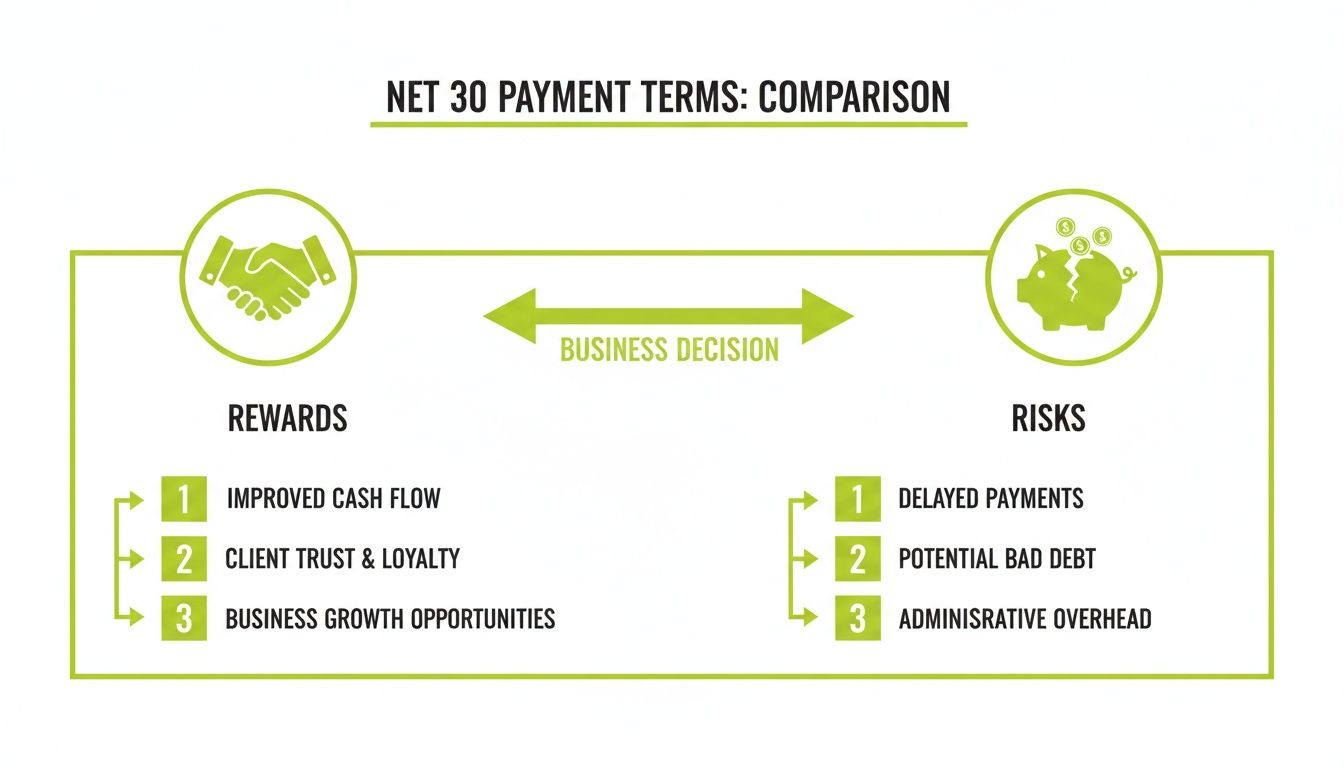
Net 30 Terms: Strategic Trade-Offs
Strategic Advantage (Pro) | Financial & Operational Risk (Con) |
|---|---|
Attract Enterprise Clients: Meets procurement requirements of large organizations, enabling access to larger contracts. | Direct Cash Flow Strain: Creates a 30+ day gap between service delivery and payment, consuming working capital. |
Gain Competitive Edge: Standard terms can be a key differentiator, building client goodwill in a competitive market. | High Administrative Overhead: Manual collections consume valuable finance team hours that should be allocated to strategic analysis. |
Foster Long-Term Partnerships: Demonstrates trust and flexibility, strengthening relationships with key clients. | Increased Risk of Bad Debt: The probability of non-payment increases as an invoice ages. |
By leveraging tools like AI AR automation, firms can secure the benefits of Net 30 while mitigating the downsides. Automated, intelligent reminders manage follow-up consistently, turning AR from a manual process into a predictable, optimized system.
Visual Idea: Cinematic imagery of a calm, organized control room. Multiple screens display real-time AR dashboards, cash flow projections, and DSO trends, representing financial control and foresight.
Building an Enforceable Net 30 Policy
A Net 30 policy reliant on hope is a direct path to lost cash flow control. An enforceable policy is built on clarity and process.
It begins with unambiguous language. Every invoice must state, "Payment due 30 days from invoice date." This removes any doubt about when the payment clock starts.
Extending credit is necessary, but without a disciplined collections framework, it directly exposes your firm to financial drag.
Establishing a Systematic Collections Workflow
A formal credit policy is non-negotiable. Performing a credit check on a new client is not adversarial; it is prudent risk management.
The core of enforcement is a systematic collections workflow. Consistency is key, which is why automation is the superior operational choice.
A robust workflow includes:
- Pre-Due Date Reminder: An automated communication sent 7 days prior to the due date prevents many invoices from becoming late.
- Day-of-Due-Date Alert: A professional notification that payment is due.
- Escalation Path: A clear, tiered process for invoices at 15, 30, and 60 days past due, with communication becoming progressively firmer.
This structure converts collections from a reactive, manual task into a predictable operational function. For more detail, review our documented procedures for accounts receivable that work.
Using Levers to Manage Payment Behavior
Financial levers can actively shape client payment behavior, shifting AR from a passive to a proactive function.
An enforceable Net 30 policy is not about aggressive collections; it is about creating a system where timely payment is the path of least resistance.
The two most effective levers are early payment discounts and late payment penalties.
- Early Payment Discounts (e.g., 2/10 Net 30): Offering a 2% discount for payment within 10 days accelerates cash flow but erodes margin. The annualized cost of a 2% discount for 20 days' early payment exceeds 36%. This is a steep price for liquidity.
- Late Fees: Stating in the contract that overdue invoices will incur a penalty (e.g., 1.5% per month) establishes a clear consequence. The purpose is not revenue generation but reinforcing that due dates are firm commitments.
How AR Automation Tames Net 30 Complexity
Manual management of Net 30 terms is a tactical grind. The cycle of tracking, reminding, and escalating diverts your finance team from strategic work.
Modern accounts receivable automation replaces this inefficiency with control. It transforms collections from a reactive burden into a proactive, data-driven system.

The primary benefit is a measurable reduction in Days Sales Outstanding (DSO). By automating reminders and follow-ups, the system ensures no invoice is overlooked, directly accelerating payments.
From Manual Effort to Systemized Control
Effective AR software for professional services orchestrates the entire collections workflow. It adapts to client behavior and internal operational needs.
The global shift toward subscription models, built on recurring Net 30 and Net 60 invoicing, makes automation essential for scalable growth. Firms relying on manual processes will be buried by the workload.
Automation does not replace a finance team; it equips it. It handles the 80% of repetitive collections work, freeing skilled operators for the 20% that requires strategic intervention.
This shift yields tangible results:
- Reduced DSO: Automated, timely reminders can decrease DSO by 10–20%. For a $10M firm, that unlocks over $80,000 in cash.
- Improved Cash Flow Predictability: Consistent collections enable more accurate forecasting.
- Reclaimed Team Capacity: It eliminates hundreds of hours of manual follow-up annually.
To manage Net 30 terms at scale, firms are automating payment processes to streamline collections and reduce administrative burden.
AI-Powered Precision in Collections
Modern AI AR automation adds a layer of intelligence to the process. AI can segment clients by payment history and risk profile, then tailor communications accordingly.
A high-value, punctual client receives a gentle reminder. A chronically late payer is placed on a more structured cadence. This approach protects key relationships while enforcing financial discipline. The key benefits of accounts receivable automation are clear.
Integrating QuickBooks AR automation further tightens this loop by syncing invoice data directly into the collections workflow, eliminating manual entry and creating a single source of truth for the AR portfolio.
The CFO's Mandate for Total AR Control
Net 30 terms are a market reality. Passively accepting their financial drag is a strategic failure.
The mandate for a modern finance leader is to implement systems that deliver control, clarity, and confidence over the entire accounts receivable lifecycle.
A systematic, automated approach to AR management strengthens cash flow, reduces DSO, and builds resilient client partnerships without overburdening your team.
The ultimate goal is to shift from reactive collections to proactive cash flow orchestration by embedding discipline and intelligence directly into the AR process.
With tools like AI AR automation, your team can move beyond repetitive follow-up to focus on high-value financial analysis.
Resolut automates AR for professional services—consistent, accurate, and human.
Common Questions
Key questions often arise regarding the operational specifics of Net 30 terms.
Do Net 30 Terms Include Weekends and Holidays?
Yes. Net 30 refers to 30 calendar days, not business days. An invoice dated June 1 is due June 30, regardless of weekends or holidays.
This is a common point of confusion. A client assuming "business days" could delay payment by nearly two weeks. Ensure contracts are explicit on this definition.
Can We Charge Late Fees for Missed Net 30 Payments?
Yes, provided the right to do so is specified in the initial contract and stated on each invoice. Without prior documentation, late fees are unenforceable.
A standard penalty is 1.5% per month on the outstanding balance. This is not a revenue driver but a mechanism to enforce payment discipline.
A late fee policy transforms payment terms from a guideline into an enforceable business rule.
How Does AR Automation Improve Net 30 Collections?
Accounts receivable automation replaces manual, inconsistent follow-up with a disciplined system. This is one of the most direct ways to reduce DSO.
An automated workflow sends a reminder before the due date, a notification on the due date, and initiates a clear escalation process for overdue accounts. This consistency accelerates payments.
Advanced AI AR automation can tailor the timing and tone of communications based on client payment history, protecting relationships while enforcing terms. For firms using QuickBooks, dedicated QuickBooks AR automation integrates invoicing directly with collections, eliminating manual data entry and human error.
***
Resolut automates AR for professional services—consistent, accurate, and human. Learn more at Resolut.