Dunning Letters: A CFO’s Guide to Improving Cash Flow
what is a dunning letter and how a strategic approach can speed collections, lower DSO, and strengthen your firm's cash flow.
A dunning letter is a critical tool for financial control, not just a payment reminder.
For professional services firms, a systematic dunning process is the difference between reactive collections and proactive financial management. It converts outstanding invoices into predictable cash flow, protecting your firm’s working capital without damaging client relationships.
This isn't about being aggressive. It's about implementing a calm, consistent system that communicates expectations and maintains financial discipline.
The Role of Dunning in Financial Control

Unmanaged accounts receivable inflates Days Sales Outstanding (DSO) and ties up capital needed for payroll, operations, or growth. Every day an invoice sits unpaid is a day your firm’s earned revenue isn't working for you.
A structured dunning process transforms accounts receivable from a liability into a managed asset.
From Historical Tool to Modern Strategy
The term "dunning letter" dates to the 17th century, from the verb 'dun,' meaning to demand payment. The history is detailed on kolleno.com.
Today, the practice is less about demanding and more about a data-driven strategy for financial governance.
Dunning as a Financial Lever
An effective dunning workflow provides a measurable framework for financial control.
- Protects Working Capital: Systematically pursuing overdue payments ensures capital isn't locked in receivables.
- Reduces DSO: A consistent follow-up cadence is one of the most direct ways to reduce DSO. For a $10M firm, a 5-day reduction in DSO frees up nearly $140,000 in cash.
- Maintains Client Relationships: A predictable, professional process avoids the inconsistent follow-ups that erode trust. Clients appreciate clarity.
- Creates Operational Discipline: It establishes a clear internal process, removing ambiguity and ensuring no invoice is overlooked.
A well-orchestrated dunning process provides the financial control necessary to forecast accurately and operate with confidence.
Modern tools like accounts receivable automation execute this process with precision. AI AR automation, particularly AR software for professional services, can integrate directly with systems like QuickBooks to manage communications consistently, making payment the expected conclusion to a successful project.
The Financial Drag of Ineffective AR Management
Poor accounts receivable management is a quiet but constant drag on your firm’s financial health. It ties up cash, slows investment, and creates unnecessary friction.
When invoices go unpaid, the first metric to suffer is Days Sales Outstanding (DSO). A high DSO means revenue is trapped on paper instead of in your bank account as working capital.
For a $10M professional services firm, a 10-day increase in DSO can lock up over $270,000 in cash. That is capital you have earned but cannot access.
Quantifying the Cost of Delayed Payments
In the U.S., roughly 50% of B2B invoices are overdue monthly, pushing the average DSO past 40 days. About 8% of those overdue debts are eventually written off—a direct hit to your bottom line. More data is available on the impact of overdue B2B invoices from Centime.com.
Without a systematic dunning process, you are financing your clients' operations at your own expense. This creates a cascade of negative effects that go beyond the balance sheet.
The internal cost of manual collections is consistently underestimated. It consumes team hours that should be spent on strategic financial analysis, forecasting, and client management.
*Visual Idea: *A clean line chart titled "Impact of DSO on Available Cash." The X-axis shows "Days Sales Outstanding (DSO)" (30, 45, 60 days). The Y-axis shows "Working Capital Tied Up in AR" ($822k, $1.23M, $1.64M for a $10M firm).
The Ripple Effects of Inconsistent Collections
Beyond the direct financial impact, inconsistent AR management creates damaging secondary problems. Sporadic follow-ups from different people send mixed signals to clients, quietly eroding trust.
The operational drag is just as significant. Manual tracking leads to human error—missed reminders or chasing invoices that have already been paid. This traps your finance team in a reactive, high-effort cycle. We analyze this in our article on the true cost of AR inefficiency in professional services.
A structured dunning process, powered by accounts receivable automation, transforms collections from a manual chore into a controlled, predictable system. That discipline is the foundation of a healthy cash flow cycle.
*Visual Idea: *Cinematic imagery of a single domino falling, triggering a chain reaction of others labeled "Higher DSO," "Strained Client Relations," "Wasted Team Hours," and "Reduced Cash Flow," representing the cascading effects of one overdue invoice.
Implementing AI AR automation—especially AR software for professional services with QuickBooks AR automation—provides the control needed to mitigate these risks and improve cash flow.
Designing a Dunning Cadence for Professional Services
A dunning cadence for professional services is an orchestrated sequence of communications. It is designed to recover funds while protecting client partnerships.
A proper cadence moves from gentle reminders to firm directives, all while maintaining a tone of professional control. This structure turns collections from a stressful activity into a standard operating procedure.
Consistency is the key to maintaining control over your cash flow.
The Pre-Due Date Reminder: A Proactive Nudge
The most effective collection process starts before an invoice is late.
A gentle reminder sent three to five days before the due date is a professional courtesy. It assumes the client intends to pay and helps keep your invoice top-of-mind.
This is a customer service touchpoint, not a traditional dunning letter. The tone should be helpful, providing invoice details and a direct payment link. This single step can significantly reduce DSO.
Stage 1: The Initial Overdue Notice (1-15 Days Past Due)
Once an invoice is past due, the first official dunning communication is sent. The tone remains professional and non-accusatory, operating under the assumption the payment was overlooked.
The message should be direct but polite. Re-attach the original invoice, clearly state the amount due and days overdue, and provide simple payment instructions.
A well-crafted initial notice, sent promptly and consistently, resolves the vast majority of late payments without escalation.
Four-Stage Dunning Communication Cadence
This table outlines a structured dunning workflow, detailing the timing, tone, and objective for each stage to manage overdue invoices while preserving client relationships.
Stage | Timing | Communication Tone | Core Message & Objective |
|---|---|---|---|
Stage 1 | 1-15 days past due | Polite & professional | "Just a reminder that invoice #123 is now past due. Here are the details and a link to pay." Objective: bring the overdue invoice to their attention. |
Stage 2 | 30 days past due | Firm but fair | "Invoice #123 is now 30 days overdue. Please let us know if there is an issue. Here is a reminder of our payment policies." Objective: create urgency. |
Stage 3 | 60 days past due | Serious & direct | "We have reached out several times about invoice #123, now 60 days delinquent. Please remit payment to avoid service interruption." Objective: signal consequences. |
Stage 4 | 90+ days past due | Final & formal | "This is a final demand for payment on invoice #123. If not paid by [date], this account will be sent to a third-party collections agency." Objective: final internal step. |
Stage 2: The Firm Reminder (30 Days Past Due)
At the 30-day mark, the tone becomes firmer and more direct. The message conveys urgency and references previous contact.
This dunning letter should:
- Reference the invoice number and the fact it is 30 days overdue.
- Ask if a problem with the invoice or service is causing the delay.
- State your firm's payment policies and mention potential late fees.
This transitions from a simple reminder to an active collections effort. The goal is to open dialogue while reiterating the need for payment. Effective recurring billing automation strategies can also reduce the need for these letters.
Stage 3: The Escalation Notice (60 Days Past Due)
At 60 days past due, an invoice is a significant drag on cash flow. The communication must reflect that seriousness. The tone is firm, direct, and signals that the account requires immediate attention.
This notice often comes from a Controller or CFO to add weight. It should summarize previous communications, state the account is severely delinquent, and outline consequences, like a pause on current work. Resolving the balance becomes the priority. Our guide on how modern AR automation protects client relationships explores this further.
Stage 4: The Final Demand (90+ Days Past Due)
At 90 days or more, the invoice poses a material risk and may require a provision for bad debt. This is the final dunning letter—a formal demand for payment with zero ambiguity.
This is the last internal step before the account is considered for third-party collections.
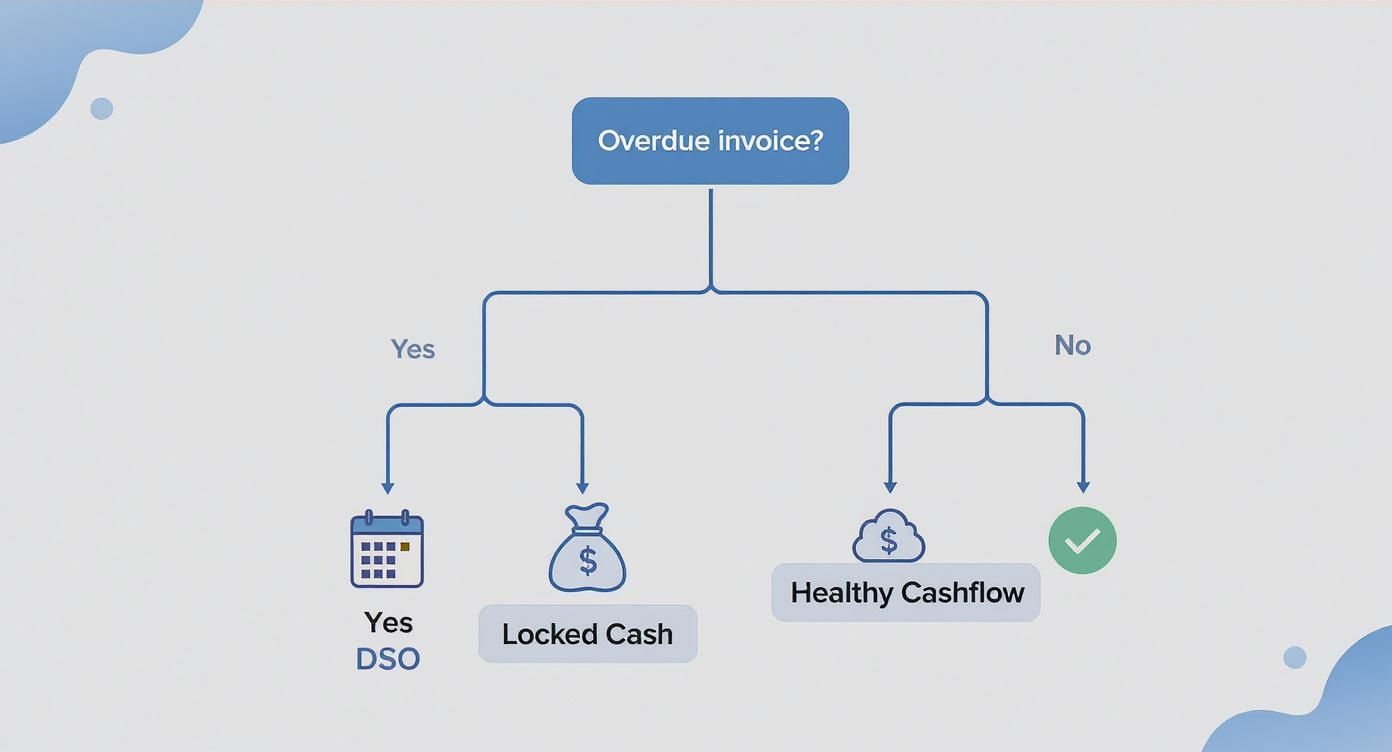
A single overdue invoice directly leads to higher DSO and locked cash. This underscores the importance of a structured dunning cadence.
A platform with QuickBooks AR automation can orchestrate this entire cadence. This systematic approach, powered by AI AR automation, transforms a manual task into a strategic asset to improve cash flow.
You cannot manage what you do not measure.
Financial leaders require hard data to manage cash flow. Tracking the right key performance indicators (KPIs) is how you move from chasing payments to strategically managing your firm's cash.
It's one thing to know what a dunning letter is. It's another to quantify its impact. These metrics provide an objective view of your AR health and pinpoint opportunities for improvement.
Days Sales Outstanding (DSO)
The most common AR metric is Days Sales Outstanding (DSO). It calculates the average number of days it takes to get paid after invoicing.
Formula: (Total Accounts Receivable / Total Credit Sales) x Number of Days in Period
For professional services firms, a DSO below 45 days is healthy. A DSO above 60 days signals that late payments are dragging on your working capital.
*Visual Idea: *A clean dashboard showing a prominent gauge for DSO at 42 days (green), a line chart tracking CEI at 97% (trending up), and a bar chart visualizing the AR aging report with most bars in the "Current" and "1-30 Days" categories.
Collection Effectiveness Index (CEI)
The Collection Effectiveness Index (CEI) measures how much of the money that was collectible in a period you actually collected. It is a pure reflection of your team’s performance.
Formula: ((Beginning Receivables + Monthly Credit Sales) - Ending Total Receivables) / ((Beginning Receivables + Monthly Credit Sales) - Ending Current Receivables) x 100
A CEI consistently over 90% indicates a highly effective collections process. Unlike DSO, CEI is not skewed by sales fluctuations, making it a more stable performance indicator.
Average Days Delinquent (ADD)
While DSO tells you how long it takes to collect, Average Days Delinquent (ADD) tells you how late, on average, your clients are paying. It isolates collection efforts from standard payment terms.
Formula: Days Sales Outstanding (DSO) - Best Possible DSO
If your DSO is 45 days and your standard term is 30 days, your ADD is 15 days. On average, clients are paying two weeks late. Reducing that number is the objective of a dunning strategy.
Accounts Receivable Aging Report
The AR Aging Report is your command center. It breaks down outstanding invoices into buckets (Current, 1-30 days past due, 31-60 days, etc.), showing exactly where cash is trapped.
This report is non-negotiable:
- It spots risk. A large balance in the 60+ day columns is a red flag for bad debt.
- It guides your strategy. It shows which clients need a phone call versus an email.
- It reveals process flaws. If invoices consistently age, your dunning cadence is failing.
Finance leaders should review this report weekly. It is the playbook for your collections team and the engine behind any effective AR software for professional services. Connecting this data with QuickBooks AR automation transforms collections into a systematic, data-driven process.
How Automation Creates a More Human Dunning Process

Accounts receivable automation makes collections more human, not less. For professional services firms where relationships are paramount, this distinction is critical.
Automation is not about sending robotic demands. It is about executing your firm’s dunning strategy with perfect consistency, eliminating the small errors that create client friction.
Precision at Scale
Manual dunning is prone to error. An associate forgets a follow-up. A reminder goes to a client who just paid. These inconsistencies erode client trust.
AI AR automation orchestrates the process without error. It sends the right message to the right client at the right time, every time. The system executes the rules you set without variance.
This precision provides control over cash flow and the client experience.
Freeing Your Team for High-Value Work
Your most valuable financial asset is the strategic mind of your Controller or finance manager. Yet, finance teams can spend up to 40% of their time chasing late payments.
Automation handles repetitive work, freeing your team for tasks humans do best:
- Managing complex situations: Personally negotiating a payment plan with a high-value client.
- Strategic analysis: Focusing on cash flow forecasting, budgeting, and other high-impact work.
- Identifying root causes: Analyzing AR data to fix systemic issues causing payment delays.
By automating the routine, you empower your team to manage the exceptions.
Data-Driven, Not Generic
Modern AR software for professional services uses data to personalize dunning.
A smart platform can be configured to:
- Segment clients: Use a gentler cadence for a high-value client versus a new one.
- Adapt to behavior: Learn not to send an aggressive reminder to a client who always pays on day 29.
- Integrate in real-time: With QuickBooks AR automation, the system knows the second an invoice is paid, avoiding embarrassing follow-ups.
This intelligent approach ensures every communication fits the client and the situation, preserving relationships. The benefits of accounts receivable automation are detailed further in our guide.
Automation provides discipline; your team provides judgment. It handles the consistency needed to reduce DSO and improve cash flow, freeing your people for what matters.
Implementing AR Automation with Confidence
Implementing an accounts receivable automation platform should not be a massive IT project. Concerns about system integration, data security, and team adoption are common.
A proper implementation addresses these concerns directly. The process is designed to be operational, not disruptive.
It starts by connecting the platform to your existing tools, like setting up QuickBooks AR automation. This creates a live data sync, ensuring your AR software has up-to-date invoice information.
From Strategy to Execution
Once connected, you translate your firm’s dunning strategy into automated workflows. You set the rules—timing, tone, and escalation paths—to match your process. This is not about ceding control; it is about ensuring your process is followed with perfect consistency.
To complement your AR strategy, many firms also implement invoice processing automation. This creates efficiencies across the entire financial workflow, from invoice creation to collection.
True automation provides oversight, not obscurity. The goal is a high-level command center to manage AR without getting lost in manual execution.
Gaining Control Through Visibility
The final step is setting up reporting dashboards. This provides an immediate, real-time view of key AR metrics—DSO, CEI, and aging reports. Instead of hours in a spreadsheet, you get an accurate, on-demand view of your firm’s cash flow health.
This level of oversight allows you to:
- Monitor Performance: See how your dunning cadence is working and adjust based on data.
- Identify Risks: Proactively spot high-risk accounts or negative payment trends.
- Forecast with Accuracy: Use reliable collections data to build trustworthy cash flow projections.
Implementing AI AR automation installs a system of unwavering discipline. It allows your team to operate with greater strategic focus, confident the daily tasks are handled.
Dunning Process FAQs
Here are common questions from finance leaders refining their dunning process.
When should an overdue account go to a collections agency?
This should be a policy decision. Most firms draw the line at 90-120 days past due. By that point, internal efforts have likely run their course.
Another red flag is a total breakdown in communication. If a client goes silent despite multiple contacts, it is time to escalate.
How can dunning letters be firm without damaging client relationships?
The key is to frame outreach as a mutual effort to solve a logistical problem, not an accusation.
Use direct but professional language. "We're flagging that we haven't received payment for invoice #4562 and wanted to ensure there wasn't an issue on our end," keeps the tone collaborative. The goal is to open a dialogue and provide clear payment options.
Can AR automation handle clients with unique billing terms?
Yes. This is a primary function of modern accounts receivable automation. Your most valuable clients often have non-standard agreements that manual processes struggle to manage.
Good AR software for professional services is built for this. You can set custom rules and dunning cadences for specific clients or groups. This flexibility is a core feature of platforms providing QuickBooks AR automation, removing guesswork from managing key accounts.
--- Resolut automates AR for professional services—consistent, accurate, and human. Learn more about our approach.