
What Is an AR Aging Report? A Guide for Financial Operators
Discover what is aging report and how it reduces DSO and boosts cash flow with practical, CFO-focused guidance.
An accounts receivable (AR) aging report is not just a spreadsheet. For a professional services firm, it’s a primary diagnostic tool for financial health and operational discipline.
It organizes all unpaid client invoices into time-based categories, providing a clear, unfiltered view of your cash flow velocity.
For a CFO or Controller, this report cuts through the noise to answer three critical questions:
- Who owes the firm money?
- What is the total amount outstanding?
- How long has each invoice been past due?
The AR Aging Report Explained
Many firms view the AR aging report as a simple list of late payers. This is a limited perspective. It is a control panel for managing the cash you've earned but not yet collected.
A well-structured report provides the data needed to guide collection strategies, refine credit policies, and produce accurate cash flow forecasts.
The report functions by categorizing outstanding invoices into standard time buckets:
- Current: Invoices within their payment terms (e.g., Net 30).
- 1-30 Days Past Due: Recently overdue. Requires initial follow-up.
- 31-60 Days Past Due: Indicates payment friction.
- 61-90 Days Past Due: Increased risk requiring escalated attention.
- 90+ Days Past Due: Highest risk category, directly threatening profitability.
This structure pinpoints precisely where cash is trapped. For a $10M firm, improving collections from the 90+ day bucket by just 5% unlocks $500,000 in cash.
The AR aging report is the primary tool for measuring and managing the client-to-cash cycle. It exposes process breakdowns before they erode the bottom line, shifting collections from a reactive task to a proactive financial strategy.
Before we go deeper, let's break down the core elements you'll find in any standard aging report. Think of these as the fundamental building blocks of your AR analysis.
Key Components of an AR Aging Report
Component | What It Tells You |
|---|---|
Client Name | The specific client or entity that owes money. |
Invoice Number | A unique identifier for tracking each billable transaction. |
Invoice Date | The date the invoice was issued, marking the start of the payment term. |
Due Date | The date by which payment is expected (e.g., 30 days from the invoice date). |
Amount Outstanding | The total balance remaining on a specific invoice. |
Aging Buckets | Columns that categorize the outstanding amount based on how far past due it is. |
Total Accounts Receivable | The sum of all outstanding invoices, giving you a top-line view of your receivables. |
These components create a clear operational picture. The objective is not just to view the totals but to understand the story they tell about client payment behavior and internal processes.
Effective management hinges on this clarity. By monitoring how invoices move between buckets, you can identify issues with specific clients or systemic flaws in your billing process. This data-driven approach is the foundation for using accounts receivable automation to systematically improve cash flow and reduce DSO.
--- Resolut automates AR for professional services—consistent, accurate, and human.
How to Read an Aging Report for Actionable Insights
Interpreting an aging report is about identifying patterns, not just summing columns. The analysis begins with the "Current" column, which represents healthy receivables within payment terms. This is your baseline for optimal cash flow.
As you scan right—across the 31-60, 61-90, and 90+ day columns—you are observing escalating financial risk. Each subsequent bucket signifies a greater delay in payment and a higher probability of write-off.
* **Visual Idea: A cinematic shot looking over a CFO’s shoulder at a tablet. The screen displays a digital aging report, with the 90+ day column glowing red, drawing the eye. The rest of the office is softly blurred in the background. ***
A concentration of receivables in older buckets is a clear alarm. It signals a breakdown in the collections process and an impending cash flow constraint. This requires immediate leadership attention.
Segmenting the Data for Clarity
To make the report actionable, move beyond grand totals to analyze individual client behavior. Do the same client names appear consistently in the 31-60 day bucket? This is not a coincidence; it is a data point indicating a need to discuss their payment process or adjust credit terms.
It is also critical to track the percentage of total receivables in each aging bucket over time. If a professional services firm finds that over 15% of its total AR is in the 90+ day category, it signifies a material operational failure that demands an immediate response.
The image below breaks down the three fundamental questions your analysis should answer to make a real difference.
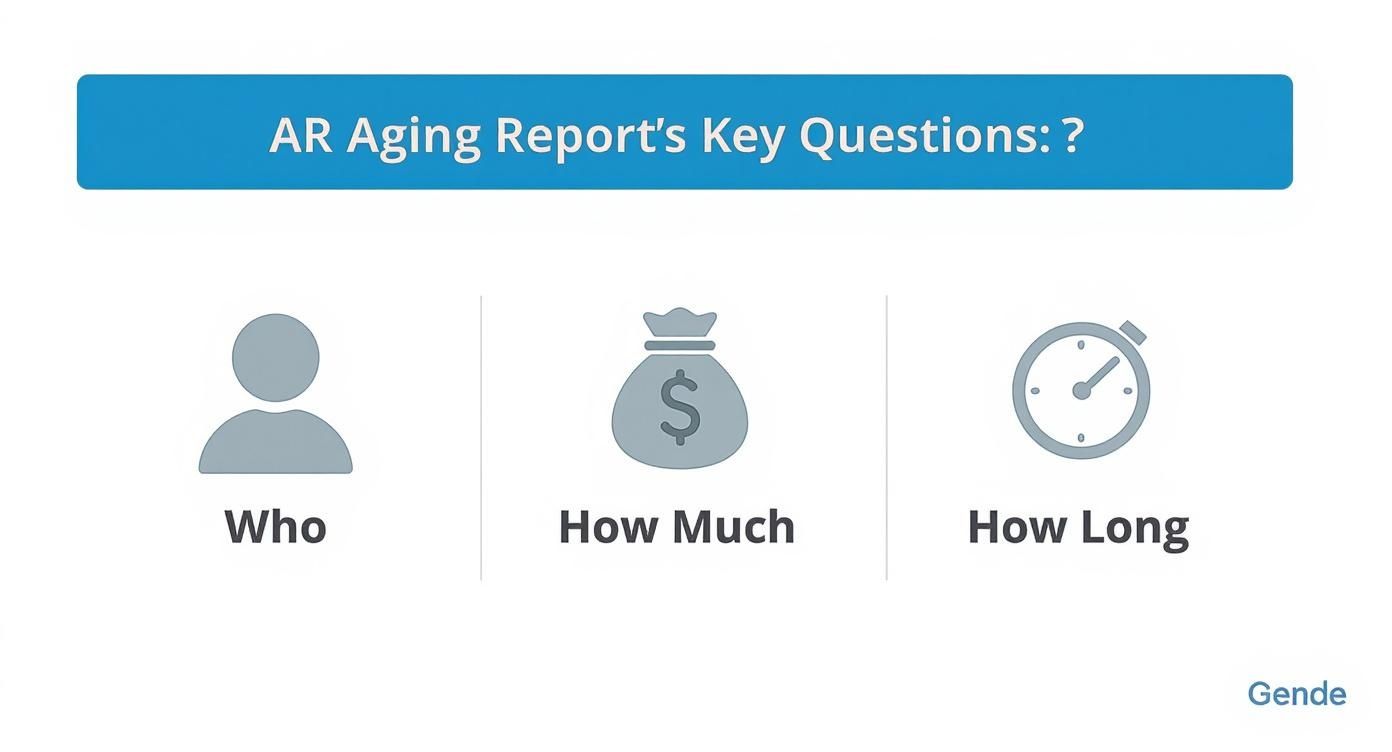
This simple framework boils the report down to its core purpose: identifying who owes you, how much they owe, and how late they are. This focus allows for faster, more targeted action.
Transforming Static Reports into Dynamic Tools
The strategic value of an aging report lies in its predictive capability. When analyzed consistently, the report evolves from a static financial statement into a dynamic management tool.
For instance, a sudden increase in the 31-60 day bucket could indicate a change in a key client’s AP department or an internal billing error. Early detection is the difference between a minor adjustment and a significant write-off. This level of insight strengthens the case for effective accounts receivable automation.
By treating the aging report as a diagnostic tool, finance leaders can identify the root causes of payment delays. This shift from reactive collection calls to proactive financial management is critical for sustaining healthy cash flow and reducing DSO.
Ultimately, reading an aging report is about understanding the operational story behind the numbers. It’s about using data from systems like QuickBooks to ask better questions and make smarter decisions, keeping the firm’s financial health strong and predictable.
Resolut automates AR for professional services—consistent, accurate, and human.
Key Financial Metrics You Must Track
An aging report is more than a list of outstanding invoices. It’s a source of critical data for measuring financial performance.
To gain control over firm finances, you must track specific metrics that reveal the health of your revenue cycle. These are the levers that directly impact profitability.
The first is Days Sales Outstanding (DSO). This is the average number of days it takes your firm to collect payment after work is completed. A low DSO indicates rapid cash conversion. A high DSO means you are effectively providing clients with interest-free financing.
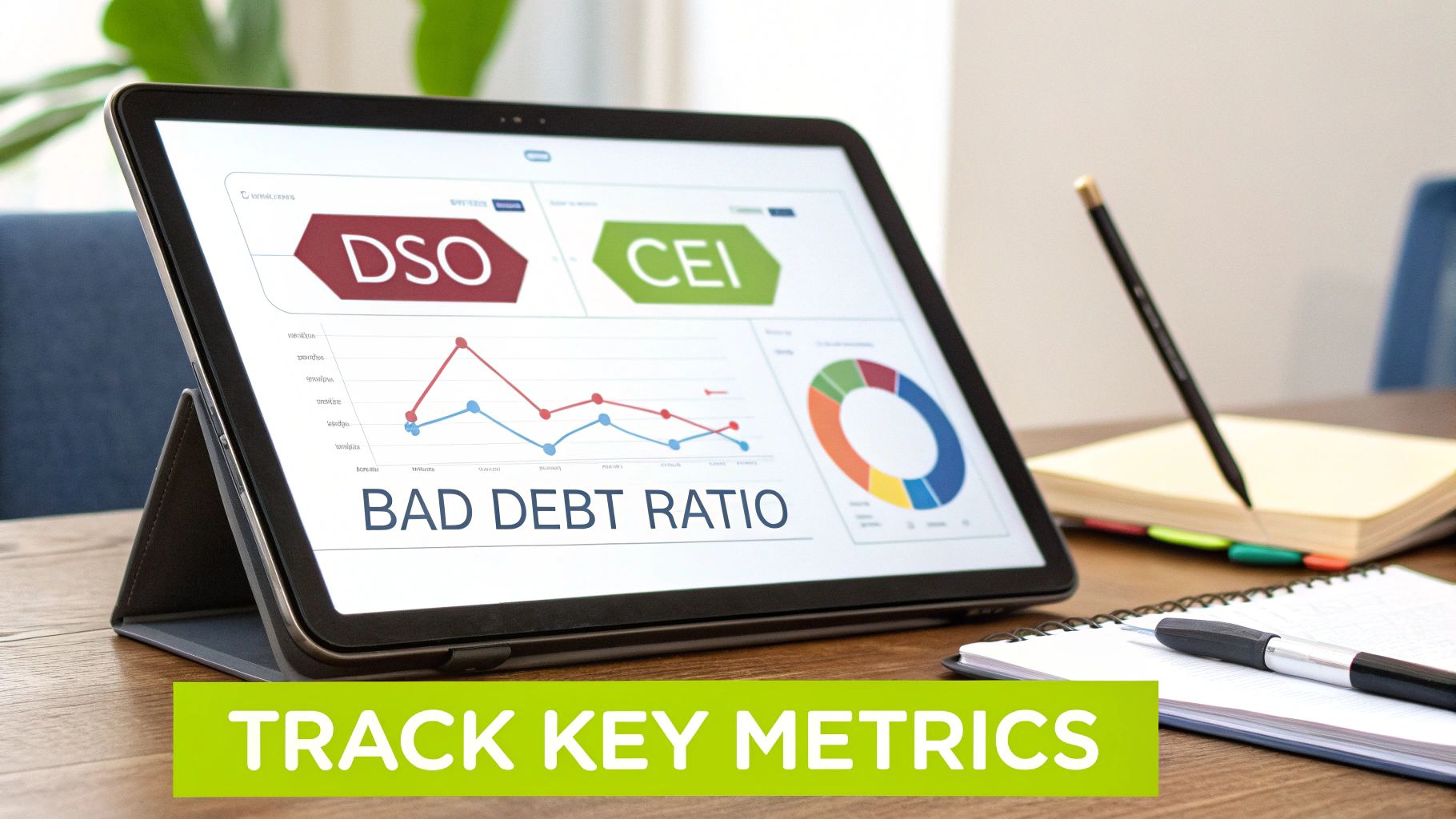
Monitoring DSO month-over-month tells a clear story. An increasing DSO suggests a weakening collections process. A decreasing DSO validates that your strategies are effective.
Measuring How Well You Collect
DSO is a primary indicator, but it doesn't provide the full picture. For a more nuanced view, you need the Collection Effectiveness Index (CEI).
CEI compares the amount collected in a period to the total receivables available for collection. It answers a simple, powerful question: "How efficient are we at collecting the money we're owed?"
A high CEI, ideally above 90%, demonstrates strong operational control. A declining CEI is a warning that an increasing number of invoices are aging, which will directly improve cash flow if corrected.
Finally, you must monitor your Bad Debt to Sales Ratio. This metric shows the percentage of revenue written off as uncollectible. While some bad debt is expected, a rising ratio signals deeper problems in client credit policies or collections execution. It is a lagging indicator of past failures.
Tracking these KPIs is essential, but benchmarks provide the context you need to understand performance. Here’s a quick look at what’s considered healthy for professional services firms.
Essential AR Metrics and Professional Services Benchmarks
Metric | Formula | What It Measures | Healthy Benchmark |
|---|---|---|---|
Days Sales Outstanding (DSO) | | The average number of days to collect payment after a sale. | 30-45 days |
Collection Effectiveness Index (CEI) | | The percentage of receivables collected during a specific period. | Above 90% |
Bad Debt to Sales Ratio | | The percentage of sales that become uncollectible bad debt. | Below 1% |
These benchmarks are not abstract targets; they are indicators of operational health. Significant deviation signals a need for deeper analysis.
Connecting Metrics to Action
These metrics are not for reporting alone; they are for directing action.
A high DSO combined with a low CEI suggests inconsistent or ineffective follow-up. A high bad debt ratio may indicate a flawed client vetting process. You can explore practical ways to increase cash flow by acting on these insights before they escalate.
Integrating these metrics into your regular financial review creates a feedback loop that drives continuous improvement. Tools that provide accounts receivable automation can deliver these KPIs on a real-time dashboard, transforming a static aging report into a dynamic control center for managing your firm’s liquidity.
Resolut automates AR for professional services—consistent, accurate, and human.
Common Pitfalls in AR Management to Avoid
Even with accurate aging data, firms fall into common traps that quietly sabotage collections and restrict cash flow.
Recognizing these pitfalls is the first step. The most prevalent is inconsistent follow-up.
Without a systematic, repeatable process, invoices are inevitably missed. A minor oversight quickly becomes a 90-day-old problem, often because no one maintained consistent contact. Manual processes breed fatigue, which leads to error.
Another frequent mistake is allowing client disputes to fester. An unresolved question on an invoice is a legitimate reason for non-payment. Many firms lack a clear, rapid process for resolving these issues, allowing a small discrepancy to delay a large payment for weeks.
* **Visual Idea: A simple, clean line chart showing two trend lines. One line, labeled "Manual Collections," is erratic and trends upward over time. The second line, labeled "Automated Collections," is smooth, consistent, and trends downward. The chart title: "DSO: Consistency vs. Volatility." ***
Misaligned Collection Strategies
The third error is a one-size-fits-all collections strategy. This approach is ineffective and can damage client relationships.
A high-value, long-term partner in the 31-60 day bucket requires a different approach than a new, smaller client in the same category. A generic script can alienate your best clients while failing to create urgency with others.
The root cause of these pitfalls is not a lack of effort; it's a reactive, manual mindset. The objective is to shift from chasing payments to proactively managing them with a system that standardizes communication and tailors outreach based on data.
To get there, it’s critical to understand the root of the problem. Learning about overcoming common reporting and data challenges is a great place to start building more reliable internal processes.
From Manual Effort to Automated Discipline
Sustaining the discipline required to avoid these pitfalls through manual effort alone is nearly impossible. This is where accounts receivable automation becomes a strategic imperative.
AI AR automation, particularly platforms designed as AR software for professional services, enforces the consistency that human processes lack.
For firms using QuickBooks AR automation, this means establishing rules that ensure every invoice receives the right communication at the right time. This structure helps reduce DSO and fundamentally improve cash flow by closing the gaps where human inconsistency and error thrive. It allows your team to shift focus from clerical tasks to strategic relationship management.
Resolut automates AR for professional services—consistent, accurate, and human.
Manual invoice pursuit is a poor use of a skilled finance team's time.
The process is inefficient, prone to human error, and a primary driver of elevated DSO. For financial control and scalability, accounts receivable automation is a necessity, not a luxury.
Modern AI AR automation platforms integrate directly with accounting systems like QuickBooks to build intelligent workflows that scale a firm's best practices without scaling headcount.

Instead of a finance manager manually tracking follow-ups in a spreadsheet, the software executes a predefined communication sequence based on invoice age and client profile. The system knows when to send a polite reminder and when to escalate an overdue account for human intervention.
No critical follow-up is ever missed.
The Measurable Impact of Systematized Collections
By automating routine, repetitive tasks—the cycle of reminders and status checks—your finance team can focus on high-value work.
This means more time resolving complex client disputes, strengthening key relationships, and contributing to financial strategy. They transition from payment chasers to strategic partners.
The result is a measurable and predictable reduction in DSO, often by 20-30% within the first six months.
The operational wins are just as compelling:
- Systematic Follow-Up: Every invoice is pursued with a consistent, pre-defined cadence, eliminating the human error that allows receivables to age.
- Intelligent Escalation: High-risk or high-value accounts are automatically flagged and routed for senior attention, focusing expertise where it is needed most.
- Centralized Communication: All client interactions are logged in a single system, creating a clear audit trail and eliminating disjointed conversations.
This is not about replacing people; it's about equipping your team with tools to enforce discipline and operate with better data. For a deeper dive, a comprehensive guide to accounts receivable automation software can help you understand what to look for in a platform.
From Reactive Chasing to Proactive Financial Health
Ultimately, automation transforms your AR function from a reactive cost center into a strategic asset. It creates a predictable cash flow engine that leadership can rely on for forecasting and investment.
This operational stability is the foundation for sustainable growth. For a broader perspective, you can explore additional strategies to improve cash flow.
Adopting AI AR automation is less about technology and more about operational philosophy. It’s a commitment to removing variability from your client-to-cash cycle. You ensure the process you design is the process that's followed—every single time.
This disciplined approach addresses the root cause of aging invoices, turning your AR report from a list of past-due problems into a dashboard of real-time control.
Resolut automates AR for professional services—consistent, accurate, and human.
Turning Your AR Data into Action
An aging report is a diagnostic tool, not the solution. Its value lies in providing the intelligence to convert outstanding invoices into cash. This requires a disciplined operational rhythm.
First, establish a weekly AR review. Monthly reporting is too infrequent for a professional services firm. A minor payment delay can become a 60-day problem before it reaches a manager’s desk. A weekly cadence creates accountability.
Second, assign clear ownership. Every client, invoice, and aging bucket must have a designated owner responsible for resolution. This transforms the report from a passive list into an active work plan.
From Insight to Process Improvement
The data must inform strategy. Use insights from the aging report to refine credit policies and client onboarding procedures.
Are new clients consistently appearing in the 60+ day bucket? This is not a collections issue; it is a flaw in your initial client vetting or contract terms. For a deeper dive into fixing these operational snags, there are several real-world ways to clean up your accounts receivable.
An aging report that shows the same patterns quarter after quarter indicates a flawed system, not just difficult clients. Financial control comes from using this data to fix root causes and harden processes against future delays.
Finally, leverage technology to enforce this discipline. An automated system ensures the designed process is the executed process—every time. It eliminates the human errors and inconsistencies that allow receivables to age.
This is how AR management shifts from a reactive chore to a strategic function that drives financial stability. With tools like AI AR automation, you build an operational framework that protects cash flow and strengthens your firm's financial position.
Resolut automates AR for professional services—consistent, accurate, and human.
Common Questions About Aging Reports
Here are answers to common questions from finance leaders at professional services firms. Getting these right is the difference between a disciplined and a reactive operation.
How often should we review the aging report?
Weekly. A monthly review is insufficient.
In one month, a new invoice can become 30 days past due before it is formally reviewed, significantly increasing collection risk.
A weekly rhythm transforms the report from a historical document into a forward-looking management tool. You identify issues before they escalate, which is the primary purpose of the exercise. This is how you reduce DSO and maintain predictable cash flow.
What is a "good" percentage for the 90+ day bucket?
Best-in-class firms maintain less than 5% of total receivables in the 90+ day bucket. For most professional services firms, under 10% is a healthy target.
If this metric exceeds 15%, it is a critical red flag. It signals a systemic breakdown in your collections, credit, or dispute resolution processes. This bucket represents the highest risk of write-off and requires immediate leadership attention.
Can automation handle client communication without sounding robotic?
Yes, if it is modern accounts receivable automation. It is not about sending generic demands.
With AI AR automation, you design communication workflows that adapt based on the client, invoice size, or delinquency period. The tone can shift from a gentle reminder to a formal notice, aligned with your firm’s brand voice.
For platforms offering QuickBooks AR automation, the system handles consistent follow-ups at scale. This frees your team to intervene personally in high-stakes conversations. The best AR software for professional services combines systematic consistency with human judgment.
***
Resolut automates AR for professional services—consistent, accurate, and human.