
What Is DSO? A CFO's Guide to Unlocking Cash Flow
Understand what is DSO (Days Sales Outstanding) and discover proven, operator-focused strategies to reduce it and unlock stronger, more predictable cash flow.
Days Sales Outstanding (DSO) is more than an accounting metric. It's the measure of your cash conversion cycle—the average number of days it takes for delivered work to become cash in your bank account.
For a financial leader in a professional services firm, a low DSO means faster access to working capital, predictable cash flow, and greater control over the firm's financial position. It's a direct indicator of operational efficiency.
Understanding DSO and Its Role in Financial Control

Think of DSO as an operational KPI. It tells you exactly how efficient your invoicing-to-payment process is. A high DSO is a drag on your firm’s momentum, tying up capital in unpaid invoices that should be funding payroll, new hires, or strategic initiatives.
A low and stable DSO, however, signals operational discipline. It indicates your invoicing is prompt, payment terms are respected, and your collections process is effective. This level of control allows for confident planning and reduces reliance on expensive credit lines to manage cash flow gaps.
The Core Components of DSO
DSO is a key working-capital metric used by finance teams, investors, and lenders to assess a company's liquidity and credit management. The calculation is straightforward: (Average Accounts Receivable ÷ Net Revenue) × Number of Days in Period.
This formula provides a clear snapshot of your average collection time. The components are what matter to a financial operator.
DSO Components for Financial Leaders
Component | What It Represents | Why It Matters for a CFO |
|---|---|---|
Accounts Receivable | The total value of all unpaid client invoices. | This is earned revenue you cannot yet use. It's a direct measure of how much working capital is locked in the collection process. |
Total Revenue | Gross sales generated over the measurement period. | This provides scale and context. A high AR balance against low revenue is a major red flag for operational inefficiency. |
Time Period (e.g., 365) | The number of days in the period being analyzed. | Consistency allows for accurate, apples-to-apples trend analysis to spot seasonal patterns or process degradation. |
DSO is not an accounting exercise; it's a direct reflection of your firm's operational health.
For a professional services firm, even a small improvement has a significant impact. A 10-day reduction in DSO on $10M in annual revenue unlocks approximately $274,000 in cash flow.
Mastering this metric is fundamental to achieving financial stability. It shifts the focus from just tracking revenue to actively managing the cash that fuels your operation.
How to Calculate and Interpret Your Firm’s DSO

To improve your cash flow, you must first measure it. Calculating your Days Sales Outstanding provides a hard number for your average collection time.
The formula is:
DSO = (Average Accounts Receivable / Total Credit Sales) x Number of Days in Period
This calculation transforms your entire accounts receivable cycle into a single metric you can track and improve. It establishes your operational baseline.
Putting the Formula to Work
Let's use a practical example. A consulting firm is reviewing its performance over the last quarter (90 days).
- Total Credit Sales (Revenue): $2,500,000
- Starting Accounts Receivable: $950,000
- Ending Accounts Receivable: $1,050,000
First, calculate the average capital tied up in receivables during the period.
- Average AR: ($950,000 + $1,050,000) / 2 = $1,000,000
Now, apply the DSO formula.
- DSO Calculation: ($1,000,000 / $2,500,000) x 90 days = 36 days
This firm takes an average of 36 days to convert its work into cash. On its own, this number is just data. The value comes from its interpretation.
From a Number to a Diagnosis
A DSO of 36 days may seem acceptable, particularly if your standard terms are Net 30. But a static number is a snapshot; the trend tells the real story.
What is your DSO indicating about your firm’s health?
- A DSO of 30–40 days: Typically points to a healthy AR process. Clients are generally paying on time.
- A DSO of 45–60 days: Suggests friction. This could be a sign of inconsistent invoicing or a reactive follow-up process.
- A DSO of 75+ days: This is a red flag. It signals significant cash flow challenges and a growing risk of bad debt.
The most important benchmark isn't an industry average; it's your firm's historical performance. A DSO that increases from 35 to 45 days over six months indicates a more serious problem than one holding steady at 50.
Viewed this way, the DSO calculation becomes a powerful diagnostic tool. It helps you identify problems before they escalate into cash flow crises. Understanding what is DSO means learning to read these signals.
The Hidden Costs of a High DSO
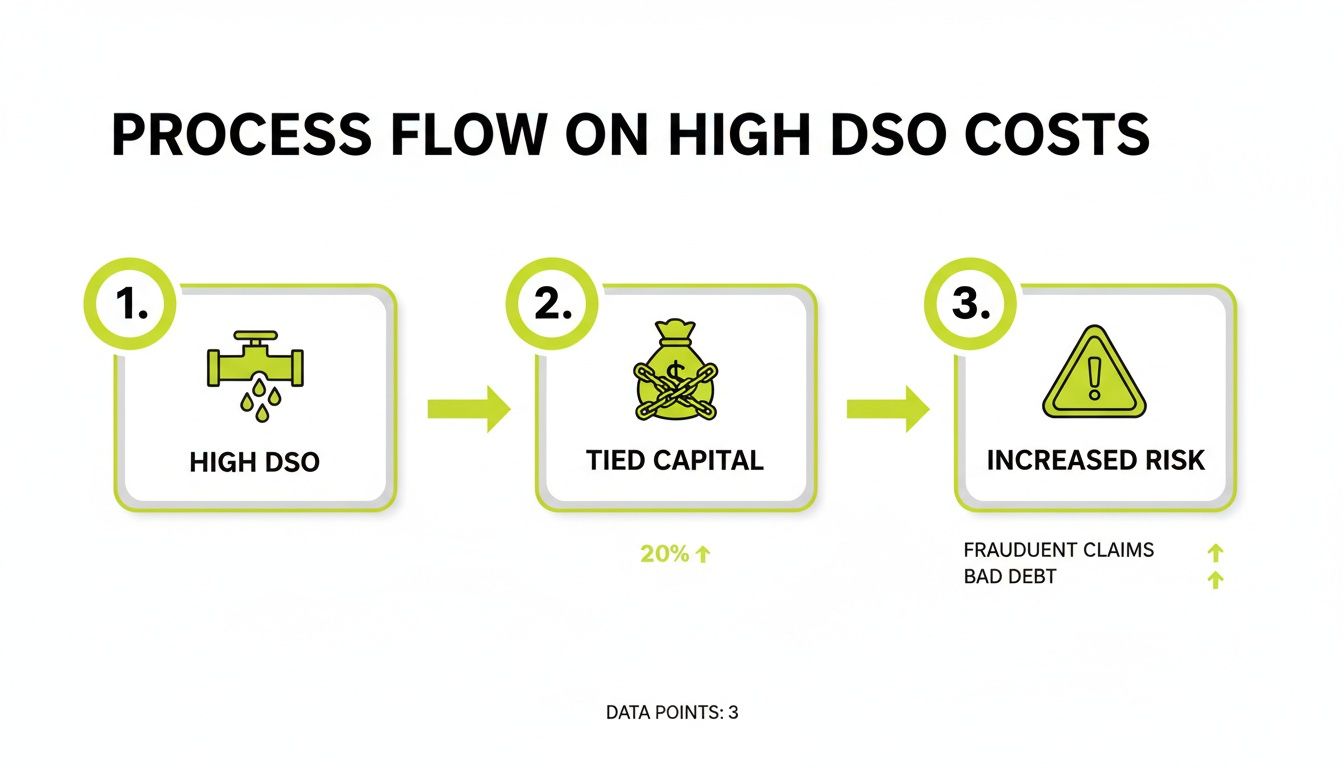
A high DSO is more than a metric on a report. For every extra day an invoice remains unpaid, you are letting earned capital sit in someone else's bank account.
This isn't an inconvenience; it's a direct business cost. An elevated DSO restricts your ability to fund operations, forcing reliance on credit lines to cover payroll or new investments. With each passing day, the risk of an unpaid invoice becoming bad debt increases, eroding your margins.
The Financial Drag on Growth
The financial impact of a high DSO is concrete. For a $15M professional services firm with a DSO of 60 days on Net 30 terms, that extra 30-day collection delay ties up roughly $1.23 million in working capital.
That is capital that could be funding a new service line, technology upgrades, or key hires.
When your cash is locked in receivables, you are effectively giving clients an interest-free loan. This forces you to fund your own growth with debt—a far more expensive way to operate.
Industry data shows nearly half of all B2B invoices in North America are overdue. Write-offs for long-overdue accounts often reach 5-6% of sales. For a firm with a 20% net margin, you must generate $250,000 in new revenue to cover a single $50,000 write-off.
Operational Strain and Strategic Blind Spots
Beyond the balance sheet, a high DSO creates operational friction. Your finance team spends its time chasing payments instead of performing strategic analysis. It's a reactive cycle that consumes your team's most valuable resource: time.
This inefficiency has a direct cost, which we explore in our guide on the true cost of AR inefficiency in professional services. The consequences manifest in several ways:
- Increased Admin Work: Manual follow-ups and payment reconciliation consume hours that could be dedicated to value-added work.
- Strained Client Relationships: Aggressive or inconsistent collections efforts can damage the client goodwill you've built.
- Inaccurate Forecasting: It is nearly impossible to plan with confidence when you cannot predict cash arrival.
Treating DSO as a core strategic priority turns accounts receivable from a liability into a well-managed operational asset.
Diagnosing the Root Causes of High DSO
To lower your Days Sales Outstanding, you must first identify the root causes. A high DSO is a symptom of operational friction somewhere between project completion and cash receipt. Pinpointing these specific bottlenecks is the only way to implement an effective solution.
The culprits in professional services firms typically fall into a few key areas that disrupt your collections timeline and, ultimately, your cash flow.
Inefficient Invoice Creation and Delivery
The DSO clock starts when your client receives a clear, correct invoice. Any delays or errors at this initial stage create a ripple effect throughout the entire payment cycle.
Ask your team:
- Timing: How many days pass between a project milestone and invoice delivery?
- Accuracy: What percentage of invoices are disputed due to incorrect billing rates, hours, or project codes?
- Clarity: Does the invoice clearly state the work performed, its value, and the precise due date?
A 5-day delay in sending the invoice automatically adds 5 days to your best-case DSO. Closing that gap with a disciplined process or accounts receivable automation is a direct, measurable win.
Ambiguous or Inconsistent Client Terms
If payment terms are vague, buried in a contract, or inconsistent across clients, you are inviting late payments. Control begins by setting clear expectations before any work is billed. Ambiguity always benefits the client, not your firm.
A strong collections process is built on a clear payment policy. If your team cannot state your firm's standard terms, neither can your clients.
Inconsistent terms introduce friction and open the door for interpretation—the primary drivers of payment delays.
Manual and Reactive Collections Follow-Up
The most common cause of high DSO is an inconsistent, manual approach to collections. When follow-up depends on an individual's memory and availability, invoices are inevitably missed. This ad-hoc process signals to clients that your deadlines are flexible.
A disciplined approach, particularly one using AI AR automation, ensures no invoice is overlooked. Tools like QuickBooks AR automation can transform your process from a manual task to a predictable system. This consistency helps reduce DSO and reinforces a professional standard that clients respect, enabling you to improve cash flow without damaging relationships.
Proven Strategies to Systematically Reduce DSO
Lowering your DSO is about operational discipline, not aggressive collection calls. It requires an operational playbook.
By refining your processes and policies, you can shorten the time it takes to convert an invoice into cash without harming client relationships. These strategies focus on process, policy, and proactive collections.
Refine Your Invoicing Process
The DSO clock starts when a client receives the invoice. Every day you delay sending it is a day you've delayed payment. The first win is to close the gap between work completion and invoice delivery.
Establish a rule: invoice immediately upon hitting a project milestone or completing a deliverable. A three-day billing delay on Net 30 terms pushes your best-case DSO to 33 days. Automation eliminates the human bottlenecks that cause these delays.
Accuracy is equally critical. An invoice with an error—a wrong PO number, a vague line item—invites a payment dispute, which stops the clock. Standardize your invoice templates to include all necessary details: project codes, a clear service breakdown, PO numbers, and the exact due date.
Enhance Your Payment Policies
Your payment policies set the rules for every engagement. When they are vague, the ambiguity benefits your client's cash flow, not yours. Standardize your terms from day one.
Policy is the foundation of a predictable collections system. Clear terms from the start reduce time spent chasing payments.
Consider these policy adjustments:
- Offer Early Payment Incentives: A 1-2% discount for payment within 10 days can effectively move your invoice to the top of the pile.
- Standardize Your Terms: Make Net 30 your default. Avoid drifting into ad-hoc Net 45 or Net 60 agreements that inflate your DSO.
- Diversify Payment Options: Simplify the payment process. Accept ACH, credit cards, and wire transfers via a client portal. Exploring options like B2B Buy Now Pay Later solutions can also accelerate cash receipt.
Implement Proactive Collections
A proactive collections strategy is systematic, not sporadic. It's a planned communication sequence that begins before an invoice is due. This transforms collections from a reactive chore into a controlled, professional process.
This is where accounts receivable automation is essential. It ensures the right message reaches the right person at the right time, every time.
A standard cadence includes:
- Invoice Confirmation: An automated email confirms receipt and notes the due date.
- Pre-Due Reminder: A polite reminder is sent 7 days before the due date.
- Day-Of Reminder: A brief note is sent on the due date.
- Past-Due Follow-Ups: A sequence of reminders begins on day 1, 7, and 15 past due, escalating as needed.
When managed with AR software for professional services, no invoice is forgotten. This creates a predictable experience that conditions clients to pay on time. The objective is to improve cash flow consistently, a topic we cover in our guide on ways to increase cash flow.
Using Automation to Drive Down DSO

Manual processes are the primary source of friction in accounts receivable. Human intervention introduces small delays and inconsistencies that inflate your cash conversion cycle.
AR automation is a strategic necessity. It is the force multiplier that makes your collections playbook executable consistently and without fail. Automation shifts your team’s focus from sending repetitive emails to managing high-value exceptions. It is how you systematically reduce DSO.
From Manual Effort to Systemic Control
Consider the typical AR workflow: an analyst remembers to send a reminder and logs the activity in a spreadsheet. The process relies entirely on human memory and bandwidth.
An AI-powered AR platform can execute a perfectly timed collections cadence for every invoice. It never forgets and never has an off day.
- Automated Invoice Delivery: Invoices are sent the moment a project milestone is hit, directly to the correct AP contact.
- Personalized Reminder Sequences: Polite, customized reminders are sent before, on, and after the due date, maintaining a professional, human tone.
- Painless Cash Application: Payments are automatically matched to open invoices, eliminating hours of manual reconciliation. This is particularly effective with tools offering QuickBooks AR automation.
Firms that adopt specialized AR software for professional services often reduce their DSO by 10-15 days within the first two quarters. This directly reflects the elimination of human error and process gaps. You can learn more in our analysis of accounts receivable automation benefits.
Automation doesn't replace your finance team; it empowers them. It provides the leverage to execute your collections strategy flawlessly, turning a reactive cost center into a proactive tool for improving cash flow.
Effective sales process automation creates cleaner handoffs from sales to finance, ensuring the entire revenue cycle is optimized from the beginning.
Common Questions About DSO
As a finance leader, you focus on the metrics that provide control and predictability. When treating Days Sales Outstanding as a strategic lever for cash flow, several practical questions arise.
What Is a “Good” DSO for a Professional Services Firm?
While benchmarks like "under 45 days" are common, the best answer is simpler: a "good" DSO is one that is close to your payment terms. If you invoice at Net 30, a DSO of 35 indicates an efficient collections process.
The most important indicator, however, is the trend line. A consistently decreasing DSO signals improving operational health. A rising DSO is a clear warning that requires immediate attention.
How Can We Reduce DSO Without Damaging Client Relationships?
This concern is based on a false premise. Effective collections are about clarity and consistency, not conflict. A well-managed AR process reinforces your firm's professionalism.
When you use accounts receivable automation, every communication is timely, polite, and helpful. Clear upfront terms and predictable reminders signal that your firm is operationally sound—a quality that sophisticated clients respect. A controlled process protects relationships, it doesn't harm them.
Our Finance Team Is Already Stretched Thin. How Can We Do More?
This is the exact problem that modern AR software for professional services is designed to solve. A rigorous, proactive collections strategy is unsustainable to manage manually. It leads to burnout and guarantees errors.
An AI AR automation platform handles repetitive, time-consuming work with perfect accuracy. It frees your team to stop chasing every invoice and focus their expertise on high-value exceptions. This is how you gain the leverage to execute your strategy and improve cash flow without increasing headcount.
--- Resolut automates AR for professional services—consistent, accurate, and human.