What is Dunning? A Guide to AR Control and Cash Flow Optimization
What is dunning? A CFO's guide to the dunning process. Learn how to reduce DSO, improve cash flow, and maintain client relationships with AR automation.
Chasing late payments is an operational drag. It’s an awkward, manual process that consumes valuable finance team hours and strains client relationships.
For CFOs at professional services firms, this isn’t just an annoyance—it’s a direct threat to working capital and financial control.
Dunning is the system that replaces reactive, inconsistent follow-ups with a structured, professional process. It’s not aggressive collection; it’s disciplined communication designed to reduce DSO and improve cash flow.
The Dunning Process: From Chaos to Control
An undefined dunning process creates operational friction. Accounts receivable becomes a manual, inconsistent effort where one person sends a polite check-in and another waits 30 days. This variability sends a mixed message to clients and makes cash flow unpredictable.
A disciplined dunning strategy brings control. It moves your finance function from chasing individual invoices to managing a predictable system.
Every overdue invoice receives a timely, on-brand, and consistent follow-up, removing guesswork and human error from a critical part of your revenue cycle.
Dunning turns the art of collections into a science. By defining stages, messages, and timing, you create a repeatable workflow that reduces ambiguity. It is a fundamental component of a healthy order-to-cash process.
The Financial Impact of a Systematic Approach
Implementing a structured dunning system is a strategic lever for financial health. The primary objective is to reduce Days Sales Outstanding (DSO)—the average number of days it takes to convert receivables into cash.
The numbers are clear. For a professional services firm with $10M in annual revenue, cutting DSO by just five days unlocks over $137,000 in cash flow. A well-executed dunning process achieves this by addressing late payments systematically, not after they become a significant problem.
Why Dunning Matters for Professional Services
In the professional services sector, client relationships are the primary asset. A single misstep in the collections process can damage a partnership built over years.
A calm, automated dunning process acts as a safeguard. It ensures every communication is professional, empathetic, and aligned with your firm’s brand standards.
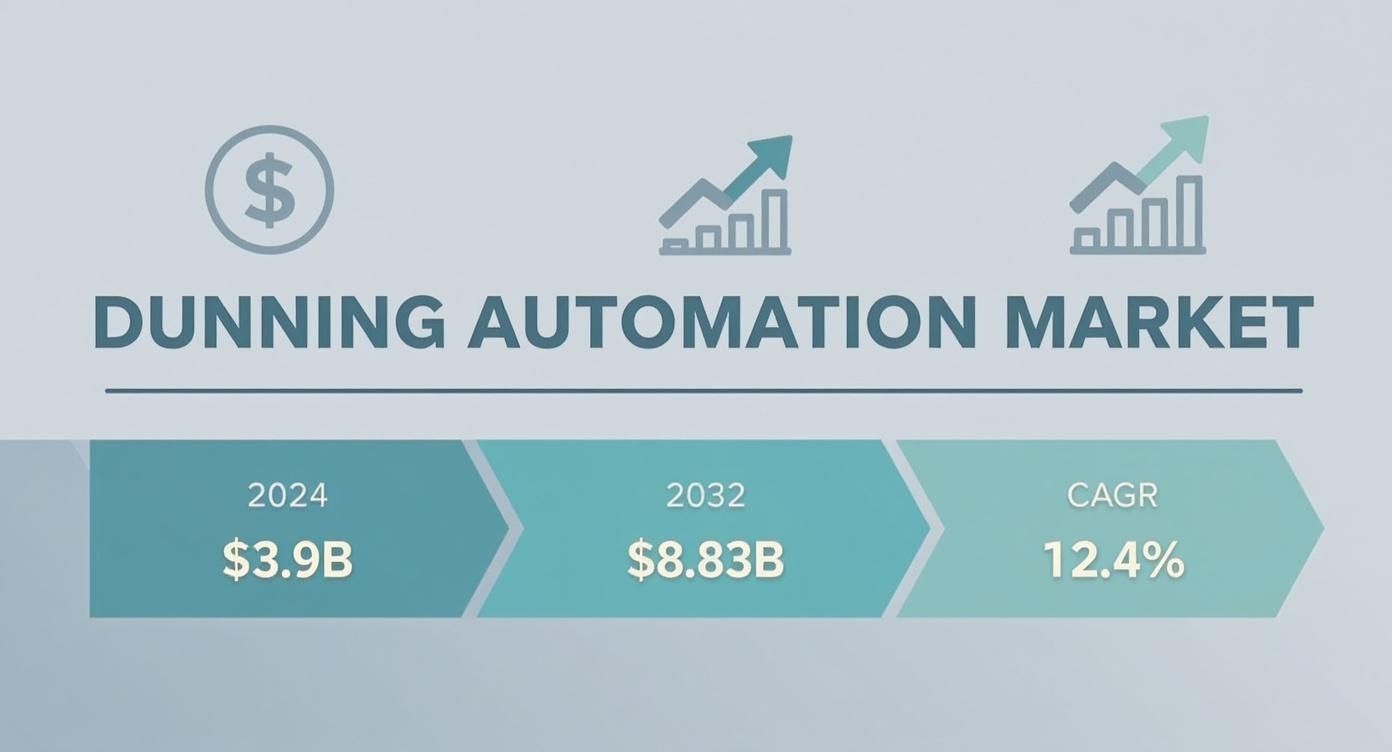
The market for accounts receivable automation reflects this need. Valued at $3.90 billion, it is projected to hit $8.83 billion by 2032. This growth is a direct response to the operational need for smarter AR management. More data is available in this report.
Ultimately, a strong dunning system provides clarity and control. It establishes clear payment expectations and reinforces your firm’s professionalism.
Anatomy of an Effective Dunning Cadence
An effective dunning strategy is a staged process that removes emotion and guesswork from collections. For professional services firms, this is non-negotiable.
The goal is to be firm but respectful, turning a potentially awkward task into a predictable and measurable part of your financial operations.
A repeatable workflow protects cash flow without damaging client relationships. This systematic approach, powered by accounts receivable automation, is becoming the standard for efficient finance functions.
Stage 0: Pre-Dunning (The Courtesy Reminder)
The most effective dunning action occurs before an invoice is late. A pre-dunning reminder, sent approximately three days before the due date, is a proactive, customer-service-oriented communication.
This touchpoint often resolves issues caused by simple oversight, such as a lost invoice or an internal approval delay.
The tone should be light and helpful. Frame it as a useful heads-up to reinforce a positive client experience while keeping your invoice top-of-mind.
Stage 1: The Gentle Follow-Up
Once an invoice is past due, the first formal dunning stage begins. A gentle follow-up, sent 1–7 days after the due date, serves as a simple nudge.
The operating assumption is that the client forgot or the invoice was misplaced. The message should be professional and direct, but not demanding.
Always include the invoice number, amount, and due date to simplify the payment process for the client's AP department.
Stage 2: Firm and Direct Communication
If the invoice remains unpaid after the first reminder, the tone shifts. Around 15 days past due, the communication becomes firmer and more direct.
The language remains professional but clearly states that payment is now expected. Reference previous contact attempts and restate the overdue status. This escalation signals that the item is a priority.
For any email cadence to be effective, it must reach the inbox. Adhering to essential email deliverability best practices is critical.
Stage 3: The Urgent Final Notice
At 30 days past due, the account enters the final stage of a standard automated cadence. This communication is urgent and outlines the consequences of continued non-payment, such as service suspension or escalation.
The objective is to prompt immediate action. The tone is serious but factual. State the terms of your agreement and the steps required to bring the account current.
This notice is the last automated step before manual human intervention is required.
Sample Dunning Cadence for Professional Services
Stage | Timing (Days Past Due) | Communication Tone | Example Subject Line |
|---|---|---|---|
Stage 0: Pre-Dunning | -3 Days | Courteous & Helpful | Friendly Reminder: Invoice [Invoice #] is due soon |
Stage 1: Gentle Nudge | +3 Days | Professional & Informative | Follow-Up: Invoice [Invoice #] is now past due |
Stage 2: Firm Reminder | +15 Days | Direct & Clear | Second Notice: Invoice [Invoice #] is 15 days overdue |
Stage 3: Final Notice | +30 Days | Urgent & Factual | URGENT: Action Required on Overdue Invoice [Invoice #] |
A systematic approach like this provides the structure to improve cash flow. This is particularly true when managed with dedicated AR software for professional services, whether as a QuickBooks AR automation layer or a standalone system.
How to Know If Your Dunning Is Working
You cannot improve what you do not measure. A dunning process without clear metrics is simply sending emails into the void.
To manage your firm’s financial health effectively, you need data showing how your AR efforts connect directly to the bottom line.
Tracking the right key performance indicators (KPIs) transforms collections from a reactive chore into a strategic financial function.
*Visual Idea: *A clean, professional dashboard showing key financial metrics like DSO and CEI, with clear charts illustrating positive trends over time.

Days Sales Outstanding (DSO)
DSO is the foundational metric for accounts receivable, measuring the average number of days it takes to get paid after invoicing. It is a direct pulse check on your cash conversion cycle.
- Formula: (Total Accounts Receivable / Total Credit Sales) x Number of Days in Period
- What it reveals: A high DSO indicates you're waiting longer for cash, which strains working capital. A declining DSO signals healthy cash flow and efficient collections.
For most professional services firms, a DSO below 45 days is considered healthy, with top performers operating closer to 30 days. The trend is key; a rising DSO is an early warning of process inefficiencies.
Average Days Delinquent (ADD)
While DSO provides a broad view, ADD focuses on problem accounts. This metric measures the average number of days your invoices are past due, isolating the performance of your collections efforts.
If your DSO is high, ADD helps determine if the cause is your payment terms or your team’s effectiveness in pursuing overdue payments.
A rising ADD, even with a stable DSO, is a red flag. It can indicate that while most clients pay on time, a small cohort of overdue accounts is aging significantly, signaling a need for a more assertive dunning strategy.
A systematic dunning cadence has a measurable impact. Some companies recover up to 60% of failed payments with well-timed follow-ups. While professional services differ from subscription models, the principle holds: consistent communication yields results. You can explore more on how businesses maximize their dunning processes for further data.
Collection Effectiveness Index (CEI)
CEI is a more precise tool for measuring team performance. It compares the amount collected in a period to the total amount that was available for collection.
- Formula: ((Beginning Receivables + Monthly Credit Sales - Ending Total Receivables) / (Beginning Receivables + Monthly Credit Sales - Ending Current Receivables)) x 100
- What it reveals: A score closer to 100% indicates a highly effective collections process.
Unlike DSO, CEI is not skewed by sales volume fluctuations, making it a purer measure of team performance. Tracking it provides a clear benchmark for evaluating the ROI of new dunning cadences or accounts receivable automation software, such as QuickBooks AR automation.
Manual Dunning vs. AR Automation
For small firms, manual dunning seems manageable. A controller with a spreadsheet can track invoices and maintain adequate cash flow.
As a firm scales, this process breaks. What was a simple task becomes a significant operational drag, consuming finance team hours that should be allocated to analysis, not administration.
The core problem with manual follow-up is inconsistency. The tone, timing, and persistence of collections depend entirely on an individual’s workload. This variability sends mixed signals to clients and prevents a disciplined, firm-wide collections strategy.
*Visual Idea: *A split-screen image. Left side: a chaotic desk with scattered papers, sticky notes, and a stressed finance professional (manual). Right side: a clean, organized dashboard on a computer screen showing real-time AR metrics (automation).

The Hidden Costs of Manual Processes
Time is the most apparent cost. Your finance professionals are trapped in administrative tasks instead of performing the high-value strategic work they were hired for.
The hidden costs are more damaging. Inconsistent messaging can strain client relationships. A lack of systematic follow-up leads directly to higher DSO and weaker cash flow as invoices age faster.
Taking Back Control with AR Automation
AR software for professional services changes the game. It shifts dunning from a reactive, manual chore to a controlled, proactive system. Automation ensures every invoice is managed with perfect consistency according to rules you define.
The purpose of automation is not to replace your finance team, but to empower it. It frees them from administrative work to focus on strategic exceptions, complex client negotiations, and high-level analysis—elevating their role from operator to strategic leader.
Platforms using AI AR automation can orchestrate sophisticated dunning cadences that adapt to client behavior. For a deeper look, see our guide to accounts receivable automation software.
An Operational Comparison
The operational difference between manual and automated dunning is stark. One relies on inconsistent human intervention, while the other provides scalable, data-driven control. For firms leveraging QuickBooks AR automation, this transition adds an intelligence layer to their existing accounting system.
Operational Area | Manual Dunning Process | Automated Dunning Process |
|---|---|---|
Consistency | Variable; depends on individual staff and their workload. | 100% consistent; follows pre-programmed rules every time. |
Scalability | Low; requires more staff to manage client and invoice growth. | High; handles increased volume with no additional headcount. |
Data & Reporting | Manual data entry; reporting is often delayed and error-prone. | Real-time, accurate dashboards for immediate insight. |
Team Focus | Consumed by routine follow-ups and administrative tasks. | Focused on strategic analysis and high-value exception handling. |
Implementing accounts receivable automation is a strategic decision to improve cash flow and reduce DSO. It replaces an unpredictable, labor-intensive process with a reliable system that protects revenue and supports scalable growth.
Integrating AR Automation with Your Financial Stack
The value of new technology is determined by its integration with your existing systems. A standalone platform that creates data silos is not an asset; it is an operational burden.
Effective accounts receivable automation should function as an intelligent layer on top of your current financial stack, creating a single source of truth for receivables.
When an AR platform integrates with your accounting system, every action—from sending a reminder to reconciling a payment—is reflected accurately across both systems in real time.
The Central Role of QuickBooks AR Automation
For most professional services firms in the $3M–$50M range, QuickBooks is the financial core. Any viable AR solution requires a deep, two-way integration.
QuickBooks AR automation pulls real-time data on customers, invoices, and payments directly from the general ledger. The platform executes the dunning cadence, processes payments, and pushes reconciled data back into QuickBooks.
This closed-loop system ensures:
- Invoice data is always current: The AR system has real-time invoice status without manual updates.
- Payment reconciliation is automatic: Payments are instantly recorded and applied to the correct open invoice in QuickBooks.
- Customer records are synchronized: Data integrity is maintained effortlessly across systems.
This direct integration ensures financial reporting is always accurate, providing a complete and trustworthy view of your firm's cash position.
Addressing Key Concerns for Financial Leaders
New software always raises questions about security, workflow disruption, and ROI.
Modern AR software for professional services is designed to be a non-disruptive layer that enhances your existing systems.
A proper integration is a secure, API-driven connection that acts as an extension of your accounting software. It inherits your existing data structure, ensuring a smooth transition and immediate benefits without forcing your team to learn a new accounting process.
A well-integrated system provides the control needed to improve cash flow and reduce DSO without disrupting your core financial engine. It adds a layer of intelligence that makes your existing stack more powerful.
Dunning Questions We Hear All the Time
We frequently address the same dunning questions from finance leaders at professional services firms. Here are the most common inquiries.
When Should We Actually Start the Dunning Process?
An account is technically late the day after its due date, but the process should begin with professional courtesy.
A good cadence starts with a gentle reminder 1 to 7 days after the due date. The initial assumption should always be oversight, not a refusal to pay.
Even better is a "pre-dunning" email sent a few days before the due date. This customer-service-oriented touchpoint is one of the most effective tools for preventing late payments.
How Can We Chase Payments Without Ruining Client Relationships?
The key is to be consistent, respectful, and unemotional. Dunning communications should feel like a standard part of business operations.
This is a primary benefit of accounts receivable automation. It removes the human emotion and inconsistency that make manual follow-ups feel awkward or aggressive. The system sends the right message at the right time, ensuring every client receives the same courteous, professional treatment.
The biggest mistake firms make is inconsistency. Random or delayed follow-ups signal that payment terms are not firm, effectively training clients to pay you late. The second mistake is waiting too long. The probability of collecting an invoice declines sharply after 90 days.
Can Automation Really Handle Our Complex Client Scenarios?
Yes. Modern AI AR automation is designed for nuance.
You can create different communication cadences for different client segments. A high-value strategic partner might receive a more personalized sequence, while a client on a standard retainer gets an automated series of reminders.
The system manages routine follow-ups, freeing your finance team to handle true exceptions that require a human conversation. The goal of AR software for professional services, including QuickBooks AR automation, is not to replace your team but to provide them with the leverage to operate more strategically.
--- Resolut automates AR for professional services—consistent, accurate, and human. Learn more.