What is the Dunning Process? A Guide to Improving Cash Flow
What is dunning process? Discover a practical plan to reduce DSO, boost cash flow, and protect client relationships.
Chasing unpaid invoices is an operational drag. The task is reactive, uncomfortable, and a poor use of a finance team's time.
The dunning process is a systematic framework for communicating with clients about outstanding receivables. It is not aggressive debt collection. It is a series of professional, well-timed reminders designed to secure payment while preserving the client relationship.
For a professional services firm, a disciplined dunning process is a direct measure of its operational maturity and financial control. It stabilizes cash flow and reduces Days Sales Outstanding (DSO).
Dunning Is About Financial Control, Not Conflict
For CFOs and controllers at professional services firms, a structured dunning process is essential financial hygiene. It converts a reactive, manual task into a proactive system for managing receivables.
It establishes control and predictability over your firm's cash conversion cycle.
The term "dunning" historically had negative connotations, associated with aggressive collection tactics. Modern practice, governed by regulations like the Fair Debt Collection Practices Act (FDCPA), mandates respectful and fair communication.
Modern dunning is about precision and professionalism, not pressure. It relies on systems, not force.
From Manual Scrambles to a Methodical System
Without a defined process, collections become an ad-hoc scramble. Staff waste hours on manual emails and inconsistent phone calls, eroding client trust and signaling operational weakness.
A structured dunning workflow, particularly one driven by effective AR software for professional services, eliminates this chaos. It implements a clear, repeatable system for every invoice.
This methodical approach delivers measurable outcomes:
- Consistency: Every client receives the same professional treatment based on predefined rules.
- Timeliness: Communications are deployed automatically at optimal intervals, preventing invoice aging.
- Clarity: It removes ambiguity for both your team and your clients, establishing clear payment expectations.
A well-run dunning process is a direct reflection of your firm's financial health. It signals that you value your firm’s time and expertise as much as you value your client relationships.
By implementing a true dunning strategy, you stop chasing payments and start guiding clients toward timely resolution. This is where tools providing QuickBooks AR automation are critical, converting a manual function into a streamlined system that protects revenue.
The Four Stages of an Effective Dunning Workflow
An effective dunning process is not a single, panicked email. It is a structured, multi-stage workflow designed to escalate logically from gentle reminders to direct requests.
This system provides a predictable framework that improves cash flow and protects client relationships.
(Visual idea: A funnel chart showing the decreasing number of invoices at each dunning stage, from "Pre-Dunning" at the wide top to "Late-Stage" at the narrow bottom, demonstrating process effectiveness.)
Stage 1: Pre-Dunning
The most effective collections activity occurs before an invoice is late. Pre-dunning is proactive communication. It is a professional courtesy designed to prevent late payments.
- Objective: Remind the client of an upcoming payment, confirm invoice details, and provide a simple payment path.
- Timing: 7–10 days before the invoice due date.
- Tone: Helpful and courteous.
- Example Message: "A reminder that invoice #1234 for $5,000 is due next week. The invoice can be viewed and paid here."
This step identifies issues like a lost invoice or incorrect contact before they cause a delay, setting a professional tone.
Stage 2: Early-Stage Dunning
Once an invoice passes its due date, the early-stage dunning process begins. The objective is immediate but gentle follow-up. Most payments at this stage are late due to simple oversight.
- Objective: Alert the client that payment is past due and prompt immediate action.
- Timing: 1–7 days after the due date.
- Tone: Polite and professional, but direct. The assumption is oversight.
- Example Message: "This is a follow-up regarding invoice #1234, which was due yesterday. Please let us know if you have any questions."
Using accounts receivable automation for this stage is crucial. It ensures no invoice is missed and maintains a consistent cadence that manual processes cannot match.
A HighRadius study indicates that 68% of businesses in North America and Europe have adopted automated dunning systems. This reflects a clear industry shift toward proactive, system-driven AR management.
The move from manual, often confrontational dunning to automated, professional workflows has been significant. This timeline shows the evolution since the regulatory groundwork was laid.
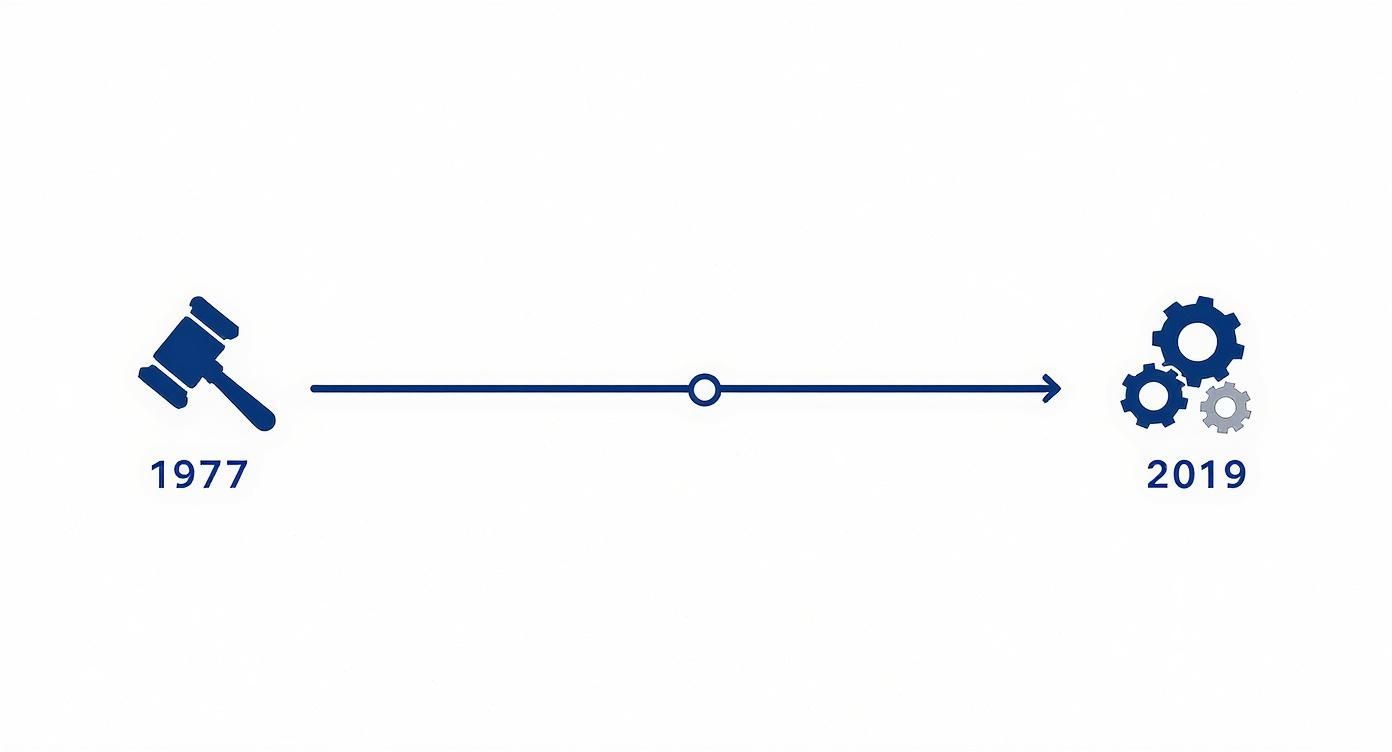
This evolution makes one thing clear: modern dunning is less about chasing and more about efficiency and compliance.
Stage 3: Mid-Stage Dunning
If an invoice remains outstanding, the process moves to mid-stage dunning. Communication becomes firmer and more frequent. The likelihood of simple oversight has decreased.
- Objective: Create urgency and secure a direct response or a firm payment commitment.
- Timing: 15–30 days after the due date.
- Tone: Firm and direct, but professional. The message shifts from a reminder to a clear request for a status update.
- Primary Channel: Mix email with a personal phone call. A human touch can resolve roadblocks that automated messages cannot.
The goal is to secure a payment commitment, not to damage the relationship. It demonstrates that your firm manages its finances seriously.
Stage 4: Late-Stage Dunning
The final phase, late-stage dunning, addresses seriously overdue invoices. At this point, you escalate internally and clearly communicate the consequences of continued non-payment.
- Objective: Secure payment and communicate the final steps before escalating to collections or legal action as defined in your service agreement.
- Timing: 30-60+ days after the due date.
- Tone: Authoritative and serious. All communication must be clear, concise, and documented.
- Escalation Path: Involve senior finance staff, account managers, and potentially a firm owner. The message may offer a final payment plan before outlining next steps.
This table provides a high-level overview of the workflow.
Dunning Process Stages and Communication Cadence
This table breaks down the entire workflow, showing how the timing, tone, and objectives shift as an invoice ages.
Stage | Timing (Relative to Due Date) | Objective | Recommended Tone | Primary Channel |
|---|---|---|---|---|
Pre-Dunning | 7-10 days before | Proactive reminder, prevent lateness | Helpful, courteous | |
Early-Stage | 1-7 days after | Gentle follow-up for simple oversights | Polite, slightly direct | |
Mid-Stage | 15-30 days after | Create urgency, get a commitment | Firm, direct | Email & Phone Call |
Late-Stage | 30-60+ days after | Secure payment, communicate consequences | Authoritative, serious | Phone Call & Email |
A structured cadence transforms collections from a reactive problem into a predictable process.
Implementing this workflow with AI AR automation ensures flawless execution. It provides the structure needed to reduce DSO and improve cash flow without constant manual intervention.
Key Metrics to Measure Dunning Effectiveness
Without measurement, you are managing by anecdote. To assess your firm's financial health, you need objective data. This distinguishes a reactive collections function from a strategic finance operation.
These key performance indicators (KPIs) are the instruments on your financial dashboard. They identify friction in your payment cycle, allowing for precise adjustments that directly improve cash flow.
Days Sales Outstanding (DSO)
Days Sales Outstanding (DSO) measures the average number of days it takes to collect payment after an invoice is issued. It is a primary indicator of cash conversion cycle health.
A high DSO indicates that cash is trapped in receivables, effectively serving as an interest-free loan to clients. A low DSO signifies an efficient collections process. For most professional services firms, a DSO under 45 days is strong. Over 60 days indicates a systemic problem.
How to calculate it: (Total Accounts Receivable / Total Credit Sales) x Number of Days in Period
Example: Your firm has $500,000 in AR and billed $1.5 million in the last quarter (90 days). Your DSO is 30 days—an excellent result, indicating a one-month cash conversion cycle.
Collection Effectiveness Index (CEI)
While DSO measures speed, the Collection Effectiveness Index (CEI) measures quality. It calculates the percentage of collectible receivables that were actually collected in a given period.
A CEI score near 100% indicates an optimized collections engine. A score consistently at 80% or below means a significant portion of revenue is not being converted to cash in a timely manner, directly impacting profitability.
Tracking CEI monthly reveals the impact of strategic changes. Implementing accounts receivable automation, for example, should yield a measurable increase in CEI within the first quarter.
Aged Receivables Analysis
An Aged Receivables report is a diagnostic tool. It segments outstanding invoices into aging buckets (e.g., 0-30 days, 31-60, 61-90, 90+). It is the most direct way to identify where the dunning process is failing.
In a healthy report, the vast majority of receivables—ideally over 85%—should be in the 0-30 day bucket. A significant balance in the 60+ day columns is a red flag, indicating that mid- and late-stage dunning efforts are ineffective.
This analysis allows for targeted intervention. If invoices are stalling in the 31-60 day bucket, the communication and escalation protocols for that stage require strengthening. Using an AR software for professional services, especially one with robust QuickBooks AR automation, provides this visibility automatically.
Using AR Automation for Dunning Consistency and Control
Manual dunning is inefficient. It is inconsistent, prone to human error, and consumes finance team hours that should be allocated to high-value analysis.
This approach does not scale. It introduces unpredictability where consistency is paramount. The objective is to execute the dunning strategy with precision, ensuring every communication is sent to the right person at the right time.
This is why accounts receivable automation is a necessity for firms managing significant revenue.
(Visual idea: A cinematic, slow-motion shot of a Newton's Cradle. The first ball swings, representing an automated trigger, and the energy transfers perfectly down the line, showing a flawless, cause-and-effect process. This visualizes consistency and control.)

Executing Your Dunning Strategy with Precision
An automated system is the engine that executes your dunning workflow. It applies your defined stages, timelines, and messages flawlessly, 24/7. This eliminates the risk of missed follow-ups or inconsistent tone.
The benefits are immediate:
- Elimination of Human Error: Automated workflows prevent missed follow-ups, incorrect invoice details, and inconsistent messaging.
- Guaranteed Timeliness: Every communication is triggered at the predefined moment to maximize its impact.
- Scalable Operations: The system absorbs growth in invoice volume without requiring additional administrative headcount.
For finance leaders, learning to automate repetitive tasks is the first step toward achieving this level of operational control. It is about building a system that performs for you.
Automation transforms dunning from a series of manual chores into a predictable, cohesive system. It ensures your firm’s financial operations reflect the same professionalism you deliver in your client work.
The Role of AI in Modern AR Automation
Modern AI AR automation moves beyond simple, timed emails. Intelligent AR platforms adapt the dunning process based on client payment behavior, bringing a level of sophistication that manual efforts cannot replicate.
This is the difference between a generic script and a tailored communication strategy. An AI-powered system can:
- Analyze Payment Patterns: It learns client payment habits and adjusts the communication cadence accordingly.
- Optimize Communication Channels: The system determines if a client responds better to email, SMS, or requires a task for a personal phone call.
- Prioritize Team Efforts: It flags high-risk or high-value invoices that require immediate human intervention, focusing your team on what matters.
This intelligent layer makes the dunning process not just consistent, but more effective. A deeper look at accounts receivable automation software can provide more detail on platform capabilities.
Integrating with Your Financial Tech Stack
For most professional services firms, QuickBooks is the financial system of record. Therefore, any AR automation tool must offer seamless QuickBooks AR automation.
A properly integrated system pulls invoice data directly from QuickBooks, triggers dunning sequences based on real-time aging, and syncs payment data back automatically. This eliminates duplicate data entry, reduces reconciliation errors, and establishes a single source of truth for your receivables.
The goal is a closed-loop system that enhances your existing financial infrastructure. This level of control is how you reduce DSO and improve cash flow.
Common Dunning Mistakes That Damage Client Relationships
The dunning process requires a careful balance: securing payment without damaging client relationships. Common mistakes can delay payments and create unnecessary friction.
Many firms initiate follow-up too late, use an inconsistent tone, or operate with unclear payment terms. These are not minor operational issues; they are systemic flaws that degrade cash flow and client trust.
Inconsistent Tone and Cadence
A lack of consistency is a critical error. Erratic communication makes your firm appear disorganized and unprofessional.
Consistency creates predictability. When clients know what to expect, they are more likely to pay on time. Accounts receivable automation enforces a disciplined, pre-set communication schedule, removing emotion and human variability from the process.
A dunning process should be a natural extension of your firm's professionalism—firm, predictable, and fair. Inconsistency erodes the trust that is the foundation of any client relationship.
Waiting Too Long to Follow Up
Delay is a cash flow killer. Hesitating to follow up on overdue invoices significantly reduces the probability of timely collection.
The best dunning processes begin before an invoice is due with a proactive reminder. Following up on day one past due is not aggressive; it signals that your firm is organized and manages its agreements seriously.
Operating with Unclear Terms
The dunning process begins with the statement of work. If payment terms, due dates, and late payment consequences are not clearly defined from the outset, you are creating future collection problems.
Ambiguity invites disputes. Contracts must explicitly state:
- Payment Due Dates: "Net 30" must be clearly defined.
- Accepted Payment Methods: Provide clear, easy ways for clients to pay.
- Late Payment Penalties: If late fees apply, they must be specified in the agreement.
Clarity upfront prevents conflict later. When both parties understand the terms, payment becomes a simple execution of an agreement.
Optimizing Your Dunning Strategy for Predictable Cash Flow
An effective dunning process is not static. It is a dynamic system that requires ongoing refinement to deliver predictable cash flow.
This is not a "set it and forget it" function. It is a responsive financial engine that adapts to client behavior and market conditions.
The objective is to balance automation with strategic human intervention. This allows the firm to collect receivables while protecting client goodwill—a critical balance for any professional services firm.
From Automation to Orchestration
Automating a flawed process only accelerates failure.
True optimization is achieved through orchestration. It involves using intelligent accounts receivable automation to execute a defined strategy, freeing your finance team to manage exceptions where their judgment adds value.
This creates a continuous feedback loop. You analyze the data, identify friction points, and make precise adjustments. If a client segment ignores the second automated email, the system can trigger a task for a personal phone call. This is the purpose of AI AR automation: to handle the routine so your team can manage the exceptions.
An optimized dunning process has a significant financial impact. One study showed that fine-tuning an automated dunning workflow recovered an additional $360,000 in annual revenue for a single firm.
The Pillars of a World-Class AR Function
Optimizing your dunning strategy requires reinforcing three core pillars. Mastering these turns accounts receivable from a cost center into a strategic asset.
These pillars are:
- A Documented Process: Dunning stages, communication templates, and escalation paths must be clearly defined and understood by the entire finance team.
- Clear Metrics: Consistently track KPIs like DSO and CEI to objectively measure performance and identify areas for improvement.
- Smart Automation: Utilize an AR platform with deep integration into your existing systems, such as QuickBooks AR automation, to ensure consistency and scalability.
Building on this foundation provides a system that not only helps reduce DSO but gives you complete control over your cash flow. For practical next steps, see these **8 real-world ways to clean up your accounts receivable**.
Your Questions, Answered
Here are answers to common questions from finance leaders developing their dunning process.
How Can We Automate Dunning Without Sounding Robotic?
Automation is a tool to execute your strategy, not replace it. Accounts receivable automation delivers the right message at the right time, consistently.
Effective AR software for professional services allows you to customize templates with your firm’s voice, segment clients based on their history, and modulate the tone as an invoice ages. The automation executes the mechanics; your strategy maintains the professional, human touch.
When Should We Escalate to a Personal Call?
A phone call changes the dynamic and should be used for maximum impact. The optimal time is typically mid-workflow, 15-30 days after an invoice is past due.
At this stage, automated reminders have already been sent. A call signals a shift from routine follow-up to direct, personal inquiry. It is the ideal moment to understand the reason for the delay and secure a payment commitment without premature escalation.
Escalation should be a calculated step in a documented process, not a reaction. The goal of the call is resolution, not confrontation.
What's the First Step to Automating Dunning with QuickBooks?
Select an AR automation platform with a deep, native QuickBooks AR automation integration. This is non-negotiable. The system must pull real-time invoice data and sync payments back automatically to avoid creating more manual work.
Once the right tool is selected, implementation is straightforward:
- Connect Your QuickBooks Account: A simple authorization links the two systems.
- Configure Your Dunning Cadence: Define the rules, timing, and sequence of your follow-ups.
- Customize Your Templates: Load your pre-written, professional email copy to ensure all communications reflect your firm’s voice.
This setup creates a closed-loop system, eliminating data entry errors and ensuring your dunning process runs on accurate, real-time information—the foundation to improve cash flow.
--- Resolut automates AR for professional services—consistent, accurate, and human. Learn more at https://www.resolutai.com.