What Is E-Invoicing and How Does It Impact Cash Flow?
Discover what is e invoicing and how it streamlines invoicing, AR, and cash flow. A practical CFO guide to reducing DSO with automation.
E-invoicing is not emailing a PDF. That's a digital file, but it's not a true e-invoice.
Real e-invoicing is structured data exchange between systems. Your invoice data flows from your accounting software directly into your client’s accounts payable system.
This eliminates manual data entry, the primary source of payment delays and disputes. It provides control over a process that is often chaotic.
Moving Beyond PDFs to True E-Invoicing
Shifting from PDF attachments to e-invoicing is a fundamental operational upgrade.
A PDF is a static image of an invoice. A human must open it, interpret it, and manually key the details into their accounting system. This process is built for error.
E-invoicing sends invoice data in a structured format like XML. Your client’s system ingests it instantly. No manual entry means no transposition errors and a faster path to payment approval.
The Problem with Manual AR Processes
Manual accounts receivable workflows are a persistent drain on a firm’s financial stability. They create friction and obscure cash flow visibility.
Key operational drags include:
- Data Entry Errors: A single incorrect digit can trigger a payment dispute that takes weeks to resolve, directly impacting Days Sales Outstanding (DSO).
- Processing Delays: An invoice can sit unread in an inbox for days, needlessly extending the payment cycle and tying up working capital.
- High Processing Costs: Manual intervention is expensive. Processing a single PDF invoice costs between $15 and $40 when factoring in labor, follow-up, and error correction.
E-invoicing transforms accounts receivable from a manual, administrative function into a strategic financial tool. It restores control and provides the foundation for a measurable reduction in DSO.
The Strategic Value of E-Invoicing
This single change breaks the bottlenecks that define traditional AR. When an invoice lands directly in a client's system, the payment clock starts immediately. This is fundamental to improving cash flow.
The global adoption rate confirms its importance. The e-invoicing market is projected to grow from $4.95 billion in 2021 to over $14.19 billion by 2024, a clear indicator of its role in B2B payments. See the data from market research on global e-invoicing trends.
For professional services firms, implementing accounts receivable automation is about building a more resilient financial operation. For firms on QuickBooks, dedicated QuickBooks AR automation is the most direct path.
The key is selecting the right technology. It's critical to understand how to choose AR automation software that works for professional services firms to ensure it integrates with your existing systems and delivers measurable outcomes.
How The E-Invoicing Process Actually Works
To understand the operational impact, you have to look at the mechanics. This is not about complex technology; it's about a better, more controlled workflow.
You are not sending a document. You are executing a secure, automated data transfer between your system and your client's.
The process has three stages. Its value lies in removing the manual handoffs that introduce errors and delays. This structured flow is a powerful tool for financial control.
Stage 1: Invoice Creation
The process begins in your accounting system, such as QuickBooks. You create an invoice as usual.
Instead of generating only a PDF, the system also creates a structured data file (e.g., XML).
This file is the invoice itself, with every line item, PO number, and payment term tagged for machine readability. This is the foundation of effective accounts receivable automation.
Stage 2: Secure Transmission
The data file is transmitted to your client through a secure network, not an insecure email attachment.
A prime example is the Peppol (Pan-European Public Procurement On-Line) network. It functions like a specialized, secure courier for financial data.
An AI AR automation provider connects to a network "Access Point," which routes the invoice data directly to your client’s corresponding Access Point. It's the digital equivalent of a sealed, tracked package.
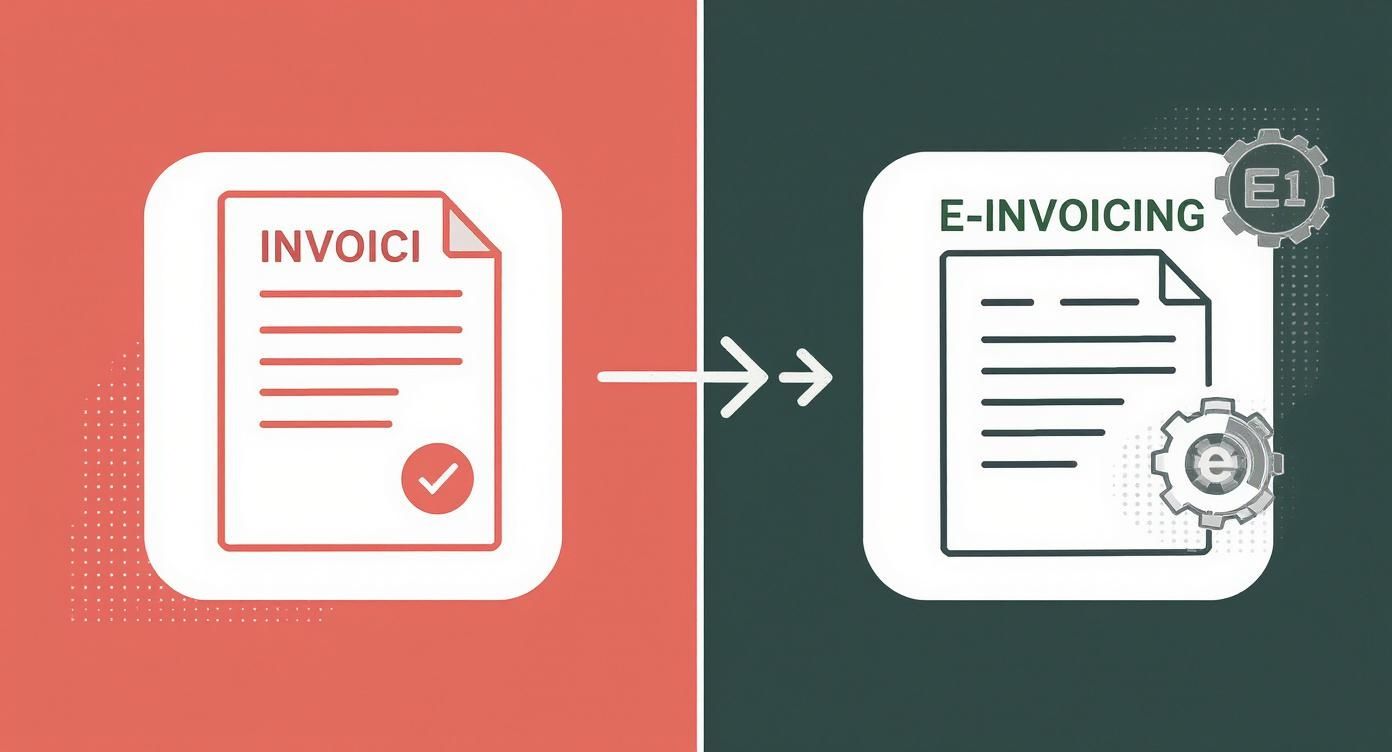
*Visual Idea: A simple flowchart showing the two paths: PDF (Create -> Email -> Download -> Manual Entry -> Error? -> Route) vs. E-Invoice (Create -> Secure Network -> System Ingest -> Auto-Validate -> Auto-Route). Highlight the manual touchpoints in the PDF path with a red 'X'.*
This eliminates the manual steps where information gets lost, delayed, or keyed incorrectly.
Stage 3: Automated Processing
This is the critical stage. Because the invoice arrives as structured data, the client's AP system can process it without human intervention.
The system automatically performs key validation tasks:
- Validation: It instantly checks for a valid PO number and confirms that line items calculate correctly.
- Matching: It can automatically perform a three-way match against the purchase order and goods receipt.
- Routing: Once validated, the invoice is routed directly to the designated approver.
This system-to-system communication allows an invoice to be received, validated, and approved for payment in minutes, not weeks. This acceleration is a primary driver to reduce DSO and materially improve your cash flow.
The operational difference is stark.
Manual Invoicing vs E-Invoicing Process Breakdown
Process Stage | Manual Invoicing (PDF via Email) | E-Invoicing (Structured Data) |
|---|---|---|
Creation | Staff manually creates a PDF and attaches it to an email. High potential for error. | ERP/accounting system automatically generates a structured data file. |
Transmission | Email is sent; vulnerable to spam filters, human error, or being ignored in a busy inbox. | Invoice data is transmitted instantly and securely through a dedicated network like Peppol. |
Reception | Client's AP team must open the email, download the attachment, and manually enter data. | Client's AP system automatically ingests the structured data with zero manual entry. |
Validation | Manual review for errors, missing PO numbers, or incorrect totals. High risk of human error. | System automatically validates all data against predefined business rules in seconds. |
Approval | The invoice is manually forwarded for approval, often with no tracking, leading to delays. | The validated invoice is automatically routed to the correct approver in the system. |
Outcome | Days or weeks to process. Prone to errors, delays, and lost invoices. High follow-up cost. | Minutes to process. Minimal errors, instant validation, and full visibility. Low operational cost. |
This isn't a minor tweak; it's a fundamental change from a slow, error-prone manual process to a fast, reliable, automated workflow.
Understanding the principles of how to automate invoice processing is key. It's how you transform AR into a smooth workflow managed by effective AR software for professional services.
The Global Shift Toward E-Invoicing Mandates
For firms with clients across state or national borders, the regulatory landscape is now a central strategic concern.
Governments globally are mandating e-invoicing to close tax gaps and combat fraud. By forcing structured data through government platforms, tax authorities gain real-time visibility into B2B transactions.
Invoicing is no longer a private matter between two businesses. It is becoming an instrument of national fiscal policy.
Two Worlds, Two Sets of Rules
Adoption varies significantly by region. In Europe and Latin America, governments mandate the process. In the United States, the market drives adoption.
Latin American countries like Brazil and Mexico pioneered the "clearance" model. An invoice must be digitally approved by the tax authority before it is sent to the client.
Europe is moving in a similar direction. Italy’s Sistema di Interscambio (SdI) is a central hub through which every B2B invoice must pass. This top-down enforcement makes e-invoicing mandatory.
An invoice process that is acceptable for a domestic client may be non-compliant for an international one, creating significant payment delays and legal risk.
The US Market-Driven Approach
The United States has no federal e-invoicing mandate. Adoption is driven by large corporations seeking efficiency through accounts receivable automation.
These companies are requiring their suppliers, including professional services firms, to comply with their specific e-invoicing standards.
This creates a fragmented environment. One client may require submission via the Peppol network, while another demands a direct API connection. For a finance leader, this fragmentation is a source of operational complexity.
This explains why U.S. adoption lags. In Europe, government mandates have driven adoption. Here, only about 20% of large U.S. businesses use structured e-invoices. This global e-invoicing trends analysis provides further detail.
This presents both a challenge and an opportunity. The challenge is maintaining compliance with a growing list of client and international requirements.
The opportunity is to gain a competitive advantage by implementing AR software for professional services that can manage these varied requirements. Firms that build this capability can serve a wider range of clients and position themselves as reliable, modern partners.
Putting Real Numbers to the Financial Impact
For a financial operator, the only metric that matters is the impact on the balance sheet and cash flow statement.
The business case for e-invoicing rests on two key metrics: Days Sales Outstanding (DSO) and cost-per-invoice.
E-invoicing directly addresses the root causes of high DSO. By transmitting structured data directly into a client's system, it eliminates the primary sources of delay: manual entry, typos, and internal routing issues. The payment clock starts upon delivery.
*Visual Idea: A cinematic image of a control room with financial dashboards. One main screen shows a graph of DSO trending sharply downward, while another shows working capital increasing. The feeling is one of calm, data-driven control.*
Driving Down Days Sales Outstanding
Consider a $10 million professional services firm with a DSO of 60 days. This firm has approximately $1.64 million tied up in accounts receivable.
Implementing e-invoicing and accounts receivable automation can realistically trim 15 days from DSO.
- Before (60-Day DSO): ($10,000,000 / 365) * 60 = $1,643,835 in AR
- After (45-Day DSO): ($10,000,000 / 365) * 45 = $1,232,876 in AR
This 15-day improvement frees up over $410,000 in working capital. This is a permanent improvement to the cash conversion cycle.
For a CFO or Controller, consistently reducing DSO is a strategic imperative. E-invoicing provides the foundation for this level of control and predictability.
Calculating the Hard Cost Savings
E-invoicing also delivers direct operational savings by reducing the per-invoice processing cost.
Studies show processing a manual paper or PDF invoice costs between $15 and $40. This includes labor for creation, follow-up, and error correction. The true cost of AR inefficiency in professional services is often hidden in plain sight.
In contrast, a true e-invoice processed through an automated system costs less than $5. For a firm sending 500 invoices a month, the savings are significant:
- Manual Cost: 500 invoices/month * 12 months * $17/invoice (conservative) = $102,000 per year
- E-Invoicing Cost: 500 invoices/month * 12 months * $3/invoice = $18,000 per year
This represents an $84,000 annual reduction in direct operating expense. Combined with the unlocked working capital from a lower DSO, the ROI is clear and compelling.
Integrating E-Invoicing With Your Current Tech Stack
Adopting e-invoicing should not require a complete overhaul of your financial systems. The goal is enhancement, not disruption.
Modern accounts receivable automation platforms act as a connecting layer. They bridge your core accounting software, like QuickBooks, to e-invoicing networks without a painful IT project.
Laying the Groundwork for a Smooth Transition
A successful integration begins with a clear-eyed assessment of your current order-to-cash process.
Key considerations include:
- Process Mapping: Map every step of your current AR cycle. This visual exercise will immediately identify bottlenecks where automation can have the greatest impact.
- ERP Integration Points: Define how data must flow between your accounting system and the AR platform to maintain a single source of truth.
- Partner Selection: Choose a technology partner who understands the nuances of professional services billing, such as project-based work and milestone invoices.
From Data Integration to Smarter Collections
The strategic value is realized when e-invoicing is integrated with QuickBooks AR automation or a similar system.
This enables intelligent, automated collections based on clean, structured data.
When an e-invoice is confirmed as delivered and accepted by the client’s system, the AR platform receives a real-time status update. This is something an emailed PDF can never provide.
By connecting these systems, you create a closed-loop process. E-invoicing ensures error-free delivery, and the AR platform uses that delivery confirmation to trigger timely, automated follow-up communications, drastically improving cash flow.
This data flow ensures collections are based on accurate, real-time information. You can configure rules to automate reminders based on invoice age and client payment history. Further reading on application-to-application integration can provide more technical context.
The result is a more controlled and predictable AR function. Your team is freed from manual chasing to focus on high-value client relationship management.
E-Invoicing as a Cornerstone of Modern Accounts Receivable
For a financial leader, understanding what e-invoicing is comes down to one truth: it is a strategic shift toward a controlled, efficient accounts receivable function.
This is how AR evolves from a reactive cost center into a core component of the firm’s financial engine. The objective is to gain control over the invoice-to-cash cycle.
A Shift from Administration to Strategy
By eliminating manual data entry and transmission errors, e-invoicing addresses the root causes of slow payments.
It removes the operational friction that inflates Days Sales Outstanding (DSO) and drains working capital. You can improve cash flow with precision.
System-to-system communication also improves client relationships. Faster, more accurate invoice processing leads to fewer disputes and fewer awkward follow-up calls.
Adopting e-invoicing is about asserting control. It provides the clean, real-time data needed to forecast cash flow accurately and make strategic decisions with confidence.
The real leverage comes from building accounts receivable automation on this foundation. This allows the firm to scale revenue without scaling AR headcount.
The Foundation for True Automation
E-invoicing creates the reliable data stream that makes powerful AI AR automation possible.
With instant delivery confirmation, an AR platform can trigger intelligent collection workflows, ensuring timely communication without manual effort.
For firms on QuickBooks, layering QuickBooks AR automation over an e-invoicing process transforms the accounting tool into a robust cash flow management system.
This is the path to turning AR from an administrative burden into a predictable financial asset. The outcome is a consistent, accurate, and scalable process that supports firm growth.
Your E-Invoicing Questions, Answered
Financial leaders ask practical questions about implementation and security. Here are direct answers.
How Secure Is E-Invoicing Compared to Email?
The security difference is absolute. Emailing a PDF is like sending a postcard—unencrypted and open to interception, fraud, and phishing.
E-invoicing operates on secure, closed networks like Peppol. It functions more like the SWIFT network for bank transfers than like email.
- Authenticated Access: Senders and receivers must be verified participants on the network.
- Encrypted Transmission: Data is encrypted from your system to theirs, moving between secure "Access Points."
- Data Integrity: The structured data cannot be altered in transit. What you send is precisely what their system receives.
This model effectively eliminates the risk of invoice fraud. It moves a critical financial process from a high-risk channel to a controlled, auditable one.
What If My Clients Can’t Accept E-Invoices?
Not all clients can receive a structured e-invoice. A modern accounts receivable automation platform is built for this hybrid reality.
The system manages 100% invoice delivery without requiring your clients to change their process.
If the system detects the client is on a network like Peppol, it sends a true e-invoice. If not, it automatically delivers a professional PDF through a secure, branded client portal.
This allows you to standardize your internal workflow while providing each client with a seamless experience.
The objective is not to force e-invoicing on every client. It is to create a single, efficient workflow on your end that intelligently adapts to each client’s technical capabilities.
How Long Does Implementation Realistically Take?
For a mid-sized professional services firm, this is not a multi-quarter IT project. The timeline is measured in weeks.
A typical project using AR software for professional services follows this path:
- Discovery & Planning (1-2 Weeks): Map current AR process and define integration points with your accounting system (e.g., QuickBooks).
- Configuration & Integration (2-3 Weeks): The partner configures the platform, connects to your accounting software, and establishes routing rules.
- Testing & Go-Live (1 Week): Run test invoices to confirm data flow before full rollout.
A firm can be operational in 4 to 6 weeks. You will begin to reduce DSO and see a material improvement in cash flow almost immediately.
--- Resolut automates AR for professional services—consistent, accurate, and human.