What a Promise to Pay Means for Financial Operators
What is Promise to Pay (what is promise to pay)? Learn how this tool reduces DSO, improves cash flow, and strengthens control over accounts receivable.
An overdue invoice is a liability on the balance sheet. An invoice with a Promise to Pay (PTP) is a scheduled cash inflow. The distinction is critical for financial control.
A PTP is a client’s confirmed commitment to pay a specific amount by a specific date.
It transforms an ambiguous receivable into a predictable cash event, providing the data needed for accurate forecasting.
The Operational Impact of a Promise to Pay in Accounts Receivable
A standard overdue invoice introduces uncertainty into cash flow models. It forces reliance on historical averages, not current commitments.
Securing a PTP converts a passive liability on the client's books into an active commitment on yours.

This shift provides the clarity required to improve cash flow projections. For any operator focused on tangible outcomes like the need to reduce DSO (Days Sales Outstanding), the PTP is a core operational tool.
Verbal vs. Written PTP: An Issue of Data Integrity
Verbal and written promises are functionally different assets.
- Verbal Promise: A commitment made by phone. It lacks an audit trail, details are subject to memory, and it provides no reliable data for forecasting.
- Written Promise: An email or portal note confirming the amount and date. It creates an immutable record for follow-up and provides a hard data point.
Requiring written confirmation is not aggressive; it is standard financial hygiene. It introduces precision and ensures mutual understanding.
To quantify the difference, compare a standard overdue invoice with one that has a documented PTP.
Promise to Pay vs. Standard Invoice: Key Distinctions
Attribute | Standard Overdue Invoice | Invoice with a Promise to Pay |
|---|---|---|
Status | Passive; past due, no confirmed action | Active; commitment made, clear next step |
Predictability | Low; payment timing is an assumption | High; payment scheduled for a specific date |
Cash Flow Impact | Creates forecast uncertainty | Improves forecast accuracy |
Next Action | Generic follow-up | Specific follow-up ("Confirming payment is on track for [Date]") |
Client Intent | Unknown | Confirmed |
Risk Signal | Ambiguous | Clearer; a broken PTP is a strong risk indicator |
The PTP fundamentally alters the nature of the receivable from a problem to a scheduled event.
A Strategic Tool, Not Just a Collections Tactic
A PTP is more than a collections instrument. It is a mechanism for managing working capital.
Each documented promise strengthens the integrity of the entire order to cash process. It generates data on which clients honor commitments and which may represent a higher credit risk.
This data allows for proactive adjustments to credit terms and collection strategies. It shifts AR management from a reactive function to a strategic one.
A documented Promise to Pay removes ambiguity. It converts a question mark into a calendar entry, providing the control to forecast cash with confidence and make data-driven decisions.
This disciplined approach builds a resilient financial operation.
Why Documenting Every Promise to Pay Is Non-Negotiable
An undocumented promise is a conversation. A documented one is a data asset.
For CFOs and Controllers, systematically recording every PTP is a fundamental risk management practice. It converts the ambiguity of a phone call into a hard data point for cash flow forecasting.
This discipline creates an undisputed audit trail and moves the commitment from an individual's memory into the firm's operational systems.
Creating an Undisputed Audit Trail
When a client verbally agrees to a payment date, the next action must be written confirmation. This is about clarity, not distrust.
A follow-up email solidifies the conversation, leaving no room for misinterpretation.
That documented trail is the firm's first line of defense in a payment dispute. It is tangible proof for auditors and reinforces the seriousness of the commitment. Without it, you are left with memory, which has zero weight in financial reporting.
A documented PTP converts a verbal intention into a measurable financial event. It provides the evidence to forecast accurately and the leverage to act decisively if the promise is broken.
This small step professionalizes the collections process and ensures data integrity for financial modeling.
Sample Language for PTP Confirmation
Confirmation does not need to be confrontational. The tone should be neutral and professional, focused on locking in details.
This template is effective:
Subject: Confirming Our Discussion on Invoice [Invoice Number]
Hi [Client Name],
Confirming our conversation, we have recorded that payment for invoice [Invoice Number] for [Amount] will be made on or before [Date].
We have updated our records accordingly.
Best regards, [Your Name/AR Department]
It is direct and leaves no room for interpretation. The email becomes a critical document validating collection efforts and setting clear expectations. For a deeper look at building these workflows, see our guide on effective procedures for accounts receivable that work.
From Data Point to Strategic Insight
The value of documentation compounds over time. When every promise to pay is recorded, you build a dataset on client payment behavior—the exact input leveraged by AI AR automation systems.
- PTP Kept Rate: What percentage of promises are fulfilled on time? A firm tracking this saw a 98% kept rate among its top 10% of clients.
- PTP Break Rate: Which clients consistently miss promised dates? One client identified that firms in a specific vertical had a 40% break rate, leading to revised credit terms.
- Average Delay Post-PTP: What is the mean delay for broken promises?
This is the transition from reactive collections to proactive credit management. This data-driven approach is a core benefit of using AR software for professional services, particularly systems offering QuickBooks AR automation.
A Framework for Managing the PTP Lifecycle
Obtaining a promise is the first step. The process of converting that promise into cash requires a system.
A verbal agreement or a stray email has no operational value unless it is integrated into a structured workflow. This is what separates reactive collections from a strategic cash flow function.
Without a framework, promises are forgotten—by the client and the AR team.
Manual Tracking vs. AR Automation Software
Many firms begin by tracking promises in a spreadsheet. This approach is fraught with risk.
Data entry errors are common. Reminders are dependent on manual intervention. Reporting is a time-consuming, manual process. The spreadsheet quickly becomes a bottleneck to growth.
This is where dedicated AR software for professional services is essential. Tools that offer QuickBooks AR automation log a PTP directly against an invoice in the accounting system, creating a single source of truth.
A manual PTP log is a record of past conversations. An automated PTP system is an active tool for future cash flow. It doesn’t just store data; it acts on it.
This is a fundamental shift from passive recording to active management. The system ensures no commitment is missed and every payment date is met with a timely reminder.
Operationalizing the PTP Workflow
An effective PTP management process runs on automation and data. The objective is a reliable, repeatable workflow with minimal manual effort.
An ideal automated workflow includes key triggers:
- Internal Team Reminders: The system notifies the AR specialist or account manager 2-3 days before a PTP is due.
- Day-Of Client Follow-Up: If payment has not been received by the promised date, an automated, human-toned email is sent immediately.
- Immediate Broken Promise Flagging: The moment a PTP date is missed, the system flags the invoice and the client account, initiating a predefined escalation path.
This structure delivers the consistency and speed required to reduce DSO.
The flowchart below shows the simple but crucial steps for documenting a PTP, turning a conversation into a concrete record in your system.
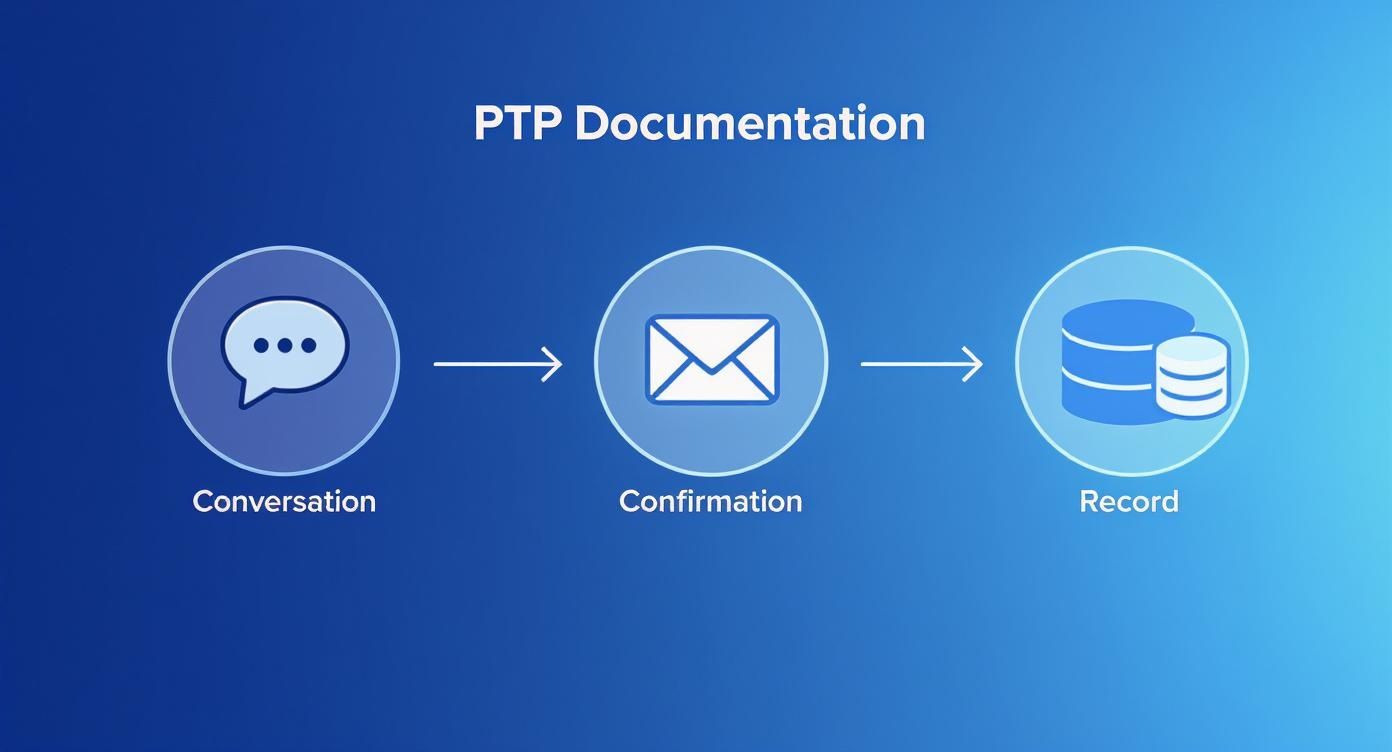
This process ensures every verbal commitment becomes a documented, trackable event inside financial systems.
Key Metrics for PTP Performance
You cannot manage what you do not measure. Modern AI AR automation platforms provide dashboards that track performance in real-time. The two most critical metrics are PTP Kept Rate and PTP Break Rate.
- PTP Kept Rate: The percentage of promises fulfilled on or before the agreed-upon date. A rate of 95% or higher indicates reliable clients and an effective process.
- PTP Break Rate: The percentage of promises missed. Analyzing this metric reveals patterns: is the rate higher for new clients, specific industries, or certain payment terms?
Tracking these KPIs moves collections beyond chasing individual invoices. A client with a consistently low kept rate may require shorter payment terms. This data-driven approach enables proactive credit risk management and helps improve cash flow with precision.
How Automation Transforms PTP Management
Manual PTP tracking is inherently unreliable. It relies on spreadsheets and human memory—systems known to fail at scale.
This is not just inefficient; it is a financial risk. A single missed follow-up can delay thousands in cash flow.
Accounts receivable automation eliminates this liability. It creates a reliable, consistent, and fully documented lifecycle for every PTP. By systemizing how promises are captured, tracked, and actioned, automation converts an administrative task into a predictable cash flow engine.

This is not an incremental improvement. Firms leveraging AR automation report a 25% or greater reduction in DSO. This is a direct result of replacing a manual, error-prone chore with a precise, automated workflow.
Seamless Capture and Logging
The initial failure point in a manual PTP process is data capture. A commitment in an email thread is easily lost; a verbal agreement may never be recorded. AI AR automation integrates directly with communications to solve this.
Modern AR software for professional services can parse client emails. When a client writes, "Payment will be sent by the 15th," the system flags it, extracts the date and amount, and logs the PTP against the invoice in the accounting system.
This delivers immediate operational advantages:
- Eliminates Manual Data Entry: This removes the risk of typos derailing follow-up sequences.
- Creates a Single Source of Truth: The PTP is linked directly to the invoice, providing clear visibility across the finance team.
- Provides an Instant Audit Trail: Every promise is time-stamped, creating an indisputable record.
An automated system doesn't just record a promise—it activates it. The moment a PTP is made, it initiates a workflow designed to convert client intent into cash.
Clean data capture is the foundation of a reliable collections process.
Precision Enforcement and Follow-Up
Once a PTP is logged, the system executes a perfectly timed communication strategy without manual intervention. This is how a soft cash flow forecast becomes a hard one.
(For a detailed analysis of these systems, our guide to accounts receivable automation software provides a breakdown.)
A typical automated PTP workflow includes:
- The Pre-Reminder: A human-toned email is sent 2-3 days before the promised date.
- The Immediate Inquiry: If payment is not received on the promised date, an automated inquiry is sent immediately.
- The Automatic Escalation: If there is no response, the system flags the account and can initiate a predefined escalation, such as notifying the account manager.
This precision ensures no promise is forgotten and every broken one is addressed instantly. This systematic approach is critical to reduce DSO. The same principle of efficiency applies to payables; explore the benefits of automated accounts payable solutions.
Automating these touchpoints builds a persistent and professional collections engine. It frees the team from administrative tasks to focus on strategic work.
The Evolution of Financial Promises: From Gold to Digital Ledgers
The concept of a promise to pay is the foundation of modern finance. Understanding its history provides context for the digital commitments managed today.
This evolution demonstrates why a client's written PTP is a cornerstone of a firm's financial stability. It converts an abstract debt into a predictable asset, just as historical promises did for entire economies.
From Gold on Demand to Governmental Faith
There was a time when the link between a promise and a physical asset was explicit. The first Federal Reserve notes, issued in 1914, pledged they were "redeemable in gold on demand at the Treasury Department of the United States." This was a paper receipt for a specific amount of a physical asset.
That direct link was severed during the Great Depression. The U.S. left the domestic gold standard in 1933, and by 1934, new bills simply stated they were "legal tender for all debts, public and private." The promise was no longer a claim on an asset but a commitment backed by governmental faith. You can find historical details in the Federal Reserve’s evolving promise on Moneyness.ca.
This shift mirrors accounts receivable. An unconfirmed invoice is assumed to have value but is not explicitly locked in. Securing a written PTP is the modern equivalent of backing that currency with gold. It makes the promise tangible.
A documented PTP hardens a receivable. It moves an invoice from the 'hopeful collection' pile to 'scheduled cash inflow,' giving you the certainty needed for accurate financial forecasting and operational control.
This history reinforces the need for discipline. Every promise from a client must be captured, confirmed, and managed with precision.
The New Frontier: Digital Promises and Code
Today, financial promises are migrating from physical assets to digital ledgers. A relevant discussion is happening around the convergence of sovereignty and code within the stablecoin ecosystem. These are a new form of financial promise, backed by code and reserves.
This shift highlights a timeless principle: for a promise to have value, it must be trusted and verifiable. In business, trust is built through systematic documentation and follow-through. AI AR automation is the modern tool for ensuring these digital-age promises are honored.
Whether backed by gold, government faith, or cryptographic proof, the function is identical: a reliable promise reduces risk. For your firm, every documented PTP does exactly that, contributing directly to stronger cash flow.
A Strategic Escalation Plan for Broken Promises
When a client breaks a promise to pay, the response must be systematic, not emotional.
An ad-hoc reaction creates inconsistency and signals a lack of process. A predefined escalation path maintains control, protects cash flow, and can preserve the relationship. The goal is resolution, not reaction.
This turns a negative event into a structured, data-gathering opportunity.
The Initial Automated Inquiry
The process begins with technology. The moment a PTP date is missed, the accounts receivable automation platform should trigger a simple, human-toned inquiry.
This is a customer service touchpoint, not an accusation.
The purpose of the first follow-up is to uncover the 'why.' Was it a simple oversight? A technical issue? Or a signal of a larger problem?
This automated outreach assumes good intent and opens a dialogue. It asks a question rather than making a demand, protecting the relationship while addressing the issue.
The Direct Phone Call
If the automated email yields no response within 24-48 hours, a direct phone call is the next step. Human intervention becomes critical.
The objective is twofold: understand the cause of the delay and secure a new, confirmed PTP. The conversation provides crucial qualitative data. Is the client experiencing cash flow issues? Is there an invoice dispute? This is vital risk assessment information.
Once a new promise is secured, document it in writing immediately.
Triggering Predefined Escalations
If a second promise to pay is broken, the issue elevates from a collections matter to a significant risk signal. This triggers the formal, internal escalation path.
Decisions at this point should not be ad-hoc. The escalation must be predefined and unemotional, dictated by policy, not individual discretion. This removes bias and ensures consistent handling.
- Internal Notification: The system automatically alerts the partner or project manager responsible for the client relationship.
- Service Pausation: For ongoing non-payment, pausing services is an effective, standard step that must be outlined in the initial engagement letter.
- Final Demand: If communication ceases, a formal demand letter is the next step before considering third-party collections.
A structured process ensures a complete, documented history exists before significant intervention is required. This systematic approach is fundamental to improving cash flow.
Common Questions on Managing a Promise to Pay
These are the most frequent operational questions from CFOs and Controllers regarding PTP management.
Is a Verbal Promise to Pay Legally Binding?
A verbal agreement can be a contract, but proving its terms in an AR context is impractical and expensive.
The operational value of a PTP is not its legal weight, but its utility for forecasting cash flow and prioritizing collection activities.
Always confirm a verbal promise in writing. This removes ambiguity and creates a documented commitment suitable for financial planning.
How Does AR Automation Handle Partial Promises?
Modern accounts receivable automation platforms are designed for this scenario.
When a client promises a partial payment, the system logs the specific amount and date against the invoice while continuing to track the remaining balance. It can be configured to send separate, automated reminders for the subsequent payment. This ensures no portion of the receivable is overlooked and provides a more granular view to improve cash flow.
When Should a Broken Promise Trigger an Escalation?
Best practice is to escalate after the second broken promise.
A single missed PTP should trigger an immediate but non-confrontational automated follow-up. The goal is to understand the reason for the delay.
If a client makes a new commitment and misses it again without communication, it signals elevated credit risk. At that point, the firm’s predefined escalation policy should activate. This structure is essential to reduce your DSO.
--- Resolut automates AR for professional services—consistent, accurate, and human. Learn more at https://www.resolutai.com.