A Guide to Account Receivable Aging and Cash Flow Control
A strategic guide to account receivable aging. Learn to analyze reports, reduce DSO, and use AR automation to master your firm's cash flow.
An accounts receivable aging report is a critical diagnostic tool for your firm's financial health. It organizes unpaid client invoices by their due date, providing a clear, real-time view of your working capital.
For a professional services firm, this report is the foundation of financial control. It tells you who owes you money, how much, and precisely how delayed those payments are. Mastering this data is the first step toward predictable cash flow.
Your Guide to Strategic AR Aging Analysis
An Accounts Receivable (AR) Aging Report is more than a list of overdue invoices. For CFOs, controllers, and owners, it is a strategic dashboard revealing cash flow vulnerabilities, collection process effectiveness, and client credit risk.
In professional services, consistent cash flow is the operational lifeblood. A well-managed AR aging schedule moves your finance function from reactive payment chasing to a proactive system that ensures predictable cash conversion.
From Data Points to Strategic Decisions
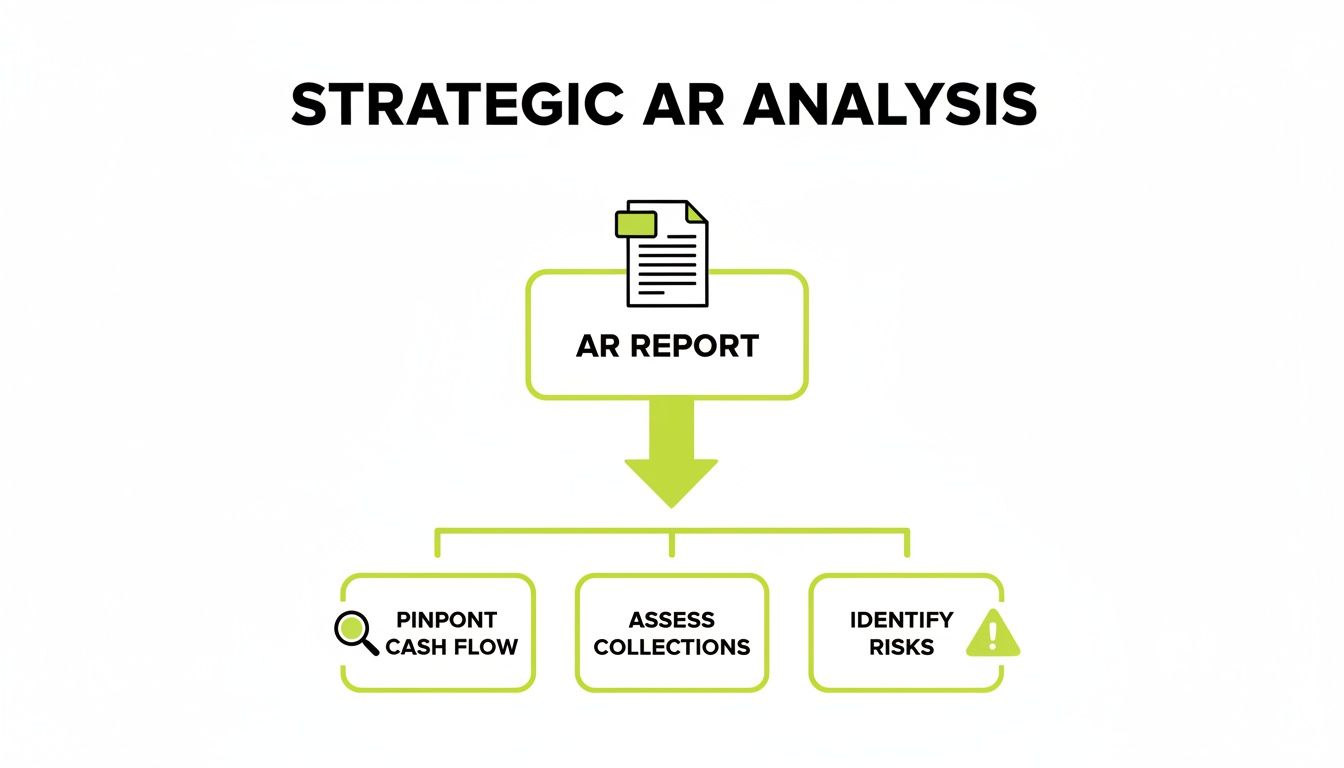
An effective aging report connects raw invoice data to critical operational decisions. It translates numbers into a clear action plan.
- Pinpoint Cash Flow Bottlenecks: Identify exactly where cash is trapped. For example, a report might show that 60% of invoices over 60 days are tied to a specific service line, signaling a need to review that line's billing process.
- Assess Collection Effectiveness: Quantify the performance of your AR process. Seeing your 31-60 day bucket shrink by 15% quarter-over-quarter provides a measurable outcome of your efforts to reduce DSO.
- Identify Credit Risks: A client who consistently moves from the 30-day to the 60-day bucket is a clear credit risk, allowing you to adjust terms before they become a write-off.
An effectively managed aging report turns raw data into actionable intelligence. It’s the difference between chasing payments and controlling your working capital with precision.
Ultimately, this guide will show you how to use these reports to make data-backed decisions and implement accounts receivable automation to execute with precision and control. Firms using dedicated AR software for professional services, including tools that offer QuickBooks AR automation, can systematize this entire process.
Resolut automates AR for professional services—consistent, accurate, and human.
How to Read an AR Aging Report
Your accounts receivable aging report is the command center for managing working capital. It organizes outstanding invoices into time-based "buckets," offering an immediate, high-level view of your financial position.
Each client balance is itemized, but the strategic value comes from how that balance is distributed over time. These standard aging buckets provide a clear roadmap for your collections strategy.
Interpreting the Aging Buckets
Each column on an AR aging report represents a specific level of urgency and risk. This structure allows you to focus your team's resources with precision. Understanding these categories is fundamental to controlling your receivables.
Here is a breakdown of the standard aging buckets and their operational implications.
Standard Accounts Receivable Aging Buckets
Aging Bucket | Timeframe | Risk Level | Required Action |
|---|---|---|---|
Current | 0–30 Days | Low | Healthy invoices within standard terms. Monitor only. |
Past Due | 1–30 Days | Watch | First sign of delay. Initiate automated, professional reminders. |
Past Due | 31–60 Days | Moderate | Risk is escalating. Collections process requires direct, systematic follow-up. |
Past Due | 61–90 Days | High | A financial red flag. Requires a direct phone call from your finance team to resolve. |
Past Due | 91+ Days | Critical | Collectibility is now significantly impaired. Escalate to a final demand; begin provisioning for loss. |
This systematic view enables you to prioritize efforts, allocating resources to the accounts that pose the greatest risk to your cash flow.
This analysis turns a simple report into a powerful management tool. You can immediately see where cash is trapped, measure collection performance, and identify credit risks before they materially impact your P&L.
Beyond Individual Invoices
A sophisticated AR aging report reveals systemic patterns, not just individual invoice statuses. Are the same clients consistently in the 60-day column? Do specific service lines have longer payment cycles? The report holds the data to answer these strategic questions.
To put this into practice, review our guide on the accounts receivable aging report template to build one tailored for your firm.
By asking these questions, you shift from chasing debt to actively managing working capital. This is where accounts receivable automation provides a distinct operational advantage, turning the entire collections process into a reliable, automated system.
The Financial Impact of Delinquent Receivables
Your aging receivables report is a direct indicator of your company's financial health. Every unpaid invoice represents trapped working capital. As invoices age, the probability of converting that revenue to cash decreases significantly.
An invoice 90 days past due is not just an operational nuisance; it is a financial liability. It increases the required allowance for doubtful accounts, directly impacting profitability. Managing your account receivable aging is a core strategy for protecting your bottom line.
The Escalating Risk of Non-Collection
The longer an invoice remains unpaid, the less likely it is to ever be collected. The decay in collectibility accelerates sharply after 90 days, converting earned revenue into a probable write-off.
A recent analysis by Dun & Bradstreet quantifies this risk: the probability of non-payment for a B2B invoice jumps to 26% after 90 days and a staggering 70% after 180 days.
Consider a firm with $10M in annual revenue. A 4% bad debt provision resulting from poor collections means a $400,000 reduction in profit. That is capital that could have funded growth or technology investment.
Compliance and Strategic Imperatives
Effective aging analysis is also a compliance requirement. The Current Expected Credit Losses (CECL) model mandates that finance leaders proactively estimate and provision for potential credit losses using historical aging data as a primary input.
This makes precise aging analysis a non-negotiable component of financial governance. It is one of the most direct ways to increase cash flow and build a more resilient balance sheet.
Resolut automates AR for professional services—consistent, accurate, and human.
Using Aging Reports to Reduce DSO

Your account receivable aging report is a primary tool for improving a critical metric: Days Sales Outstanding (DSO). High DSO indicates that you are waiting longer to convert revenue into cash, which constrains operations and growth.
Systematic analysis of your aging report allows you to identify the root causes of payment delays and take targeted action. The objective is to shift receivables from older, high-risk buckets back into the 'Current' column.
Establishing a Baseline and Target
First, calculate your firm's current average DSO to establish a clear baseline. With this metric, set a realistic, measurable reduction goal.
For a firm with $10M in annual revenue, reducing DSO by just 5 days frees up over $137,000 in working capital. This is about unlocking earned capital for reinvestment or strengthening your financial position.
A targeted DSO reduction strategy transforms the aging report from a passive document into an active tool for capital management. The focus moves from simply tracking debt to strategically accelerating cash conversion.
Segmenting Outreach for Maximum Impact
A one-size-fits-all collections approach is inefficient. Your aging report provides the blueprint for a segmented strategy that focuses resources on accounts with the highest risk and greatest financial impact.
A structured collections cadence ensures the appropriate level of intervention at each stage of delinquency.
- 31-60 Day Bucket: Moderate risk. Initiate automated, professional reminders to prompt payment without damaging the client relationship.
- 61-90 Day Bucket: High risk. This requires direct human intervention. A phone call from your finance team is necessary to understand the delay and secure a payment commitment.
- 91+ Day Bucket: Critical risk. Implement a multi-channel approach combining direct calls, formal correspondence, and a clear escalation path.
This systematic process prevents wasted effort on low-risk accounts while ensuring high-risk invoices receive immediate attention. Firms that implement this level of discipline, often through accounts receivable automation, consistently reduce DSO and improve recovery rates. AR software for professional services, especially with QuickBooks AR automation, can execute this strategy flawlessly.
Resolut automates AR for professional services—consistent, accurate, and human.
Identifying Systemic Risk in Your Client Base
Your accounts receivable aging report serves as a diagnostic tool for your entire client portfolio. Consistent late payments are not isolated incidents; they are data points that reveal trends and concentrated risk across your customer base.
This is where a CFO’s strategic value is realized. The report enables a shift from addressing individual late payers to proactively managing portfolio-level credit risk.
From Client Delinquency to Industry Trends
Certain industries carry higher payment risk. Recent data from Dun & Bradstreet highlights this fact: in Q1 2024, the transportation and warehousing sector had 15.3% of its total AR dollars aged 91+ days past due.
If your firm has significant revenue concentration in a high-risk sector, your aging report is your early warning system. It provides the empirical data needed to assess and mitigate this exposure.
When multiple clients from the same industry begin aging into the 60-90 day bucket, it is no longer a collections issue. It is a strategic risk indicator signaling broader instability that could impact your firm's cash flow.
Turning Insights into Action
This portfolio-level analysis enables finance leaders to move from a reactive to a proactive stance, protecting the firm’s financial stability.
- Refine Credit Policies: Use aging data to justify tighter credit terms or require retainers for clients in historically volatile industries.
- Adjust Payment Terms: If slow payment is a consistent pattern for a specific client type, modify your standard terms for new engagements in that vertical.
- Improve Cash Flow Forecasting: Incorporating these risk trends into your financial models produces more accurate and reliable forecasts for capital allocation.
This strategic approach elevates the account receivable aging report from an operational tool to an instrument of financial governance and risk management.
Resolut automates AR for professional services—consistent, accurate, and human.
How AR Automation Improves Aging Management
Manual AR aging management is inefficient, prone to error, and unscalable. Inconsistent follow-up and administrative burden prevent your team from focusing on high-value financial strategy. Accounts receivable automation solves this operational drag.
Modern AR platforms integrate with your accounting software, such as QuickBooks, transforming a static aging report into an intelligent, automated collections engine. This provides real-time visibility and control, helping you improve cash flow while preserving client relationships.
From Manual Tracking To Intelligent Workflows
Instead of relying on manual reminders, an automated system executes a personalized collections cadence based on preset rules. This ensures every client receives timely, professional communication without manual intervention.
For instance, a firm could automate a multi-stage collections workflow:
- 31 Days Past Due: A polite, automated email reminder is sent. This serves as a professional nudge.
- 61 Days Past Due: The system escalates, sending a more direct email and creating a task for a collector to make a personal phone call.
- 91+ Days Past Due: The workflow automatically sends a final demand notice and flags the account for senior management review, ensuring critical debts receive immediate attention.
This systematic process is proven to reduce DSO. Nothing is missed, and your collections process becomes consistent and predictable.
AI AR automation transforms your aging report from a historical document into a forward-looking action plan. It systematically addresses overdue accounts based on risk, not just on which customer is yelling the loudest.
Data-Driven Collections and Scalability
Implementing AI AR automation provides valuable performance data. You can track email open rates, payment portal clicks, and customer response times to continuously optimize your collection strategies. For targeted outreach, integrating tools like call center software for small businesses can enhance effectiveness.
This scalability is crucial for growing professional services firms. You can maintain a disciplined, high-touch collections process without increasing headcount. Learn more about how accounts receivable automation software is purpose-built for firms like yours.
Resolut automates AR for professional services—consistent, accurate, and human.
Frequently Asked Questions
How Often Should We Review Our AR Aging Report?
For most professional services firms, a weekly review is the correct cadence. This frequency allows you to identify overdue invoices early, before they become significant cash flow problems.
A monthly review is the absolute minimum, but this delay can allow a manageable issue to escalate. A weekly rhythm provides the agility to adjust collection tactics and maintain cash flow predictability.
What Is the Formula for Accounts Receivable Aging?
There is no single "formula" for generating an accounts receivable aging report. It is a method of classifying outstanding invoices into time-based categories (e.g., 0-30 days, 31-60 days).
However, the data within the report is essential for calculating key performance indicators. For example, the Average Collection Period is calculated as: (Average Accounts Receivable / Total Net Credit Sales) * Number of Days in Period. Your aging report provides the real-time data to make this metric meaningful.
Can AR Aging Analysis Impact Client Relationships?
Yes, it impacts them directly. A manual, inconsistent collections process can create friction and damage client relationships with unprofessional follow-ups.
Conversely, a structured system built on accounts receivable automation maintains professionalism. Automated reminders are perceived as helpful, not harassing. The data also allows you to have proactive, strategic conversations about payment terms with clients who are habitually late, turning a potential conflict into a productive discussion.
A well-managed AR process does more than just protect your cash flow—it reinforces your firm's professionalism. It transforms a potential point of conflict into an opportunity to set clear, mutually respected financial boundaries with your clients.
--- Resolut automates AR for professional services—consistent, accurate, and human. Learn more at https://www.resolutai.com.