Mastering Account Receivable Processes to Improve Cash Flow
A guide for CFOs on optimizing account receivable processes. Learn to reduce DSO, improve cash flow, and leverage automation for strategic financial control.
Inefficient account receivable processes are a quiet drain on your firm's working capital. For a professional services firm, this isn't a minor administrative issue; it's a direct constraint on growth, tying up cash that should be funding operations or strategic investments.
Poor AR management creates operational drag. It consumes your finance team's time with low-value tasks like chasing invoices and reconciling payments, preventing them from focusing on strategic financial analysis. Every late payment introduces instability, forcing a reactive posture instead of a proactive one.
This isn't just an inconvenience; it's a hard cost. For a firm operating on a 20% margin, a 30-day delay in collecting a $100,000 invoice effectively locks up $20,000 in profit. This is an opportunity cost that compounds over time, placing a real ceiling on your firm's ability to scale.
The True Cost of Inefficient Account Receivable Processes
Manual AR processes introduce friction and risk into your cash flow. The hidden costs accumulate quickly, turning earned revenue into a liability until the cash is in the bank.
This friction forces reliance on lines of credit to cover operational expenses like payroll, creating a debt cycle that erodes profitability. An inefficient AR system functions like a high-interest loan you never applied for, forcing you to pay to access your own capital.
The Financial Drain of Manual AR
The core problem is the delay between completing work and realizing cash. A delay of just 15-30 days on major invoices can be the difference between funding growth and drawing on credit.
This directly impacts your ability to forecast accurately and operate with agility. When cash inflow is unpredictable, strategic planning for hiring, expansion, or technology investment becomes a guessing game.
Quantifying the Impact of Late Payments
Late payments are a systemic issue. In the B2B space, a significant percentage of invoices are paid late, and a surprising number—often cited around 23%—are simply due to forgetfulness or administrative oversight.
This points to a fundamental breakdown in process, not necessarily a client's unwillingness to pay. It’s a gap that well-designed accounts receivable automation can close with immediate, measurable impact.
This financial friction creates cascading problems:
- Inaccurate Forecasting: Unpredictable cash receipts make reliable financial modeling impossible.
- Strained Client Relationships: Inconsistent or aggressive collection efforts can damage goodwill.
- Reduced Operational Agility: Tied-up capital limits your ability to seize opportunities or weather downturns.
Optimizing your account receivable processes is one of the most direct ways to improve cash flow and strengthen your firm's financial foundation.
Diagnosing Your End-to-End AR Lifecycle
To gain control over your firm’s cash flow, you must map the entire accounts receivable lifecycle. The process is a sequence of dependent steps; an error in an early stage creates compounding problems downstream.
For professional services firms, this lifecycle begins not with an invoice, but with the Statement of Work (SOW). Ambiguity at the start guarantees disputes at the end.
From Client Onboarding to Final Payment
Each step in the AR journey must be executed with precision. Any gray area in the initial agreement is a future payment delay.
A breakdown at any point disrupts the entire flow. The table below outlines the key stages and their most common failure points, which directly translate to increased DSO and strained client relationships.
AR Lifecycle Stages and Common Failure Points
Each stage has a clear objective and inherent risks. Identifying these weaknesses is the first step toward building a resilient process.
AR Stage | Primary Objective | Common Failure Point |
|---|---|---|
Onboarding & SOW | Set clear payment terms and deliverables. | Vague scope or billing milestones invite disputes and payment holds. |
Invoice Creation & Delivery | Bill accurately and promptly after work is completed. | Manual errors, incorrect project codes, or multi-week invoicing delays. |
Collections Management | Proactively manage receivables to ensure timely payment. | Reactive, inconsistent follow-up; no defined escalation path. |
Payment & Cash Application | Provide a seamless payment experience and apply cash accurately. | Clunky payment portals; slow, manual cash application masking true cash position. |
Dispute Resolution | Address and resolve invoice queries efficiently to release payment. | Lack of a clear process, leading to extended delays and client frustration. |
Reporting & Analysis | Track KPIs to monitor performance and identify bottlenecks. | Relying on static, outdated spreadsheet data for critical financial decisions. |
Each failure point is a direct hit to your cash flow. A single ambiguous SOW can hold up six figures in revenue for an entire quarter.
The flowchart below illustrates how a simple invoicing delay cascades into a significant cash flow problem, turning a routine task into a protracted recovery effort.
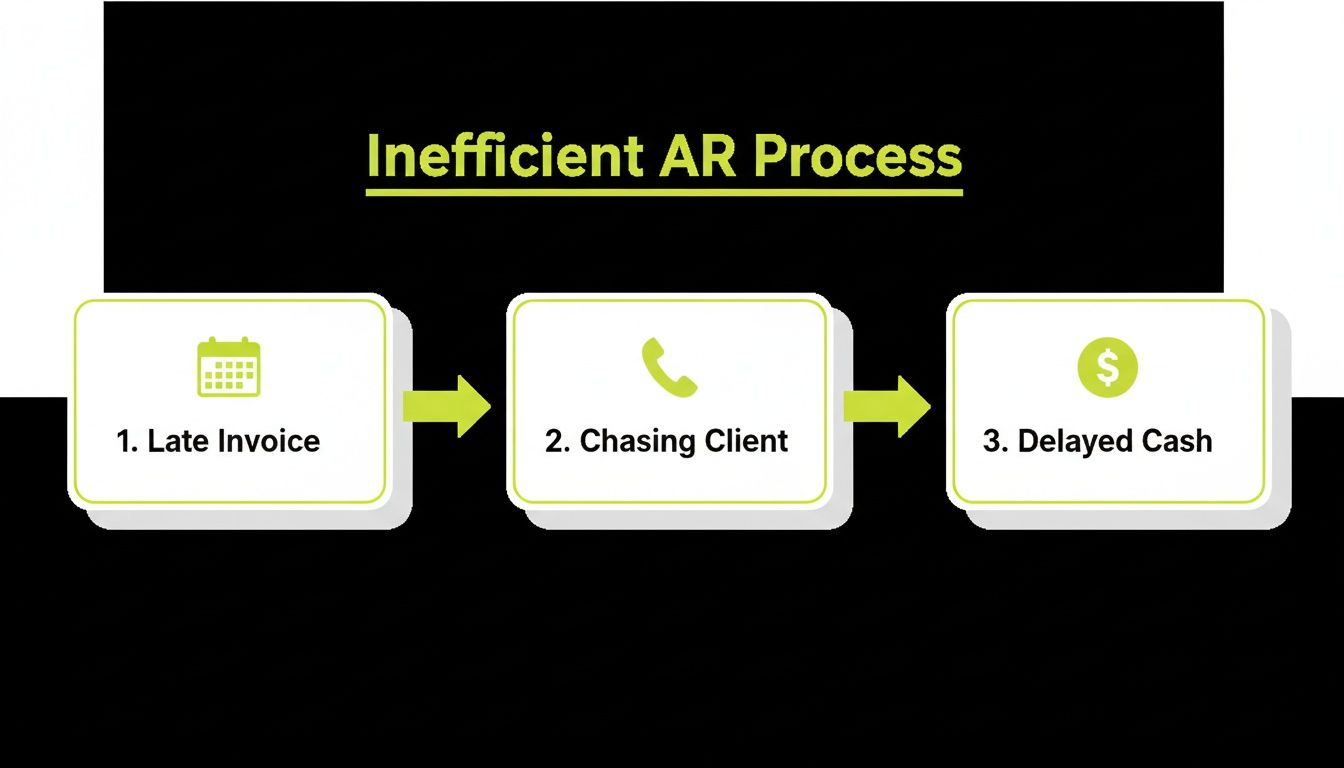
This process breakdown consumes resources, pulling your team away from high-value analysis and delaying revenue you have already earned.
Where Things Break Down in Professional Services
Professional services firms bill for expertise and outcomes, not standardized products. This subjectivity is where most AR problems originate.
The root of most AR disputes in professional services is a lack of process clarity, not a client's inability to pay. Confusion stops payment.
The most common process failures we observe are:
- Vague Statements of Work (SOWs): If deliverables and billing triggers are not defined with precision, clients have grounds to question invoices.
- Delayed or Inaccurate Invoicing: Manual time tracking and billing are prone to error. An invoice sent three weeks late signals that payment is not urgent.
- Lack of Proactive Communication: Waiting until an invoice is 30 days past due is reactive. A simple, automated reminder before the due date can prevent most late payments.
- High-Friction Payment Methods: Forcing clients to mail checks or use outdated payment portals creates unnecessary barriers to payment.
By analyzing each stage of your account receivable processes, you can move from a reactive collections model to a proactive system of financial control, addressing the root causes of high DSO.
The Critical KPIs For Measuring AR Performance
Effective cash flow management relies on data, not intuition. The right accounts receivable metrics provide a clear view of performance and early warnings of potential shortfalls.
For finance leaders, these KPIs are essential for making informed decisions and maintaining healthy working capital.
Days Sales Outstanding (DSO)
DSO measures the average number of days it takes to convert receivables into cash. A lower DSO indicates faster collections and stronger liquidity.
If your firm's DSO increases from 45 to 60 days on $10M in annual revenue, you have effectively tied up an additional $410,000 in working capital. Monitoring this trend is critical. A steady decline after implementing accounts receivable automation validates the investment.
Collection Effectiveness Index (CEI)
While DSO measures speed, CEI measures the percentage of receivables collected during a specific period. It provides a clearer picture of collections performance than DSO alone.
CEI compares cash collected against the total amount available for collection. A firm that starts a quarter with $1M in receivables, adds $2M in new invoices, and collects $2.5M has a CEI of 83.3%. A consistently low CEI suggests aging invoices are being neglected.
Average Days Delinquent (ADD)
ADD focuses exclusively on past-due invoices, measuring the average number of days they remain unpaid after the due date.
A high ADD often indicates weaknesses in the dunning process or a lack of a clear escalation strategy.
- DSO: "On average, we get paid in 52 days."
- ADD: "When an invoice is late, it is, on average, 21 days late."
Tracking ADD helps fine-tune your collections strategy. Implementing AI AR automation can systematically reduce DSO and ADD by ensuring disciplined, timely follow-up without manual intervention. For many firms, QuickBooks AR automation integrations are an effective first step.
Making the Switch to Smart AR Orchestration
Transitioning from manual processes to an intelligent system provides control over your accounts receivable processes. This is more than scheduling automated reminders; it is about managing the entire AR lifecycle as a single, cohesive workflow.
Modern AR platforms unify credit management, invoicing, collections, and cash application. This shift from basic automation to true orchestration transforms a reactive collections function into a predictable cash flow engine.

The market reflects this trend, with significant growth projected for accounts receivable automation. The results are clear: data shows that integrated payment portals improve collections, and automating the invoice chase strengthens client relationships by removing friction.
From Automation to Orchestration
Basic automation, such as scheduled email reminders in accounting software, is a useful but limited tool. Intelligent orchestration uses real-time data to adapt its approach, freeing your team for strategic work.
AI AR automation is designed to augment your team, not replace it. The system handles high-volume, repetitive tasks with perfect consistency, allowing finance professionals to intervene only when a human touch is required.
An orchestrated system can:
- Adapt communication tone based on a client's payment history and relationship value.
- Identify at-risk accounts by analyzing payment patterns, enabling proactive intervention.
- Automate cash application, accurately matching payments to invoices—including partial or bundled payments—to maintain a clean ledger.
A Unified AR Workflow
An orchestrated AR system integrates siloed functions into a single source of truth. Credit, invoicing, and collections data are centralized, eliminating manual reconciliation between disparate systems.
Orchestration ensures the terms agreed upon in the SOW are accurately reflected on the invoice, that the invoice is followed up on professionally, and that payment is applied correctly. It closes the operational gaps where cash is lost and client frustration is born.
This unified view provides your team with complete context for every client interaction. The benefits of accounts receivable automation extend beyond efficiency to improved decision-making.
What This Looks Like in Practice
The results of implementing an orchestrated system are measurable and directly impact the bottom line.
- Reduced Errors: Automation of invoice creation, delivery, and cash application eliminates the manual errors that delay payment.
- Improved Cash Flow: Timely, consistent follow-ups and frictionless payment options systematically reduce DSO.
- Increased Strategic Focus: Your finance team is freed from tactical chasing to focus on forecasting, analysis, and managing strategic client relationships.
For firms using QuickBooks, dedicated QuickBooks AR automation platforms provide the necessary engine to orchestrate this entire workflow.
An Actionable Framework for AR Process Improvement
Improving your accounts receivable requires a structured, operator-led plan. The objective is to move from a reactive collections model to a proactive system that provides financial control and predictable cash flow.
This framework outlines the critical phases for implementation, focusing on process re-engineering rather than just technology procurement.

Each step builds on the last, ensuring the final system is both efficient and adopted by your team and clients.
Phase 1: Audit Your Current State
Document your existing AR process from contract signing to cash application. Identify every touchpoint, system, and individual involved. This creates your operational baseline.
Calculate your current KPIs—DSO, CEI, and ADD. Use historical data from your accounting system, not estimates. These metrics will be used to measure the project's success.
A common failure is to underestimate the complexity of existing workflows. A detailed process map reveals hidden bottlenecks and sources of friction that raw KPI numbers alone cannot explain.
Phase 2: Define Clear Objectives
Establish specific, measurable, and time-bound goals. Vague targets like "improve cash flow" are not actionable.
A strong objective is tangible and directly impacts the P&L. It provides a clear definition of success for the project.
- Example Objective 1: Reduce average DSO from 58 to 45 days within 90 days of implementation.
- Example Objective 2: Decrease invoices aging over 60 days by 40% within six months.
- Example Objective 3: Automate 90% of payment reminders to free up 15 hours of controller time per week for strategic analysis.
Phase 3: Evaluate Technology Partners
Your technology partner provides the engine for your new AR process. When evaluating AR software for professional services, prioritize operational fit and integration capabilities over a simple feature checklist.
For firms running on QuickBooks, seamless and bidirectional QuickBooks AR automation is non-negotiable. The integration must ensure that invoice, customer, and payment data flows automatically, maintaining a single source of financial truth.
Select a partner that understands the nuances of professional services billing, such as project-based invoicing, retainers, and milestone payments. A generic platform often creates more complexity than it solves. This is a key differentiator when comparing software with receivable management services.
Phase 4: Plan a Phased Rollout
A "big bang" implementation is high-risk. A phased rollout is a more controlled, operator-led approach that minimizes disruption and ensures successful adoption.
Begin with a pilot program involving a small group of trusted clients or a single service line. This allows you to validate the new workflow, gather feedback, and resolve any issues on a manageable scale.
Once the pilot is successful, expand the rollout incrementally. This methodical approach builds confidence within your team and ensures a smooth transition for your clients, turning a large project into a series of manageable wins.
The Future of AR Is Consistent and Client-Focused
Modernizing your accounts receivable is about strengthening client relationships while tightening control over cash flow. By moving from manual collections to an intelligent, orchestrated system, you transform AR from a point of friction into a reflection of your firm's professionalism.
Automation handles repetitive tasks with perfect consistency, ensuring every communication is timely, professional, and helpful. This frees your finance team from tactical chasing and elevates their role to strategic financial management.
Their focus shifts from administrative work to high-value analysis and strategic client conversations.
This operational discipline delivers a measurable impact. Firms that successfully implement AR orchestration often achieve a 15-25% reduction in DSO within the first six months, releasing significant working capital back into the business.
Ultimately, an optimized AR function creates a system as reliable and professional as the services you deliver.
Resolut automates AR for professional services—consistent, accurate, and human.
Frequently Asked Questions
Key questions about your firm's account receivable processes center on control, efficiency, and financial impact. Here are answers to common queries from finance leaders.
How Does AR Automation Integrate With QuickBooks?
Effective AR platforms use secure APIs for a continuous, two-way synchronization with accounting systems like QuickBooks. It is not a one-way data dump.
When an invoice is created in QuickBooks, it appears instantly in the AR platform. When payment is received, the invoice is marked as paid and the transaction is reconciled in the general ledger. This maintains a single source of truth and eliminates manual data entry.
Will Automating Collections Hurt Client Relationships?
No. A well-configured AI AR automation system protects them. Manual collections are often inconsistent and can become emotionally charged. Automation replaces this with professional, timely, and predictable communication.
The system is configured to reflect your firm's tone—respectful, clear, and helpful. It removes friction from the payment process for your clients, turning collections into a smooth, professional experience that reinforces your brand.
An automated system ensures every client interaction is consistent and professional. It removes the emotional and often reactive nature of manual collections, preserving the goodwill your firm has worked hard to build.
What Is a Realistic Timeframe to Reduce Our DSO?
While results vary, most firms see a measurable reduction in DSO within the first 90 days. Initial gains come from implementing automated reminders and a client payment portal, which accelerates payments from your most organized clients.
A realistic target is a 15-25% reduction in DSO within six months. This timeframe allows for full adoption by your client base and for fine-tuning your collections strategy, leading to a sustained improvement in cash flow.
--- Resolut automates AR for professional services—consistent, accurate, and human.