
Mastering Account Receivables Procedures for Predictable Cash Flow
Discover how account receivables procedures can transform cash flow with practical steps to reduce DSO and strengthen collections.
Inefficient accounts receivable procedures are a direct threat to a firm's financial health. They quietly drain working capital, stall growth, and consume leadership's focus, turning small invoice delays into significant cash flow constraints.
Strong AR procedures are not a back-office function; they are a core lever for financial control and operational stability.
The Hidden Costs of Inefficient AR Procedures
Slow collections signal operational friction and put predictable revenue at risk. The moment an invoice ages past 30 days, the probability of collecting in full decreases while the cost to collect increases.
This isn't a minor issue. For a $10M firm with a 45-day DSO, over $1.2M is tied up in receivables at any given time. Reducing DSO by just 10 days frees up over $270,000 in working capital.
Late payments are often rooted in weak accounts receivable procedures. Inconsistent manual follow-ups and clerical errors are common culprits. A surprising 23% of late payments occur simply because clients forgot—a problem a systematic reminder process can solve.
The True Cost to Your Firm
The damage extends beyond the balance sheet. Unpredictable cash flow directly impacts your ability to invest in talent, technology, or strategic growth initiatives. It forces leadership to spend valuable time chasing payments instead of focusing on high-value work.
This operational drag manifests in measurable ways:
- Increased Days Sales Outstanding (DSO): High DSO means cash is trapped in receivables, constraining liquidity.
- Strained Client Relationships: Disorganized or aggressive collection efforts erode the trust built over time.
- Inaccurate Financial Forecasting: Attempting to forecast cash flow without a reliable collections process is speculative and undermines strategic planning.
- Wasted Team Resources: Your finance team's time is better spent on analysis and strategy, not manual email reminders.
The core problem is typically a lack of a standardized, repeatable system. When collections depend on individual effort and memory, results are inconsistent. Procedure-driven improvement is the only reliable path to financial control.
Weak AR processes introduce unnecessary risk. They obscure your true financial position and create a reactive cycle of managing cash flow crises. Understanding the true cost of AR inefficiency in professional services clarifies the urgency of building a better system. This guide provides the framework.
Laying the Groundwork for On-Time Payments
Securing on-time payment begins at client onboarding, not when an invoice is 30 days past due.
Firms that treat invoicing as an administrative afterthought are the ones who later face collection challenges. A disciplined front-end process is the single most effective way to prevent cash flow problems.
This is about setting clear expectations. When clients understand your terms, receive clear invoices, and have a simple way to pay, the entire process functions smoothly. This establishes professional clarity before work begins.
Performing Practical Creditworthiness Checks
For a professional services firm, a "credit check" is a practical risk assessment, not a formal underwriting process. You are extending credit every time you perform work before payment.
Start with non-invasive steps:
- Trade References: Ask for two or three vendors they work with. A brief call can reveal payment habits. Do they pay on time or consistently extend terms to Net 60 or 90?
- Initial Project Scoping: A client's reaction to a retainer provides a data point. Aggressive pushback on a reasonable deposit may signal future payment risk.
- Payment History (for existing clients): Past payment behavior is the best predictor of future performance. A quick review of your accounting system is sufficient.
This is about mitigating risk, not turning away business. A client with a shaky payment history might require a shorter billing cycle or a larger upfront retainer—adjusting terms to match the risk profile.
Establishing Unambiguous Payment Terms
Vague payment terms invite late payments. Your Master Services Agreement (MSA) and Statement of Work (SOW) must eliminate any room for interpretation.
The most common source of payment delays is ambiguity, not malice. Defining terms like "Net 15" or "Net 30" in the contract eliminates confusion and provides a firm legal basis for collection.
Specify that payment is due within 30 calendar days from the invoice date. If you have a late fee policy, the percentage and its trigger date must be documented. This contractual clarity is your first line of defense.
Crafting the Perfect Invoice
An unclear or inaccurate invoice is the leading cause of payment delays and disputes. Design every invoice to be paid, not questioned.
A perfect invoice includes:
- A Unique Invoice Number: Essential for tracking and reconciliation.
- Client Purchase Order (PO) Number: Many corporate clients have a strict "no PO, no pay" policy. Obtain this upfront.
- Clear "Bill To" Information: The correct legal entity, department, and contact person to ensure it reaches the right desk.
- Detailed Line Items: Use clear descriptions, dates, and costs. "Consulting Services" invites questions; be specific.
- Obvious Payment Instructions: Provide multiple payment options (ACH, credit card) and make the details impossible to miss.
Structured invoicing is a core part of effective accounts receivable procedures. It transforms a bill into a tool that accelerates payment. Tools offering QuickBooks AR automation ensure this data is pulled correctly, eliminating human error.
Designing a Proactive Collections Playbook
Effective accounts receivable management is a systematic playbook that anticipates payment timelines with professional persistence.
A solid collections cadence removes guesswork and ensures every client receives consistent attention. This transforms collections from a reactive scramble into a predictable operational function. The goal is to get paid on time while strengthening client relationships.
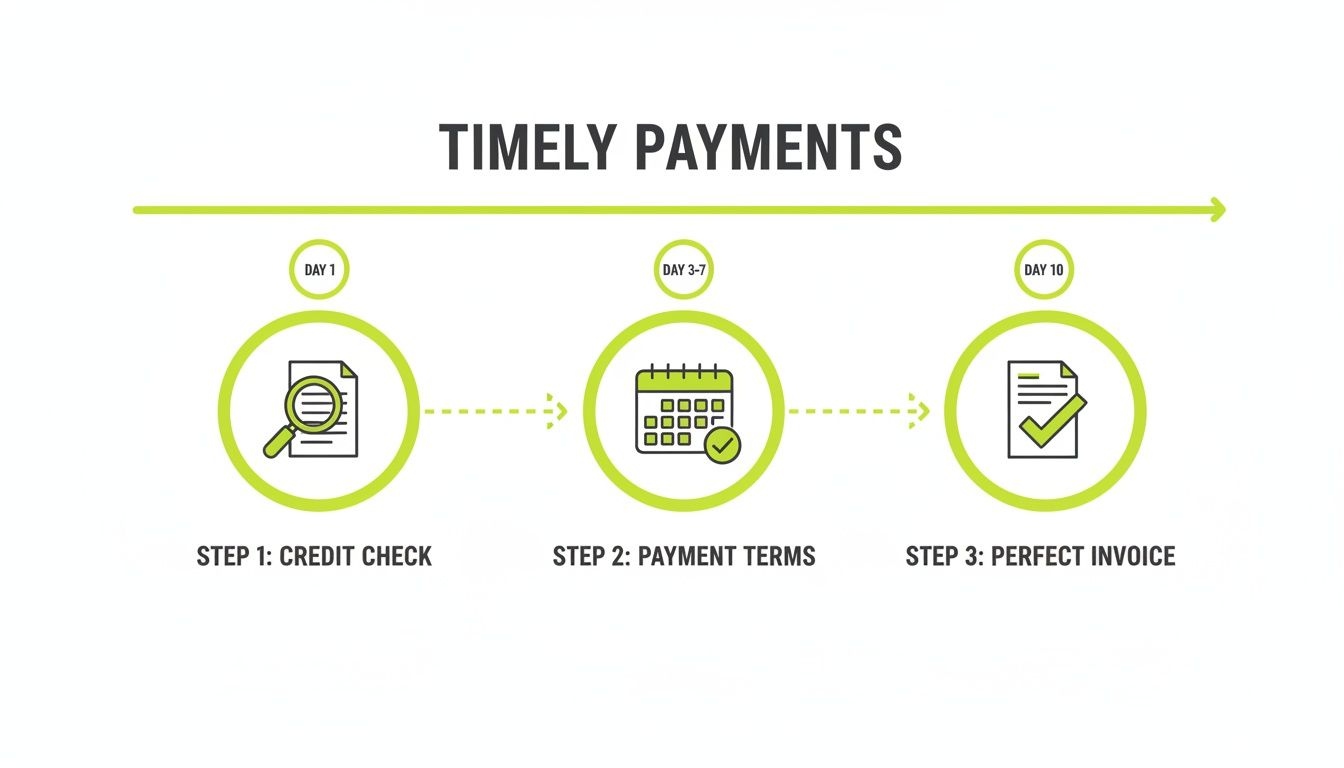
A strong collections process is built on meticulous onboarding, clear terms, and flawless invoicing. Get these right, and half the battle is won.
The Automated Pre-Due Date Nudge
The most effective collections action occurs before the due date. An automated reminder is a professional courtesy that prevents the most common reason for late payments: simple oversight.
- Timing: 7 days before the invoice is due.
- Method: Automated email.
- Tone: Friendly, helpful, and low-pressure.
This touchpoint confirms the client has the invoice and provides a direct link to pay. Platforms that handle accounts receivable automation execute this consistently without manual effort.
Action on the Due Date
If payment has not been received by the morning it is due, a second automated reminder should be sent. The tone shifts slightly to a direct notification that payment is expected.
This should still be automated. At this stage, personal intervention is inefficient. The system handles predictable, repetitive follow-ups, freeing your team for higher-value analysis.
A due-date reminder acts as a final, polite prompt. It keeps the invoice top-of-mind and provides another convenient opportunity to pay.
The First Week Past Due
Once an invoice is 1–7 days overdue, the cadence remains systematic, but communication becomes more direct. An automated email sequence should trigger on Day 1 and Day 5 past due, explicitly referencing the overdue status.
Template for Day 5 Past Due:
Subject: Invoice [Invoice Number] is now 5 days past due
"Hi [Client Name],
Following up on invoice [Invoice Number] for $[Amount], which was due on [Due Date].
Please let us know the status of this payment. A copy of the invoice is attached, and you can pay online here: [Payment Link]."
This template is firm, clear, and provides everything needed to resolve the payment.
Escalation to a Personal Follow-Up
If an invoice is unpaid at 15 days past due, it is time for human intervention. The AR specialist or controller should place a call.
The goal is to understand the cause of the delay—a dispute, a lost invoice, or an internal AP issue. A calm, inquisitive call can uncover the root cause and secure a firm payment commitment.
- Objective: Understand the delay and get a concrete payment date.
- Action: Document the call details and promised payment date in your AR software.
This transition from automated reminders to a personal call is a critical step in effective account receivables procedures. For more on structuring these efforts, see our guide on **receivable management services**.
Senior-Level Intervention
At 30 days past due, the issue requires escalation. A Controller, CFO, or firm partner should send a personal email or make a call. This signals the seriousness of the delinquency and leverages senior-level relationship equity.
The communication should be direct and focused on resolution. This step is reserved for significant delinquencies to maintain its impact.
The Final Demand and Pausing Work
When an invoice hits 60 days past due, the firm must take a firm stance to protect its financial health.
- Issue a Final Demand Letter: A formal communication stating the balance, referencing previous collection attempts, and outlining the consequences of non-payment.
- Pause All Active Work: Continuing to provide services to a client who is severely delinquent is a poor business decision. A professional notification that work is paused pending payment is a necessary lever.
Manual Vs Automated Collections Workflow
Stage | Manual Process (Typical Firm) | Automated Process (Optimized Firm) |
|---|---|---|
Pre-Due Date | No reminders sent. Relies on client to remember. | Automated "friendly reminder" email sent 7 days before due date. |
Due Date | AR specialist checks bank account. Manual follow-up if unpaid. | Automated email triggered if payment isn't received by morning. |
1-7 Days Past Due | Inconsistent follow-ups. Depends on AR team's workload. | Automated, escalating email reminders sent on Day 1 and Day 5. |
15 Days Past Due | AR specialist starts making calls. Process is often reactive. | System flags the invoice for a scheduled, personal phone call. |
30 Days Past Due | Escalations are ad-hoc. Senior leaders get involved sporadically. | Automated alert notifies Controller/CFO for a planned escalation. |
60 Days Past Due | Delays in deciding next steps. Often results in write-offs. | Clear playbook dictates issuing a demand letter and pausing work. |
This structured playbook, blending AI AR automation with targeted human intervention, creates a powerful system to improve cash flow and reduce DSO.
Managing Disputes and Applying Cash with Precision
Invoice disputes and misapplied payments are not minor accounting headaches; they are financial blind spots that distort your view of the business.
An unresolved dispute ages into bad debt. Misapplied cash creates a false sense of security about client balances. Both scenarios destroy control over working capital.
A standard operating procedure is non-negotiable. It contains small issues before they snowball and ensures your system reflects reality. Without that precision, forecasting is guesswork.
Creating a Dispute Resolution Framework
An invoice dispute is a client relationship test and a red flag for a potential operational issue. The moment a client questions an invoice, the standard collections cadence must pause, and a documented resolution workflow must begin.
The goal is rapid resolution. A dispute should never be left to linger.
A defined process with clear ownership is essential:
- Immediate Triage: The AR specialist logs the dispute with all relevant details: invoice number, client contact, reason for the dispute, and any documentation.
- Assign Ownership: The issue is assigned to the project manager or account lead who can speak to the work performed.
- Set a Resolution SLA: A firm Service Level Agreement (SLA) of 48 hours is critical. The owner has two business days to investigate and propose a solution.
- Document Everything: Every email, call, and action is logged in the AR system, creating a complete audit trail.
This structured approach prevents disputes from falling through the cracks, protecting revenue and client relationships. For more on this, see the guide on automated chargeback and dispute management with AI.
The Critical Importance of Cash Application
Cash application—matching incoming payments to open invoices—is the bedrock of accurate financial reporting. Errors create a domino effect of problems, hiding delinquency and leading to reconciliation nightmares.
Manual processing is prone to error, especially with:
- Partial Payments: A client pays a portion of an invoice.
- Bundled Remittances: One payment covering multiple invoices.
- Unspecified Payments: Funds arrive without remittance advice.
A single typo can leave a paid invoice showing as past due, triggering an unnecessary collections email to a client in good standing.
The accuracy of your AR aging report is entirely dependent on the precision of your cash application process. If you cannot trust the data, you cannot make sound financial decisions.
The need for precision is intensifying. With 42% of firms admitting that late payments cause them to struggle with their own payables, the blind spots from sloppy cash application are unaffordable.
Modern AR software for professional services changes this. It automates reconciliation, using AI to match payments to invoices with near-perfect accuracy, even in complex scenarios. This level of AI AR automation provides a true, real-time picture of your receivables—fundamental to reliable forecasting.
Using AR Automation for Consistency and Control
A well-designed playbook for account receivables procedures is only as good as its execution. Manual execution is inherently flawed.
A follow-up is missed. An escalation is delayed. These small cracks are where cash flow leaks and DSO inflates.
Automation empowers your finance team. It ensures your collections playbook is executed perfectly, every time, providing a level of control and visibility impossible to achieve manually.
This shift allows your team to move from administrative tasks to high-value work, like resolving complex disputes or analyzing payment trends to refine strategy.
The Role of AI in AR Automation
Modern accounts receivable automation is more than an email scheduler. It adds a layer of intelligence that learns from client behavior and provides actionable insights.
An AI AR automation platform becomes the operational core of your receivables process, centralizing data and managing communications.
- Systematic Cadence Execution: The system sends reminders and follow-ups with the correct tone and timing, handling the 80% of collections work that is repetitive but critical.
- Intelligent Escalation Triggers: The system analyzes invoice amount, client payment history, and recent communication to ensure human intervention is reserved for maximum impact.
- Unified Communication Hub: All interactions are logged in one place, creating a single source of truth for the entire team.
This orchestration closes the gap between process design and real-world execution.
From Manual QuickBooks Entries to Automated Control
For many professional services firms, QuickBooks is the financial hub, but AR management within it is often manual and time-consuming. Connecting a dedicated AR platform creates a seamless system.
With QuickBooks AR automation, the platform pulls invoice data in real-time, enrolling each new invoice into the appropriate collections playbook automatically.
This direct integration provides a live, accurate AR aging report. As payments are received, the system updates instantly, offering a true picture of your cash position. Firms that implement these systems often see a 10-25% reduction in DSO within months, a key metric among the benefits of accounts receivable automation.
Achieving Predictable Cash Flow and Reduced DSO
The goal of refining account receivables procedures is to make cash flow predictable. Automation makes this possible.
When a firm cuts its DSO from 45 to 35 days, it isn't just an accounting win. For a $10M firm, that 10-day improvement unlocks over $270,000 in working capital.
That is cash that can be reinvested into the business. More importantly, it provides the financial stability that allows leadership to focus on the future, not on chasing last month's revenue. The right AR software for professional services provides the framework to achieve this.
Achieving Predictable Cash Flow
Mastering accounts receivable is about gaining control over working capital. It is the difference between a reactive collections process and a proactive system that delivers predictable revenue.
The pillars are simple: disciplined client onboarding, flawless invoicing, and a relentless collections cadence.
These are not separate tasks but parts of a unified system. When they work in concert, you build a resilient financial operation that frees up cash and leadership focus for growth.
From Reactive Tactics to a Proactive System
A strong AR system replaces inconsistent follow-ups and manual tracking with a reliable workflow. This is where financial control is forged, turning a cost center into a strategic asset.
The goal is to reduce DSO and improve cash flow with a process that is both firm and professional. A clear playbook minimizes lost revenue while preserving client relationships.
The real measure of your AR process is the reliability of the system that prevents invoices from becoming overdue in the first place.
To gain a full picture of financial health, it is critical to look at both sides of the ledger. This means understanding the interplay between accounts payable and accounts receivable is essential for effective working capital management.
The Impact of Automation on Financial Control
Technology makes a systematic approach scalable. Accounts receivable automation provides the discipline your procedures demand, ensuring no detail is missed. An AI AR automation platform orchestrates your entire collections strategy.
For firms running on QuickBooks, this is a game-changer. It eliminates manual data entry and provides a live, accurate view of your cash position. That real-time visibility is the bedrock of reliable forecasting and strategic decision-making.
This guide provides the framework. By combining disciplined procedures with smart automation, you will build an AR operation that is not just efficient but a powerful engine for predictable growth.
--- Resolut automates AR for professional services—consistent, accurate, and human.