A Controller's Guide to Accounts Receivable Aging
A definitive guide for CFOs on using accounts receivable aging reports to reduce DSO and improve cash flow. Learn best practices and automation strategies.
An accounts receivable aging report is not a passive list of debtors. It is a diagnostic tool for cash flow, showing precisely how long your firm's revenue remains uncollected.
For CFOs and Controllers at professional services firms, this report is the primary instrument for managing working capital. It provides the data needed to protect your firm’s financial health and stability.
Why Your AR Aging Report Is a Strategic Asset
The AR aging report is a real-time health scan of your firm’s most critical asset: cash. It converts a raw list of outstanding balances into actionable financial intelligence.
Your collections strategy begins here. Sorting receivables into aging buckets—typically Current, 1–30, 31–60, 61–90, and 90+ days—allows for targeted intervention. It directs resources to accounts that pose the greatest risk to your liquidity.

From Reactive Chasing to Proactive Control
A reactive AR approach—waiting until payments are critically late—drains working capital and strains client relationships. A proactive strategy, guided by the aging report, transforms collections into a controlled, strategic function.
Professional services firms face unique challenges, such as complex project billing and milestone payments, which can extend payment cycles. An AR aging report identifies these friction points before they escalate into significant cash flow problems. A disciplined focus on your accounts receivable aging is the most direct way to reduce DSO (Days Sales Outstanding).
For a CFO or Controller, the AR aging report isn’t about what’s owed; it’s about what’s at risk. It quantifies the cost of inaction and provides the data needed to protect the firm’s most critical asset: cash.
The Foundation of Financial Decisions
A well-managed aging report enables more accurate forecasting and strategic planning. To fully leverage it, you must understand the fundamentals of accounts receivable accounting. Clear visibility into when cash is actually collected supports confident decisions on hiring, investments, and capital allocation.
This is where systematic processes like accounts receivable automation become essential. Tools that provide QuickBooks AR automation, for instance, use the aging report as their operational blueprint. They execute timely, professional follow-ups that improve cash flow without damaging client goodwill.
How to Analyze an AR Aging Report
An AR aging report is a map of your firm’s cash flow health. For financial leaders, reading this map is a core discipline. It is how you move from merely chasing payments to controlling your financial outcomes.
The report segments unpaid invoices into time-based categories, or aging buckets. These buckets provide an immediate diagnostic, showing not just what is owed, but how long it has been outstanding.

Decoding the Standard Aging Buckets
Each column on an AR aging report reveals information about client payment behavior and your internal processes. The report is structured to guide your attention from low-risk to high-risk accounts.
This table breaks down the standard buckets, their associated risk, and the appropriate operational response. It helps leadership prioritize collections efforts effectively.
AR Aging Buckets: Risk and Required Actions
Aging Bucket | Risk Level | Primary Action |
|---|---|---|
Current (0-30 Days) | Low | Healthy sign of recent billing. Monitor for timely payment as due dates approach. |
1-30 Days Past Due | Moderate | Prime window for automated reminders. The goal is to prompt payment without escalating. |
31-60 Days Past Due | High | A critical juncture. These invoices require direct, personal follow-up to diagnose the delay. |
61-90 Days Past Due | Severe | These accounts pose a significant threat to cash flow. Trigger a formal escalation process. |
90+ Days Past Due | Critical | Probability of collection drops sharply. Signals a potential breakdown in the collections process or client viability. |
The further an invoice moves to the right, the lower the probability of collection.
From Data Points to Strategic Insights
An effective Controller or CFO analyzes patterns, not just totals. Real analysis uncovers why the AR balance is structured the way it is.
For example, if 75% of your overdue balance resides in the 31-60 day bucket, it indicates a systemic issue. Perhaps your standard Net 30 terms are misaligned with your clients' payment cycles.
An accounts receivable aging report tells you where your cash is trapped. The real analysis begins when you ask why it’s trapped there. Is it a client problem, an invoice problem, or a process problem?
The report is also your primary tool for identifying concentration risk. If a single client represents 40% of your 90+ day balance, that is a critical vulnerability requiring immediate intervention. This directly impacts your ability to reduce DSO and maintain necessary working capital.
Connecting Aging to Compliance and KPIs
The AR aging report is essential for both internal management and external compliance. Under accounting standards like CECL, firms must estimate credit losses using historical data. Your aging buckets are the foundation for these calculations. For a deeper analysis, see this unleashing the power of accounts receivable reports on GBQ.com.
This data also drives key performance indicators (KPIs) like the Collections Effectiveness Index (CEI). You cannot calculate such metrics without a precise aging report. Modern AR software for professional services, including tools that offer QuickBooks AR automation, relies on this structure to turn raw data into a healthier balance sheet.
*Visual Idea:* A dashboard view showing AR aging buckets as a bar chart, with a prominent KPI callout box for "DSO" and "Percentage of AR > 60 Days." This visually connects the report to measurable outcomes.
Diagnosing the Root Cause of Aging Invoices
An aging report shows you what is late. The critical work is diagnosing why.
When balances accumulate in the 31-60 or 61-90 day buckets, you are observing a symptom of a deeper issue. For professional services firms, the root cause is rarely simple client negligence.
The friction is often internal: inaccurate invoicing, ambiguous payment terms, or delayed project sign-offs. Your objective is not just to collect late invoices but to correct the systemic flaws that create them.
Internal Friction vs. External Factors
Every overdue invoice stems from a problem you can control or one you cannot. Separating internal process friction from external client issues is the first step in effective diagnosis.
A single error on your end—like a missing PO number—can turn a standard invoice into a 90-day collection effort, damaging the client relationship and consuming internal resources.
A late payment is a data point. Multiple late payments from different clients following the same pattern? That's a clear signal your own workflow—not your clients—is the real problem.
Consider these common internal failure points:
- Vague Statements of Work (SOWs): Ambiguous milestones give clients a basis to dispute an invoice and delay payment.
- Delayed or Inaccurate Invoicing: Sending an invoice weeks late or with incorrect information provides a valid reason for payment delay.
- No Designated Payment Contact: An invoice sent to a project manager instead of the accounts payable department will sit unaddressed.
A Diagnostic Framework for Overdue Invoices
When an invoice reaches 31 days past due, the objective should be investigation, not just reminder.
Instead of simply resending the invoice, your team should ask targeted questions to diagnose the delay. This functions as a quality control check on your entire service delivery and billing cycle.
*Visual Idea:* A decision tree flowchart titled "Diagnosing a 60-Day Invoice." It starts with "Invoice 60 Days Past Due" and branches into questions like "Was the invoice sent to the correct AP contact?" and "Has the final project deliverable been formally approved?" leading to internal vs. external root causes.
This diagnostic process transforms your collections function into a powerful feedback loop. You may discover that 25% of overdue invoices are tied to project managers who are slow to secure final client sign-offs. That is an operations problem, not a collections problem, and it has an actionable solution.
Turning Diagnosis into Action
Once the root cause is identified, the solution becomes clear.
If invoices lack PO numbers, update your billing template and client onboarding checklist. If milestone approvals are the bottleneck, implement an automated sign-off process that triggers invoicing. You can find more practical solutions in our detailed guide to cleaning up accounts receivable.
This approach converts your accounts receivable aging report from a list of fires into a roadmap for operational improvement. By fixing the systemic issues that create payment friction, you not only reduce DSO—you build a more predictable financial foundation for the firm.
The 90-Day Cliff and the Cost of Inaction
In accounts receivable, not all delinquencies are equal. An invoice 30 days past due requires a nudge. At 60 days, it is a problem. But once an invoice crosses the 90-day threshold, it becomes a material liability.
The 90-day mark represents a financial cliff where the probability of collection drops precipitously. Allowing invoices to reach this stage is a reactive error that directly erodes working capital and profitability.

The Economics of Aged Debt
As an invoice ages, the cost to collect increases while the probability of collection decreases. Each day an invoice remains in the 90+ day bucket, it becomes more expensive to pursue and less valuable as an asset.
The opportunity cost is significant. Every hour your team spends chasing a 95-day-old invoice is an hour not spent on higher-value financial analysis or client management.
The data is clear. Industry benchmarks show that invoices aged beyond 90 days have collection rates that fall to 50% or less. You can find more stats on the correlation between AR aging and write-offs on resolvepay.com that illustrate this reality.
From Asset to Liability
An invoice in your "Current" column is a healthy asset. An invoice in the "90+ Days" column begins to function as a liability, forcing an increase in your allowance for doubtful accounts and reducing net income.
For a firm with $10M in annual revenue, having just 5% of receivables age past 90 days ties up $500,000 in at-risk capital. A 50% write-off of that balance results in a direct $250,000 loss to the bottom line—capital that could have funded key hires or strategic initiatives. This is the tangible cost of inaction.
The goal isn't to get better at collecting 90-day-old debt. The goal is to build a system where invoices rarely get there in the first place. Proactive intervention is the only viable strategy.
The Case for Proactive AR Automation
The 90-day cliff is the strongest argument for transitioning from a reactive to a proactive collections model. Strategic accounts receivable automation is the most effective way to implement this shift.
Modern AI AR automation platforms orchestrate a precise, human-toned communication cadence long before an invoice approaches the danger zone.
- Days 1-30: Automated reminders are sent to keep the invoice top-of-mind and provide simple payment options.
- Days 31-60: The system flags the account for a personal check-in, providing your team with the full communication history.
- Days 61-90: Automated escalations engage senior stakeholders or adjust communication tone according to pre-defined rules.
This systematic approach surfaces issues early, protecting both cash flow and client relationships. With the right AR software for professional services, particularly a solution offering deep QuickBooks AR automation, the 90-day cliff becomes a rare exception, not a recurring crisis. You improve cash flow and reduce DSO by solving problems at day 15, not day 95.
Implementing Strategic Workflows to Reduce AR Aging
Diagnosing why accounts receivable is aging is the first step. The next is to build a repeatable, scalable system to manage it. Ad-hoc collections are inconsistent and ineffective.
A strategic workflow removes guesswork from the collections process. It provides a clear playbook, ensuring every overdue invoice receives the right attention at the right time. The objective is to build a process that prevents invoices from reaching the 90-day cliff.
A Multi-Stage Collections Playbook
A one-size-fits-all collections approach is inefficient for professional services firms. A tiered workflow, aligned with your aging buckets, brings discipline to the process.
This three-stage playbook can be adapted to your firm’s needs:
- Stage 1: The Proactive Nudge (1-30 Days Past Due) The focus here is polite persistence. Automated reminders at 7, 15, and 25 days past due assume good intent and provide one-click access to view and pay the invoice. The tone is helpful, not demanding.
- Stage 2: The Direct Inquiry (31-60 Days Past Due) At this stage, automation should trigger a task for a team member to make a phone call. The goal is to diagnose the delay: Is there a dispute? A missing PO? An internal approval bottleneck?
- Stage 3: The Formal Escalation (61+ Days Past Due) Invoices this old represent a significant risk. The workflow should initiate a formal escalation, such as a final demand letter or communication from a senior partner, outlining the next steps if payment is not made.
The Role of Intelligent AR Automation
Executing this playbook manually is prone to human error. This is where accounts receivable automation provides a strategic advantage. Modern platforms orchestrate sophisticated, multi-channel communication workflows with precision. Understanding what is workflow automation is key to leveraging these tools.
An intelligent system manages the "Proactive Nudge" stage flawlessly. Once an account hits 31 days past due, it can automatically assign a task for a personal call, complete with the full communication history.
Automation doesn't replace your finance team; it elevates them. It handles the high-volume, repetitive tasks, freeing up your experts to resolve complex disputes and manage at-risk client relationships.
For example, AI AR automation might determine a client is 80% more likely to pay after an SMS reminder than an email. The system can then adjust the workflow accordingly. This level of orchestration is a core component of effective receivable management services.
From Process to Predictable Cash Flow
Implementing these workflows transforms your AR function from a reactive cost center into a predictable system. A firm that automates its initial follow-up sequences can achieve a 15-20% reduction in DSO within six months.
This systematic approach also generates valuable performance data. Platforms offering QuickBooks AR automation ensure this entire process is integrated with your core financial data, providing a single source of truth. The result is a controlled, data-driven approach to collections that strengthens your firm's financial position.
Building a Resilient Cash Flow Engine
Managing your accounts receivable aging is the discipline that separates firms with predictable working capital from those constantly chasing cash.
The shift occurs when you move from simply reading an aging report to diagnosing the operational friction causing payment delays. This allows you to build a system that prevents delinquencies. It means implementing structured, proactive workflows that resolve issues long before they threaten cash flow.
The goal is to engineer a process where timely payment is the standard outcome. A consistent collections process relies on systematic reminders, follow-ups, and a clear escalation path.
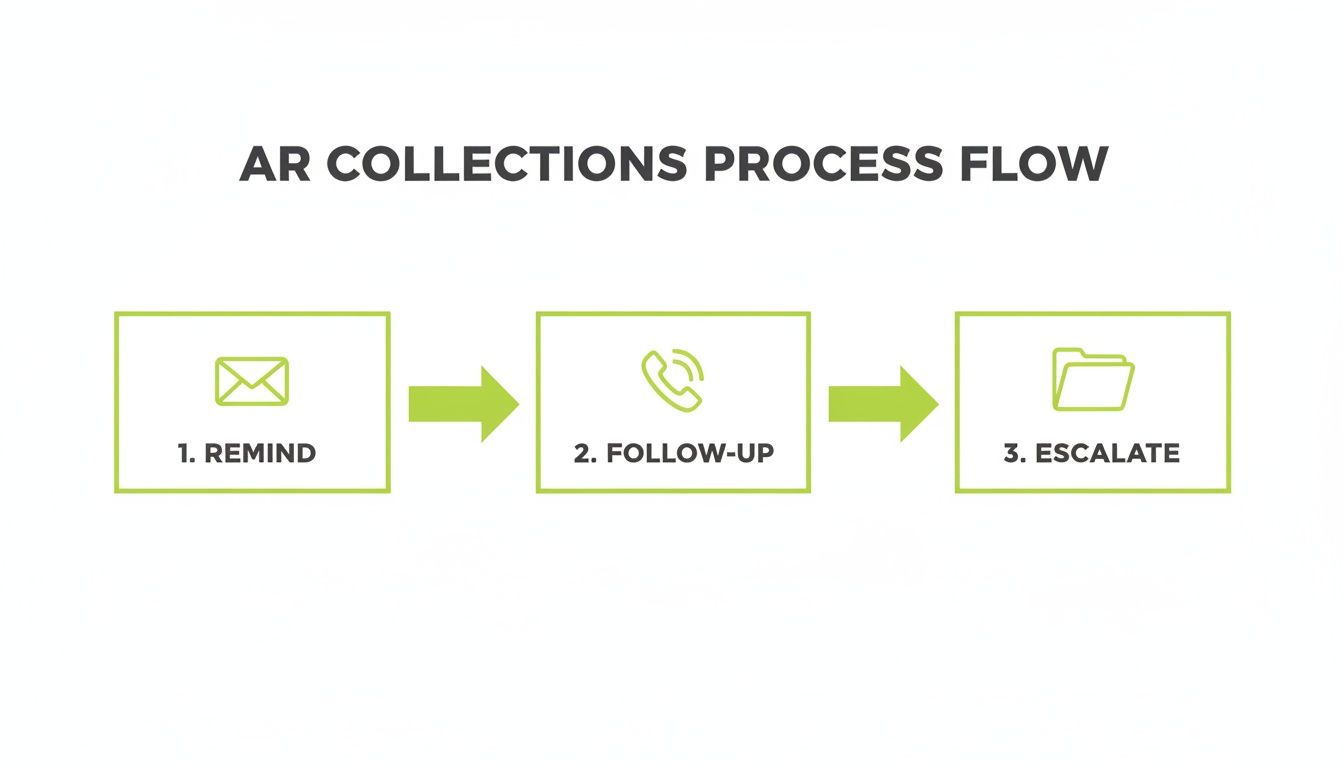
This structured approach ensures no invoice is overlooked, with engagement increasing logically as an account ages.
From Process to Predictability
Achieving this requires embedding a new mindset where on-time payment is the default. This is where accounts receivable automation provides a critical advantage, executing your strategy with a precision that manual efforts cannot match.
Modern AI AR automation can manage nuanced, human-like communication that protects client relationships while accelerating payments. You can learn more about the different ways to increase cash flow by optimizing your operations.
With the right combination of strategy and technology, you gain direct control over your cash conversion cycle. This control provides the confidence to invest, hire, and scale, backed by a predictable financial foundation.
Common Questions About Accounts Receivable Aging
For financial leaders at professional services firms, these are common operational questions. Here are direct answers.
What’s a Good Percentage for Receivables Over 90 Days?
For a healthy firm, receivables over 90 days should constitute less than 20% of your total AR balance.
Once an invoice surpasses 90 days, the probability of collection can fall below 50%. A rising percentage in this bucket is not just a collections issue—it is a direct threat to working capital.
Will AR Automation Make Us Sound Like Robots?
No. Effective accounts receivable automation enhances client relationships by ensuring communication is consistent, professional, and timely.
Well-designed automation replaces inconsistent manual follow-ups with polite, predictable reminders. The best systems use a human-like tone and provide easy payment portals, reducing friction. It builds process trust.
Automation ensures every client gets the same professional, timely communication. It scales your best practices, protecting client relationships from the inconsistency of manual follow-up.
Can AR Software Connect to Our Accounting System?
Yes. Any credible AR software for professional services must integrate seamlessly with major accounting platforms like QuickBooks, Xero, and NetSuite.
This integration is essential. It ensures data flows between systems automatically, keeping your accounts receivable aging report continuously synchronized with your collections activity. This is the foundation for effective QuickBooks AR automation.
How Fast Can We Actually Lower Our DSO?
Firms that implement a well-configured AI AR automation platform often see a measurable reduction in DSO within the first quarter.
By automating just the initial reminders for invoices in the 1-30 day bucket, many firms reduce their DSO by 15-20% within six months. The key is consistency. An automated system executes your collections playbook perfectly, every day, turning small, consistent actions into significant cash flow improvements. You solve problems on day 15, not day 75.
--- Resolut automates AR for professional services—consistent, accurate, and human.