A CFO's Guide to the Accounts Receivable Aging Method
Master the accounts receivable aging method to improve cash flow, reduce DSO, and see how AR automation gives finance leaders complete control.
The accounts receivable aging method organizes unpaid invoices into time-based buckets. This framework provides a clear, strategic view of a firm's cash flow and credit risk.
For a professional services firm, this isn't just an accounting exercise. It's the primary tool for converting billable hours into cash.
Beyond Invoices: A Strategic View of AR
For a professional services firm, accounts receivable is a direct signal of operational health. A passive "wait and see" approach to collections creates predictable problems: erratic cash flow and wasted administrative hours.
When revenue is tied directly to the team's billable hours, delays in payment directly impact profitability. Waiting for payments instead of managing them creates financial uncertainty.

From Collections to a Controllable Asset
The accounts receivable aging method transforms AR from a reactive chore into a strategic asset. It provides the data structure to make informed financial decisions.
By sorting invoices into buckets like Current, 1-30 days past due, and 31-60 days past due, you immediately identify collection risks. This segmentation is the foundation of a proactive system designed to reduce DSO and improve cash flow.
An aging report converts raw invoice data into operational intelligence, revealing which clients are reliable and where the collections process requires intervention. It is the control panel for a firm's incoming cash.
The Cost of an Undisciplined Process
Without an organized aging method, finance teams treat every invoice with the same urgency, a significant misallocation of resources. This leads to several failures:
- Wasted Hours: Teams chase small, recent invoices instead of focusing on older, higher-risk accounts that threaten cash flow.
- Strained Relationships: Inconsistent follow-ups appear unprofessional and erode client trust.
- Inaccurate Forecasting: Without a clear view of payment timelines, forecasting becomes unreliable, impacting hiring and investment decisions.
To gain control, firms must move beyond basic reports. This guide on How to Use Financial Analytics to Drive SMB Growth introduces the aging method as the core system for achieving financial predictability.
How to Build a Clear AR Aging Schedule
An AR aging schedule transforms a list of open invoices into a strategic map of your cash flow. Building one is an exercise in data discipline.
The process begins by exporting key data points from your accounting system. To accelerate this and eliminate manual errors, an Invoice AI Scanner can extract the necessary information automatically.

Gathering the Essential Data
The accuracy of an aging schedule depends entirely on the quality of the source data. A clean export of all open invoices must include these fields:
- Client Name: Identifies the debtor.
- Invoice Number: The unique identifier for each bill.
- Invoice Date: The starting point for aging the receivable.
- Due Date: The contractually expected payment date.
- Outstanding Balance: The precise amount owed.
With this data, each invoice can be sorted into the appropriate time-based category.
Structuring the Aging Buckets
The core of the accounts receivable aging method is segmenting open invoices into standardized time buckets. This categorization pinpoints where cash is tied up and flags collection risks.
A standard aging schedule uses these buckets:
- Current: Invoices sent but not yet past due. This is the healthy pipeline.
- 1–30 Days Past Due: Recently overdue. This is the first signal for follow-up.
- 31–60 Days Past Due: Requires more structured and consistent collection efforts.
- 61–90 Days Past Due: These invoices pose a significant risk and require direct intervention.
- Over 90 Days: The highest-risk category, where collectibility has dropped significantly.
This segmentation provides a snapshot that allows finance leaders to forecast potential bad debt and assess the firm’s financial health.
From Raw Data to a Strategic Report
After sorting, the report directs focus to the accounts that need it most. A large balance in the Current bucket is positive. A smaller but growing amount in the 61–90 day bucket signals a systemic breakdown requiring immediate attention.
This is how an aging schedule turns data into operational intelligence. It tells you where to focus your team’s limited time for the greatest impact on cash flow.
The table below illustrates this structure, providing a consolidated view of individual invoices across aging buckets.
Example Accounts Receivable Aging Schedule
Client Name | Invoice Number | Total Due | Current | 1-30 Days Past Due | 31-60 Days Past Due | 61-90 Days Past Due | Over 90 Days |
|---|---|---|---|---|---|---|---|
Alpha Corp | INV-101 | $5,000 | $5,000 | ||||
Beta Co | INV-102 | $2,500 | $2,500 | ||||
Gamma LLC | INV-103 | $8,000 | $8,000 | ||||
Delta Inc | INV-104 | $1,200 | $1,200 | ||||
Epsilon Group | INV-105 | $3,500 | $3,500 | ||||
Totals | $20,200 | $5,000 | $2,500 | $8,000 | $1,200 | $3,500 |
This structure is the first step toward a predictable collections process. The objective is to improve cash flow and maintain control over the revenue you have earned.
How to Read Your Aging Report for Actionable Intelligence
An AR aging report is useless until its data is translated into intelligence. The value comes from reading it with an operator’s eye to diagnose collections health and forecast cash positions.
Each aging bucket is a signal of risk and demands a calculated response to protect the firm’s cash flow.
Interpreting Signals in Each Bucket
The first step is to calculate the percentage of total receivables in each category. This shifts the focus from raw dollar amounts to the structural health of your AR. A high concentration in the "Current" bucket indicates a functional system.
A bulge in the 31-60 day bucket is an early warning. It could point to a clunky invoicing process or a large client who consistently pays just outside of terms. Treat it as an operational flag.
The 61-90 day bucket is where risk compounds. This is capital that should be funding operations. This bucket requires immediate, direct intervention. An aging report is an early warning system, enabling a shift from reactive collections to a proactive strategy.
Pinpointing Troubling Patterns
Analysis must go beyond totals to identify patterns. Is one client responsible for 80% of your "Over 60 Days" balance? That is a concentrated credit risk that requires direct action, such as renegotiating payment terms or pausing work.
If multiple clients are clustered in the same bucket, that suggests an internal process failure. Your invoices may be confusing, or your follow-up cadence is inconsistent.
The "Over 90 Days" Threshold
The "Over 90 Days" column is the most critical. Statistically, the probability of collection drops significantly once an invoice crosses this threshold.
Data shows that accounts receivable over 90 days old have collection rates as low as 50%. This means half of this aged debt may become a write-off. You can discover more insights on the correlation between aging AR and bad debt. Keeping this number low is a primary objective.
Turning Interpretation into Action
By acting on these insights, you can achieve measurable outcomes:
- Accurate Cash Flow Forecasting: Reliable predictions based on where cash is held up.
- Reduced DSO: Proactive intervention in earlier buckets lowers Days Sales Outstanding.
- Lower Bad Debt Expense: Focused collection efforts on high-risk accounts reduce write-offs.
The accounts receivable aging method transforms a report into a diagnostic tool, providing the clarity needed to maintain financial control.
Turning Your Report into a Proactive Collections Strategy
An aging report is not a scorecard; it's a playbook. Its purpose is to shift collections from a reactive process into a proactive, predictable system.
The core principle is to tie specific, escalating actions to each aging bucket. This removes guesswork and ensures every invoice receives the right attention at the right time, protecting both client relationships and cash flow.
Building a Repeatable Escalation Policy
An escalation policy is the blueprint for collections. It clarifies who does what and when, ensuring communication is professional and consistent.
A simple, effective structure for professional services firms:
- Current Invoices: An automated reminder 3-5 days before the due date acts as a helpful nudge.
- 1–30 Days Past Due: This is where accounts receivable automation is most effective. A series of automated, personalized emails are sent, assuming the delay is an oversight.
- 31–60 Days Past Due: An email from the client’s main point of contact, followed by a direct phone call, signals this is becoming a priority.
- 61–90 Days Past Due: The finance team intervenes. A formal message from the Controller or CFO requests immediate resolution. Ongoing work may be paused.
- Over 90 Days: This bucket requires decisive action, such as a final demand letter or a strategic decision to write off the debt.
The goal is predictability. When clients understand your process is firm and consistent, their payment cycles are more likely to align with yours.
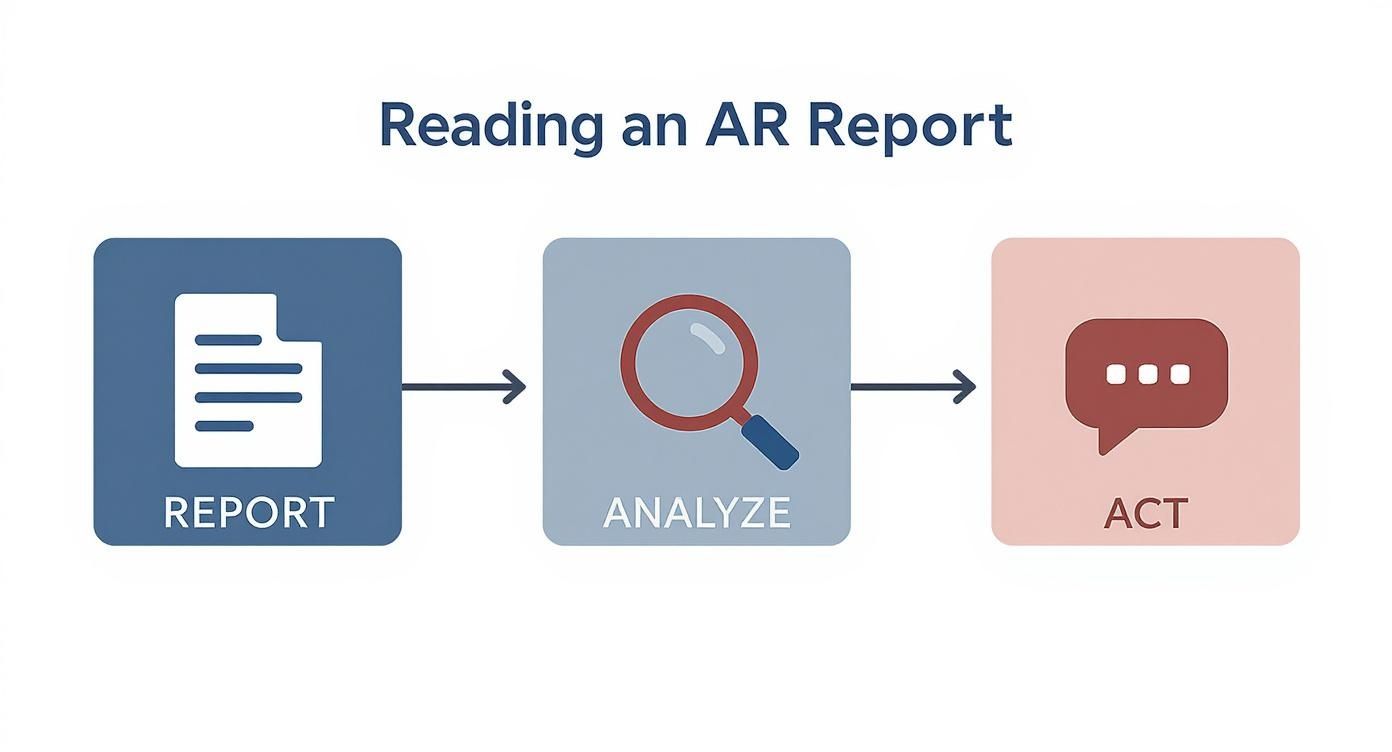
The Report, Analyze, Act cycle is the engine that converts static AR data into measurable improvements in cash flow.
Documenting Communications and Defining Ownership
For this system to work, every interaction must be logged—every email, call, and payment promise. This creates a clear audit trail.
Equally important is defining ownership. Ambiguous roles lead to dropped accounts. Clear ownership creates accountability and is one of the most effective ways to increase cash flow without acquiring new clients.
Modern AI AR automation platforms are built to execute this entire workflow. For firms using QuickBooks, specialized QuickBooks AR automation tools pull invoice data and trigger the follow-up sequence with minimal manual input, turning a passive report into an intelligent system.
Connecting AR Aging to DSO and Bad Debt Expense
An AR aging report provides the raw data for high-level metrics like Days Sales Outstanding (DSO) and the allowance for doubtful accounts. It is the bridge between daily collections and long-term financial health.
The conversation shifts from "who is late?" to "how efficiently are we converting work into cash?" This is where the accounts receivable aging method demonstrates its strategic value.
The Direct Impact on Days Sales Outstanding
Days Sales Outstanding (DSO) measures operational efficiency, showing the average number of days it takes to collect payment after work is completed. A low DSO is critical for any professional services firm.
The formula is:
DSO = (Total Accounts Receivable / Total Credit Sales) x Number of Days in Period
Every bucket in your aging report impacts this number. Invoices in older columns bloat the total AR balance, driving DSO higher. Each day an invoice sits unpaid is a drag on this key metric.
A rising DSO is a red flag that requires investigation. The aging report reveals if the issue is a single client, a systemic invoicing delay, or an ineffective follow-up strategy. This is the core of effective receivable management services.
Calculating a Data-Driven Allowance for Doubtful Accounts
The aging report is the primary tool for calculating a realistic allowance for doubtful accounts. This is not a formality; it is a critical estimate that ensures accurate financial statements.
This method applies historical non-payment rates to each aging bucket, a more defensible approach than a flat percentage. It reflects the reality that the probability of collection decreases as an invoice ages.
A typical schedule assigns higher risk percentages to older invoices. For instance, you might assume a 1% uncollectible rate for current invoices, but 40% or more for anything over 90 days.
Here is a practical example:
Aging Bucket | Outstanding Balance | Estimated Uncollectible % | Allowance for Doubtful Accounts |
|---|---|---|---|
Current - 30 Days | $200,000 | 1% | $2,000 |
31 - 60 Days | $75,000 | 5% | $3,750 |
61 - 90 Days | $25,000 | 15% | $3,750 |
90+ Days | $10,000 | 40% | $4,000 |
Total | $310,000 | $13,500 |
This structured method produces a precise, auditable number for the bad debt reserve and forces a regular review of collection risk across the client portfolio.
Using AR Automation for Control and Consistency
Manual AR management is a drag on finance teams, prone to human error and inconsistency. A well-designed collections strategy is useless without flawless execution.
This is where processes break down. A follow-up is missed. An escalation is delayed. A Controller wastes time chasing a small invoice instead of managing major financial risks.

Executing Your Strategy with Precision
Accounts receivable automation executes your defined escalation policies with perfect consistency.
Modern AR software for professional services provides a framework for control:
- Scheduled Reminders: Automated reminders are sent before and after due dates.
- Automated Escalations: Accounts move through the collection strategy based on predefined rules.
- Centralized Logging: All communications are tracked in one place, creating an audit trail without manual data entry.
From Reactive Chasing to Predictive Insights
The best AI AR automation platforms do more than send reminders. They analyze payment history to predict which invoices are likely to become delinquent, allowing your team to focus on accounts that pose a real threat to cash flow.
AR automation transforms your aging report from a historical document into a forward-looking tool. It pinpoints future problems, allowing intervention before an account becomes high-risk.
This shift delivers measurable results. Firms using AR automation typically see a 10-20% reduction in DSO. You can review the key accounts receivable automation benefits to see how this operational change improves financial performance.
For firms on QuickBooks, a dedicated QuickBooks AR automation tool creates an integrated system that manages the entire invoice lifecycle with minimal human effort, resulting in a collections process that is both efficient and professional.
Common Questions on AR Aging
Here are answers to practical questions finance leaders have about implementing the accounts receivable aging method.
How Often Should We Run an AR Aging Report?
Running an aging report weekly is the right cadence for most professional services firms. It provides a current, actionable view of receivables.
A weekly review is tactical, allowing the finance team to address overdue invoices before they escalate. Monthly reports are suitable for board-level reviews, but weekly analysis is where the work to improve cash flow happens.
What is a Good Benchmark for Receivables Over 90 Days?
While industry-dependent, a sound target for professional services firms is to keep receivables over 90 days below 10-15% of total AR.
If this metric consistently exceeds 20%, it signals a breakdown in the collections process or a problem with specific accounts. The objective is to bring this bucket as close to zero as possible.
Can AR Automation Handle Complex Client Situations?
Yes. Modern accounts receivable automation platforms are designed for nuance. They are not generic template systems.
You can configure custom rules and communication cadences for different client segments. Strategic accounts can receive a high-touch, personalized workflow, while smaller accounts follow a standard automated sequence.
This flexibility is what makes modern AR software for professional services effective. The system handles repetitive follow-ups, freeing your team to manage the exceptions and negotiations that require a human touch.
--- Resolut automates AR for professional services—consistent, accurate, and human. Learn more at https://www.resolutai.com.