Accounts Receivable vs. Accounts Payable: A Guide for Finance Operators
A practical guide on accounts receivable vs accounts payable for professional services. Learn to optimize cash flow, working capital, and profitability.
The distinction between accounts receivable vs accounts payable is a matter of cash direction. Accounts receivable (AR) is the cash your clients owe for services delivered—an asset. Accounts payable (AP) is the cash your firm owes its vendors—a liability.
For a finance operator, AR is cash inflow to be accelerated. AP is cash outflow to be controlled.
Mastering this dynamic is fundamental to managing working capital effectively.
The Two Levers of Working Capital
For finance leaders at professional services firms, AR and AP are the primary levers for managing working capital. They are not back-office functions; they are strategic controls that directly dictate the firm's financial agility and capacity for growth.

Accounts receivable represents earned revenue that requires systematic collection to become cash. Accounts payable represents obligations that require strategic payment timing to preserve cash without damaging vendor relationships.
Balancing these two levers is the core of financial control.
Strategic Distinctions for Firm Leaders
While AR and AP are two sides of the same ledger, their impact on a service-based business is asymmetric. A deficient AR process, where collections lag and Days Sales Outstanding (DSO) rises, directly erodes profitability. It locks up capital required for payroll, talent acquisition, and investment.
For a $10M services firm, a five-day increase in DSO traps approximately $137,000 in working capital. This is not an accounting delay; it is a direct constraint on operational capacity.
Conversely, while mismanaged AP can damage credit and vendor trust, the immediate financial impact is typically less severe than a cash-flow crisis caused by uncollected revenue. You can analyze this dynamic further in our guide on what is working capital management.
This table outlines the strategic differences:
Aspect | Accounts Receivable (AR) | Accounts Payable (AP) |
|---|---|---|
Balance Sheet Item | Current Asset | Current Liability |
Primary Goal | Accelerate cash inflow and reduce Days Sales Outstanding (DSO). | Control cash outflow and optimize Days Payable Outstanding (DPO). |
Operational Focus | Proactive, client-facing communication and collections. | Internal verification, approval, and payment timing. |
Source of Funds | Revenue generated from client services. | Cash reserves used to settle obligations. |
For most professional services firms, optimizing the AR function provides the most significant and immediate opportunity to unlock cash. It converts a reactive administrative task into a predictable system for cash generation, providing the clarity required for confident financial decisions.
Contrasting Core Operational Objectives
Operationally, accounts receivable and accounts payable function with opposing objectives and tempos. The AR function is an accelerator, designed to convert recognized revenue into cash. The AP function is a brake, designed to ensure deliberate control over cash outflows.
The mission of an Accounts Receivable team is to close the gap between invoicing and cash receipt. This is not an administrative task; it is the firm's liquidity engine. Every process is geared toward one outcome: to reduce DSO (Days Sales Outstanding).
The Accounts Payable team's objective is to manage cash outflow with precision. The function revolves around accuracy, verification, and timing—settling valid obligations while retaining working capital for as long as is strategically sound. It is a function of control, not speed.
The AR Mandate: Speed and Precision
For a services firm, the AR clock starts the moment a project milestone is met or a retainer period begins. The workflow must be engineered for speed but requires absolute precision, as it is client-facing.
Key operational stages include:
- Prompt Invoicing: Issuing clear, accurate invoices immediately upon work completion. Any delay is a self-inflicted drag on cash flow.
- Systematic Follow-Up: Adhering to a consistent, professional communication cadence for every outstanding invoice. This requires balancing persistence with diplomacy.
- Payment Facilitation: Removing friction from the payment process. Simplified payment paths accelerate cash receipt.
A single error—a mistake on an invoice or a miscommunication—not only delays payment but can also erode client trust. The operational pressure is to be both fast and flawless.
The AP Mandate: Accuracy and Strategic Timing
The AP workflow is an internal process built on verification and control. The objective is to ensure the firm pays only what it owes, precisely when it makes financial sense.
The AP process includes:
- Invoice Verification: Matching vendor invoices against contracts, POs, and proof of delivery. This is the first defense against overpayments or fraud.
- Internal Approvals: Routing invoices through the proper chain of command before funds are disbursed.
- Strategic Payment Scheduling: Timing payments to align with cash flow objectives, often settling on the due date to maximize Days Payable Outstanding (DPO).
An effective AP team functions as a gatekeeper of firm capital. Success is measured not by payment speed, but by accuracy and cash preservation.
To put these goals in perspective, here's a direct comparison of what each team is trying to achieve.
Operational Deep Dive: AR vs AP Objectives
A comparison of the fundamental goals, processes, and strategic focus for Accounts Receivable and Accounts Payable within a professional services firm.
Metric | Accounts Receivable (AR) Focus | Accounts Payable (AP) Focus |
|---|---|---|
Primary Goal | Accelerate cash inflow | Control and time cash outflow |
Key Performance Metric | Days Sales Outstanding (DSO) - Minimize | Days Payable Outstanding (DPO) - Maximize |
Core Process | Invoicing, collections, and cash application | Invoice verification, approval, and payment scheduling |
Operational Mindset | Proactive, externally-focused, and client-centric | Defensive, internally-focused, and detail-oriented |
Impact on Cash Flow | Directly increases cash on hand | Preserves existing cash on hand |
Relationship Focus | Managing and nurturing client relationships | Managing and maintaining vendor relationships |
These opposing operational mandates create a natural tension. The AR team accelerates cash inflow, while the AP team carefully manages outflow.
For services firms, strengthening AR through accounts receivable automation almost always delivers a superior impact on financial stability. Implementing AI AR automation brings necessary discipline to this high-stakes process.
Analyzing KPIs That Drive Financial Health
The strategic difference between accounts receivable and accounts payable becomes sharpest when examining their key performance indicators (KPIs). These are not dashboard metrics; they are vital signs of your firm's financial stability and operational discipline.
AR success is measured by the efficiency of converting invoices into cash. AP success is measured by the strategic management of cash outflow.
This visual captures the core tension: AR's mission is to accelerate cash collection, while AP's is to strategically time payments.
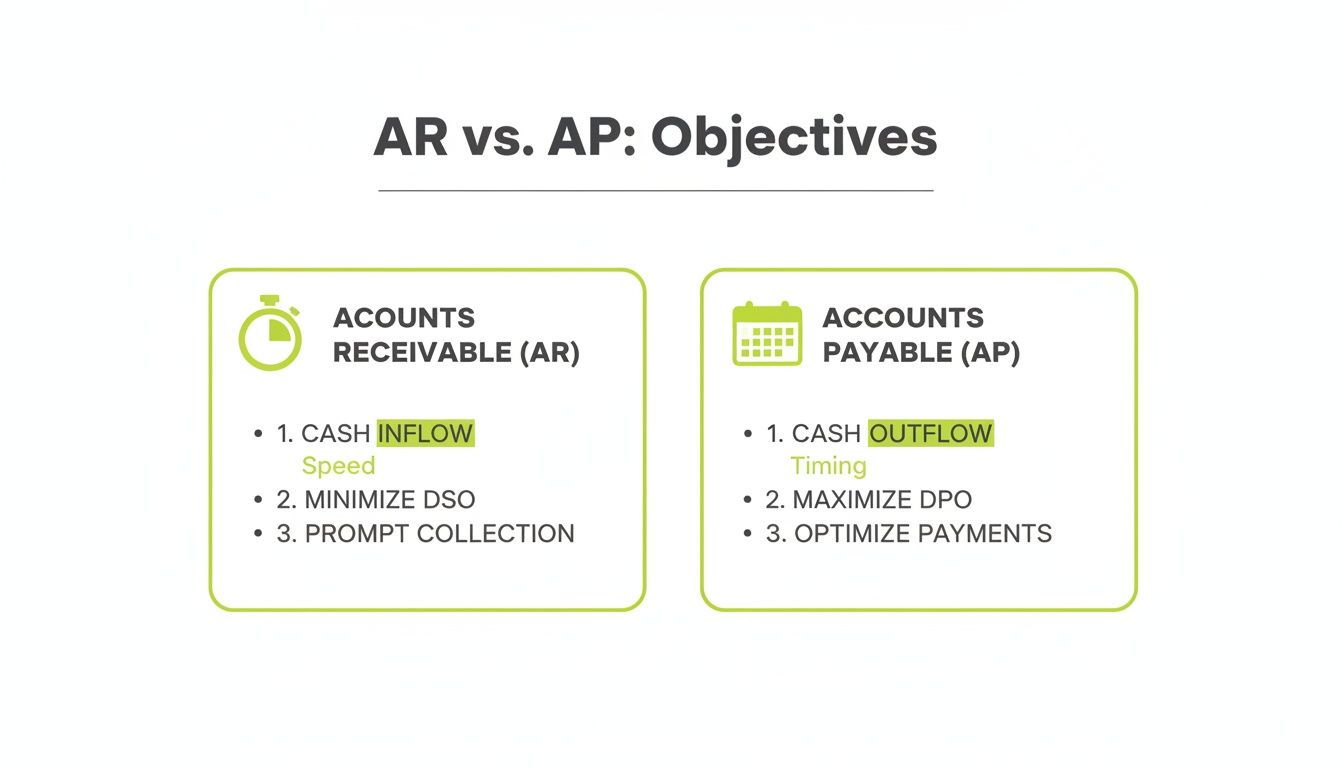
The graphic clarifies the opposing forces: one function pulls cash in, while the other manages its release.
Core AR Metrics That Impact Cash Flow
The firm's cash position is directly tied to a few critical AR metrics. Monitoring these provides a clear view of collection efficiency.
- Days Sales Outstanding (DSO): The single most critical AR metric. It measures the average number of days to collect payment after an invoice is sent. High DSO indicates trapped cash and operational drag.
- AR Aging Report: This report segments outstanding invoices by age (e.g., 0-30, 31-60, 91+ days). It is a diagnostic tool that flags collection issues before they become unrecoverable.
- Collection Effectiveness Index (CEI): This metric measures the percentage of collectible receivables that were actually collected during a period. A CEI near 100% indicates a highly effective collections process.
The impact of these metrics is substantial. For a $10M services firm, reducing DSO by just five days unlocks over $137,000 in working capital. This is not an accounting gain; it is cash available for payroll, investment, or operations. Our guide on what is DSO provides a deeper analysis.
Contrasting AP Metrics for Cash Preservation
While AR is about speed, AP is about control. AP KPIs reflect the goal of preserving cash while maintaining vendor standing.
Poor AR performance directly erodes cash reserves and increases bad debt risk. AP performance centers on strategic cash preservation and operational accuracy—the difference between collecting what you are owed and managing what you owe.
Key AP metrics include:
- Days Payable Outstanding (DPO): The inverse of DSO, this KPI tracks the average number of days it takes the firm to pay its vendors. A higher DPO indicates effective working capital management.
- Vendor Payment Error Rate: This tracks the percentage of incorrect payments, such as duplicates or overpayments. A low error rate demonstrates a controlled process that prevents cash leakage.
The operational contrast here is critical. The B2B late payment crisis means AR risk is immediate and severe. Once an invoice is 120 days past due, the probability of collection falls to just 20-30%. This reality underscores the urgency of disciplined accounts receivable automation.
Determining Where to Invest in Automation First
For a finance leader, the question is not if to automate, but where to begin for maximum impact. While both AR and AP benefit from technology, the strategic calculus for a professional services firm points decisively to AR. The choice is defined by how each function creates value.
AP automation is primarily a cost-reduction initiative. It improves internal efficiency, reduces manual data entry, and allows the team to process more vendor invoices with the same headcount. The ROI is measured in operational savings—valuable, but incremental.
In contrast, accounts receivable automation is a direct driver of revenue and cash flow. It addresses the firm's core financial engine by accelerating the conversion of earned revenue into cash. The ROI is not just process savings; it is unlocked capital.
The Asymmetric Impact on Cash Flow
The high cost of manual AR processes creates urgency. Delaying a vendor payment may strain a relationship, but a delayed client payment directly depletes working capital and threatens firm stability. A disciplined AR process is non-negotiable for predictable financial performance.
AP automation saves money on the process of paying bills. AR automation makes money by ensuring the firm gets paid on time. For a service-based business, the latter is the more urgent strategic priority.
The financial drag from a weak AR process is significant. It includes not just the late payments, but the compounding administrative burden and the material risk of bad debt. When your team is consumed with chasing invoices, they are not performing the high-value financial analysis for which they were hired.
The scale of this problem is vast. The global AR & AP automation market is projected to reach US$5,944 million by 2031, driven by this clear need. Enterprises waste an estimated $200 billion annually on AR administration, and 1 in 10 B2B invoices go unpaid.
Calculating the Return on AR Automation
The ROI for AP automation is straightforward: lower processing costs per invoice and fewer late payment fees.
AR automation delivers a more substantial financial return across the balance sheet and income statement:
- Reduced DSO: Every day removed from DSO injects cash directly into the business. For a $25M firm, a ten-day DSO reduction frees up nearly $685,000 in working capital.
- Lower Bad Debt: Proactive, systematic follow-up significantly reduces the number of invoices that enter the 90+ day category, where collectability plummets.
- Increased Team Productivity: Automating reminders and follow-up frees finance staff for strategic work like forecasting and analysis, rather than collections.
While learning to automate company approval workflows is a sound step, the initial focus should be on where the most value is trapped.
The Clear Choice for Professional Services
For a firm billing for time and expertise, cash flow is the primary operational constraint. Optimizing payables is good financial hygiene. Optimizing receivables is a matter of survival and growth. An investment in AR software for professional services generates a faster, larger, and more strategically critical return.
The logic is simple: you must collect the cash before you can allocate it. A basic tool like QuickBooks AR automation handles invoicing, but a dedicated platform is required to manage collections with the discipline needed to improve cash flow. By prioritizing AI AR automation, you are not just fixing a back-office process; you are engineering a more resilient, cash-positive business.
How AI-Driven AR Automation Creates Predictable Cash Flow
Effective accounts receivable management is more than sending invoices and chasing late payments. It requires orchestrating the entire collections process with precision and intelligence. For professional services firms, this means transforming AR from a manual, reactive function into a predictable cash flow engine.
AI-driven accounts receivable automation provides the framework for this transformation. It does not replace human judgment but equips your team with data-driven workflows that ensure operational consistency. This systematic approach directly addresses the primary challenge in the accounts receivable vs accounts payable dynamic: the unpredictability of cash collection.

Orchestrating Client Communications
A modern AR platform intelligently manages client outreach. This surpasses the generic reminders of standard accounting software. An AI AR automation system orchestrates a sequence of communications across multiple channels, adapting its strategy based on invoice status and client payment history.
For example, the system can send a professional email reminder five days pre-due date, followed by an SMS notification on the due date. If an invoice becomes overdue, the platform can escalate to a more direct tone or assign a task for a personal phone call. This discipline ensures consistent follow-up without manual intervention.
A Seamless and Modern Client Payment Experience
Payment friction is a primary cause of delayed collections. Forcing clients to mail a check or navigate a cumbersome portal adds days to your DSO. AR software for professional services eliminates this by providing a clean, self-service client portal for viewing and paying all outstanding invoices with a single click.
By offering flexible payment options—ACH, credit card, digital wallets—you remove common barriers. Firms we work with have achieved a 10-15% reduction in DSO simply by improving the client payment experience.
This delivers the same professional, modern standard in your billing as you do in your core services. As you evaluate new technology, using AI for operational efficiency can be transformative for financial processes like AR.
From Reactive Chasing to Proactive Risk Management
Traditional AR is reactive; the finance team chases an invoice only after it is late. Modern AR automation reverses this model. It uses data to predict which invoices are at risk of delinquency before they pass their due date, enabling proactive cash flow management.
This predictive power is derived from several factors:
- Payment History Analysis: The system identifies clients with a history of late payments and flags their new invoices for earlier, more frequent follow-ups.
- Behavioral Triggers: It tracks client portal activity, such as invoice views, to gauge engagement and payment intent.
- Invoice Complexity: The system recognizes that complex, multi-line-item invoices are more prone to dispute and can prompt pre-emptive communication.
This data-driven approach allows your team to focus its expertise on the accounts that pose the greatest risk to cash flow. A well-implemented receivable management system becomes an indispensable tool for strategic financial oversight.
For any firm relying on basic QuickBooks AR automation, this represents a fundamental shift. It elevates AR from an administrative task to a strategic asset that generates reliable, forecastable cash. That is the control finance leaders require to drive firm growth.
Final Analysis: The Strategic Priority is AR
For a finance leader at a professional services firm, the accounts receivable vs. accounts payable debate is central to financial strategy. While both are critical, mastering Accounts Receivable provides the greatest strategic leverage. It is the most direct path to controlling the cash that fuels the firm.
AR process deficiencies carry a high, measurable cost. This cost materializes as working capital trapped in aging invoices, client relationships strained by inconsistent follow-up, and finance talent wasted on administrative collections. Shaving just five days off DSO for a $10M firm frees up over $137,000 in cash—a direct result of disciplined AR management.
Throughout this guide, we've reinforced a key operational truth: AP efficiency controls costs, while AR efficiency generates capital. Modern tools can now transform your AR process from a reactive, manual function into a strategic, automated asset.
The objective is not merely to chase overdue invoices, but to build a system that creates predictable cash flow. Shifting from a collections mindset to an orchestration mindset is what enables sustainable growth and true financial control.
With accounts receivable automation, you can systematize client outreach, simplify payment, and gain clear visibility into collection risks. With AI AR automation, you can add intelligent, personalized communication that retains a human touch. This is no longer a luxury; it is a necessity for financial control.
Resolut automates AR for professional services—consistent, accurate, and human.
Frequently Asked Questions
When finance leaders analyze the operational differences between accounts receivable and accounts payable, several practical questions arise. Here are direct answers to help optimize your AR function for maximum financial impact.
What Is the First Step to Improve Our AR Process?
Begin with a diagnostic review. Pull your AR aging report to identify the volume and value of past-due invoices, revealing where your primary risks are concentrated.
Next, calculate your firm's average Days Sales Outstanding (DSO) to establish a clear performance baseline. Segment overdue accounts to determine if late payments are concentrated among a few large clients or distributed across many smaller ones.
This analysis quantifies the problem, providing the data to determine whether your core challenge is inconsistent communication, complex invoices, or a systemic weakness requiring accounts receivable automation.
A thorough diagnostic review builds the business case for investing in a solution. Presenting data showing that 30% of working capital is tied up in invoices over 60 days past due makes the need for action clear.
Can AR Automation Harm Client Relationships?
No, the opposite is true. Modern AI AR automation is designed to protect and enhance client relationships. The myth of harmful automation is based on outdated, aggressive collection tactics.
Today's intelligent platforms use personalized, flexible workflows with a professional, human tone. They send helpful reminders before an invoice is due and provide clients with a simple self-service portal for payment.
By professionalizing the collections process, you eliminate the need for awkward, manual follow-up calls. This creates a more consistent and respectful client experience, strengthening the relationship by removing financial friction.
Is a Separate AR Tool Necessary If We Use QuickBooks?
Yes. While QuickBooks is an effective accounting system, its native AR features are designed for basic invoicing, not strategic, at-scale collections. It lacks the functionality to manage a proactive collections process.
A dedicated AR automation platform integrates with your general ledger, adding a layer of intelligence to your accounting data. A specialized tool provides:
- Automated, Multi-Channel Outreach: Orchestrates communication sequences via email and SMS that QuickBooks cannot perform.
- Dynamic Communication Workflows: Adapts follow-up strategies based on client payment history and invoice status.
- Advanced Analytics: Delivers deep insights into collection effectiveness, DSO trends, and at-risk accounts.
- Modern Payment Portal: Offers clients a consumer-grade experience for viewing and paying invoices online.
QuickBooks AR automation logs the transaction. A dedicated AR software for professional services converts that static data into an active engine to improve cash flow and reduce DSO.
--- Resolut automates AR for professional services—consistent, accurate, and human. Learn more at https://www.resolutai.com.