Accounts Receivable Automation: A CFO's Guide to Cash Flow Control
A CFO's guide to accounts receivables automation. Learn how to reduce DSO, improve cash flow, and select the right AR software for professional services.
For professional services firms, revenue isn't real until it's in the bank. Yet, many firms operate with a manual accounts receivable process—a significant, self-imposed hurdle between delivering great work and getting paid.
This isn't just about a few late payments. It's a measurable financial liability that quietly erodes profit margins, consumes your team's focus, and restricts your firm's growth potential.
The True Cost of Manual Accounts Receivable
Start with the direct labor cost. A skilled finance professional spending 10-15 hours per week chasing invoices is a significant misallocation of a valuable salary.
That is time a Controller or finance lead should dedicate to strategic modeling, capital allocation, or cash flow forecasting—activities that drive the business forward.
But the costs extend beyond wasted hours. Manual AR introduces operational friction. A typo on an invoice or a payment applied incorrectly can take days to resolve.
During that time, cash is delayed, and your team is diverted from high-value work. These small errors compound, impacting both cash flow and client perception.
Quantifying the Financial Drag
Consider a professional services firm with $10 million in annual revenue. A high Days Sales Outstanding (DSO) is the primary symptom of an inefficient AR process.
If that firm's DSO is 60 days, it means that at any given moment, $1.64 million of its earned revenue is tied up in receivables, not accessible as working capital.
A mere 5-day reduction in DSO—from 60 to 55 days—would unlock over $137,000 in cash. This is a permanent increase in the working capital available to invest in talent, technology, or growth initiatives.
The financial drain doesn't stop there. The costs are cumulative:
- Opportunity Cost: Every hour your senior finance team spends on AR minutiae is an hour not spent on strategy. This is high-value, unbilled time with the greatest impact on your firm’s long-term health.
- Inconsistent Client Experience: Manual collections are inherently erratic. One client might get a friendly reminder on day 31, while another hears nothing for 45 days. This unpredictability can seem unprofessional and introduce friction.
- Lack of Real-Time Insight: Spreadsheets and email chains provide a fractured, rearview look at your receivables. They cannot give you real-time visibility into which clients are becoming a risk or help you accurately forecast collections.
This operational drag isn't a small administrative headache; it's a serious financial drain. Before considering a solution like accounts receivables automation, it's crucial to understand the cost of inaction. Standard account receivable procedures that rely on manual effort often become the single biggest bottleneck to healthy cash flow.
Ultimately, manual AR forces your firm to operate with less cash and less strategic focus than it’s capable of. It turns the finance department from a strategic partner into a reactive administrative center—a cost no growing professional services firm can afford.
How Accounts Receivables Automation Works
Navigating AR with manual processes is like using a folded paper map in a new city. You might get there, but it's slow, inefficient, and you only realize you've made a wrong turn blocks after the fact.
Accounts receivable automation is the upgrade to a live-traffic GPS. It doesn't just show the map; it plans the optimal route, anticipates delays, and gets you to your destination—cash in the bank—faster and with far less stress.
This isn't a "black box" solution. It is a logical system of integrated components designed to free your finance team from repetitive tasks so they can focus on financial strategy and high-value analysis.
The Core Components of AR Automation
A robust AR automation platform integrates four key functions. Together, they transform a series of disjointed manual tasks into a smooth, predictable financial operation.
- Automated Invoicing: As soon as an invoice is created in your accounting system, the platform sends it. No more exporting PDFs, checking email addresses, or wondering if the client received it.
- Intelligent Collections: This is the system's engine. It uses smart workflows to determine when to send a reminder, what to say, and how to send it based on the client's payment history, invoice value, and age.
- Client Payment Portals: You provide clients with a secure, self-service portal to view all their invoices, ask questions, and submit payment via credit card or ACH. This removes friction and eliminates the "I never received the invoice" issue.
- Automated Cash Application: When a payment is made, the software automatically matches it to the correct open invoice(s) and records the transaction in your accounting system. This removes one of the most tedious and error-prone AR tasks.
Orchestrating the Invoice-to-Cash Cycle
The power lies not just in individual features, but in how they orchestrate the entire cycle. It’s the difference between reacting to problems and proactively preventing them. For instance, using tools like automated invoice reminders is a core part of this, turning a manual chase into a systematic, hands-off process.
This shift directly targets the hidden costs that quietly drain your resources, as this chart shows.
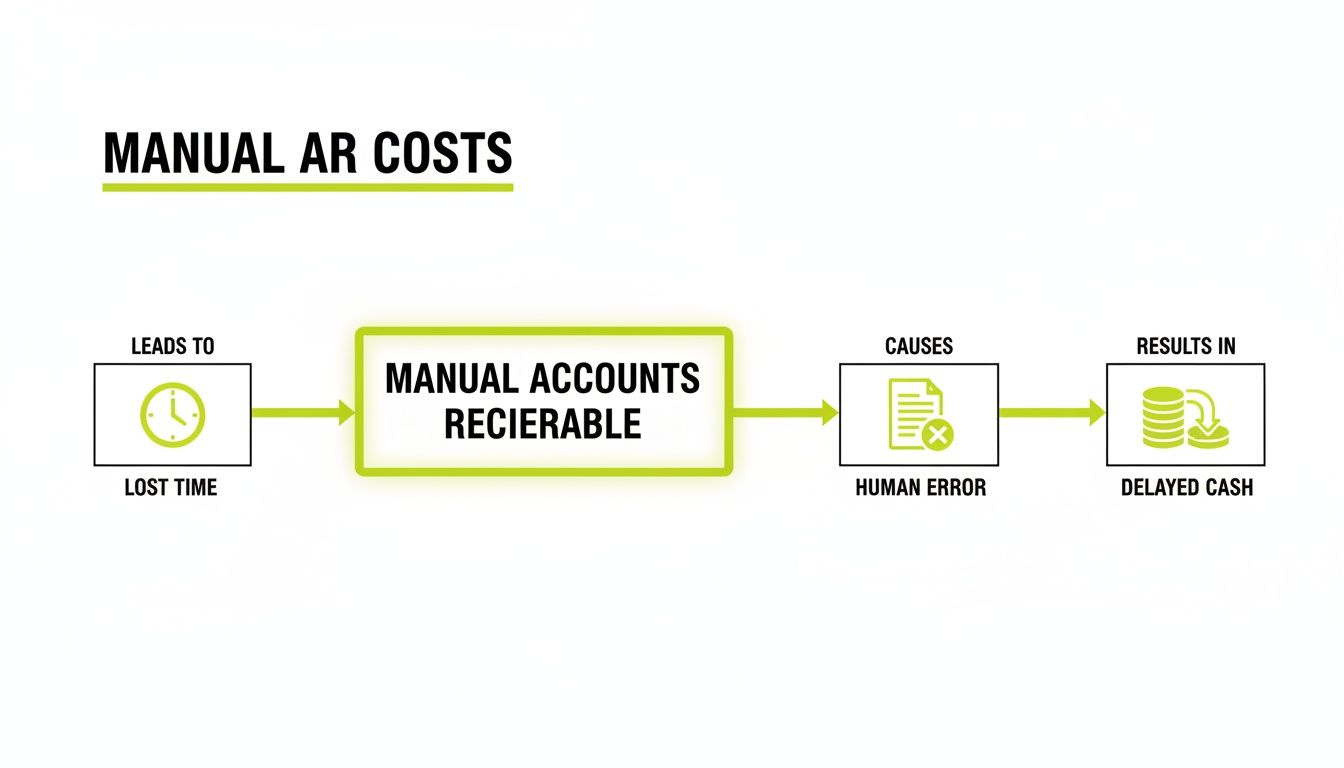
Lost time, human error, and delayed payments create a drag on your firm's cash flow. AR automation is designed specifically to resolve these issues.
The global accounts receivable automation market is projected to grow from USD 4.79 billion in 2025 to USD 12.86 billion by 2033. This growth is fueled by firms recognizing that manual processes are unsustainable. Finance teams often spend up to 40% more time than necessary managing AR with outdated systems.
For professional services firms, this orchestrated approach means your team is no longer a group of manual invoice chasers. Instead, they are alerted only when a human needs to intervene—such as for a high-value client disputing a charge.
The system handles all routine follow-up, freeing your best people to manage relationships and think strategically. This is how you reduce DSO, improve cash flow, and maintain positive client relationships.
Calculating the ROI of AR Automation
As a finance leader, you operate on numbers. Promises of "efficiency" are insufficient; an investment in accounts receivable automation must deliver a clear, measurable return.
The most immediate return is a direct reduction in your Days Sales Outstanding (DSO). Every day an invoice goes unpaid is a day your earned revenue is unavailable for payroll, investment, or operations.
The Direct Impact of Reduced DSO
Let’s model the impact for a professional services firm with $10 million in annual revenue. A DSO of 60 days means approximately $1.64 million of revenue is tied up in receivables.
By systemizing invoice delivery, follow-up, and payment, firms often reduce DSO by 5-15 days within the first few months.
A conservative 5-day reduction for that $10M firm has a significant impact:
- Annual Revenue: $10,000,000
- Daily Revenue: $10,000,000 / 365 = $27,397
- Cash Flow Unlocked: 5 Days x $27,397 = $136,985
This isn't a one-time event. It is a permanent increase in your available working capital. That unlocked cash could fund a key hire, reduce reliance on a line of credit, or fuel strategic projects. To analyze your own metrics, see our guide on the accounts receivable turnover calculation.
Secondary ROI from Operational Control
Beyond the reduction in DSO, the returns from AI AR automation ripple across your operation. These secondary benefits deliver tangible value that strengthens the business case.
- Reduced Bad Debt: A proactive system doesn't wait for an account to go bad. Automation helps you spot at-risk clients before they become write-offs by flagging changes in payment behavior, enabling you to intervene early.
- Lowered Cost-to-Collect: Automation absorbs the hours your team sinks into chasing payments and matching them to invoices. Getting just 10 hours a week back for a senior finance professional is a massive productivity gain.
- Improved Cash Flow Predictability: An AR software for professional services provides data-driven forecasts based on actual payment histories, not just anecdotal promises. This gives your treasury function a far more dependable picture of incoming cash.
The inefficiency of manual AR is a global problem. Industry reports suggest that manual processes lead to $200 billion in yearly waste for businesses, with 10% of all invoices never being paid. You can find more on this in recent market research. For any firm using a system like QuickBooks, AR automation provides a clear path to reclaiming that lost revenue.
ROI isn't just about saving money; it's about gaining control. It is the ability to forecast cash with confidence, reduce financial risk, and free your team to focus on strategic work instead of administrative churn.
Ultimately, the ROI conversation is about transforming a reactive, manual process into a predictable, efficient financial engine for your business.
Must-Have Features in an AR Automation Platform

When evaluating AR software for professional services, the goal is not to find the most features. For a CFO or Controller, the right platform delivers control, predictability, and improved cash flow.
True accounts receivables automation is an orchestration engine for the entire invoice-to-cash cycle. It must provide a complete, real-time view from invoice delivery to cash application.
The market is already moving this way. Cloud-based accounts receivable automation is projected to capture over 79% of the market by 2026 as firms abandon clunky, on-premise software. You can review the data in reports on the AR automation market.
A Collections Engine That Thinks
The core of an effective AR platform is its collections engine. It should not be a blunt instrument that sends generic emails every 15 days. A smart system uses dynamic workflows that adapt based on client profile and behavior.
You should be able to segment clients based on your criteria—invoice value, payment history, or contract type. This allows the system to apply a tailored collections strategy.
This is where AI AR automation becomes a practical tool. It is a system that can:
- Adapt tone and timing. A new client relationship may call for a polite message, while a chronically late payer requires a more direct follow-up.
- Identify at-risk invoices. By analyzing payment patterns, the system can flag accounts showing early signs of delinquency, allowing your team to get ahead of the problem.
- Select the right channel. It can determine if an email, SMS message, or system-generated call is the best way to reach a specific contact.
This level of intelligence ensures your collections efforts are both effective and professional, protecting the client relationships you've worked hard to build.
Effortless Integration and Cash Application
An AR platform that doesn't integrate with your accounting software creates another data silo and more manual work. For any firm, and especially those using QuickBooks AR automation, seamless integration is non-negotiable.
Equally important is automated cash application. Your finance team’s time is better spent on analysis than matching incoming payments to open invoices.
When a client pays through the portal, the system should instantly match that payment to the correct invoice, update its status, and reconcile the entry in your accounting software. This feature alone can free up dozens of hours of manual work each month.
The Power of Autopilot and Co-Pilot Modes
Finally, the best platforms provide the flexibility to switch between "autopilot" and "co-pilot" modes. You need automation for routine work and human oversight for high-stakes accounts.
- Autopilot: The system runs the entire collections workflow for defined client segments. This is ideal for the 80% of receivables that simply require consistent, professional reminders.
- Co-Pilot: The system provides data, suggests the next step, and drafts the communication, but a team member makes the final decision. This human-in-the-loop approach is critical for key clients or sensitive disputes.
Not all platforms offer this balance of automation and control. The right system provides the efficiency of automation without sacrificing the expert judgment that defines your firm.
A Practical Roadmap for Implementing AR Automation

Implementing accounts receivables automation is a focused business initiative, not a massive IT project. A methodical plan ensures a smooth transition and a rapid return on investment.
The process is designed to be manageable, breaking the project into phases that deliver specific, measurable outcomes, such as hitting a target DSO reduction. Success depends more on clear goals and effective change management than on technical complexity.
Phase 1: Discovery and Goal Setting
Before evaluating software, define what success looks like. This phase is about building a business case with measurable goals.
Start by benchmarking your current AR performance. Document your average DSO, the percentage of invoices over 30 days past due, and the hours your team spends on manual collections.
With this baseline, set concrete targets. A practical initial goal is to reduce DSO by 10% within six months or cut manual follow-up time by 50%. These objectives will guide your decisions.
Phase 2: Data Preparation and System Integration
An automation platform is only as good as its data. This phase focuses on cleaning your data and ensuring it flows correctly from your accounting system to create a single source of truth.
Do not rush this step. Outdated client contacts, duplicate accounts, or inconsistent payment terms can undermine an otherwise sound implementation. A dedicated data cleanup sprint is a worthwhile investment.
For firms using standard software, establishing a QuickBooks AR automation connection is typically straightforward. The critical task is ensuring that all data—invoices, payments, credit memos—syncs automatically and accurately.
Poor data is the number one reason AR automation projects fail to deliver. Time invested here prevents scaling a chaotic process. It’s not about perfection; it's about ensuring core data is reliable from day one.
Phase 3: Workflow Configuration and Team Adoption
With clean data flowing, you can build your automated workflows. Start by translating your existing collections policy into a series of simple, automated steps for the 80% of receivables that follow a standard pattern.
Map out a basic communication sequence:
- Day 1: Invoice is sent automatically upon creation.
- Day 28: A polite reminder is sent two days before the due date.
- Day 35: A follow-up is sent five days after the due date with a direct payment link.
This is also the critical point for securing team adoption. Demonstrate that the system is a tool that helps them, not one that replaces them. Explain that AI AR automation handles repetitive tasks, freeing them for more valuable work.
A phased rollout is always preferable to a "big bang" launch. Start with a small group of clients to test workflows and allow your team to acclimate. Once you confirm the system is working as intended, you can expand the rollout.
Building a More Strategic Finance Function
Moving from manual collections to accounts receivables automation is a fundamental shift in strategy. It is a decision to exit the reactive cycle of chasing payments and gain strategic control over your firm's cash.
The conversation in your finance meetings shifts from, "Have they paid yet?" to "What's the best way to deploy this capital?"
From Collections to Control
This change elevates your team's function. Instead of being mired in administrative tasks, they are free to analyze payment patterns, strengthen client relationships, and deliver the insights leadership needs to make informed decisions.
This is a cornerstone of the wider digital transformation in finance. It provides the control needed to manage cash flow with confidence, minimize risk, and plan for sustainable growth.
The ultimate goal is to transform cash flow from a reactive metric into a managed resource. Automation provides the data and discipline to make that happen, putting you in firm control of your company's financial health.
Adopting AI AR automation demonstrates a commitment to financial discipline and operational excellence. It creates a modern, professional experience for your clients while building a predictable financial engine to power your firm’s growth.
Resolut automates AR for professional services—consistent, accurate, and human.