Mastering the Ageing of Accounts Receivable Method for Financial Control
Discover how to use the ageing of accounts receivable method to improve cash flow, reduce DSO, and gain financial control. Actionable insights for CFOs.
For any finance leader at a professional services firm, a single accounts receivable number is a lagging indicator. It tells you what happened, not what's about to happen.
The ageing of accounts receivable method provides the necessary context. It segments receivables by the age of the invoice, transforming a static balance into a predictive tool for managing cash flow and assessing client payment behavior.
This isn't an academic exercise; it's a core operational discipline.
Understanding the Ageing of Accounts Receivable Method
The ageing method categorizes total receivables into time-based buckets, typically aligned with standard payment terms. This segmentation reveals the quality of your receivables, not just the quantity.
- 0–30 days (Current)
- 31–60 days (Past Due)
- 61–90 days (Significant Risk)
- 90+ days (High Risk / Potential Write-off)
This structure acts as a financial radar. It distinguishes healthy, current accounts from those trending toward delinquency, providing the data needed for early intervention long before they become uncollectible.

From Reactive Reporting to Proactive Control
An AR aging report is not a historical document for the month-end close. It is a live dashboard for directing collections and preserving working capital.
Its primary function is to guide your finance team on where to focus their efforts for maximum impact on cash flow.
The core principle is straightforward: the probability of collection decreases as an invoice ages. The ageing method quantifies that risk, enabling precise, data-driven intervention.
This is critical for firms with project-based billing. A growing balance in the 61–90 day bucket is a direct signal of a future cash constraint. When AR over 90 days exceeds 18-22% of total receivables, we have observed that write-off rates can increase by a factor of 3 to 4. You can discover more insights about AR aging and write-off correlations here.
Effective use of this method shifts the AR function from reactive payment chasing to proactive financial management. This control directly helps reduce DSO and improve cash flow, objectives streamlined by tools like QuickBooks AR automation or specialized AR software for professional services.
Building and Calculating the AR Aging Report
A properly constructed AR aging report is the foundation of effective receivables management. It defines risk, shapes client communication, and directs operational focus.
The process begins with a single, critical decision.
You must choose whether to age receivables by invoice date or due date. For professional services firms operating on terms like Net 30 or Net 60, the only logical choice is the due date. It provides an accurate measure of payment performance against agreed terms. Aging by invoice date introduces noise by flagging invoices that are not yet delinquent.
The Two Primary Aging Methodologies
The starting point—invoice date versus due date—produces fundamentally different operational pictures.
- Aging by Invoice Date: This method starts the clock upon invoice creation. It is simple to implement but operationally misleading. An invoice with Net 30 terms appears in the "0-30 days" bucket immediately, creating a false signal of an issue.
- Aging by Due Date: This is the standard for operational control. An invoice is categorized as past due only after its payment term expires. This provides an accurate view of delinquency and allows your team to focus exclusively on accounts that have breached payment terms.
For firms using QuickBooks AR automation, configuring the system to age by due date is a critical setup requirement for maintaining data integrity.
Constructing the Aging Schedule
With the methodology set to "due date," the next step is building the schedule. This involves categorizing all outstanding invoices into time-based buckets, typically in 30-day increments to mirror standard payment cycles.
The structure is a simple ledger: list each client with an open balance and allocate unpaid invoices to the appropriate aging columns. To begin, you can download a free accounts receivable aging report template for a standardized format.
The report becomes a predictive tool when you apply historical collection data to establish an estimated uncollectible percentage for each aging bucket. This process transforms a simple debt schedule into a forecast for your allowance for doubtful accounts.
This estimate is essential for accurate financial statements under GAAP. It informs the contra-asset account on your balance sheet, providing a realistic valuation of your receivables.
A Practical Example Calculation
Consider a consulting firm, "Acumen Strategy," with $500,000 in total accounts receivable. Based on historical payment data, the controller has established non-payment probabilities for each aging category.
This table demonstrates how these rates are applied to calculate the required allowance.
Sample AR Aging Schedule and Allowance Calculation
This is Acumen Strategy's AR aging report breakdown. It illustrates the categorization of their $500,000 in receivables and the application of historical non-collection rates to determine the allowance for doubtful accounts.
Aging Category (Days) | Amount Receivable ($) | Estimated Uncollectible (%) | Allowance for Doubtful Accounts ($) |
|---|---|---|---|
0-30 (Current) | $320,000 | 1% | $3,200 |
31-60 | $90,000 | 5% | $4,500 |
61-90 | $55,000 | 20% | $11,000 |
91+ | $35,000 | 50% | $17,500 |
Total | $500,000 | $36,200 |
Based on this analysis, Acumen Strategy requires an allowance of $36,200. This is not a guess; it is a data-driven forecast of expected credit losses.
Note how the 91+ day bucket, with a 50% uncollectible rate, is the largest contributor to the allowance. This is a clear indicator of where collection efforts must be focused to improve cash flow.
This systematic ageing of accounts receivable method moves financial planning from estimation to a calculated discipline. Manual execution is resource-intensive, which is why firms increasingly adopt accounts receivable automation. Effective AR software for professional services performs these calculations in real-time, delivering a continuously updated view of risk.
Connecting AR Aging to Critical Financial KPIs
An aging report is not a static table. It is the raw data that powers the vital signs of your firm's financial health.
It connects the daily operational tasks of billing and collections to the strategic objective of cash flow stability. Translating aging buckets into clear KPIs shifts the perspective from simply observing numbers to understanding their direct financial impact.
A growing 90+ day bucket is a quantifiable drag on your firm's ability to convert revenue into cash. This is the distinction between firms that react to financial problems and those that preempt them.
Translating Aging Data into Days Sales Outstanding
The ageing of accounts receivable method is the engine that drives Days Sales Outstanding (DSO), a primary KPI for measuring collection efficiency.
The formula shows a direct correlation between the health of your aging report and your cash conversion cycle.
DSO = (Total Accounts Receivable / Total Credit Sales) x Number of Days in Period
Every dollar that moves into an older aging bucket inflates total AR and increases DSO.
For example, a firm with $5M in annual credit sales and $600,000 in outstanding receivables has a DSO of 43.8 days. If inefficient collections push that AR balance to $800,000, DSO climbs to 58.4 days. That represents an additional two weeks of waiting for earned cash.
This is not a hypothetical risk. In the US, the average time-to-paid recently reached 29.8 days, with late payments adding another 10 days. Contrast this with Australia, where late payments average only 6.2 days. You can see more global payment insights here.
The entire AR reporting process, from invoice creation to aging schedule, underpins these critical KPIs.
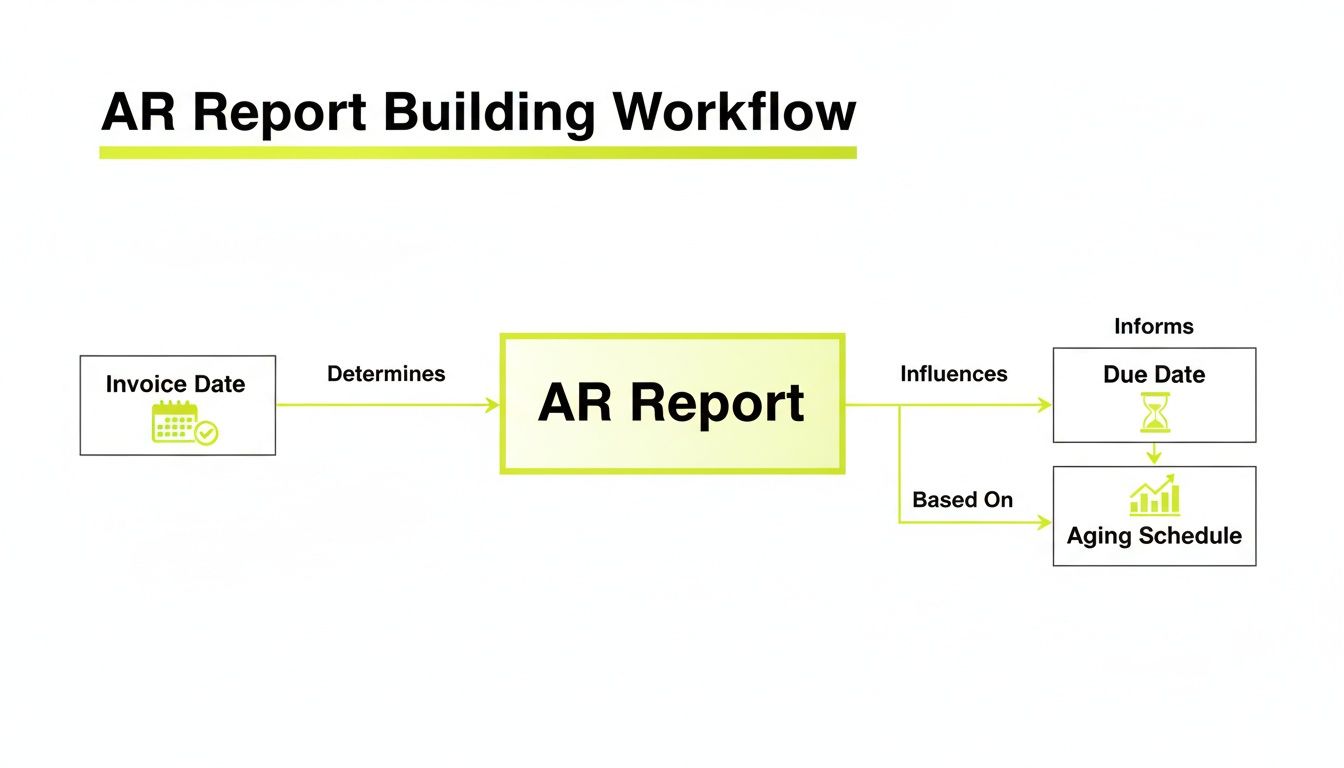
As this workflow illustrates, the integrity of your financial metrics begins with accurate invoice tracking and a properly configured aging schedule.
Measuring Performance with the Collection Effectiveness Index
While DSO measures the speed of collections, the Collection Effectiveness Index (CEI) measures their quality. It calculates the percentage of collectible receivables that were actually collected during a period.
The calculation is as follows:
- CEI = [(Beginning Receivables + Monthly Credit Sales) - Ending Total Receivables] / [(Beginning Receivables + Monthly Credit Sales) - Ending Current Receivables] x 100
A CEI of 90% or higher indicates a disciplined collections process. A sustained figure below 80% signals a systemic issue requiring investigation.
Monitoring both DSO and CEI provides a comprehensive view of AR health. This enables targeted action and identifies actionable ways to increase cash flow for your firm.
These KPIs are real-time operational tools, not just quarterly reporting figures. This is where accounts receivable automation provides significant value, ensuring data is always current and transforming the aging report into a live diagnostic tool.
Operationalizing Your Aging Report
An aging report's value is realized through action. It is a playbook for executing a methodical collections strategy—one that accelerates cash flow without damaging client relationships.
The process starts with data integrity. A common error in accounting systems like QuickBooks is aging invoices by issue date instead of due date. Correcting this single setting prevents your team from pursuing payments that are not yet late.

Prioritizing Collections with a Tiered Approach
An accurate report allows you to stop treating all invoices equally. The goal is to apply the right level of intervention at the right time, reserving human capital for high-risk accounts.
A standard tiered strategy includes:
- 0–30 Days (Current): Automated, low-touch reminders. A polite email sent a few days before the due date is sufficient. Accounts receivable automation executes this consistently without manual effort.
- 31–60 Days (Early Delinquency): The communication becomes more direct. Automated follow-ups can increase in frequency. After 45 days, a personal call from an AR specialist is warranted to identify the issue.
- 61–90+ Days (High-Risk): These accounts are a direct threat to working capital and require senior-level intervention. A manager or partner should be involved to resolve the situation.
This approach prevents wasted effort on current accounts and ensures high-risk receivables receive immediate, appropriate attention.
Navigating Professional Services Complexities
Professional services firms face unique AR challenges. Milestone billing disputes or disagreements over a single line item can stall payment on a large invoice. A client may withhold a $50,000 payment over a minor $2,000 issue.
A rigid collections process can fracture a valuable client relationship over a resolvable issue. The key is to create a strategy that is firm but fair, enforcing financial discipline without being adversarial.
A collections call should be a diagnostic conversation, not just a demand. The root cause is often a simple misunderstanding or a need for additional documentation. Treating collections as an extension of client service can resolve the dispute and secure payment for the undisputed portion of the invoice. This is a core component of effective receivable management services.
Implementing a Firm and Fair Strategy
A clear collections protocol is essential. Communicate payment terms and late payment policies during client onboarding to set clear expectations.
Using AI AR automation helps manage this process systematically. A platform can handle the early, automated reminders, freeing up your team for the nuanced, relationship-driven escalations required for older invoices. This blend of technology and human oversight helps reduce DSO and improve cash flow without compromising client trust.
How Automation Optimizes the AR Aging Process
Manual aging reports are inefficient. They are prone to human error, consume valuable team resources, and are obsolete moments after they are created.
Managing real-time cash flow with a static report is ineffective. This operational gap is closed by AR automation. Modern platforms integrate directly with your accounting system, creating a live, dynamic view of receivables that is always current and accurate.

From Static Reports to Intelligent Workflows
The value of accounts receivable automation is not just in live data, but in translating that data into intelligent, automated actions. An AI-driven system uses real-time data to trigger pre-defined collection workflows.
This is the shift from reactive collections to proactive financial management. The system executes the collections policy with precision, sending the right communication at the right time without manual intervention for routine follow-ups.
Consider this workflow:
- Day 25: An automated reminder is sent for an invoice with Net 30 terms.
- Day 31: The invoice is flagged as one day past due, triggering a firmer follow-up.
- Day 45: The communication escalates, and an internal alert notifies an AR specialist to place a call.
This systematic process drives consistency and frees your finance team to focus their expertise on high-value, high-risk accounts that require human intervention.
Proactive Risk Management and Escalation
Automation transforms the ageing of accounts receivable method from a reporting tool into a proactive risk management engine. A smart system analyzes payment patterns and invoice attributes to flag at-risk accounts before they become severely delinquent.
An automated system can highlight a high-value invoice the moment it enters the 31-60 day bucket, ensuring it receives immediate attention long before it becomes a 90+ day problem.
The 90+ day bucket is the primary indicator for bad debt. Once invoices pass 120 days, the probability of a write-off increases dramatically. With healthy firms maintaining 90+ day AR below 18-22%, allowing this metric to rise is a significant risk. Up to 50% of invoices aged 90 days can ultimately go unpaid.
For necessary escalations, automation ensures a controlled and strategic process. The system can automatically assign tasks to senior team members or partners, guaranteeing that high-risk accounts receive proper oversight. Our guide to accounts receivable automation software provides a deeper look at these systems.
The Measurable Impact of AI in AR
For CFOs and controllers, the objective is control and predictability. AI AR automation provides this by building a reliable, error-free foundation for receivables management. Deep integrations with platforms like QuickBooks ensure complete data integrity.
The results are measurable. Firms using AR software for professional services see a significant reduction in manual hours spent on collections, lowering operational costs. More importantly, the consistency of automated workflows produces a quantifiable reduction in DSO and a tangible improvement in cash flow.
By eliminating human error and ensuring timely follow-ups, automation turns the aging report from a historical artifact into a powerful engine for financial control.
From Data to Predictability
Mastering the ageing of accounts receivable method is about establishing financial control. It is the difference between managing from a static spreadsheet and operating with a clear, real-time view of your firm's financial position. This is the foundation of a predictable business.
When this process is optimized, AR management shifts from a reactive task to a strategic, data-driven function. For example, a firm that reduces its 90+ day bucket from 15% to 5% of total receivables isn't just improving a report—it is unlocking significant working capital.
From Data to Decisions
The value of an aging report lies in the actions it triggers. With clean data, you can build an intelligent collections strategy where senior partners focus on the largest, highest-risk accounts, while automation handles routine follow-ups.
To complete the financial oversight loop, this discipline must be paired with effective bank reconciliation strategies. This final check ensures that AR data aligns with actual cash deposits.
The goal is a collections process that is consistent and accurate, but never robotic. A human, client-centric approach in all communications preserves relationships while protecting the firm’s financial stability.
Modern AR software for professional services, particularly systems featuring AI AR automation, provides the tools to achieve this balance. By integrating with accounting software like QuickBooks, these platforms ensure data is always live. This makes collections timely and effective, which is how you sustainably reduce DSO.
Resolut automates AR for professional services—consistent, accurate, and human.
Frequently Asked Questions
How often should our firm review the AR aging report?
For active financial management, the AR aging report should be reviewed weekly. This frequency enables early detection of delinquent invoices before they move into higher-risk categories.
A weekly review is tactical, allowing for immediate course correction. A deeper monthly review is strategic, informing forecasting and trend analysis. Modern accounts receivable automation platforms provide real-time data on demand, ensuring you are always operating with the current financial picture.
What is the most common mistake firms make with the aging method?
The most significant error is treating the aging report as a passive, historical document rather than an active, operational tool. The report's purpose is to dictate immediate action: who to contact, when, and with what message.
Another common failure is poor data integrity. Incorrect due dates or unapplied payments render the report useless. Utilizing QuickBooks AR automation or similar tools helps maintain clean data, which is essential for sound decision-making.
When should an invoice in the 90+ day bucket be written off?
An invoice in the 90+ day bucket requires immediate senior-level attention. The probability of collection has significantly decreased. The decision to write it off depends on your firm's collections policy and recent client communications.
As a general rule, an invoice that passes 120 days with no payment, communication, or agreed-upon payment plan should be considered for write-off or referral to a collections agency.
This action is crucial for maintaining an accurate allowance for doubtful accounts and providing a realistic assessment of your firm's financial health.
Can AR automation integrate with our existing accounting software?
Yes. Leading AR software for professional services is designed for seamless integration with major accounting platforms like QuickBooks, Xero, and other ERPs.
This direct connection automates the synchronization of invoice and payment data, creating a single source of truth. It eliminates manual data entry, guarantees the accuracy of your AR aging report, and enables AI AR automation to execute intelligent collection workflows based on real-time information. This is foundational to any initiative to reduce DSO.
--- Resolut automates AR for professional services—consistent, accurate, and human. Find out more at https://www.resolutai.com.