
Mastering the Aging Receivables Method for Predictable Cash Flow
Learn to master the aging receivables method to improve cash flow and reduce DSO. A practical guide for finance leaders on using AR data for strategic growth.
The aging receivables method is a financial control for categorizing outstanding invoices by age. It moves accounts receivable from a static balance sheet line item into a dynamic tool for managing cash flow.
Instead of viewing a flat list of receivables, this method provides a clear, structured view of who owes you money and, more critically, the risk associated with each dollar.
Why Your AR Aging Report Is More Than an Accounting Task
An AR aging report is a diagnostic tool. For CFOs, controllers, and firm owners, it offers a data-driven view into the operational health of the business and the payment behaviors of its clients.
This single report provides the clarity needed to shift from reactive collections to proactive cash management. It forms the foundation of a predictable financial strategy.

From Static Data to Strategic Insight
An AR aging report becomes a predictive model, not just a historical record. It allows finance leaders to identify systemic risks before they impact the P&L.
This is the distinction between knowing you have receivables and understanding their true, time-sensitive value. Mastering this method provides direct control over your firm’s primary asset: cash.
- Collection Effectiveness: Quantify how efficiently your team converts invoices into cash. No guesswork.
- At-Risk Accounts: Isolate clients whose payment cycles are deteriorating, enabling intervention before an account requires a write-off.
- Cash Flow Predictability: Improve the accuracy of cash forecasts, leading to better capital allocation for payroll, investments, and operations.
The function of the aging receivables method is to turn a passive asset into an actively managed component of your financial strategy. It reveals the operational story behind the numbers.
This strategic view is essential for any firm focused on its financial stability. Precise data enables objective decisions on credit terms, collection priorities, and client viability. The outcome is a calm, confident control over the firm's financial trajectory.
How to Build and Interpret an AR Aging Schedule
An effective AR aging schedule tells a story about your cash flow, client reliability, and operational efficiency. Constructing this report is the first step in turning raw invoice data into an actionable financial instrument.
The process begins by sorting outstanding invoices into time-based categories, or "buckets." Each bucket signals a different level of risk and requires a distinct collections strategy.

The Standard Aging Buckets
For most professional services firms, a standard set of buckets provides the necessary clarity without overcomplicating the analysis.
- Current: Invoices within standard payment terms (e.g., Net 30). This represents healthy, predictable cash flow.
- 1-30 Days Past Due: The initial signal of a delay. A systematic, automated reminder is sufficient here, a primary function of accounts receivable automation.
- 31-60 Days Past Due: Invoices are now officially late. These require direct, personal follow-up.
- 61-90 Days Past Due: Risk elevates significantly. Immediate, senior-level attention is required.
- 90+ Days Past Due: The high-risk category. The probability of collection has dropped, impacting forecasts and potentially requiring a write-off.
A firm with 85% of its receivables in the "Current" and "1-30 Days" columns is in a much stronger position than one with 30% tied up in 60+ day categories.
Here is a sample AR aging schedule for a professional services firm.
Sample AR Aging Schedule for a Professional Services Firm
Customer | Invoice Number | Amount | Current | 1-30 Days Past Due | 31-60 Days Past Due | 61-90 Days Past Due | 90+ Days Past Due |
|---|---|---|---|---|---|---|---|
Global Corp | INV-101 | $15,000 | $15,000 | ||||
Bright Solutions | INV-102 | $7,500 | $7,500 | ||||
Innovate Inc | INV-103 | $22,000 | $22,000 | ||||
Innovate Inc | INV-095 | $5,000 | $5,000 | ||||
Apex Services | INV-104 | $12,500 | $12,500 | ||||
Apex Services | INV-088 | $3,000 | $3,000 | ||||
Totals | $65,000 | $37,000 | $7,500 | $5,000 | $12,500 | $3,000 | |
% of Total AR | 56.9% | 11.5% | 7.7% | 19.2% | 4.6% |
This schedule immediately identifies risk. While 56.9% of AR is current, a significant portion (19.2%) from Apex Services is critically late. Innovate Inc. is also showing a pattern of payment delays.
Invoice-Level vs. Customer-Level Aging
A robust AR analysis requires two perspectives: the individual invoice and the aggregate customer.
Invoice-level aging is tactical. It provides the granular detail for daily collections, allowing your team to target specific overdue bills. It answers the question, "What action is required today?"
Customer-level aging is strategic. It groups all of a client's outstanding invoices, exposing payment patterns. A single late invoice may be an oversight; a consistent trend of invoices aging into the 31-60 day bucket indicates a systemic client-side issue.
An AR aging schedule is not just a list of debts. It is a behavioral analysis of your client base, revealing who pays on time, who is slipping, and where financial risk is concentrated.
Most modern accounting platforms, including those with QuickBooks AR automation, can generate these reports instantly. The skill lies in interpreting the data to build a strategy that improves cash flow and helps you reduce DSO.
The Correlation Between Aging Invoices and Write-Offs
The older an invoice, the lower the probability of collection. The rate of decay is often underestimated. The aging receivables method serves as a real-time risk meter that quantifies this decay.
This isn't about creating alarm. It's about establishing a data-driven sense of urgency and allocating resources effectively.
An invoice 35 days past due is an operational issue. At 95 days, it becomes a direct threat to your margin. As an invoice moves from the 31-60 day bucket to 61-90 days, the cost-to-collect increases while the probability of collection decreases. Proactive efforts in the early stages deliver the highest ROI.
The 90-Day Cliff
The 90-day mark is a critical financial tipping point. Beyond this, the likelihood of collection plummets, and the internal conversation shifts from collection strategy to write-off analysis.
Past 90 days, an invoice is no longer just 'late.' It is a high-risk financial liability with a quantifiable probability of default.
This is a statistical reality. Industry data indicates that once a receivable crosses 90 days, the collection rate can drop to 50%. After this point, write-off rates accelerate. You can review more data on AR aging correlations to see these patterns.
From Aging Data to Risk Forecasting
A more advanced application of the aging receivables method involves assigning a weighted risk factor to each bucket based on your firm's historical collection data. This transforms a static report into a predictive model for the allowance for doubtful accounts.
A firm might apply the following risk percentages:
- 1-30 Days Past Due: 2% risk of non-collection
- 31-60 Days Past Due: 10% risk of non-collection
- 61-90 Days Past Due: 25% risk of non-collection
- 90+ Days Past Due: 50%+ risk of non-collection
This data-driven methodology produces a more accurate forecast of potential bad debt than a flat-rate estimate. It also builds a clear, quantitative case for investing in accounts receivable automation, as early, consistent intervention is the only proven way to prevent invoices from aging past the 90-day threshold.
Turning Aging Data Into Actionable Collection Strategies
An aging report's value is realized through execution. A systematic process that matches the collection response to the level of risk is essential. A one-size-fits-all approach is inefficient and can damage client relationships.
The key is segmented, escalating follow-up. Invoices in the 1-30 day bucket require a polite, automated reminder. This is a primary function of AR software for professional services, ensuring consistent follow-up without consuming team resources.
Escalating Responses for Higher-Risk Buckets
As invoices age, the strategy must shift from automated reminders to direct engagement.
Once an account moves into the 31-60 day category, a personal call from a dedicated team member—or an Accounts Receivable Virtual Assistant—is warranted.
Invoices in the 61-90 day and 90+ day buckets require senior-level intervention. A direct call from a controller or partner signals the seriousness of the delinquency and is often required to resolve communication logjams. This tiered system focuses your most senior resources on the highest-risk accounts, which is the objective of effective receivable management services.
The chart below illustrates the declining probability of collection over time.
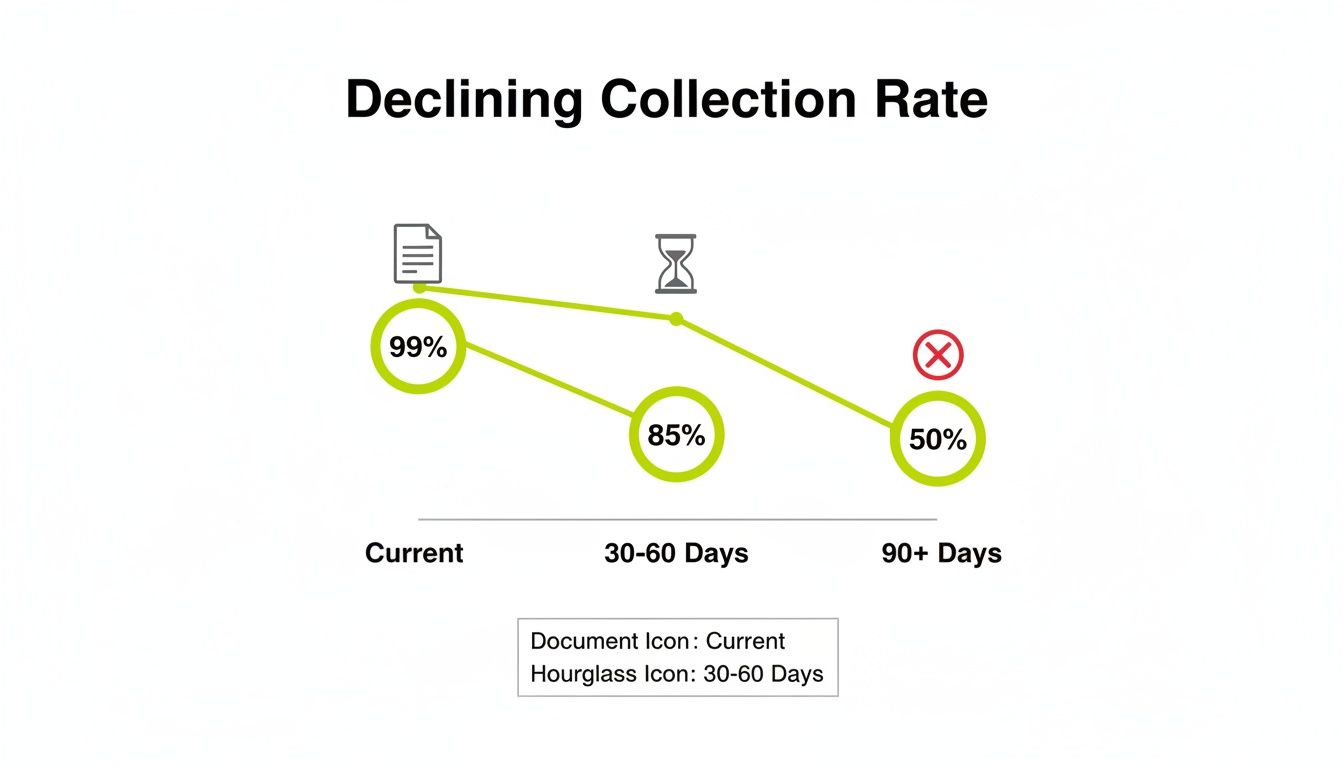
This visual shows that by the 90+ day mark, the probability of payment is reduced by half. This is a direct impact on your firm’s profitability.
Using Aging Trends to Refine Credit Policies
Beyond collections, the aging receivables method provides the data needed to refine your firm’s credit policies. Consistent patterns of late payment from a client or industry serve as a leading indicator of risk.
An aging report is not just a collections tool; it is a forward-looking risk management dashboard. It provides the empirical data needed to set smarter credit policies.
If a client consistently lands in the 31-60 day bucket, their payment terms could be shortened from Net 30 to Net 15. For new clients in slow-paying industries, lower credit limits can be set until a reliable payment history is established.
This proactive approach mitigates future collection issues. Implementing these strategies can deliver a tangible reduction in DSO. A measurable outcome would be reducing your 90+ day bucket by 15% or lowering overall DSO by five days in a single quarter. This is how data is used to improve cash flow with precision.
How Your AR Performance Compares to Industry Peers
To accurately assess performance, you must benchmark your firm’s accounts receivable metrics against industry peers. Context is critical.
Payment cycles in professional services vary significantly. Comparing your AR data to a generic, all-industry average is misleading and can lead to flawed conclusions.
Finding and Applying Relevant Benchmarks
Industry-specific benchmarks help set realistic performance goals. If the average DSO for consulting firms is 45 days, and your firm’s DSO is 65 days, you have a clear indicator that your collections process requires review.
Benchmarking allows you to distinguish between a true performance gap and normal industry payment cycles.
Your aging receivables method is most powerful when it answers not just 'what' is outstanding, but 'how' that performance stacks up against competitors.
Sector-specific variations are significant. A Dun & Bradstreet report found that in 15 of 202 industries studied, 10% or more of receivables were in the oldest aging categories. This confirms that an effective aging receivables method must be calibrated to your specific operating environment. See more on statistical variations in AR aging here.
Using Benchmarks to Pinpoint Opportunities
With relevant benchmarks, you can precisely measure collection effectiveness and identify opportunities for improvement.
- Underperformance: If your 60-90 day bucket is consistently 10% higher than the industry average, your mid-stage collections or credit policies may be flawed.
- Superior Performance: If your DSO is five days lower than your peers, that is a competitive advantage that directly impacts your ability to improve cash flow and reinvest in growth.
This comparative analysis transforms a routine operational report into a strategic compass, guiding financial and operational improvements.
Using Automation for Proactive AR Management
Manual collections processes are inefficient and prone to error. The traditional aging report is a static snapshot; it identifies what is late but does not prescribe a solution.
This is where accounts receivable automation provides value. It converts the static report into a dynamic, intelligent workflow. Your finance team shifts from chasing payments to managing client financial relationships. AR software for professional services uses aging data to trigger the right action at the right time, every time.
From Static Report to Dynamic Workflow
Modern AR platforms integrate with your accounting system—think QuickBooks AR automation—to execute your collections strategy with precision. The objective is to improve cash flow without increasing your team's workload.
This looks like:
- Trigger-Based Reminders: The system automatically sends a predefined reminder when an invoice becomes 1 day past due. No delays or manual errors.
- Dynamic Communication: The tone and frequency of follow-ups adjust based on client payment history or invoice age.
- Proactive Risk Flagging: AI AR automation can identify payment patterns and flag at-risk accounts before they reach the 90+ day bucket, enabling early intervention.
The results are measurable. Firms using AR automation often achieve a 10-20% reduction in DSO within the first two quarters. The core accounts receivable automation benefits all lead to a more stable financial position.
Automation does not replace a finance team; it augments it. It enables flawless, consistent execution of your collections strategy, freeing up your experts from the manual grind.
This allows your team to focus on high-value activities: financial analysis, client relationship management, and strategic planning. When ready, similar efficiencies can be found with tools like AI-powered support solutions for related business functions.
Your Path to Predictable Cash Flow Starts Here
You now understand how to construct an aging schedule and interpret its implications for collections, credit policy, and financial health. The final step is execution. This is where you connect the insights from your aging report to your cash position.
The goal is not to replace financial expertise with software, but to amplify it.
Effective accounts receivable automation removes the manual, repetitive tasks from your finance team. It allows them to focus on strategic analysis, key client relationships, and capital allocation. Technology handles the tactical execution with perfect consistency; your experts make better strategic decisions.
From Insight to Impact
The value of an aging report is realized through the actions it inspires. Financial control is achieved when those actions are executed with discipline and consistency. Modern AR software for professional services closes the gap between knowing and doing.
The ultimate value of an aging report lies not in what it shows, but in the disciplined, timely actions it triggers. Automation ensures those actions happen every single time.
This disciplined approach directly impacts key performance metrics. Consistent follow-up allows firms to systematically reduce DSO and increase cash flow. Using AI AR automation helps identify at-risk accounts before they enter the 90-day danger zone, protecting revenue from becoming a write-off.
The path to predictable cash flow is built on accurate data, strategic insight, and unwavering execution. The aging receivables method provides the map. Automation provides the engine.
***
Resolut automates AR for professional services—consistent, accurate, and human.