Unlocking Business Process Automation Benefits for Professional Services
Explore key business process automation benefits for professional services. Learn how to reduce DSO, improve cash flow, and enhance accuracy with AI automation.
For a professional services firm, the value of business process automation comes down to a simple trade: swapping expensive, error-prone manual work for efficient, accurate systems. This isn't just about modernizing; it's about a direct impact on your bottom line.
Key outcomes include reduced overhead, faster cash flow, and freeing up your best people for client-facing work that grows the business. The goal is control over your financial operations.
The Finance Operator's Case for Automation
As a CFO, Controller, or firm owner, "operational efficiency" isn't a buzzword. It's a measurable effect on your P&L. Business process automation (BPA) is one of the most powerful levers for improving financial performance.
From a finance operator’s perspective, automation is about gaining control. It’s about wrestling chaotic, manual processes into submission and turning them into predictable, reliable workflows.
This is especially true in accounts receivable, where haphazard follow-ups and manual payment matching directly constrain revenue and cloud your true cash position.
Moving Beyond the Manual Grind
Consider the hours your team sinks into chasing late invoices, keying in payment details, and matching payments to open bills. Each manual step is a point of failure—an error that can lead to payment disputes, frustrated clients, and hours of rework.
Industry data confirms that manual processing drives up operational costs and slows down payment cycles. Automation is the operational fix for this drag on performance.
At its core, business process automation is about designing a system that executes perfectly every time. It’s the difference between hoping an invoice gets paid on time and ensuring it does through structured, consistent action.
This systematic approach liberates your skilled finance professionals from low-value administrative work. Instead of spending their time on data entry and reminder emails, they can apply their expertise to financial modeling, cash flow forecasting, and strategic analysis.
The Strategic Shift to Systemization
Implementing accounts receivable automation is a clear example of this strategic shift. You stop relying on one person's memory or a messy spreadsheet and instead build a system that handles client outreach and collections with total precision.
- Automated Reminders: Send personalized, well-timed reminders for invoices that are coming due or are already late, ensuring consistent follow-up.
- Integrated Payment Portals: Give clients a simple, self-service way to pay online with a credit card or ACH, which drastically cuts down payment friction and accelerates cash receipt.
- Automatic Reconciliation: Use tools like QuickBooks AR automation to instantly match incoming payments to the right invoices, eliminating a time-consuming and error-prone task.
In professional services, where client relationships are paramount, this systemization improves the client experience by providing helpful, consistent communication. We discuss this balance in our guide on managing customer communication in AR.
The business case is clear. When you automate rule-based financial operations, you create a more resilient and scalable firm—one that can grow without seeing overhead costs grow in lockstep. This is how you take back control of your cash flow.
The Hard Numbers Behind Automation
Talk about "efficiency" is fine, but as finance leaders, we operate based on the P&L and balance sheet. The real power of business process automation is in the measurable metrics you can take to the bank.
For a professional services firm, the cost of manual accounts receivable is a silent drain on profitability. Every hour spent chasing an overdue invoice or fixing a clerical error is a direct hit to your margin. Automation targets these hidden costs, creating a clear return on investment.
Driving Down Operational Costs
The first and most immediate win from automation is a significant drop in operational overhead. Research shows that a majority of businesses adopting automation report significant cost savings. For finance teams, this impact is direct and immediate.
These savings come from eliminating repetitive, low-impact tasks.
- Slash Labor Costs Per Invoice: When software handles payment reminders and reconciliation, the human hours needed to manage each invoice plummet. It’s common for firms to see their cost-per-invoice drop by 50-80%.
- Eradicate Costly Errors: Automation follows rules without deviation. It doesn't make typos or forget to send a follow-up. This consistency eliminates the human errors that lead to disputes, write-offs, and rework.
- Free Up Your Best People: When your sharpest minds aren't stuck in administrative tasks, they can focus on strategic financial analysis, cash flow forecasting, and identifying growth opportunities.
A key metric is the amount of time saved, and solid time saved tracking is crucial for showing stakeholders the true ROI of your investment.
This is what that financial impact looks like in practice.
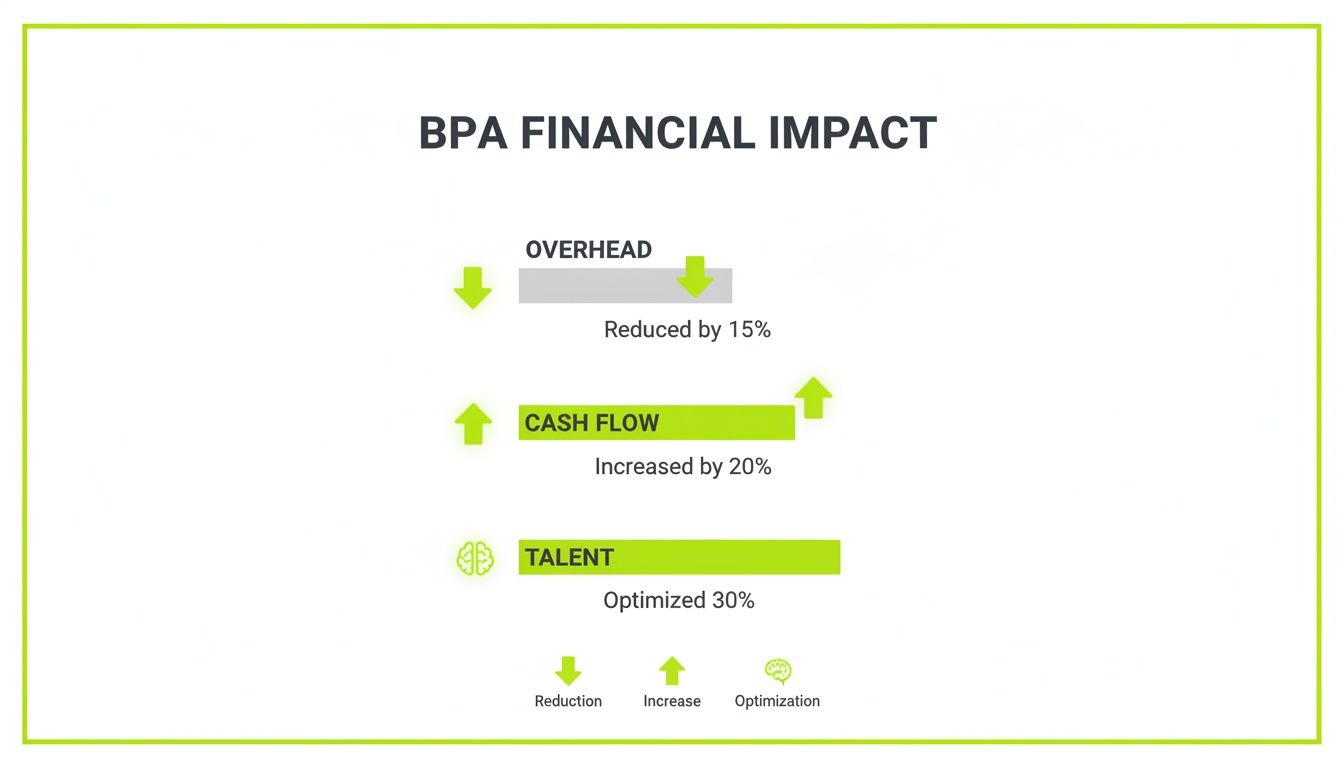
Automation cuts overhead, accelerates cash collection, and optimizes the use of your existing team.
Accelerating Cash Flow
Beyond cutting costs, automation is a powerful engine for accelerating your cash flow. The key metric here is Days Sales Outstanding (DSO). Every day you can trim from your DSO is real cash injected back into your business.
A smart AI AR automation system gets right to the root causes of a high DSO.
A lower DSO isn't just a number on a report; it's operational liquidity. It's the capital you need to fund growth, make payroll without stress, and seize new opportunities.
An automated system sends professional, timely reminders so no invoice is forgotten. By giving clients an easy-to-use online payment portal that syncs with your accounting software, you remove the friction that causes payment delays. The result is a faster, more predictable cash conversion cycle.
Manual vs. Automated AR Process Metrics
The difference between a manual and an automated AR process is stark. The table below shows the typical shift a professional services firm can expect when moving from a traditional approach to an automated one.
Metric | Manual AR Process (Industry Average) | Automated AR Process (Expected Outcome) |
|---|---|---|
Days Sales Outstanding (DSO) | 45–65 Days | 30–40 Days |
Cost Per Invoice | $12–$25 | $3–$5 |
Staff Time on Collections | 20–30 Hours / Week | 3–5 Hours / Week |
Invoice Error Rate | 3–5% | <0.5% |
These figures show why the move to automation is so compelling. This isn't about small gains. It's about fundamentally resetting your financial operations to a higher standard of performance.
How AI AR Automation Systematically Reduces DSO
A low Days Sales Outstanding (DSO) reflects your firm's financial health and operational control. For professional services firms, a high DSO often points to friction in the invoice-to-cash cycle. Intelligent automation is built to smooth out this friction.

AI-powered AR automation addresses collection delays with methodical precision. It swaps sporadic, manual follow-ups for a structured system that ensures no invoice falls through the cracks. The result is a direct, measurable boost to your cash position.
Enforcing Timely and Personalized Communication
The biggest driver of high DSO is inconsistent communication. When chasing payments relies on an individual's packed schedule or a manual scan of an aging report, invoices are overlooked. Accounts receivable automation fixes this by systemizing your collections strategy.
An intelligent system executes a planned communication schedule for every invoice. Modern platforms allow for personalization, tailoring the tone and timing of reminders based on the client relationship, invoice size, and payment history.
A well-designed AR automation system acts as a tireless, perfectly consistent extension of your finance team. It ensures every client receives the right message at the right time, escalating from gentle reminders to more direct requests as an invoice ages.
This systematic outreach keeps your payment top-of-mind and dramatically improves the probability of on-time payment, all without consuming your team's time.
Removing Payment Friction with Modern Tools
Even with perfect follow-ups, a clunky payment process can halt your cash flow. If paying you requires a client to mail a physical check, you are adding days or weeks of unnecessary delay.
This is where AR software for professional services makes an immediate difference. By embedding a simple online payment portal into your invoices and reminders, you remove that friction. Clients can pay instantly with a few clicks.
- ACH & Bank Transfers: A low-cost, straightforward option for clients to settle larger invoices.
- Credit Card Payments: Offers convenience for smaller bills, giving clients flexibility while getting cash in your bank faster.
- Automated Reconciliation: The system automatically marks the invoice as paid in your accounting software, as with QuickBooks AR automation, which means no more manual cash application.
By making it easy for clients to pay you, you shorten the payment cycle. Firms that add online payment options often see a 15-20% reduction in DSO from this one change alone.
From Reactive Chasing to Proactive Intervention
Traditional AR is reactive. A finance team member usually starts chasing an invoice after it's already past due. By that point, the probability of collection has started to decline.
Here’s where AI AR automation provides a strategic advantage. These systems analyze payment trends to flag at-risk accounts before they become serious problems.
For example, the AI can identify a client who consistently pays 15 days late. This insight allows your team to stop being collectors and start being proactive. Instead of chasing a 60-day-old debt, they can make a call on day 35 to check in.
This proactive approach is fundamental to how these systems improve cash flow. By spotting risk early, you can intervene when the problem is small. We dive deeper into these ideas in our guide to the core accounts receivable automation benefits.
When you follow an invoice’s journey from creation to cash, it becomes clear that automation tightens every step. It provides professional persistence, removes barriers to payment, and gives you the foresight to keep your cash flow predictable.
Building a Resilient and Scalable Financial Operation
Beyond improving today's cash flow, business process automation builds a more resilient and scalable financial backbone for your firm's future. For any leader guiding a firm from $3M to $50M and beyond, this structural integrity is non-negotiable.

Automation shifts your finance function from reactive and reliant on individuals to systematic and process-driven. It creates a stable foundation that can support aggressive growth targets without showing cracks under pressure.
Reinforcing Compliance and Mitigating Risk
As your firm grows, so does its risk exposure. Manual processes are a primary source of this risk, from data entry mistakes to inconsistent collection policies. When you automate key financial workflows, you enforce control and create a clean audit trail.
Every action—from invoice creation to final payment application—is logged and traceable. This level of detail is a powerful defense during an audit, as it demonstrates procedural soundness and reduces the odds of compliance failures.
A systemized AR process delivers consistency and control. It guarantees that collections are handled the same way every time, regardless of staff turnover. This predictability is the bedrock of a resilient financial operation.
This procedural discipline ensures your firm’s credit and collections policies are applied uniformly to every client, protecting relationships from the inconsistencies of manual work.
Scaling Operations Without Scaling Overhead
For any firm owner with ambitious growth plans, the critical question is how to grow revenue without costs growing in tandem. This is where the strategic power of automation shines.
Imagine your invoice volume doubles. With a manual AR process, your only option is to hire more people. This inflates your G&A expenses, eating into the profitability your growth was supposed to create.
- Handle Increased Volume: An automated system processes 10,000 invoices with the same efficiency as 1,000. The marginal cost of processing another invoice is nearly zero.
- Maintain Lean Teams: You can support a major increase in business without a linear increase in finance headcount. This frees capital to invest in revenue-generating roles, not administrative overhead.
- Ensure Consistent Performance: As volume grows, a manual system breaks down and DSO creeps up. Automation maintains performance, ensuring your cash flow stays strong during rapid expansion.
This is the essence of scalable growth. You build a financial engine that can handle a heavier load without faltering or demanding a costly overhaul. The system itself becomes a competitive advantage.
Building an Asset for the Future
Ultimately, implementing accounts receivable automation isn’t just about solving today’s collection problems. It’s about building an operational asset that adds tangible value to your firm. A predictable, low-DSO cash flow and a lean finance operation make your business more attractive to investors, lenders, and potential acquirers.
Choosing the Right Automation Partner for Your Firm
Selecting an automation platform is a strategic decision. For professional services firms, where client relationships are paramount, the wrong choice can create friction and damage goodwill. The right partner acts as an extension of your finance team.
Many automation tools are blunt instruments designed for high-volume, low-touch businesses. Your firm needs a solution built with the understanding that every communication reflects on your brand.
Integration as a Non-Negotiable Foundation
The primary reason AR automation projects fail is poor integration. If your new system can't talk to your existing accounting software, you have not eliminated manual work—you have only moved it.
This is why a deep, two-way integration with platforms like QuickBooks is a mandatory requirement.
- Real-time Sync: When you create an invoice in QuickBooks, it should appear in the automation platform instantly. When a client pays, that payment should immediately be recorded and reconciled back in QuickBooks.
- No Manual Entry: Data must flow seamlessly in both directions to eliminate human error and maintain a single source of financial truth.
A one-way data push isn’t true integration. True QuickBooks AR automation requires a bi-directional sync to maintain data integrity and deliver on the promise of efficiency.
Balancing Automation with Human Oversight
The point of automation is to eliminate repetitive tasks, not to cede control. In professional services, some client situations require a human touch. A platform that only offers a rigid, "full autopilot" mode is too inflexible.
Look for a solution that provides both "autopilot" and "co-pilot" modes. This dual approach allows you to:
- Automate the 90%: Let the system handle routine touchpoints—sending invoices, gentle reminders, and payment confirmations.
- Flag the 10%: Have the system intelligently flag complex or sensitive accounts for human review before a message goes out. This lets your people step in when their judgment is needed most.
This blended approach delivers the efficiency of AI AR automation and the judgment of your experienced finance team. For a deeper look at these systems, our post on choosing a receivable management system breaks it down further.
Key Questions for Potential Vendors
When evaluating AR software for professional services, ask questions that cut through the marketing fluff. Here’s a practical checklist:
- Integration: How deep is your two-way sync with our accounting software? Show me how a payment is reconciled in real-time.
- Customization: Can we customize the tone, timing, and cadence of every communication to match our firm's voice?
- Control: Do you have a "co-pilot" mode for human review and approval on specific accounts or high-value invoices?
- Analytics: What specific KPIs does your dashboard track? Can we easily measure team productivity, cost-per-invoice, and the direct impact on DSO?
- Client Experience: What will our clients see? Walk me through their payment experience—is the portal simple, professional, and secure?
Choosing a partner is about finding a tool that aligns with your operational philosophy—one that values efficiency but never at the expense of control and client trust.
How to Implement Automation Without Disrupting Operations
Bringing a new system online can feel disruptive. The primary concern is that a complex rollout will derail the very operations you’re trying to improve. A successful transition, however, uses a phased approach that builds momentum and demonstrates value quickly.
A successful launch is a strategic, step-by-step process focused on quick wins. For accounts receivable, that means starting with the tasks that create the most drag on your team and cash flow.
Phase 1: Start with High-Impact Workflows
Begin by automating the most repetitive, rule-based parts of your AR cycle. This first phase is about delivering immediate value with minimal disruption. The goal is to prove the concept and build confidence in the new system.
Focus your initial efforts on these areas:
- Automated Invoice Reminders: Set up a systematic follow-up schedule. This one change can dramatically reduce DSO by ensuring no invoice gets lost.
- Integrated Payment Processing: Add a self-service payment portal. Making it easy for clients to pay with a credit card or ACH removes friction and speeds up cash collection.
These first steps are low-risk and high-reward. They tackle core AR pain points without requiring a complete operational overhaul, providing the momentum to move forward.
Phase 2: Empower Your Team, Don't Replace Them
A common concern is how automation will affect finance staff. Frame this change correctly: automation is a tool to empower your team, not replace them. The goal is to elevate their work from manual tasks to strategic oversight.
This shift means they can stop chasing individual invoices and start analyzing the data the new system generates. Instead of data entry, they can pinpoint at-risk accounts, handle complex collection cases, and offer insights into cash flow trends.
The real benefit is transforming your finance team into a strategic asset. You’re automating the robotic work so your people can focus on the analysis and client relationships that require human judgment.
As you consider new systems, a practical guide to AI workflow automation can offer insights for managing this human-focused transition.
Implementing accounts receivable automation is a manageable project that makes your firm stronger. By starting small, proving value early, and empowering your team, you can realize the full scope of business process automation benefits without disrupting daily work.
Your Top Questions About AR Automation, Answered
Making a change to a core system is a significant decision. As a leader, you need to know how automating processes will affect your team, your clients, and your firm's financial health.
Here are straightforward answers to the questions we hear most often from CFOs, Controllers, and firm owners.
Will Automation Make Us Sound Like Robots and Hurt Client Relationships?
This is a primary concern, and it's valid. The answer is no—not with the right system. Modern accounts receivable automation platforms are designed for a human touch.
You can customize the tone, timing, and frequency of every communication. This ensures your follow-ups match your firm's professional voice, allowing you to be persistent without being impersonal.
Think of it this way: automation handles the repetitive follow-ups. This frees your team to personally step in on complex issues or have higher-value conversations, strengthening relationships.
How Does This System Work with Our Current Accounting Software?
Any worthwhile automation platform must integrate seamlessly with your existing software. The best AI AR automation tools are built with a deep, two-way sync with accounting software like QuickBooks.
This constant communication means that invoices, payments, and customer information are always up-to-date across both systems. No more manual data entry or discrepancies.
A bi-directional sync is critical. It creates a single source of truth for all your financial data, which eliminates reconciliation headaches and gives you an accurate, real-time picture of your cash position.
Without deep integration, you are not truly automating; you are just creating new manual work.
What’s the Real ROI, and How Fast Can We Expect to See It?
The return on investment is tangible and appears quickly, often within the first quarter. The most immediate win is a significant reduction in DSO (Days Sales Outstanding), which directly boosts cash flow. Most firms see a meaningful drop within 60-90 days.
Beyond that, other financial benefits accumulate:
- Lower labor costs due to cutting hours of manual invoice chasing and processing.
- Reduced bad debt thanks to a more systematic, proactive collections process.
- Faster payments by offering clients convenient, one-click digital payment options.
Can We Still Control the Collections Process?
Yes. In fact, the goal is to give your team more control, not less. A good AR software for professional services will offer the flexibility of both "autopilot" and "co-pilot" modes.
This dual approach lets you automate the 90% of follow-ups that are routine while keeping your team in the driver's seat for sensitive client communications. Your team can always approve or edit a message before it goes to a key account, giving you a blend of automated efficiency and human oversight.
Resolut automates AR for professional services—consistent, accurate, and human. Learn more about how Resolut can help your firm.