A Finance Leader’s Guide to AR Communication
Discover practical strategies for managing customer communication in AR to boost trust, engagement, and outcomes for finance leaders.
For professional services firms, managing accounts receivable isn't an administrative task. It's a core component of financial control.
The way your firm communicates about payments directly impacts Days Sales Outstanding (DSO), working capital, and client relationships. A disciplined communication strategy turns revenue into predictable cash flow.
The Framework for AR Communication Strategy
Many firms operate in a reactive loop of manual follow-ups and inconsistent emails. This approach creates operational drag and unpredictable cash flow.
An effective AR process is systematic. It’s not about sending more reminders, but sending the right message, to the right contact, at the right time. The objective is a consistent, professional communication engine that accelerates payments without damaging client relationships.
This framework establishes clarity and control, freeing up your finance team for higher-value analysis instead of routine collections.
Client Segmentation
You wouldn’t use the same language with a new client as a 10-year strategic partner. Your payment communications should reflect this distinction.
Segment your client base into clear operational tiers:
- High-Value Accounts: Long-term partners with significant recurring revenue. Communication must be relationship-first.
- New Clients: Firms in their first 90-180 days. Use this period to establish clear payment expectations and habits.
- At-Risk Accounts: Clients with a history of late payments. They require a more structured and firm communication sequence.
Once segmented, you can map appropriate communication channels. A multi-channel sequence—an email reminder followed by an SMS notification—creates multiple professional touchpoints and improves response rates.
A structured AR communication framework provides operational control. It ensures every action is deliberate and measurable, turning accounts receivable from a cost center into a predictable source of working capital.
The Role of Automation in Modern AR
Accounts receivable automation is no longer optional for firms focused on efficiency and cash flow optimization. It's a baseline requirement for a modern finance function.
For leaders overseeing receivable management services, the benefits are clear. Firms using AI and automation report tangible improvements in both efficiency and financial outcomes.
Adopting AR automation isn’t about replacing staff. It’s about equipping them with tools that handle repetitive tasks, allowing them to focus on strategic financial management and complex client issues.
Designing Communication Workflows That Drive Cash Flow
Effective AR communication is a structured, intelligent system designed to secure payment. Moving from reactive collections to a predictable workflow means you stop chasing invoices and start managing cash flow.
The process must begin before an invoice becomes overdue.
A pre-dunning notice—a professional reminder sent several days before the due date—can prevent up to 15% of late payments. It’s a proactive measure that keeps your invoice visible to the client’s AP team.
From there, the workflow defines what happens next, escalating professionally as an invoice ages.
Sequencing Channels for Maximum Impact
Relying on email alone is inefficient. A multi-channel strategy is more effective, but the sequence must be logical. An email at Day 1 past due is standard. If ignored, the system must automatically shift channels.
For example, an SMS notification at Day 7 past due can cut through inbox clutter. Firms using layered communication see a 25% faster response rate on invoices aged 7-15 days.
The sequence must map to client segments. A high-value partner receives a more personal, spaced-out cadence. A new client receives a more structured set of reminders to establish payment habits.
A communication workflow’s goal is not to bombard clients. It is to create deliberate, professional touchpoints that facilitate payment. Each step should be automated, measurable, and designed to move the invoice toward closure.
This visual illustrates the framework for building these AR workflows.
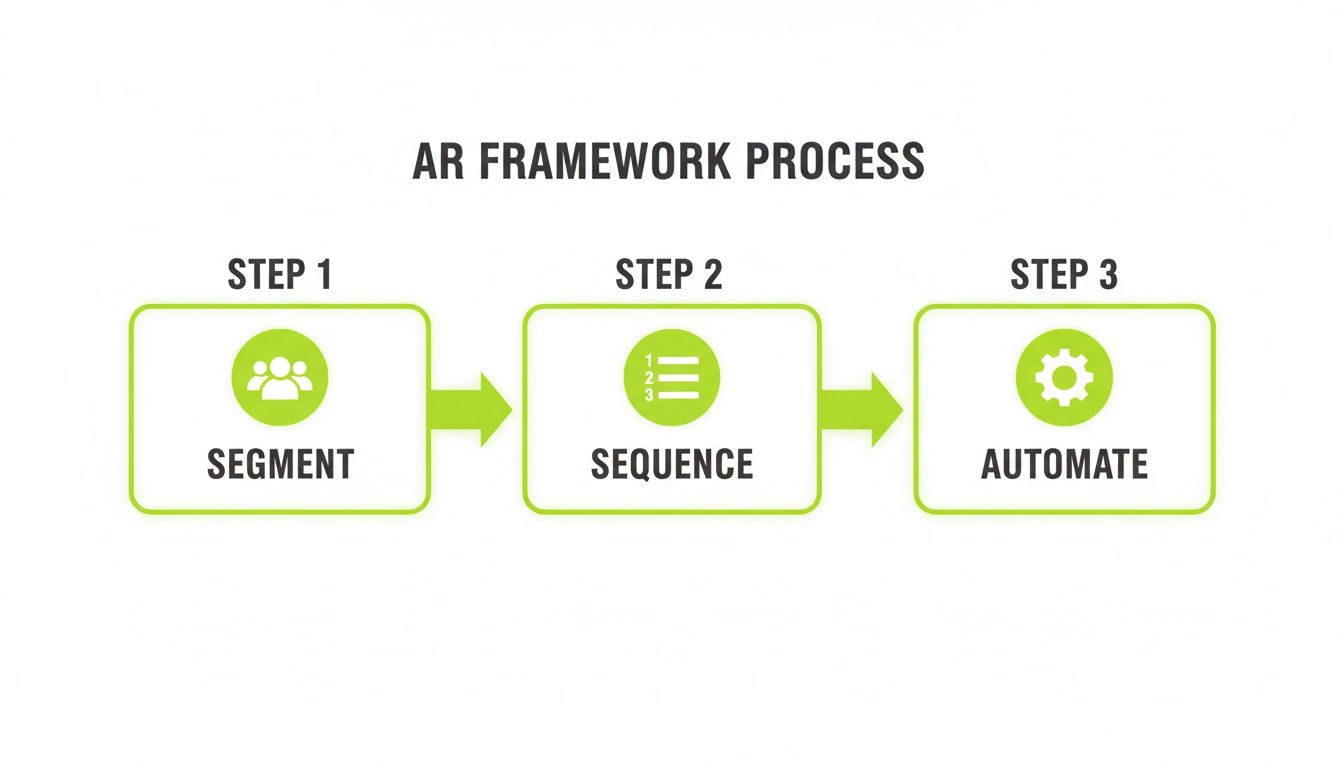
The progression is logical: segment clients, sequence outreach, and automate execution. This process ensures every client receives the appropriate message at the correct time.
Defining Triggers for Human Handoffs
AR automation doesn’t replace your team. It focuses their expertise on high-value interventions. A well-designed workflow knows when to trigger a human handoff.
These triggers ensure your team addresses complex situations, not routine follow-ups.
Key handoff points include:
- Client reply with keywords: A response containing "dispute," "question," or "incorrect" should immediately pause automation and flag the conversation for review.
- Broken payment promise: A client commits to a payment date but misses it. The system should alert an operator to make a direct, personal call.
- High-value invoice threshold: For invoices over $25,000, the workflow might require manual review before the final reminder is sent.
This hybrid model delivers efficiency without sacrificing the nuance required to manage key client relationships. For more on these steps, explore our guide on effective procedures for accounts receivable that work.
Finally, a simple, automated post-payment confirmation closes the loop professionally, confirming receipt of funds and reinforcing an orderly financial relationship.
Balancing Automation with Human Oversight
Automation provides the scale to manage accounts receivable efficiently. Human oversight protects client relationships.
The objective is not to remove people but to reserve their expertise for moments requiring judgment. The optimal approach to managing customer communication in AR combines an AI-driven process with a human-in-the-loop control system.
Let your AI AR automation platform manage the high-volume, routine follow-ups. This frees your team to focus on complex negotiations, dispute resolution, and high-value client conversations. It’s a hybrid model that improves cash flow without depersonalizing your firm.

Building Trust Through Humanized Automation
While 61% of customers express hesitation in trusting AI, 64% are more likely to trust it if the communication sounds human and context-aware. This is a clear indicator for how communication strategies need to evolve.
Your automated messages must be tuned with empathy. They cannot be generic.
A capable AR software for professional services allows customization based on client history and payment behavior. A reminder to a decade-long partner should feel different from a notice to a new client 60 days late on their first invoice.
Defining Operational Rules for Intervention
A disciplined system operates on clear rules that define when the machine handles a task and when a person must intervene. Your accounts receivable automation platform should manage standard workflows but immediately flag scenarios requiring human judgment.
These triggers are the controls that protect your most important assets: client relationships and cash flow.
Here is a practical framework for defining these rules:
Automated vs. Human Intervention Triggers
This table outlines when automated systems should proceed versus when a human team member must take control.
Scenario | Automated Action (Default) | Human Intervention Trigger | Rationale |
|---|---|---|---|
First Past-Due Invoice (New Client) | Send polite reminder email with payment link. | No trigger; full automation. | Establishes professional expectations from the start. |
Client Responds with "Dispute" or "Question" | Pause all automated follow-ups for that invoice. | Instantly create a task for an AR specialist. | Prevents automated messages from appearing tone-deaf to a legitimate client concern. |
High-Value Invoice (> $50k) Reaches 30 Days Past Due | Send standard 30-day reminder. | Flag for controller review before the next escalation. | Provides senior oversight on significant receivables before communication becomes more firm. |
Client Makes a Partial Payment | Acknowledge receipt and update the outstanding balance. | Alert an operator to confirm the reason for the short payment. | Proactively addresses potential issues instead of letting a partial balance age unnecessarily. |
This structured approach transforms collections from an inconsistent effort into a predictable financial operation.
The machine handles 90% of standard touches. Your team manages the critical 10% requiring strategic thought. As detailed in our guide, this is precisely how modern AR automation protects client relationships.
By implementing intelligent handoffs, you reduce DSO while reinforcing your firm’s professional and organized approach. This balance is the hallmark of a modern finance function.
Implementing Controlled Escalation Paths
Most overdue invoices are resolved through standard reminders. For unresponsive accounts, a different, documented playbook is required.
A controlled escalation path is not about aggression; it's about maintaining control of the collections process.
As financial risk increases, the authority and formality of your communication must increase in parallel. The account moves from an automated workflow to a structured, human-led engagement. This minimizes surprises and maximizes the probability of payment before legal action is considered.
Internal Flags and Leadership Involvement
Escalation begins internally. Your accounts receivable automation system should automatically flag accounts at specific aging thresholds, such as 60 days past due.
This flag is an internal alert for a senior finance team member, like a Controller or CFO. The purpose is visibility, allowing leadership to make a strategic decision on the next steps.
Once an account is 60 to 75 days overdue, it is time for a Controller or other senior leader to send a direct, personal message.
The goal of this first human touchpoint isn't to threaten. It is to show the overdue balance is now on leadership's radar. This simple shift in sender conveys a seriousness that automated reminders cannot, often prompting an immediate response.
This step is critical. It protects the relationship while clarifying that payment has become a priority for the firm’s leadership.
Introducing a Third-Party Tone
When a direct note from the Controller is ignored and an account exceeds 90 days past due, the tone must escalate again.
The next step is to introduce a formal, third-party voice. This formal demand letter, often called a "voice of a lawyer" notice, is sent from your firm but written with the authoritative tone of legal counsel. It signals that legal action is the next logical step—without the immediate cost.
This tactic is highly effective for unresponsive clients, communicating that you are prepared to enforce your contract. It is a standard tool in a modern AR software for professional services playbook.
Clear, consistent rules for its use are non-negotiable:
- Account Age: The invoice must be 90+ days past due.
- No Active Dispute: The client is unresponsive, not actively disputing the invoice.
- Internal Review: The CFO or firm owner has authorized its use.
This controlled process ensures all internal options are exhausted before incurring collections or legal fees. It is a disciplined method for managing customer communication that helps reduce DSO.
Measuring AR Performance to Optimize Your System
An AR communication system is not a "set it and forget it" tool. It is a dynamic financial asset that requires data-driven management.
A disciplined approach to performance tracking is what separates a basic collections process from a strategic driver of cash flow.
The focus must extend beyond Days Sales Outstanding (DSO). DSO is a lagging indicator; it tells you what happened, not why. To manage your cash conversion cycle effectively, you must track leading indicators.
This requires a concise dashboard providing a clear view of your collections engine.

Core Metrics Beyond DSO
To gain operational control, your dashboard should focus on a few key KPIs that tell a complete story about the effectiveness of your communication strategy.
Track these essentials:
- Collection Effectiveness Index (CEI): The clearest measure of your team’s ability to collect receivables during a specific period. A CEI consistently above 90% indicates a healthy process.
- Average Days Delinquent (ADD): Unlike DSO, ADD isolates collections performance by measuring the average number of days paid invoices were past due.
- Touchpoint Response Rate: This metric connects communication directly to results. For example, what percentage of clients pay within 48 hours of receiving a 7-day past-due SMS?
These data points turn the art of managing customer communication into a measurable science, identifying which actions drive payments.
Using Data for Systematic Optimization
A clear dashboard enables small, data-backed adjustments that compound over time. Your AR software for professional services becomes an analytical tool to improve cash flow with precision.
Run simple A/B tests on email templates. Test a subject line focused on urgency ("Action Required: Invoice [Number] Past Due") against one focused on assistance ("Question about Invoice [Number]?"). A modern AI AR automation platform will track payment rates to identify the superior version.
An effective AR system is never static. It is a feedback loop where performance data from your AR software informs iterative improvements to your communication workflows, turning collections into a predictable and optimized financial operation.
This data-driven approach applies to all aspects. If data shows that SMS reminders sent at 10 AM have a 15% higher response rate than those sent at 4 PM, that is an immediate, actionable insight.
Similarly, if your QuickBooks AR automation integration shows clients using the online portal pay 12 days faster, feature that portal link more prominently.
By establishing a monthly or quarterly review of these metrics, you build a system of continuous improvement, reducing write-offs and turning accounts receivable into a more liquid asset.
Taking Control of Your AR Communication
For most firms, accounts receivable is a reaction, not a system. It’s an unpredictable, manual process that turns finance teams into collections agents.
The objective is not just to get paid. It is to build a deliberate, professional process that generates predictable cash flow.
When you map communication with segmented workflows, smart automation, and clear escalation paths, you transform a chaotic function into a controlled financial operation. This is not about aggression; it is about clarity.
The result is a measurable reduction in your DSO and improved working capital. Your team shifts from chasing payments to analyzing performance and strategically managing the firm’s financial health.
A systematic approach to AR communication ensures every touchpoint is intentional and measurable. It transforms a manual chore into a data-driven process that lets you improve cash flow with precision.
This level of control ensures you are paid on time for the value you deliver, solidifying your financial foundation.
Resolut automates AR for professional services—consistent, accurate, and human.