
Collecting on Accounts Receivable: A Guide for Professional Services Finance Leaders
Discover collecting on accounts receivable strategies to speed cash flow and reduce aging in professional services.
Relying solely on an accounts receivable aging report is insufficient for financial control.
Reactive collections—chasing payments after they're late—is an inefficient use of resources. It creates financial uncertainty and strains client relationships. A superior approach begins with diagnosis: understanding the root cause of payment delays before initiating contact.
This operational discipline transforms AR from a liability into a predictable asset.
How to Diagnose Your Accounts Receivable Health
Before optimizing a collections process, a quantitative assessment of your firm’s current AR health is required. An aging report identifies what is late, but not why.
A proper diagnosis segments receivables beyond simple aging. You must analyze them by client value, risk profile, and payment history to isolate systemic issues impacting your cash conversion cycle.
This is the foundation for effective procedures for accounts receivable that work.
Moving Beyond Standard Aging Reports
A complete diagnosis requires specific, actionable metrics. Days Sales Outstanding (DSO) is a standard measure, but lacks sufficient context on its own.
Consider these KPIs for a clearer operational view:
- Average Days Delinquent (ADD): This metric measures the average number of days invoices are past due. A high ADD indicates a failure in the follow-up process, directly impacting working capital.
- Collection Effectiveness Index (CEI): CEI quantifies the percentage of receivables collected in a given period. A CEI below 80% signals significant cash leakage.
- Client Risk Segmentation: Stratify clients into tiers (e.g., high-value/low-risk, low-value/high-risk) to allocate collection resources efficiently and protect key relationships.
A disciplined diagnostic approach shifts AR from a back-office function to a strategic one. It reveals whether delays stem from invoice disputes, client-side cash flow issues, or internal process friction.
To provide a clearer view, here is a breakdown of essential AR metrics for professional services leadership.
Key AR Health Metrics and Their Meaning
Metric | Calculation | What It Reveals |
|---|---|---|
Days Sales Outstanding (DSO) | (Total AR / Total Credit Sales) x Number of Days | The average number of days to collect payment post-sale. A high DSO often signals process inefficiencies. |
Average Days Delinquent (ADD) | DSO - Best Possible DSO | The average number of days payments are overdue. A more direct measure of collection effectiveness than DSO. |
Collection Effectiveness Index (CEI) | ((Beginning Receivables + Monthly Credit Sales) - Ending Total Receivables) / ((Beginning Receivables + Monthly Credit Sales) - Ending Current Receivables) x 100 | The percentage of collectible receivables actually collected. It measures your team's ability to convert invoices to cash. |
Tracking these metrics provides a quantifiable pulse on your firm's financial health and helps identify issues before they escalate.
Identifying the Root Causes of Delays
Late payments are a significant drain on working capital. In professional services, the impact is acute. For example, management consulting firms can see payment cycles extend to 125 days, while architecture and engineering firms often wait 67-74 days. You can see how your industry's payment cycles stack up.
By diagnosing specific reasons for delays—a client's invoice approval bottleneck or your own lack of proactive reminders—you can build a collection strategy that addresses the actual problem. This is the critical first step before implementing accounts receivable automation.
Designing Outreach Cadences That Get a Response
A standardized, one-size-fits-all reminder email is ineffective. At best, it is ignored. At worst, it damages a high-value client relationship by sounding robotic and impersonal.
A more effective method is designing segmented outreach cadences—distinct communication plans for different client tiers. A strategic partner with a perfect payment history should not receive the same automated nudge as a new, smaller account.
Segmentation protects key relationships while maintaining a consistent collections process for all other clients.
The Foundation of an Effective Cadence
The objective is a repeatable system that accelerates payment without manual intervention for every invoice. Data shows this is a solvable problem. In the B2B sector, 39% of invoices are paid late, and 23% of those delays are due to simple oversight.
This indicates that a proactive, systematic reminder is more effective than reactive pursuit.
A structured cadence includes:
- Pre-Due Date Reminders (3-5 days prior): An automated email framed as a courtesy, including the invoice and a direct payment link.
- Day-Of Alert: A simple notification that payment is due, reinforcing the deadline professionally.
- Early Overdue Follow-ups (1-14 days past due): Tone shifts to be more direct, referencing the invoice number and overdue date.
- Escalated Follow-ups (15-30+ days past due): The cadence now involves internal stakeholders, such as the client manager or a senior finance team member.
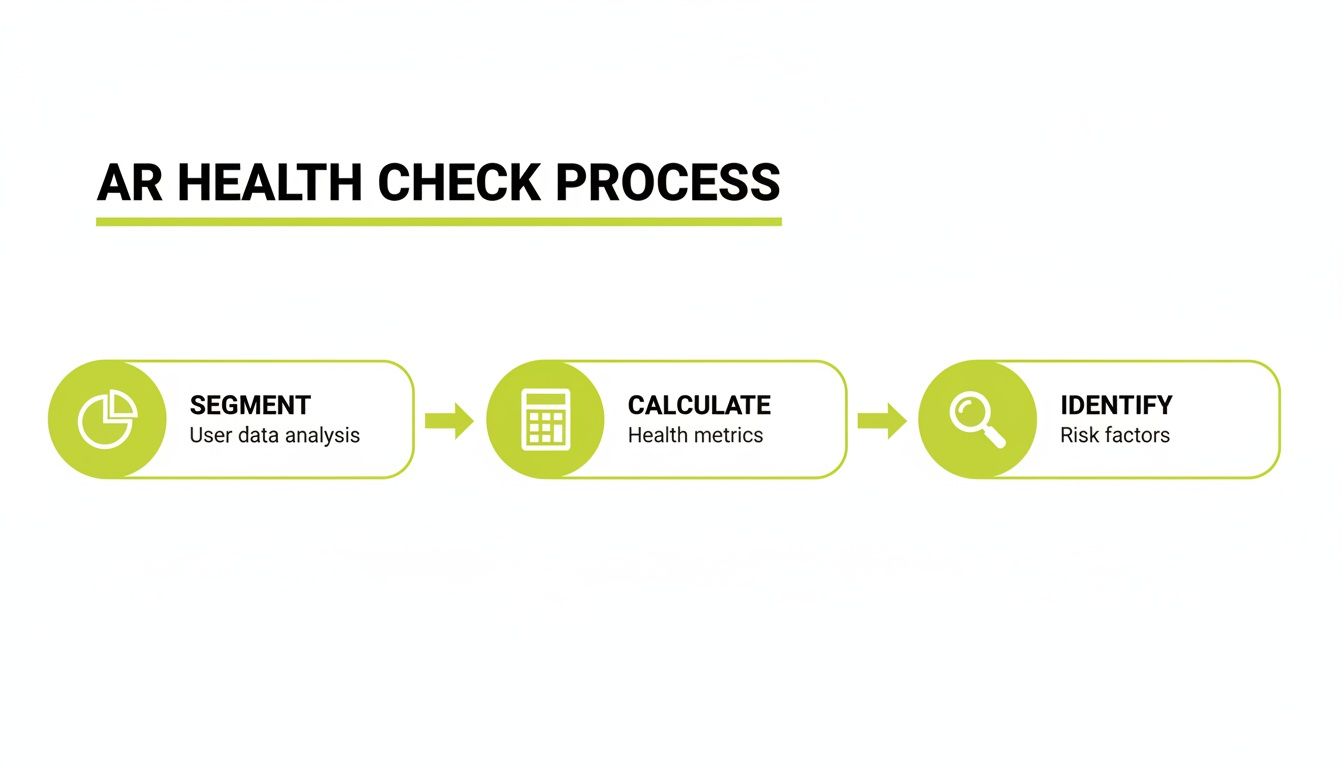
This diagnostic work allows your team to design data-driven outreach, delivering the right message to the right client at the right time.
Tailoring Communication for Impact
For top-tier accounts, initial follow-ups should be personalized, ideally from a known contact. For smaller accounts, a fully automated email sequence using accounts receivable automation software is more efficient.
The core principles of effective sales outreach apply here. Reviewing sales cadence best practices can provide a useful framework for structuring multi-touch sequences that are persistent without being intrusive.
By designing cadences that are professional and persistent, firms can significantly reduce DSO and improve cash flow without alienating their best clients.
For firms using QuickBooks, dedicated QuickBooks AR automation can execute these cadences flawlessly. This reduces manual effort and ensures no invoice is overlooked, turning collections into a predictable, low-friction process.
Using Automation to Drive Collections
Manual follow-up is the primary point of failure in most collections processes.
It is inconsistent, resource-intensive, and unscalable. Adopting an automated system is not merely an efficiency play; it embeds financial discipline into your operations to improve cash flow.
Accounts receivable automation transforms collections from a reactive, manual function into a proactive, reliable system. For a professional services firm, this ensures every client receives timely, professional communication without requiring a staff member to manage the process from a spreadsheet.
This frees your finance team to focus on high-value analysis and strategic client engagement instead of payment chasing.

Implement Omnichannel Outreach and Portals
A single email reminder is easily missed. An effective AI AR automation strategy employs omnichannel outreach—email, SMS, and AI-driven calls—to connect with clients on their preferred channels.
This approach increases the probability that an invoice is seen and actioned.
The objective is to make payment the easiest task on your client’s to-do list. A modern payment portal is non-negotiable for removing friction that delays payment.
A secure, self-service payment portal allows clients to pay immediately via their preferred method (ACH, credit card). This single change can significantly reduce DSO by eliminating the manual processes of mailing checks or executing wire transfers. Our guide to **receivable management services** offers more strategies.
Use AI to Predict and Prevent Delinquency
Modern AR software for professional services leverages AI to identify at-risk invoices before they become delinquent. The system analyzes payment histories, invoice values, and communication patterns to flag accounts exhibiting early warning signs.
This predictive capability allows for proactive intervention. For example, the system might flag a high-value client who is typically punctual but has not engaged with a recent large invoice. This can trigger an alert for the account manager to make a personal call, preserving the relationship while addressing the potential delay.
For firms on QuickBooks, integrating a dedicated QuickBooks AR automation tool adds this intelligence layer without disrupting existing accounting workflows.
Establishing Clear Escalation Pathways for Tough Accounts
Automation and consistent outreach will resolve the majority of outstanding invoices. However, a small percentage of accounts will remain unresponsive. An undefined, reactive approach to these accounts is a direct threat to cash flow.
A documented, multi-stage escalation path is required for these exceptions. This policy removes ambiguity, dictating who acts, when, and how. It is not about aggression; it is a clear plan to protect the firm’s financial health and prevent unnecessary write-offs.
Internal Escalation Triggers
The process begins internally, moving methodically from standard AR procedures to senior financial oversight. The goal is to apply increasing internal pressure and resolve the issue before the client-facing tone must change.
- 30-45 Days Past Due: The automated cadence flags the account internally. The AR specialist first verifies that communications were sent and received. If no progress is made within 48 hours, the first hand-off occurs.
- 45-60 Days Past Due: The account is assigned to a Controller or senior finance manager. Their objective is to make direct contact with their counterpart at the client company, focusing on understanding the root cause of the delay.
Engaging the Relationship Owner
If direct finance-to-finance communication is unsuccessful, the primary relationship owner—a partner, director, or account manager—is engaged. They possess the relational capital needed to resolve the issue without damaging the partnership.
Their involvement must be surgical. They are not collections staff. The finance team must equip them with a concise summary: invoice details, amount, days overdue, and a history of collection attempts. The objective is a single, direct conversation to secure a firm payment commitment.
An escalation is a strategic shift in who communicates and with what authority. Engaging the primary client contact is often the key to unlocking a stalled payment.
The Final Stages: Demand Letters and Legal Review
When an account exceeds 90+ days overdue without a payment commitment, the relationship is already compromised. Protecting the firm’s financial interests becomes the priority.
- Formal Demand Letter: This is a formal letter sent via certified mail from the CFO or firm owner. It states the debt, references the invoices, and provides a final, non-negotiable deadline (e.g., 10 business days). It must state that failure to pay will result in the matter being turned over to legal counsel.
- Legal Counsel Engagement: If the deadline passes, the account is transferred to a collections attorney for review and potential legal action. This is a business decision, weighing the amount owed against the cost of recovery.
How to Measure and Report on Collections Performance
A collections process without quantitative measurement is based on conjecture. To demonstrate operational and financial ROI, consistent, clear reporting is non-negotiable.
This is about focusing on the vital signs of cash flow and presenting them in a format that drives decisions, not creating complex spreadsheets that go unread.
For finance leaders, the goal is to create a tight feedback loop where data from your AR software for professional services directly informs collections strategy. Effective reporting proves the value of your process and pinpoints areas for improvement.
Core Metrics for Your AR Dashboard
A performance dashboard should provide an at-a-glance view of collections health, focused on metrics that impact working capital.
These three KPIs are the foundation of any meaningful AR report:
- Days Sales Outstanding (DSO): The standard measure of the cash conversion cycle. A sustained reduction in DSO is the clearest indicator of effective collections and accounts receivable automation.
- Collection Effectiveness Index (CEI): This metric shows the percentage of receivables collected within a period. A consistent CEI above 85-90% indicates a high-performing process.
- Aged AR Analysis: Analyze 90+ day receivables as a percentage of total AR. An increasing percentage is an early warning that escalation pathways are failing.
Data visualization is critical. Simple trend lines showing DSO reduction quarter-over-quarter tell a powerful story and make the impact of your strategy immediately apparent to leadership.
Manual vs. Automated AR Workflow Comparison
The table below contrasts a manual AR process with one driven by intelligent automation. The difference in time, cost, and operational risk is clear.
Activity | Manual Process (Time & Cost) | Automated Process (Time & Cost) |
|---|---|---|
Invoice Reminders | 2-4 hours/week of manual emails. High risk of human error and inconsistent tone. | <15 minutes/week to review cadence. System sends personalized, on-brand reminders automatically. |
Payment Processing | 1-2 hours/week reconciling checks. Delays cash application by several days. | Instant. Client portal payments are auto-reconciled, accelerating cash flow and freeing up team capacity. |
Dispute Resolution | Days to weeks. Fragmented email communication slows resolution and payment. | Hours to days. Centralized communication within a platform keeps all stakeholders informed for faster resolution. |
Reporting & Analytics | 4-6 hours/month pulling data into spreadsheets. Reports are often outdated upon viewing. | Real-time. Dashboards are always current, providing immediate insight into DSO, CEI, and aging. |
The hours saved represent a fundamental shift from reactive administration to proactive financial management.
Translating Data into Business Impact
The power of reporting lies in connecting AR metrics to broader business outcomes like cash flow and working capital. Frame the data in terms of its meaning for the firm's stability and growth.
A 5-day reduction in DSO for a $10M firm is not an abstract improvement. It translates to approximately $137,000 in cash unlocked for hiring, investment, or debt service.
This is how you articulate the ROI of a disciplined approach to collecting on accounts receivable.
For example, after implementing QuickBooks AR automation, a simple before-and-after report showing the change in DSO and CEI provides a tangible business case for continued investment in process optimization.
Common Questions About Accounts Receivable Collections
Finance leaders in professional services encounter recurring challenges in collections. Here are direct answers to common questions.
How Can We Collect Without Damaging Client Relationships?
Shift from a "chasing" mindset to one of proactive, helpful communication.
Send polite, automated reminders before an invoice is due. This frames the follow-up as a customer service gesture, not a demand. You are helping them manage their payables.
Automating these early, gentle nudges ensures consistency and reserves direct, personal calls for situations that truly require them. It establishes a clear, professional expectation from the outset.
What Is the First Step in Implementing Automation?
Before evaluating accounts receivable automation software, diagnose your current process.
Analyze your AR aging report to identify where delays are concentrated. Are most in the 30-60 day bucket, or is the primary problem with accounts over 90 days?
Then, map every manual touchpoint in your current workflow—every email, call, and spreadsheet update. This baseline analysis reveals bottlenecks and clarifies where AI AR automation will deliver the greatest impact.
Implementing a solution like QuickBooks AR automation without understanding the root problem is like prescribing medication without a diagnosis. You might address a symptom, but not the underlying issue.
At What Point Should We Consider Legal Action?
Legal action is the final step in a clearly defined escalation path.
Before considering legal counsel, all internal options must be exhausted:
- A complete sequence of automated and personal follow-ups.
- Internal escalation from the AR team to a Controller or CFO.
- A direct call from the client’s primary relationship manager at your firm.
If these steps fail, a formal demand letter from your firm is next. Legal action is typically reserved for high-value invoices that are 90-120+ days overdue, particularly when the client is unresponsive.
The decision must pass a cost-benefit analysis. The goal is to reduce DSO and improve cash flow, not to win a Pyrrhic victory.
Taking Control of Your Firm's Cash Flow
Accounts receivable has often been treated as a reactive, administrative burden. It does not have to be.
By implementing a structured, data-driven collections process, you transform AR from a source of friction into a strategic driver of financial health. This shift is about achieving consistency, clarity, and control.
Significant results do not require a complete overhaul. Incremental changes—automating the first reminder, segmenting an aging report more effectively—can create a substantial, lasting impact on working capital.
From Reactive to Strategic
This is about actively managing a critical balance sheet asset. A well-defined AR process enables accurate forecasting. Capital allocation decisions can then be based on reliable cash-inflow data, not assumptions.
For deeper analysis, explore advanced finance FPA data analysis tools for forecasting and scenario planning.
An optimized AR process directly contributes to the bottom line by providing the liquidity needed for growth and managing expenses. For more on this, review these practical ways to increase cash flow.
Ultimately, taking control of your AR is about building a more resilient, predictable, and financially sound professional services firm.
--- Resolut automates AR for professional services—consistent, accurate, and human.