Mastering the Collection Effectiveness Index
A practical guide for CFOs on the Collection Effectiveness Index (CEI). Learn to calculate, benchmark, and improve this vital AR metric for better cash flow.
For years, professional services firms have relied on Days Sales Outstanding (DSO) to measure collections performance. It’s the metric everyone knows.
But DSO only measures speed, not effectiveness. It's a lagging indicator, showing you problems after they’ve already impacted your cash flow.
A better metric is the Collection Effectiveness Index (CEI). It bypasses timing and measures actual performance.
CEI answers a simple, direct question: of the receivables available for collection in a given period, what percentage did your team actually convert to cash?
Why CEI Is the Metric That Matters
Think of DSO as looking in the rearview mirror. CEI is your dashboard. It provides a real-time, operational view of your firm’s financial engine.
A low CEI score is a clear signal of an internal process failure.
It could be an inconsistent follow-up strategy, unresolved client disputes, or slow invoicing. CEI is a diagnostic tool that helps you fix problems before they become crises.

A Clearer View of Financial Health
CEI sharpens your focus on operational efficiency instead of being misled by client payment timelines.
Here is how it provides clarity:
- Performance vs. Timing: A "good" DSO can be deceptive. A low DSO might be driven by a few large, new invoices paid quickly, while older, more difficult debts are aging toward write-off. CEI catches this. It exposes the money being left on the table.
- Proactive Management: A dip in your CEI is an immediate call to action. You can investigate and address the root cause—be it a process gap or a specific client issue—before it escalates into a significant cash flow problem.
- Strategic Insight: Tracking CEI shows which collection strategies are working. It reveals the true cost of AR inefficiency in professional services and points directly to the fix.
Understanding Industry Benchmarks
You aren't operating in a vacuum. A CEI between 70% and 90% is standard for most B2B companies.
Top-performing organizations consistently achieve 85% or higher. This provides a solid baseline for evaluating your firm's performance.
A strong CEI score is a direct reflection of a well-controlled financial operation. It signifies that your processes—from invoicing to client communication—are aligned and effective, converting billable hours into predictable cash.
When analyzed alongside other essential banking performance metrics, CEI provides a complete picture of your financial stability. Adopting it is a critical step toward gaining precise control over your firm’s working capital.
How to Calculate Your Collection Effectiveness Index
Forget DSO. To understand how effectively your team converts receivables to cash, you need the Collection Effectiveness Index (CEI).
This isn't an academic exercise. It's an operator's metric, built with data you already have in your accounting software, whether that's QuickBooks or a larger ERP.
The calculation compares cash collected against the total amount that was realistically available to collect during a specific period. This focus is why CEI is so effective for diagnosing and fixing cash flow issues.
CEI Formula:(Beginning AR + Monthly Credit Sales – Ending AR) / (Beginning AR + Monthly Credit Sales – Ending Current AR) x 100
Let's define these components.
Defining the Core Components
You only need four figures to calculate your CEI.
- Beginning AR: Your total accounts receivable balance on day one of the period (e.g., October 1st).
- Monthly Credit Sales: The total value of new invoices issued during the period (e.g., October 1st to October 31st).
- Ending AR: Your total accounts receivable balance on the last day of the period (e.g., October 31st).
- Ending Current AR: The portion of your Ending AR that is not yet past due.
The final component—Ending Current AR—is what makes the formula precise. By excluding invoices that aren't yet due, you stop penalizing your team for collections that weren't expected.
This isolates what was actually collectible, providing a true measure of your team's effectiveness.
A Practical Example: A $10M Consulting Firm
Let's run the numbers for a $10M consulting firm for the month of October.
***
CEI Calculation Example for a $10M Consulting Firm
Component | Description | Example Value |
|---|---|---|
Beginning AR | Total outstanding receivables on October 1st. | $1,200,000 |
Monthly Credit Sales | Total new invoices issued during October. | $850,000 |
Ending AR | Total outstanding receivables on October 31st. | $1,150,000 |
Ending Current AR | Portion of Ending AR that is not yet past due. | $400,000 |
***
With these figures, we can analyze the firm's collections performance.
First, calculate total cash collected in October.
- Total Collections: $1,200,000 (Beginning AR) + $850,000 (Credit Sales) – $1,150,000 (Ending AR) = $900,000
Next, calculate the total amount that was available for collection.
- Total Available for Collection: $1,200,000 (Beginning AR) + $850,000 (Credit Sales) – $400,000 (Ending Current AR) = $1,650,000
Now, we calculate the CEI.
- CEI: ($900,000 / $1,650,000) x 100 = 54.5%
A CEI of 54.5% is a significant red flag. The firm collected just over half the cash it should have, leaving nearly half a million dollars in overdue accounts.
This is the kind of hard, actionable data that DSO completely misses.
Running this calculation monthly shifts you from reacting to cash flow gaps to proactively controlling your firm’s financial health. You turn AR management from a cost center into a strategic advantage.
Benchmarking Your Firm's CEI Score
Calculating your CEI is the first step. The real work is understanding what the number indicates about your operational health. Context is what turns this metric into a management tool.
While there’s no universal standard, a CEI of 80% or higher indicates a well-managed AR process.
If you’re consistently hitting 90% or more, you’re in elite territory, turning receivables into cash with exceptional control and predictability.
A score below 70% is a warning light. It signals a breakdown in your process, whether it's inconsistent follow-up, invoicing errors, or unresolved client disputes. Whatever the cause, it's actively draining your working capital.
Interpreting Your CEI Score
Your score reflects your internal discipline and client relationships. A high CEI typically means operations are running smoothly. A low one points to specific, fixable problems in your collections workflow.
Consider the operational difference between two firms:
- Firm with 95% CEI: Cash flow is predictable. Invoicing is likely automated and accurate. Communication is proactive and payment terms are enforced. The finance team focuses on strategy, not chasing debt.
- Firm with 70% CEI: This firm leaves 30% of collectible cash on the table each period. This points to process friction—missed follow-ups, payment-stalling disputes, or a lack of visibility into at-risk accounts.
The diagram below breaks down the core components of the CEI formula.
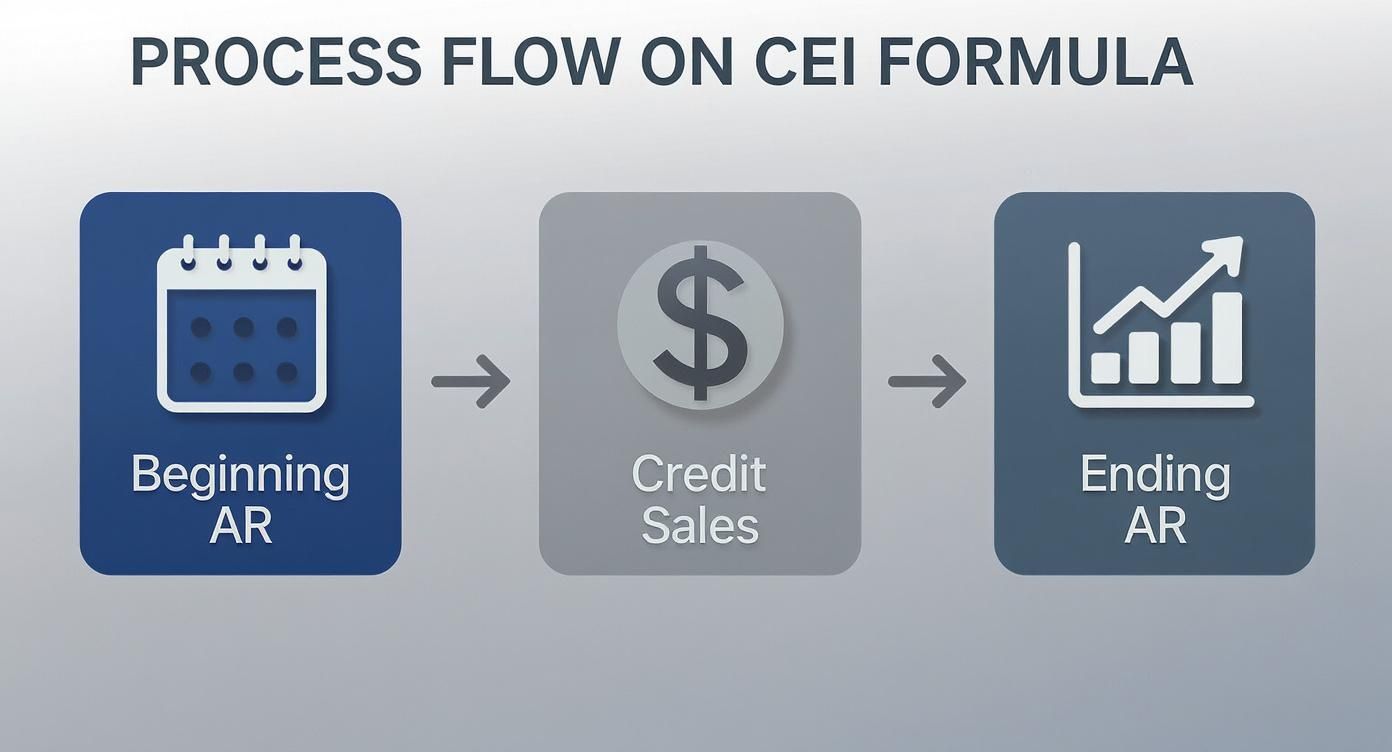
This visual shows how your beginning AR, credit sales, and ending AR combine to create a clear picture of collection performance.
Common Pitfalls That Distort CEI
Before overhauling your collections strategy, ensure your data is clean. Common accounting errors can inflate or deflate your CEI, sending you to solve the wrong problems.
A distorted CEI is worse than no metric at all. It provides a false sense of security or triggers unnecessary alarms, distracting you from the real operational challenges that impact your cash flow.
Watch for these pitfalls:
- Miscategorized Receivables: Including items like employee loans in your AR account will skew the calculation. Your Beginning and Ending AR should only include client invoice balances.
- Inconsistent Credit Policies: If you offer some clients Net 30 and others Net 90 arbitrarily, you cannot establish a reliable benchmark. Standardized terms create a stable baseline.
- Delayed Write-Offs: Holding onto uncollectible debt inflates your AR balances and artificially lowers your CEI score. A disciplined write-off policy ensures your metric reflects what is realistically collectible.
Accurate benchmarking requires internal consistency and clean data. Only then can your collection effectiveness index become a reliable guide for improving your firm’s financial health and implementing effective accounts receivable automation.
Pinpointing the Process Failures That Lower CEI
A low Collection Effectiveness Index is a symptom. It tells you that somewhere between invoicing and payment, your process is broken.
For professional services firms, these breakdowns are often subtle but have a significant impact on working capital.
Identifying the root cause is the only way to regain control. A score below 80% suggests a systemic issue, not just a single slow-paying client. These are internal process problems that need to be fixed.

Unstructured Collections and Vague Ownership
The most common culprit is a reactive, ad-hoc approach to collections. When no one owns an overdue account, follow-ups are inconsistent and invoices fall through the cracks.
This creates unpredictable cash flow.
Without a clear collections protocol, key questions remain unanswered:
- Who is responsible for contacting a client when an invoice hits 15 days past due?
- What is the escalation path for a non-responsive client at 45 days?
- How are disputes logged and routed for resolution?
A lack of clear answers means a lack of accountability. This operational gap is a primary driver of a poor collection effectiveness index.
Delayed and Inaccurate Invoicing
Your collections clock starts when work is completed, not when the invoice is sent. Billing delays are self-inflicted wounds that directly hurt your CEI.
A two-week delay in generating an invoice is an automatic two-week extension of payment terms.
Invoice errors make the problem worse. A wrong PO number or miscalculated rate brings the payment process to a halt. The client now has a valid reason not to pay, locking the invoice in a dispute loop that can add months to your collection time. Learn more by reading our guide on receivable management services.
An invoice dispute resets the payment clock. The burden shifts from the client’s AP team to your internal team to investigate, correct, and reissue—all while your cash remains tied up.
Lack of Proactive Client Communication
Many firms wait until an invoice is past due to contact a client. This is a mistake.
A proactive check-in confirms the invoice was received and is on track for payment. This simple step can uncover issues before they become delinquencies.
Consider the difference:
- Reactive: Calling a client 30 days after an invoice is due, only to find it was sent to the wrong contact.
- Proactive: An automated email goes out three days after the invoice is sent to confirm receipt and accuracy, solving the problem before the due date.
Shifting from reactive to proactive stops minor administrative hurdles from becoming major payment delays. By addressing these core process failures, you move from just tracking your collection effectiveness index to actively improving it.
Actionable Strategies for Improving Your CEI
A low Collection Effectiveness Index score is a diagnostic tool. It shows you exactly where your process needs to be tightened.
Improving your CEI is about building a disciplined, predictable AR process. These are measurable steps that turn accounts receivable from a reactive problem into a strategic asset that protects your cash flow.
Establish a Firm and Fair Credit Policy
Effective collections start before an invoice is sent. It begins with a clear, documented credit policy that is communicated upfront.
Without one, you operate on assumptions, leaving payment terms vague.
Your policy establishes the rules of engagement. It should clearly define:
- Payment Terms: Net 30, Net 45. Whatever you choose, be consistent.
- Credit Limits: Specify the maximum receivable balance a client can carry.
- Late Payment Consequences: Outline the exact steps for delinquent accounts, from reminders to service holds.
Clarity prevents the misunderstandings that cause payment delays and lower your collection effectiveness index.
Implement a Proactive Outreach Cadence
Most firms wait until an invoice is late to contact a client. A proactive outreach cadence—a structured sequence of communications—prevents small issues from becoming large collection problems.
An effective cadence is systematic and automated. For example:
- Invoice Confirmation (Day 3): An automated email confirms receipt, catching delivery errors immediately.
- Payment Reminder (7 Days Before Due): A polite, automated reminder helps clients schedule payment.
- Day-Of Notice: A simple notification that payment is due.
- Past-Due Follow-Up (Day 1, 7, 15): A sequence of increasingly firm but professional reminders.
This structured approach ensures no invoice is forgotten. It systematizes the follow-up work that is often inconsistent when performed manually.
Standardize Your Dispute Resolution Workflow
Unresolved disputes are a direct anchor on your CEI. An invoice in dispute will not be paid, yet it remains in your accounts receivable, distorting metrics and locking up cash.
A formal dispute resolution process is non-negotiable. It must immediately route the issue to the right person—a partner or project manager—with a clear deadline for response. Otherwise, disputes fester and client relationships sour.
Your workflow must define clear steps for logging, assigning, and resolving any client issue. This is where AI AR automation can create massive efficiencies. When a client flags a problem, the system can instantly create a ticket, notify the correct contact, and track resolution time. This speed gets an invoice back on track for payment. Fixing these internal loops is one of the most effective ways to increase cash flow.
Leverage AR Software for Professional Services
Implementing these strategies manually is possible, but it invites burnout and human error. Significant gains in CEI come from technology built for this purpose.
AR software for professional services turns these strategies into automated, repeatable workflows.
For firms using QuickBooks, QuickBooks AR automation adds this layer of structure without requiring a full system migration. It orchestrates outreach, manages dispute workflows, and provides real-time CEI tracking without manual spreadsheets. This frees your finance team for high-value analysis instead of administrative tasks.
These actions bring predictability and control to your collections process. By focusing on clear policy, disciplined process, and the right tools, you can systematically lift your CEI, reduce DSO, and build a healthier financial foundation.
Using AR Automation to Drive a Higher CEI
Manual processes are the single biggest anchor on your Collection Effectiveness Index. They create friction, introduce errors, and cause delays.
Relying on manual effort makes it nearly impossible to achieve a best-in-class CEI. Your best people are buried in administrative work.
This is where accounts receivable automation closes the gap. It is not about replacing your team; it is about giving them tools to execute your collections strategy flawlessly and at scale.

Orchestrating the Entire Collections Workflow
Effective AR automation is more than an email reminder tool. It orchestrates the entire collections process, from invoice delivery to payment reconciliation.
This ensures every account gets the right attention at the right time.
Intelligent systems run outreach cadences without fail, eliminating forgotten invoices and missed follow-ups.
Automation transforms your collections strategy from a document into a living, operational workflow. It ensures every invoice is managed with the same discipline, regardless of who is on vacation.
This level of control frees your team to manage exceptions, not chase routine payments. They can focus on complex disputes or high-risk accounts while the system handles repetitive tasks. On average, firms that adopt automation see a 10- to 15-point lift in their CEI within the first year.
Personalizing Communication at Scale
A common concern is that automation sounds robotic. The opposite is true.
Modern AI AR automation enables personalization at a level that is impossible to achieve manually. Workflows can be tailored based on a client’s payment history, invoice size, or risk profile.
A long-term, high-value client can receive a softer, relationship-focused nudge, while a new client receives a firmer follow-up.
You maintain a human touch while the system ensures consistency. Many AR platforms integrate with other tools, like customer service automation software, to handle invoice queries and speed up dispute resolution.
Gaining Real-Time Financial Control
Calculating CEI manually is like driving by looking in the rearview mirror. By the time you pull the data from QuickBooks and run the numbers, the opportunity to intervene is gone.
AR software for professional services provides a live dashboard view of CEI and other critical metrics.
You can watch your score update daily, spot negative trends as they start, and take immediate action. This is the difference between reactive damage control and proactive financial management. For firms on QuickBooks, dedicated QuickBooks AR automation layers this capability on top of your existing accounting system.
This instant data access allows you to:
- Identify bottlenecks in your collections cycle as they happen.
- Measure the immediate impact of process changes on your CEI.
- Improve cash flow forecasting with more accurate, real-time information.
By removing the manual burden and providing real-time intelligence, AR automation fundamentally changes how you manage receivables. It addresses the root causes of a low CEI—inconsistency, human error, and delayed responses—to systematically reduce DSO and improve cash flow.
A Few Common Questions About CEI
Once you adopt the Collection Effectiveness Index, practical questions often arise. Clarity on the details is what makes a metric useful.
How Is CEI Different From Days Sales Outstanding (DSO)?
This is the most frequent question. DSO and CEI measure different things.
DSO tracks speed—the average time it takes to get paid. CEI measures effectiveness—how much of the money you could have collected was actually collected.
A firm can have a low DSO by collecting new invoices quickly, but a poor CEI because it's letting older debt slide. CEI tells you what you're leaving on the table.
Can I Calculate CEI Using QuickBooks?
Yes. All the necessary numbers are in QuickBooks. You can use the AR Aging Summary for beginning and ending balances and a P&L report for credit sales.
The challenge is that the calculation is manual.
Specialized AR software for professional services, including QuickBooks AR automation, calculates these numbers continuously. You get real-time CEI tracking without the spreadsheet work. This is how you improve cash flow without adding administrative overhead.
A manual CEI calculation is a snapshot in time. An automated one is a live dashboard. It lets you see the impact of your collections strategy as it happens, giving you the chance to fix problems before they escalate.
How Often Should We Measure Our CEI?
For most professional services firms, monthly measurement is ideal.
This cadence provides timely, actionable insights. You can spot negative trends early enough to intervene and measure the impact of process improvements.
Comparing CEI month-over-month gives you a clear picture of performance and helps you reduce DSO more effectively.
--- Resolut automates AR for professional services—consistent, accurate, and human.