How to Reduce Days in Accounts Receivable and Improve Cash Flow
A CFO's guide to reducing days in accounts receivable. Learn proven strategies and automation tactics to accelerate cash flow and improve financial health.
Days in accounts receivable is a direct measure of your firm's financial drag. A high DSO doesn't just look bad on a report; it turns earned revenue into a source of stress and puts a governor on growth.
For professional services firms, this metric is a speedometer for cash flow. It dictates your ability to hire, invest, and operate with confidence.
The Real Cost of High Days in Accounts Receivable
When your days in AR climb, the revenue you've earned becomes trapped capital. You are essentially providing clients a zero-interest loan, which directly limits your ability to scale.
This locked-up cash creates tangible opportunity costs. It's the top-tier talent you can't hire, the technology you can't invest in, or the payroll you sweat every month.

This isn't an isolated problem. Global working capital recently hit its highest level since 2008, with U.S. firms shouldering $1.7 trillion in excess working capital. That is cash unavailable for growth.
The Financial Drag in Practice
Let’s attach real numbers to this problem.
A consulting firm with $5 million in annual revenue and a healthy 45-day DSO has approximately $616,438 tied up in receivables at any given time.
If minor process inefficiencies cause DSO to increase by just 15 days to 60, that locks up another $205,479 of working capital. That's cash that could have funded a key hire or a new service line.
This is why managing days in accounts receivable is a strategic priority, not a back-office task. The true cost is measured in missed opportunities and unnecessary risk. For more on the operational impact, explore the true cost of AR inefficiency in professional services.
Calculating and Benchmarking Your Firm's DSO
You cannot control what you do not measure. Mastering your firm's cash flow starts with a handle on your Days Sales Outstanding (DSO). It answers the critical question: "How long does it take to convert our work into cash?"
The calculation is straightforward. It is the first step toward building a more predictable business.
The DSO Formula for Professional Services
For a service-based firm, the formula requires a few key inputs. We aren't tracking inventory; we're tracking the value of expertise delivered on credit.
Here is what you need:
- Total Accounts Receivable: The total dollar amount of all unpaid client invoices at the end of a specific period.
- Total Credit Sales: The total revenue billed during that same period.
- Number of Days: The length of the period being measured (e.g., 30 for a month, 90 for a quarter).
The Formula: DSO = (Total Accounts Receivable / Total Credit Sales) x Number of Days in Period
The real value comes from tracking DSO consistently—monthly or quarterly. This creates a trend line that acts as a leading indicator of your financial health.
A Practical Calculation Example
Let's apply this. Imagine your professional services firm is reviewing its Q1 performance.
This calculation provides a tangible measure of how your collections process is performing.
DSO Calculation Example for a Professional Services Firm (Q1)
Metric | Value | Calculation Step |
|---|---|---|
Total Accounts Receivable (end of Q1) | $750,000 | The sum of all outstanding client invoices. |
Total Credit Sales (for Q1) | $1,500,000 | Total revenue billed on credit terms during the 90-day period. |
Number of Days in Period | 90 | The time frame being measured (e.g., Q1). |
DSO Calculation | 45 Days | |
In this scenario, the firm's DSO is 45 days. On average, it takes a month and a half to get paid after sending an invoice. The number's value comes from context.
Benchmarking Your Firm's Performance
A DSO of 45 days may be excellent for one firm and a critical problem for another. Context comes from comparing your number to industry benchmarks and, more importantly, your own historical trends.
Here is a general framework for most professional services firms:
- Under 30 Days (Healthy): This is elite territory. It signals an efficient collections process and strong working capital.
- 31-60 Days (Average): Most firms operate in this range. It's manageable, but there is almost always room for improvement.
- Over 60 Days (High Risk): A DSO this high indicates a systemic problem in your invoicing, follow-up, or client onboarding. It requires immediate attention.
Your goal should be a consistent downward trend. A DSO that creeps from 45 to 55 over six months is a red flag that operational friction is quietly taxing your business.
Systematically managing your days in accounts receivable begins with consistent measurement. It’s the foundation for strategic improvements like accounts receivable automation. Implementing the right AR software for professional services, particularly tools offering integrations like QuickBooks AR automation, helps you systematically reduce DSO and regain control.
The Root Causes of Collection Delays
A high DSO is a symptom, not the disease. To fix your accounts receivable, you must dig into the operational friction that causes the delays.
These issues are subtle, baked into daily workflows, and quietly worsen over time. This requires a shift from a reactive collections mindset to a proactive, operational one.
The root causes fall into three areas: internal process friction, client-side bottlenecks, and communication gaps. Identifying where breakdowns occur is the only way to apply a durable fix.
Internal Process Friction
Often, the primary source of delay originates within your own firm. These are self-inflicted wounds—small process cracks that give clients valid reasons to delay payment.
Look here first:
- Inconsistent Invoicing: Are invoices sent on a predictable schedule? Do they contain required information like PO numbers and project codes? A single error can push an invoice into an exception queue for weeks.
- Vague Contract Terms: If contracts lack explicit due dates or late-fee clauses, you invite payment ambiguity. Clear terms set the stage for prompt payment.
- No Clear Ownership: Who owns an unpaid invoice at 15 days past due? At 45? At 90? Without a defined owner and escalation path, follow-up becomes random and ineffective.
When an invoice is clear, accurate, and contractually sound, the burden of action shifts to the client's payment department, where it belongs.
Client-Side Bottlenecks
Once sent, your invoice enters your client's AP process, a system you don't control. However, you can anticipate and plan for common bottlenecks that stall payments.
These holdups often manifest in predictable ways:
- Complex Approval Chains: In larger companies, an invoice may require multiple sign-offs. A delay at any step adds weeks to your timeline.
- Disputed Work or Scope Creep: If a client questions the work, payment stops until the issue is resolved. This often points to a need for clearer project sign-offs on your end.
- Inefficient AP Departments: Your invoice may be perfect but sits in a queue with hundreds of others. This is common with large clients that process payments in rigid, infrequent batches.
Systemic Communication Gaps
The final category of root causes involves communication breakdowns. In most professional services firms, the conversation about payment happens too late—only after an invoice is overdue.
This creates an adversarial dynamic. With 39% of U.S. invoices paid late, proactive communication isn't just a best practice; it's a necessity. As you can discover more insights about accounts receivable trends, it becomes obvious that manual, reactive communication is insufficient.
Fixing these gaps requires a shift in approach:
- Set Expectations Early: The onboarding process must include a clear conversation about your billing process and payment terms.
- Send Proactive Reminders: Professional reminders sent before an invoice is due prevent it from getting lost. This is where accounts receivable automation provides significant leverage.
- Establish a Central Point of Contact: When a client has a billing question, do they know whom to contact? A single, informed point of contact eliminates confusion and delays.
By systematically addressing these three areas, you can move beyond chasing late payments and build a more resilient, predictable cash flow engine.
Actionable Strategies to Systematically Reduce DSO
Diagnosing collection delays is the first step. The real solution comes from building operational discipline that shifts your accounts receivable from reactive to proactive.
Bringing down your days in accounts receivable isn't about aggressive tactics. It's about precision, clarity, and consistency.
Think of these strategies as layers: foundational process improvements, smarter communication, and intelligent automation. Each builds on the last to create a system that accelerates cash flow while protecting client relationships.
Fortify Your Foundational Processes
Before technology can help, your core mechanics must be solid. Most payment delays start with internal friction. Resolve these issues to create a clear path to payment.
- Standardize Contract Terms: Your agreements must be unambiguous. Specify due dates (e.g., “Net 30”), payment methods, and consequences for late payment.
- Ensure Prompt, Error-Free Invoicing: An invoice should go out the moment a milestone is complete. Verify that each invoice includes the client’s required information, like a purchase order number, to avoid rejection by their AP department. Good invoice management software can streamline this process.
- Establish a Consistent Follow-Up Cadence: Map out a repeatable schedule for follow-ups: a reminder three days before the due date, a notice on the due date, and a clear escalation path at 15 and 30 days past due. Consistency signals professionalism.
Implement Strategic Client Communication
Once your process is solid, tailor your communication. A one-size-fits-all collections approach is inefficient.
This chart breaks down common reasons for collection delays, highlighting where better communication and tighter processes can make the biggest impact.
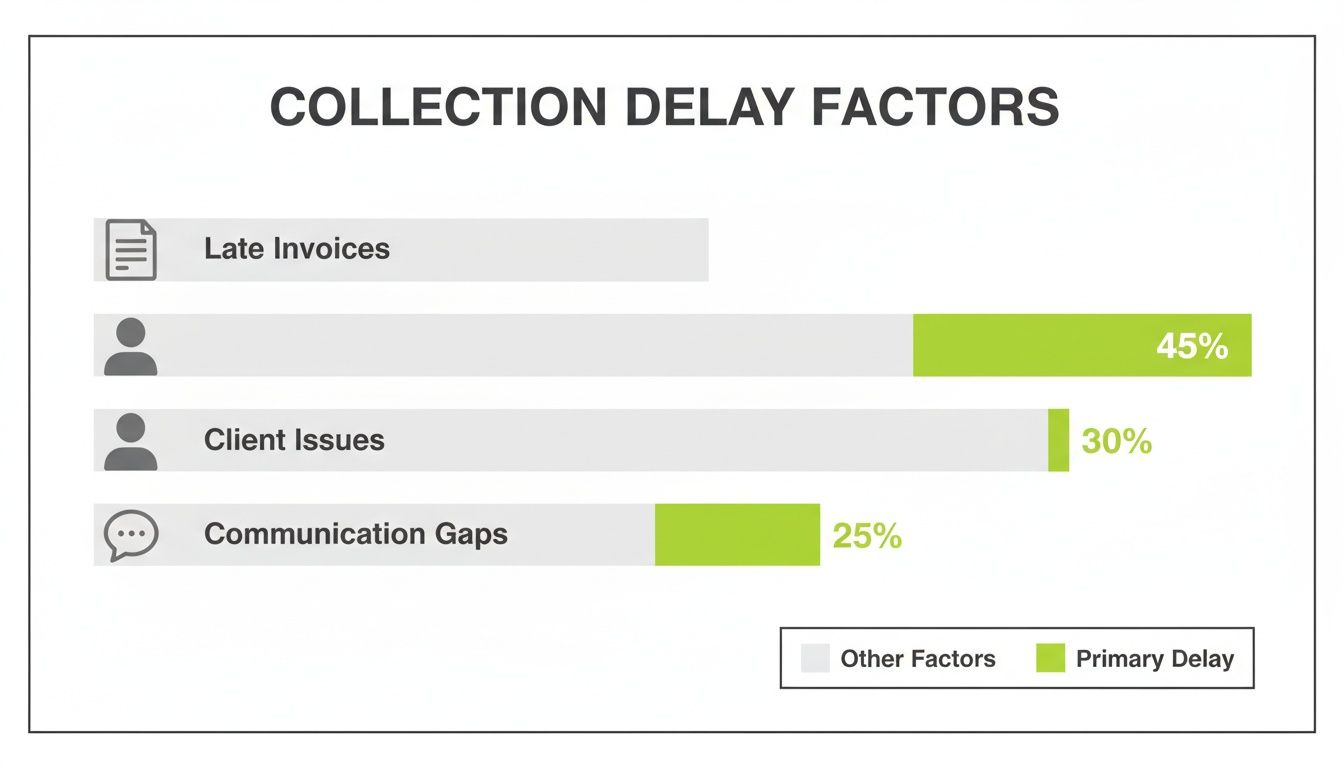
The data shows that internal friction and poor communication are significant hurdles—and both are within your control.
Segment clients based on payment history. Prompt payers may only need automated reminders. Chronically late clients require a more direct, personal approach. This allows your team to focus its energy effectively. For more, see these 8 real-world ways to clean up your accounts receivable.
Embrace Intelligent AR Automation
The final layer is using technology to run your collections process. Manual follow-up is prone to error and doesn't scale. Modern AR software for professional services creates a smart, automated system that executes your strategy perfectly.
Accounts receivable automation doesn't replace your team; it amplifies its effectiveness. It handles repetitive tasks, freeing finance professionals to manage exceptions and build client relationships.
The impact is measurable. Firms using automation report tangible results: 91% of mid-sized users see better cash flow, and 53% of CFOs credit client payment portals for collection improvements.
Look for these key features in an automation platform:
- Intelligent Workflows: Systems that adapt the timing, tone, and channel of reminders based on a client's risk profile. This is where AI AR automation excels.
- Client Payment Portals: A self-service portal where clients can view invoices, pay online, and ask questions removes friction and accelerates payment.
- Automated Cash Application: Tools that automatically match incoming payments to invoices eliminate hours of manual reconciliation. This is particularly valuable for firms using QuickBooks AR automation.
By layering these strategies, you can systematically reduce DSO and build a predictable cash flow engine. It starts with discipline, improves with strategy, and is perfected with automation.
Leveraging Automation for Predictable Cash Flow
Managing accounts receivable manually is a reactive, draining exercise. For a growing professional services firm, it is not sustainable. It consumes team resources, introduces human error, and creates unpredictable cash flow.
The solution is not to replace people but to install an orchestration engine—a system that provides control, predictability, and leverage. This is where modern accounts receivable automation changes the game. You stop chasing payments and start engineering outcomes.
Moving Beyond Simple Reminders
Effective automation is more than a generic email sent when an invoice is past due. True orchestration builds smart, multi-channel communication workflows that deliver the right message to the right person at the right time.
For example, the system sends a professional email five days before the due date. If unpaid, it follows up with an SMS text. At day 30, it automatically flags the issue for an account manager, complete with the full communication history.
The system adapts its tone and cadence based on client profile and payment history, ensuring a consistent, accurate, and human-centric touch at scale. It executes your collections strategy flawlessly.
To integrate these systems effectively, consider advanced cloud accounting solutions that connect all your financial operations.
Key Automation Features That Drive Results
The impact of AI AR automation is tangible: lower DSO, a more efficient team, and stronger client relationships. This is driven by specific features designed to remove payment friction.
Three core components deliver the largest impact:
- Client Payment Portals: These self-service hubs allow clients to view open invoices, see payment history, ask questions, and pay via their preferred method (ACH, credit card). This convenience eliminates common excuses for delays.
- Automated Cash Application: Manually matching payments to invoices is tedious and error-prone. Automation tools, especially those offering QuickBooks AR automation, reconcile payments instantly and accurately, freeing up hours of team time.
- Proactive Risk Flagging: A smart system analyzes payment patterns to identify at-risk accounts before they become seriously delinquent. This allows your team to intervene early and prevent a small delay from becoming a write-off.
By implementing these tools, you build a system that strengthens both cash flow and client relationships. Learn more about structuring these systems in our guide to receivable management services. The goal is to reduce DSO not by aggression, but by creating a well-orchestrated, professional process.
Building Your AR Performance Dashboard
What gets measured gets managed. But a static, month-end aging report is a rearview mirror. A dynamic performance dashboard is a forward-looking guidance system for your firm's cash flow.
To gain control over your days in accounts receivable, you need a consolidated, weekly view of the metrics that matter. This is about boiling down your collections process into a handful of indicators that signal health or risk.

Core Dashboard KPIs Beyond DSO
DSO provides a high-level view, but the operational story is in the details. An effective dashboard dissects AR performance. Your weekly review should center on these vitals.
- Aged Receivables Breakdown: Segmenting outstanding invoices into buckets (0-30, 31-60, 61-90, and 91+ days) immediately shows where risk is concentrated. A swelling 91+ day column is a direct threat to working capital.
- Collection Effectiveness Index (CEI): This answers: "Of all the money we could have collected, how much did we actually bring in?" A CEI consistently below 80% signals a broken process that requires investigation.
- Average Days Delinquent (ADD): While DSO averages all receivables, ADD focuses on only late invoices. It tells you, "When clients pay late, how late are they?" This helps distinguish slow payers from chronically delinquent clients.
A well-designed dashboard transforms financial data into operational intelligence. It empowers you to predict cash flow shortages and intervene proactively, rather than reacting to past-due invoices.
Designing for Actionable Insights
Your dashboard’s layout should make the next action obvious. Use simple visuals—a trend line for DSO, a bar chart for aged receivables—to make patterns clear. Visual clarity turns a report into a decision-making tool.
Modern AR software for professional services generates these dashboards automatically, especially platforms offering QuickBooks AR automation. This eliminates manual reporting and ensures your data is always current.
By integrating accounts receivable automation, your dashboard becomes a dynamic command center. It provides the confidence to systematically reduce DSO and improve cash flow—not just for a month, but permanently.
Stop Chasing. Start Unlocking.
Lowering your days in accounts receivable is not a one-time project; it is a fundamental shift in operational discipline. It's about moving from a reactive chase to a proactive, orchestrated system that puts you in control of your firm's cash.
This is how you unlock the working capital trapped on your balance sheet. That capital is what fuels strategic investments, reduces financial risk, and strengthens client relationships through a seamless, professional payment experience.
Evolve Your Finance Function
An orchestrated AR system elevates your finance team. Instead of administrators chasing invoices, they become strategic partners focused on analysis and risk management.
Time once spent on manual follow-up is reallocated to forecasting and identifying opportunities to improve cash flow. This is the real power of accounts receivable automation.
This shift—from tactical collections to strategic cash flow management—is the defining mark of a high-performing finance operation. It turns a cost center into a predictable engine for growth.
Visual Idea: A cinematic image of a key turning in a lock, with a bright light emanating from the keyhole, symbolizing "unlocking" working capital.
Visual Idea: A simple animated chart where a bar for "Trapped Capital" shrinks while a bar for "Growth Capital" expands, linking DSO reduction to strategic investment.
Using AI AR automation, particularly AR software for professional services that integrates with tools like **QuickBooks, is how you achieve this control. It is how you systematically **reduce DSO and build a more resilient financial future.
--- Resolut automates AR for professional services—consistent, accurate, and human.