A CFO's Playbook for Automated Debt Recovery
A playbook on debt recovery for businesses. Learn to triage debt, automate outreach, and improve cash flow with proven tactics for finance leaders.
Unpaid invoices aren't just line items on an aging report. They are a drag on working capital, complicating financial forecasts and inhibiting growth. For professional services firms, this is a direct constraint on operations.
Systematizing Corporate Debt Recovery for Predictable Cash Flow
Collections has historically been a reactive, often confrontational process. Manual follow-ups and inconsistent efforts are no longer sufficient when every dollar of working capital counts. The paradigm must shift from chasing debt to managing a financial control system.
The true cost of a late payment extends beyond the invoice value. It represents lost opportunities for reinvestment in talent, technology, or strategic initiatives. This playbook provides a framework for transitioning from reactive collections to proactive accounts receivable management.

[Visual Idea: A cinematic shot of a calm, organized finance department. Sunlight streams in. A large dashboard on the wall shows DSO trending down and cash flow projections improving.]
This is not about damaging client relationships. It is about implementing a data-driven framework to accelerate and predict payments. The measurable outcomes are significant.
- Reduce DSO: Firms can cut payment cycles by 10-25% by systematizing follow-ups and simplifying the payment process.
- Improve Cash Flow: A structured process delivers a clearer forecast of cash inflows, which is fundamental for strategic planning.
- Increase Team Efficiency: Automating routine reminders frees the finance team to focus on high-value analysis and strategic client negotiations.
The Growing Need for Systematized Recovery
Late payments are a persistent and growing issue. The global debt recovery services market is projected to reach $15 billion by 2025, growing at a 5.5% CAGR through 2033. This statistic signals that finance leaders require more efficient strategies to manage receivables as corporate debt levels rise.
The core principle is straightforward: every invoice is secured revenue. The longer it remains uncollected, the more its value erodes. An automated system ensures no invoice is overlooked and every receivable is managed with precision.
This guide is a practical playbook for CFOs, Controllers, and finance operators. It details how to implement tools like AI AR automation—including systems offering robust QuickBooks AR automation—to overhaul your AR process. We will cover actionable steps for triage, communication, and escalation.
Beyond Chronological Chasing: A Data-Driven Triage for Receivables
A collections strategy based on working down an aging report is inefficient. It allocates equal effort to a routine $500 invoice and a high-risk $50,000 receivable. This approach keeps your team busy, but not effective.
Effective debt recovery begins with intelligent prioritization long before a call is made. The mindset must shift from "who is next on the list?" to "which account poses the greatest immediate risk to our cash flow?"
Building a Multi-Factor Triage Matrix
Instead of sorting solely by age, receivables should be analyzed through a multi-factor lens. A triage matrix provides a clearer picture of where risk is concentrated. This allows you to segment high-value accounts requiring a personal touch from smaller ones manageable with automated reminders.
Key factors for analysis include:
- Invoice Value: A $50,000 invoice presents a greater risk to working capital than a $500 one.
- Client Payment History: Is this a reliable client who is late for the first time, or one with a consistent history of paying past 60 days? These are distinct scenarios.
- Invoice Age: The probability of collection decreases significantly after 90 days. Early intervention is critical.
- Client-Specific Factors: Contractual payment terms, strategic importance of the client relationship, or known business changes (e.g., mergers) provide essential context.
The purpose of data-driven triage is to focus your team's time on the accounts that most impact the business. This is the difference between inefficient activity and measurable results.
From Manual Spreadsheets to Smart Automation
Controllers often spend hours in spreadsheets, manually exporting data from QuickBooks and cross-referencing payment histories to create priority lists. This process is slow, error-prone, and outdated upon completion.
This is where accounts receivable automation provides a solution. Modern AR software for professional services performs this analysis instantly and continuously. By integrating with your accounting system, such as through QuickBooks AR automation, these tools score and segment every open invoice automatically.
Consider two accounts:
- Account A: A $75,000 invoice, 45 days past due. The client has paid late on three of the last five invoices.
- Account B: A $2,000 invoice, 50 days past due, from a client with a perfect five-year payment history.
A standard aging report might prioritize Account B due to its age. A smart system, however, will immediately flag Account A as the top priority. The combination of high value and poor payment history signals a significant risk requiring immediate human intervention. Account B can likely be resolved with a simple automated reminder.
Further detail on account classification can be found by exploring the aging receivables method.
[Visual Idea: A clean, minimalist chart showing DSO before and after AR automation. The "before" bar is high and jagged (unpredictable). The "after" bar is 20% lower and stable (predictable).]
This automated segmentation is the engine of an efficient collections process. It helps reduce DSO and improve cash flow by applying the appropriate level of effort to the right accounts at the right time. Your team is liberated from tedious administration and provided with a prioritized, actionable workflow.
Orchestrating Automated Outreach Sequences
After triaging receivables, the next step is to execute a systematic outreach plan. Effective debt recovery is not about making ad-hoc calls. It is about a consistent, multi-channel communication cadence tailored to each client's profile.
The objective is not to send generic, demanding emails. The goal is to build an automated sequence that feels human, applying persistent, professional pressure that escalates appropriately. This approach removes emotion and human error from the early stages of collections.
Designing a Smart Outreach Cadence
Start with low-friction channels and introduce more direct methods as an invoice ages. An initial email is easily overlooked. A follow-up SMS message is more direct and signals a professional escalation.
A strong sequence blends different channels to ensure the message is received. A proven structure:
- Days 1-15 (Reminder Phase): Automated emails are ideal. The tone should be helpful, providing an easy path to payment.
- Days 15-30 (Direct Nudge Phase): Introduce a second channel. An SMS is highly effective, cutting through inbox clutter. An automated call can also formally flag the overdue account.
- Days 30+ (Human Intervention Trigger): If automated touches yield no response, the system should flag the account for human intervention—a personalized email or direct call.
This triage process is about applying the right pressure at the right time.
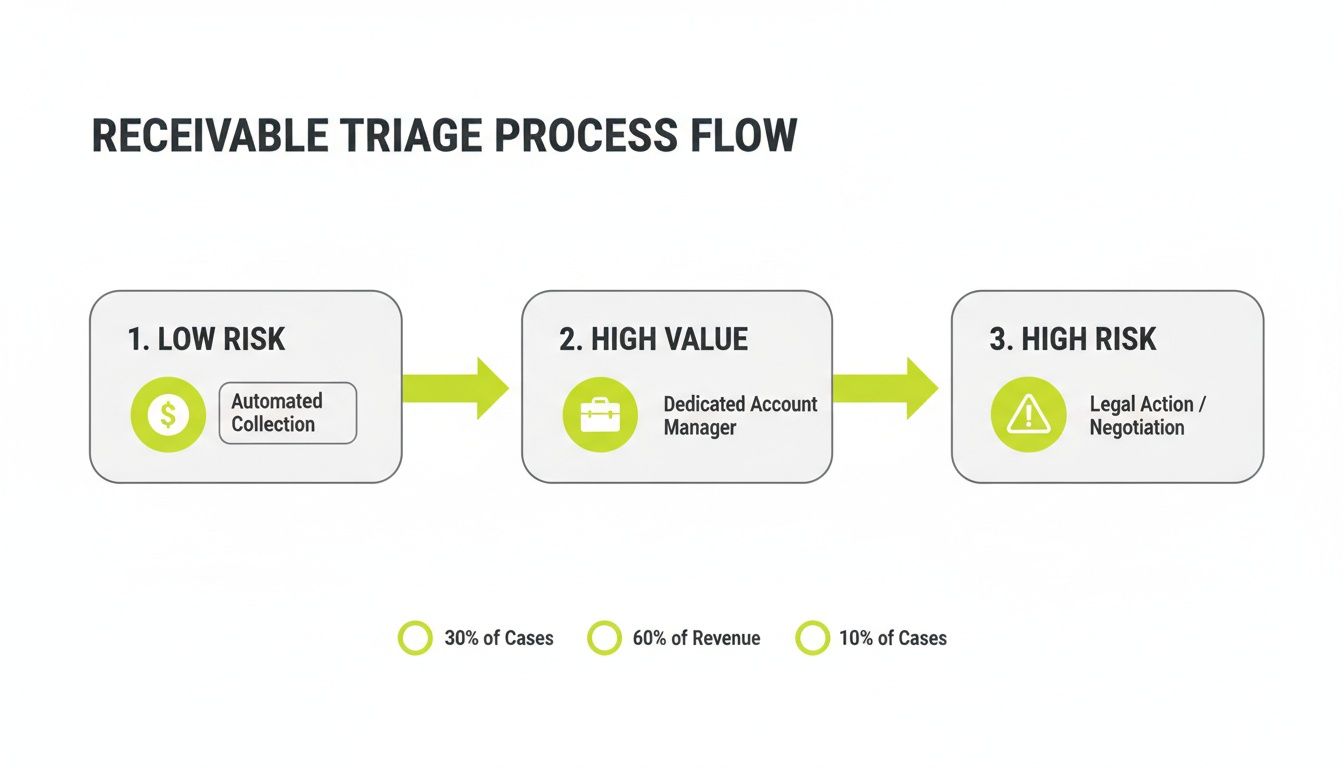
By segmenting receivables, you can let automated sequences manage low-risk accounts, freeing your team for high-value and high-risk accounts that require human expertise.
Implementing AR Automation Tools
This is where AI AR automation platforms become instrumental. Tools with integrations like QuickBooks AR automation do more than send emails on a schedule. They analyze client data—payment history, engagement, communication preferences—to fine-tune the timing and tone of each message.
For example, a system may learn a client is more responsive to an SMS sent at 10 AM on a Tuesday and adjust its cadence accordingly. For a firm managing hundreds of invoices, this level of dynamic personalization is impossible to achieve manually.
A systematic approach is critical in the current economic climate. Higher borrowing costs through 2026 are squeezing corporate cash flow, often forcing companies to delay vendor payments. A robust accounts receivable automation process provides a competitive advantage, using intelligent risk signals to flag problem accounts early.
Sample Outreach Messages for Key Stages
The message content is as important as the channel. Maintain a calm, confident tone focused on resolution.
A well-crafted automated message is a helpful notification with a clear path to payment. The goal is to make it as easy as possible for clients to pay.
Effective messaging as an invoice ages:
- Email (Day 3 Past Due): "Subject: Reminder: Invoice #5678 Past Due. Hi [Client Name], A quick reminder that invoice #5678 for [$Amount] was due on [Due Date]. You can view and pay here: [Link]."
- SMS (Day 15 Past Due): "Hi [Client Name], Following up from [Your Firm Name] about invoice #5678. To avoid service interruption, please use this link to pay: [Link]"
- Automated Call (Day 30 Past Due): "An automated message from [Your Firm Name] for [Client Name]. Our records show a past-due balance. Please log in to your portal or call us at [Phone Number]."
Each message is concise, provides essential details, and includes a clear call to action.
Sample Omnichannel Outreach Cadence
A sample automated cadence for a moderately overdue invoice:
Day Past Due | Channel | Message Focus | Tone |
|---|---|---|---|
3 | Automated Email | First gentle reminder, provide payment link | Helpful and friendly |
10 | Automated Email | Second reminder, re-attach invoice | Professional and direct |
15 | SMS | Brief follow-up, highlight urgency, direct link | Firm but polite |
21 | Automated Email | Final automated notice, warn of manual follow-up | Serious and concerned |
30 | Automated Call | Formal notification of overdue status | Official and non-emotional |
This structured sequence ensures no invoice is missed and that escalation is consistent.
This systematic, omnichannel approach is a core function of modern AR software for professional services. It ensures every invoice is pursued consistently, which directly helps reduce DSO and improve cash flow without damaging client relationships.
Negotiation and Payment Plan Tactics for Human Intervention
When automated sequences are exhausted and an invoice remains unpaid, human intervention becomes your most valuable asset. This is not about confrontation, but about shifting to a collaborative, problem-solving dialogue.
Successful negotiation is a structured operational process, not an improvised one. Your team must be prepared.

Before making a call, the collector must have the complete client history, understand the relationship's value, and know the firm's bottom line. The priorities are, in order: secure payment, preserve a valuable relationship, and improve cash flow.
Crafting a Structured Payment Plan
Offering a payment plan is a pragmatic strategy to recover cash that might otherwise be written off. The goal is to propose a manageable schedule for the client while recovering funds. A good plan secures an immediate payment and establishes a clear path to full collection.
A common scenario:
- The Debt: A good client owes $20,000 on an invoice 75 days past due, citing a temporary cash crunch.
- The Ineffective Approach: Demanding the full $20,000 or making vague threats. This creates an adversarial dynamic.
- The Effective Approach: Propose a structured plan. "To resolve this, we can set up a plan: an immediate payment of $5,000 today, followed by three monthly payments of $5,000."
This approach demonstrates flexibility while securing an immediate commitment. It converts a large, stalled receivable into smaller, predictable cash inflows.
The US debt collection industry provides a relevant lesson. Post-pandemic, agencies are adopting more human-centric strategies. With inflation driving late payments, BPO trends for 2026 focus on using data for high-value accounts and offering self-service payment plans—a strategy proven to increase recovery rates.
Formalize the Agreement
A verbal agreement is insufficient. Every payment plan must be formally documented and signed. This eliminates ambiguity, creates a new binding agreement, and provides legal protection.
A payment plan without a signed agreement is just a conversation. Your AR system must be able to generate, send, and track these documents for them to be enforceable.
Dedicated AR software for professional services manages this workflow:
- Generate Agreement: Instantly create a professional document detailing the payment schedule.
- Send for E-Signature: Deliver the agreement via a client portal for a secure, legally binding signature.
- Automate Reminders: Automatically send reminders before each installment is due.
This systematizes the process, reducing administrative work and ensuring no installment is missed. The documentation provides enforceability, transforming a difficult conversation into a controlled, documented process.
A Framework for Escalation
Some accounts will require more than reminders. Knowing when to escalate from collections to a pre-legal or legal stage requires a data-driven process, not an emotional reaction. A clear framework brings control and predictability to escalation.
Escalation should be a calculated operational step, not a last-ditch effort. A consistent playbook ensures every account is managed with the same professional rigor.
Defining Escalation Triggers
Establish hard rules for escalation based on invoice age, value, and client communication. The goal is objective criteria that automatically advance an account.
For example, a multi-factor rule:
- Trigger Condition: Any invoice over $10,000 reaches 90+ days past due.
- And: There has been no client communication in the last 30 days.
This rule prevents premature escalation on a communicative client while ensuring high-value, silent accounts receive immediate attention before recovery odds decline.
The Pre-Legal Step: Voice of a Lawyer
Before engaging outside counsel, a powerful intermediate step is to send a formal demand letter from a legal authority—a "voice of a lawyer" letter. This is not a lawsuit but a final, official demand that carries the seriousness of a law firm.
This communication changes the dynamic. The issue is no longer an internal collections matter but a formal, pre-legal dispute. This shift is often sufficient to prompt a response.
This tactic shows the client you have a formal process for serious delinquencies. It is a cost-effective buffer and a crucial part of modern debt recovery for businesses before engaging in litigation.
Managing Escalation with AR Software
Managing this process with spreadsheets is prone to error. Accounts receivable automation provides the necessary control and consistency.
Modern AR software for professional services can manage this workflow:
- The system continuously monitors every invoice against preset triggers.
- When an account meets escalation criteria, it is automatically flagged and routed.
- Integrated platforms like Resolut can manage the "voice of a lawyer" step by generating and sending the formal notice through an affiliated legal partner.
This automated approach ensures no high-risk account is overlooked. It also creates a complete audit trail, which is invaluable in the event of legal action. By using technology to manage this stage, you can improve cash flow and recovery rates without the immediate cost of litigation.
Modern Debt Recovery: Frequently Asked Questions
Transitioning from manual collections to a structured system raises valid questions for CFOs, controllers, and firm owners. Here are answers to the most common ones.
Will AR Automation Feel Robotic and Damage Client Relationships?
This is a primary concern. Modern accounts receivable automation is not about replacing your team but augmenting their effectiveness. The system handles polite, early-stage reminders with perfect consistency, acting as an efficient assistant.
This process often improves client relationships by providing clear communication and easy payment options. Your team is then free to apply their expertise to complex negotiations and strategic client conversations where a human touch is essential.
How Does AR Automation Integrate with QuickBooks?
Seamless integration is non-negotiable. Leading platforms are built to sync with accounting software like QuickBooks, NetSuite, and Xero.
The process is a two-way data flow:
- The AR platform pulls invoice, customer, and payment data directly from your accounting system.
- It executes outreach sequences based on that live data.
- When a payment is received, the system posts it back to your accounting software, closing the invoice and simplifying reconciliation.
This QuickBooks AR automation eliminates manual data entry errors and ensures your general ledger remains the single source of truth.
What Is the Expected ROI from an AR Automation Platform?
The return on investment from AI AR automation is tangible and appears directly on financial statements.
The most significant and immediate result is a sharp reduction in Days Sales Outstanding (DSO). Professional services firms typically reduce DSO by 10-25% within the first few quarters.
Further financial impacts include:
- Reduced Administrative Overhead: Finance teams reclaim hours previously spent on manual follow-ups, reallocating that time to strategic work.
- Lower Bad Debt Write-Offs: Systematic follow-up and early risk identification dramatically reduce the number of uncollectible invoices. A 1-2% reduction in write-offs has a substantial impact on the bottom line.
- Predictable Cash Flow: An automated system provides a clear forecast of cash inflows, transforming accounts receivable into a reliable source of working capital.
While these points cover modern specifics, you may also find useful context in these general frequently asked questions about debt. The combined benefits present a clear financial case for modernizing your AR process.
Your Path to Predictable Cash Flow
Effective debt recovery is not about aggression; it is about being systematic. This playbook is built on combining data-driven decisions with automated outreach and strategic human intervention. This is how finance leaders transform accounts receivable from a reactive challenge into a predictable source of cash.
Let accounts receivable automation handle routine follow-ups. This frees your team to focus on complex negotiations that require a human touch. Systems using AI AR automation provide the backbone, ensuring no invoice is forgotten and every interaction is professionally logged.
The best collection strategy is proactive. Financial strategies that transform your SME through recurring payments can bake consistency into your revenue model, creating a steady income stream.
The goal is not just to chase overdue payments. It is to build a controlled, predictable system that accelerates cash flow. When the process is optimized, the results are immediate and measurable.
This disciplined approach, powered by platforms with QuickBooks AR automation, is how you permanently reduce DSO and improve cash flow, bringing a new level of clarity and control to a critical business function.
--- Resolut automates AR for professional services—consistent, accurate, and human. Learn more at https://www.resolutai.com.