How to Define Payment Terms to Control Cash Flow
Define payment terms to control cash flow and reduce DSO. A guide for professional services leaders on structuring, negotiating, and automating AR.
Payment terms are not contract fine print. They are the operational rules dictating when and how your professional services firm is paid.
For financial leaders, these terms are the primary lever for controlling working capital, reducing DSO, and ensuring financial stability.
Payment Terms are Your First Line of Defense
In professional services, payment terms establish the rhythm of your cash flow. Get them right, and they become a strategic tool, not a formality.
Think of them as your first line of defense against late payments and the slow creep of high Days Sales Outstanding (DSO).
Clear terms create predictable financial forecasts by setting unambiguous expectations. This is the difference between a reactive collections process and a proactive financial strategy.
The Core Components of Strong Terms
Effective payment terms are built on three pillars, each serving a critical operational purpose:
- Payment Periods: Net 30, Net 15, or upon receipt. This directly impacts your cash conversion cycle.
- Late Fee Clauses: These are the enforcement mechanism. They create a clear financial incentive for clients to pay on time.
- Accepted Methods: ACH, wire, credit card. Defining these removes payment friction and accelerates cash application.
Net 30 was once standard, but liquidity pressures have stretched average B2B payment cycles to 46 days globally. This trend makes enforcing tight terms more critical than ever. For a closer look at payment market trends, you can explore more on this topic.
Payment terms are not a suggestion; they are a non-negotiable component of a healthy client engagement. Ambiguity here is a direct threat to your firm's financial stability and an open invitation for DSO creep.
Clarity is the objective. Your terms should leave zero room for interpretation. Both your team and your client must understand the financial obligations from day one. It's also helpful to understand how technology is shaping this landscape, especially with recent AI payments innovations changing how money moves.
Mastering your payment terms is the first step toward building a resilient accounts receivable process.
Choosing the Right Payment Structure for Your Firm
Your payment terms are a critical lever for your firm's cash position. A one-size-fits-all approach is a recipe for unpredictable cash flow.
For professional services, the right terms de-risk your work and tie payment directly to value delivered.
Picking the right structure is a strategic decision. It requires a clear-eyed assessment of the engagement type, client relationship, and your firm's working capital requirements.
The decision to rigorously define payment terms is one of the most fundamental control points for your firm's financial health. This flowchart breaks down the simple but critical choice: either you establish and enforce clear terms, or you accept the risk of a climbing DSO.
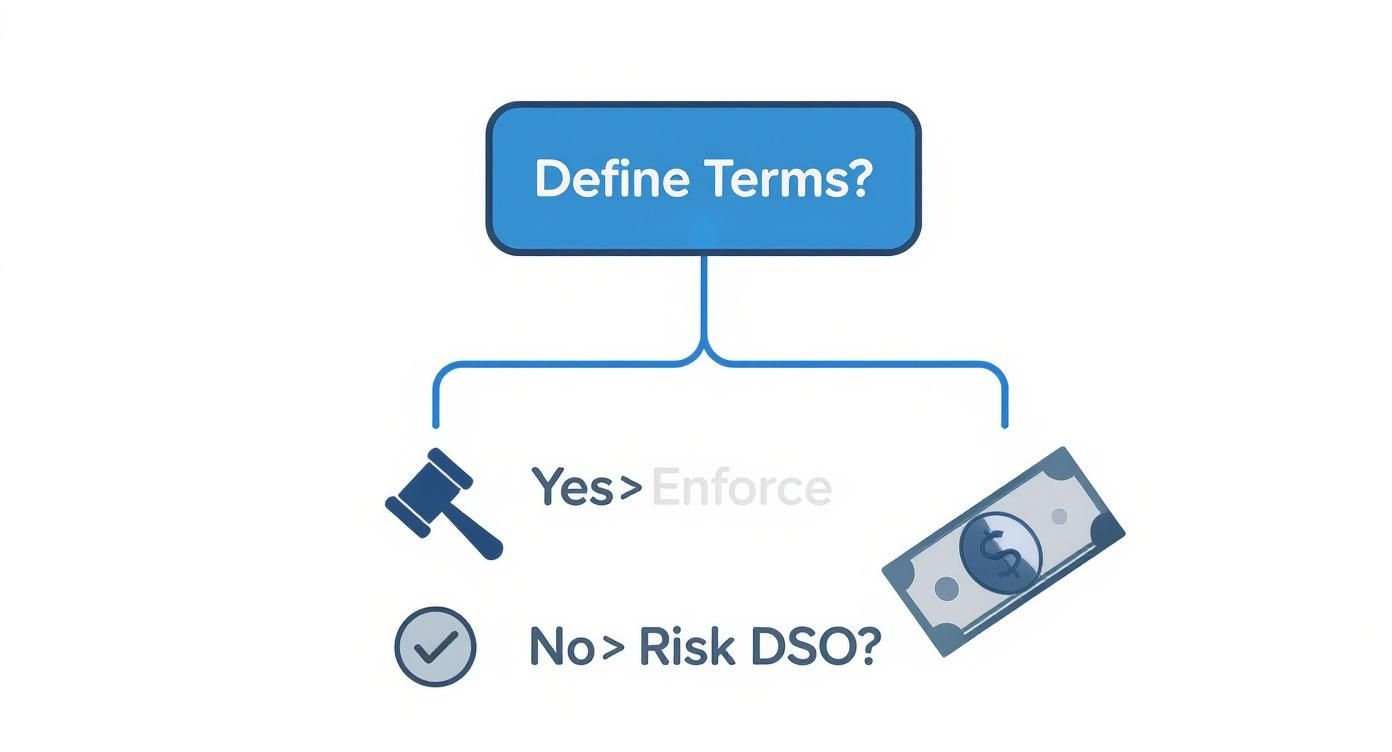
As the visual shows, defining your terms puts you in control. Ambiguity is a direct path to financial drag.
Standard Net Terms
Net 30 is common for professional services. It strikes a balance between client convenience and your cash conversion cycle. It signals a professional, systematic approach.
Extending to Net 60 or longer must be a deliberate strategic decision. It may be required for a large enterprise client, but it means your firm is providing 0% financing for two months, pressuring your working capital.
A firm with $5M in annual revenue on Net 60 terms has, on average, over $820,000 tied up in accounts receivable. That is capital that could be used for hiring or growth.
Project-Based and Retainer Structures
For complex projects, standard net terms introduce unacceptable risk. More sophisticated structures are required to protect your firm's finances.
- Milestone Payments: This structure ties payments to specific, pre-defined project phases. It aligns your cash inflows directly with value delivery, reducing the risk of non-payment for completed work.
- Upfront Deposits and Retainers: Requiring a deposit (25-50% is common) before work begins mitigates risk. It confirms client commitment and provides cash for initial project costs. For ongoing advisory, a monthly retainer creates predictable, recurring revenue.
The following table compares how these term structures perform in a professional services context.
Payment Term Structures Comparison for Professional Services
Term Structure | Ideal Use Case | Cash Flow Impact | Primary Risk |
|---|---|---|---|
Net 30/60 | Standard, transactional engagements with established clients. | Delayed; creates a gap between work delivery and payment receipt. | High DSO; you're essentially financing your client's operations. |
Upfront Deposit | New clients, large projects, or engagements requiring initial outlay for resources. | Positive; cash is received before significant work begins, improving working capital. | Can create sales friction if not positioned correctly. |
Milestone Payments | Long-term projects with clearly defined phases and deliverables (e.g., software dev, consulting). | Staggered; cash flow is tied to progress, reducing large receivable balances. | Scope creep; poorly defined milestones can lead to payment disputes. |
Monthly Retainer | Ongoing advisory, support, or access-based services. | Highly predictable; creates a stable, recurring revenue stream. | Perceived value; client must consistently see the value to justify the recurring cost. |
Choosing the right structure is about aligning your financial needs with the nature of the work. The goal is always to reduce risk and improve cash flow.
Sample Clause Language: Milestone Payment"Payment for services rendered shall be made according to the following milestone schedule: 25% of the total project fee due upon contract execution; 25% upon delivery of the initial strategic analysis; 25% upon completion of the implementation phase; and the final 25% upon project completion and final report delivery. Each invoice is due and payable Net 15."
This specific language removes ambiguity. It transforms terms from a passive due date into an active tool for managing your business. Effective AR software for professional services can automate invoicing and reminders for these schedules, ensuring nothing is missed.
How Unclear Terms Create DSO Creep
Your firm's Days Sales Outstanding (DSO) is its financial pulse. Your payment terms keep that pulse steady.
DSO creep is the slow, often unnoticed stretching of payment times. It occurs when terms are vague or unenforced.
A "Net 30" term that is consistently paid in 47 days indicates a failure to define payment terms with operational authority. This quiet erosion of working capital becomes the new normal, steadily undermining financial stability.
The Financial Drag of Ambiguity
Consider a professional services firm with $10 million in annual revenue. If their enforced Net 30 terms slip into a loosely managed "Net 45" reality, that 15-day creep locks up an additional $410,000 in working capital.
That is not just a spreadsheet figure. It is capital that could have funded a strategic hire or a critical growth initiative. As the global payments ecosystem approaches $157 trillion in transaction value, precision is non-negotiable.
DSO creep is the direct result of misaligned expectations. When terms are vague, clients create their own payment timelines. Your firm’s financial stability should never be subject to a client’s interpretation.
Clear terms are the bedrock of financial control. Just as ambiguity in business creates risk, it’s valuable to learn from other sectors by understanding preventable financial barriers to see how clarity builds financial health.
Modeling the Impact on Cash Flow
The DSO formula makes the impact clear:
(Total Accounts Receivable / Total Credit Sales) x Number of Days in Period
A lower DSO means you convert work into cash more quickly.
- Scenario A (Effective Net 30): An average collection period of 35 days supports a lean cash conversion cycle.
- Scenario B (Ineffective Net 60): An average collection period of 65 days requires nearly double the working capital to cover the same operating costs.
Tightening payment terms is one of the most direct ways to reduce DSO. Effective receivable management services begin here. Automation provides the structure to enforce these terms consistently, turning policies into predictable cash flow.
Negotiating and Enforcing Terms with Confidence
Defining clear payment terms is the foundation. Enforcement is what protects your cash flow.
Mastering both negotiation and enforcement allows financial leaders to maintain control without damaging client relationships.
Frame your payment terms as a standard part of doing business. Present them with calm confidence in every proposal and contract, not as a last-minute detail.
Build a Standard Operating Procedure
A firm, professional collections strategy is systematic, not aggressive. It is a documented process that removes emotion and guesswork.
Your enforcement procedure should define a precise cadence for every invoice.
- Invoice Sent: Immediately upon milestone completion. No delay.
- Pre-Due Reminder: An automated notice sent 7 days before the due date.
- Due Date Notice: A direct notification on the day payment is due.
- First Overdue Notice: Sent 3 days after the due date; professional but firm.
- Escalation: At 15 days overdue, a senior finance team member may initiate direct contact.
This structured approach signals that you manage receivables with precision. It replaces random follow-ups with a predictable, professional system.
Tactical Enforcement Without Friction
Enforcement involves knowing when to use contractual levers, like late fees or a work stoppage. These actions should not be a surprise.
Communicate them clearly, always referring back to the agreed-upon terms.
The goal isn’t to be punitive; it's to uphold the agreement. A client who consistently ignores your payment terms is introducing risk into your business, and that risk must be managed.
As cross-border payment flows exceed $194 trillion, complexity increases. Efficient, transparent terms are your best defense. You can explore detailed insights on payment trends from industry leaders.
This is where technology like accounts receivable automation becomes a critical tool. An automated system executes your defined enforcement cadence flawlessly. It provides the data to spot problematic accounts early, allowing your team to act strategically.
Using Automation to Systematize Your Terms
Manual accounts receivable processes are where good payment terms fail.
A system of spreadsheets and calendar reminders is prone to human error, delays, and inconsistencies—the root causes of inflated DSO.

This is the point where you stop just defining terms and start operationalizing them. Accounts receivable automation transforms a static contract clause into a dynamic, systematic workflow.
From Policy to Automated Protocol
AR automation executes your collections strategy with a precision that manual effort cannot match.
Every action is tied to your established payment terms, creating a consistent, professional experience for every client.
- Automated Invoice Delivery: Invoices are sent the moment a milestone is hit, eliminating initial processing delays.
- Scheduled Payment Reminders: Your pre-defined communication cadence is executed automatically. No more forgotten follow-ups.
- Streamlined Digital Payments: Integrated payment portals remove friction. Clients can pay via ACH or card directly from a reminder email.
A firm processing 500 invoices a month can save hundreds of hours annually. But the real value is consistency. Every client receives the same professional treatment, reinforcing the seriousness of your terms.
Your payment terms are only as strong as your ability to enforce them. Automation provides the operational discipline to ensure those terms are respected, turning your AR function from a reactive cost center into a strategic asset that protects cash flow.
Integrating with Your Financial Core
For firms using QuickBooks, the manual burden is often magnified. QuickBooks AR automation platforms layer on top of your accounting software, pulling invoice data in real-time to drive the collections workflow.
The integration is seamless. An invoice created in QuickBooks automatically triggers the pre-set follow-up sequence. When a client pays, the payment is reconciled back. The loop is closed with minimal human intervention. To see how this impacts a firm's bottom line, exploring the core benefits of accounts receivable automation is a logical next step.
Ultimately, AI AR automation is how you scale financial discipline. It ensures that as your firm grows, your ability to reduce DSO and improve cash flow grows with it.
The Path to Predictable Cash Flow
Defining your payment terms is the first step. Enforcing them is how you secure your firm's financial health.
Effective AR management is a system. It begins with strategic terms in your contracts and is supported by a disciplined process for enforcement.
Technology connects these elements, ensuring operational integrity. This is how you systematically reduce your DSO and achieve financial predictability.
When these components work together, you improve cash flow and free up leadership to focus on growth. For a deeper dive, review these tactical ways to increase cash flow.
Your terms, your enforcement, and your technology must operate as a single, unified system. A weakness in one part undermines the whole structure, allowing DSO to creep up and erode working capital.
This integrated approach, powered by accounts receivable automation, is what turns financial policies into reliable outcomes. It is the final step from merely defining terms to mastering your firm’s financial future.
Resolut automates AR for professional services—consistent, accurate, and human.
A Few Common Questions
Practical answers for finance leaders on defining and managing payment terms.
What Are the Best Payment Terms for a Consulting Firm?
There is no single "best" setup. Most firms use a hybrid approach that matches the term to the work.
Use a retainer for ongoing advisory to secure predictable cash flow. For large projects, tie payments to specific milestones.
For smaller, one-off engagements, standard Net 15 or Net 30 terms are effective, but only if they are consistently enforced. This is where accounts receivable automation is non-negotiable. Without a system, "standard" terms can easily stretch.
How Do We Change Payment Terms with Our Existing Clients?
This requires clear, professional communication.
Provide advance notice. Frame the change as a standardization of your processes to improve operational efficiency, which ultimately benefits them.
Allow existing projects to conclude under old terms. State clearly that all new statements of work will use the new structure. The key is a calm, matter-of-fact tone. This is an operational update, not a negotiation.
Your payment terms are a core part of how you run your business. When you update them, treat it like the standard process evolution it is. Confidence and clarity are what prevent friction with the clients you value most.
This is the moment to define payment terms as a firm-wide standard, not a client-by-client variable.
Do Early Payment Discounts Actually Work?
They can, but the math must be sound. A "2/10 Net 30" term offers a 2% discount for payment in 10 days instead of 30.
This accelerates cash inflow, but that 2% is effectively a high-interest loan you provide for 20 days of speed.
For firms with tight working capital, this trade-off can be a valuable tool to reduce DSO. If you have strong cash reserves, you may be giving away margin unnecessarily. Analyze your cost of capital to determine if it is a smart financial move.
--- Resolut automates AR for professional services—consistent, accurate, and human. Learn more at https://www.resolutai.com.