How to Improve Working Capital: A CFO’s Guide for Professional Services Firms
Learn how to improve working capital with proven strategies for CFOs. Reduce DSO, optimize payables, and leverage AR automation to unlock cash flow.
Improving working capital isn't a project; it's a financial discipline. The goal is to systematically shorten the time between performing work and banking the cash.
For a professional services firm, this means converting billable hours into collected revenue faster while strategically managing payments to vendors.
Establishing Your Working Capital Baseline

Before optimizing, you must diagnose. A vague sense of tight cash flow is a symptom, not an analysis. You need hard data to understand your firm's financial rhythm.
This process starts by establishing a data-backed baseline. Without it, improvement efforts are shots in the dark. Pinpoint the specific bottlenecks in your cash conversion cycle to make targeted, effective changes. It’s also important to understand what working capital management truly entails before diving in.
The Core Metrics That Matter
For professional services, a few key metrics cut through the noise. You don't have physical inventory, but the value of your team's time and expertise is everything. These numbers measure how efficiently you manage it.
Here are the essential formulas and what they reveal.
Key Working Capital Metrics for Professional Services
Metric | Formula | What It Measures |
|---|---|---|
Days Sales Outstanding (DSO) | (Accounts Receivable / Annual Revenue) x 365 | The average number of days it takes to collect payment after an invoice is issued. |
Days Payable Outstanding (DPO) | (Accounts Payable / Cost of Goods Sold) x 365 | How long, on average, your firm takes to pay its suppliers. |
Cash Conversion Cycle (CCC) | DSO - DPO | The time required to convert your investments (primarily payroll) into cash. |
A lower Cash Conversion Cycle is the primary objective. It signifies that your firm requires less time—and less external capital—to fund its operations, creating a more resilient financial position.
Putting the Numbers to Work
Consider a consulting firm with $10M in annual revenue and $1.5M in accounts receivable. Their DSO is 55 days ($1.5M / ($10M/365)). With a DPO of 30 days, their CCC is 25 days.
Now, a peer firm has a DSO of 75 days. With the same 30-day DPO, their CCC expands to 45 days. That's an extra 20 days of cash locked in receivables—capital that could fund growth or provide a crucial buffer.
What the Data Reveals
Your baseline metrics are diagnostic tools. A high DSO isn't just a "slow-paying client" problem; it often indicates inefficient invoicing, a lack of proactive follow-up, or unclear payment terms.
Each metric is a clue that guides your next move. Understanding these numbers is the first step in a much bigger strategy to increase cash flow for your business.
Data shows that firms without disciplined processes can see cash conversion cycles stretch past 100 days—a significant operational drag. The same data reveals that targeted changes can free up capital almost immediately.
Establishing a clear, data-driven starting point moves you from reacting to financial pressure to proactively controlling your firm's liquidity. The next step is using these insights to build a system that gets you paid faster.
Accelerate Inflows with AR Automation

For a services firm, the most direct path to improving working capital is to collect cash faster. Each day shaved off your Days Sales Outstanding (DSO) puts measurable capital back on your balance sheet.
The goal isn't aggressive collection. It’s about building a predictable, professional system for turning billable work into cash. A well-designed AR process prevents late payments before they occur.
When executed correctly, firms can achieve a sustainable 15-20% reduction in DSO within two quarters. This has a direct and material impact on cash reserves.
Bill on Value, Not the Calendar
The first tactical shift: move away from arbitrary monthly billing cycles. Instead, tie invoices to value delivery—completing a project phase, for example.
This links the payment request directly to a tangible outcome for the client. An invoice arriving just after a milestone is met feels earned and timely, unlike a generic invoice that appears on the 30th of the month.
Reminders Must Be Proactive
Waiting until a payment is overdue is a reactive, inefficient strategy. A modern accounts receivable process is proactive, using automated reminders that begin before the due date.
A disciplined, automated cadence might look like this:
- 7 Days Before Due Date: A professional courtesy email confirming the upcoming payment.
- On Due Date: A notice that payment is now due, with simple payment links.
- 3 Days Past Due: A clear reminder that the invoice is overdue.
- 10 Days Past Due: An escalated notice, potentially copying a secondary contact.
Using both email and SMS ensures your invoice remains visible without consuming your finance team's time on manual follow-ups. You establish a rhythm of professional persistence.
The Operational Impact of AI in AR
Managing this level of personalized outreach manually is not scalable. This is where AI AR automation provides a distinct operational advantage.
Modern AR software for professional services orchestrates these communication workflows without constant human input. These tools use data to determine the optimal channel and timing for each client, adapting based on payment history. This lets your team focus on high-value exceptions, not routine follow-up. Firms can integrate these capabilities directly with tools like QuickBooks AR automation.
Our guide on receivable management services offers a blueprint for structuring this process to improve cash flow.
Remove All Payment Friction
The final component is eliminating payment friction. If paying you requires a client to locate a checkbook, you are unnecessarily slowing down your own cash flow.
A modern payment portal is a baseline requirement.
- ACH/Bank Transfers: Low-cost and ideal for B2B payments.
- Credit Cards: Provides client convenience.
- Digital Wallets: Aligns with modern payment behaviors.
Multiple, convenient payment options eliminate common delay tactics. A robust accounts receivable automation system embeds these options into every communication, turning each touchpoint into a direct path to payment. This tactical change can dramatically improve cash flow.
Optimize Payables and Operating Expenses
Accelerating cash inflows is only half of the equation. A lack of discipline on cash outflows will negate those gains.
Effective working capital management applies the same strategic focus to payables as it does to receivables. The objective is not to delay payment but to control the timing of outflows to align with your inflows.
Extend Payment Terms Strategically
Your largest and most strategic suppliers are the first place to negotiate better payment terms. A strong history of on-time payments provides leverage.
A conversation about moving from Net 30 to Net 45 is not a request for a handout. Frame it as a move to strengthen a long-term partnership by aligning cash cycles.
The impact is significant. For a firm with $500,000 in monthly payables, extending DPO by 15 days frees up $250,000 in working capital. You are not avoiding payment; you are managing timing.
Key Takeaway: A 10-day increase in DPO has the same positive cash impact as a 10-day reduction in DSO. Both sides of the equation are critical for optimizing your cash conversion cycle.
This is standard practice among well-run companies. Top-quartile firms often manage their payables aggressively as a core strategy to shorten their cash conversion cycles. The link between disciplined payables and financial health is clear.
The Strategic Use of Early Payment Discounts
While extending terms is the primary goal, early payment discounts can offer a high return on cash.
A standard "2/10, n/30" offer is equivalent to a 36% annualized return. If liquidity is sufficient, capturing these discounts is a far better use of cash than letting it sit in a low-yield bank account.
This requires an accurate cash forecast. You must be certain that the short-term outlay is more valuable than holding the liquidity for another 20 days. Treat it as a calculated investment decision.
Control Operating Expenses with Precision
Beyond vendors, a rigorous review of operating expenses (OpEx) can uncover significant cash savings. For professional services, this often points to three areas: software subscriptions, marketing spend, and T&E.
The question is not merely "Do we need this?" but "Is this cost generating a measurable return?"
A quick audit often reveals easy wins.
- Software Audit: Identify and eliminate redundant SaaS subscriptions.
- Procurement Discipline: Centralize major purchases to leverage volume discounts and maintain control.
- T&E Policies: Implement clear travel and entertainment policies with pre-approval requirements.
Treating cash outflows with strategic intent builds a more resilient financial foundation. For more ideas, explore these proven cost reduction strategies. This discipline directly strengthens your working capital.
Using Technology to Drive Sustainable Improvement
Manual processes are the primary drag on working capital. Chasing invoices and reconciling payments are low-value administrative tasks that consume your finance team's time.
A strategic shift to technology builds a scalable, predictable system for managing cash flow. It moves you from reacting to accounts receivable to actively orchestrating it.
The Limits of Manual AR Management
In a services firm, a manual AR process is a source of hidden risk. Every invoice error or forgotten follow-up directly erodes working capital.
Manual efforts are also inherently inconsistent. One person may follow up diligently; another may be swamped. This inconsistency makes accurate cash flow forecasting impossible. The result is a perpetually reactive state.
Implementing Accounts Receivable Automation
The first operational leap is implementing accounts receivable automation. This technology, whether through dedicated platforms or integrated QuickBooks AR automation, replaces manual repetition with systematic precision. It’s the foundational step to improve cash flow consistently.
Automation ensures every invoice is followed up on according to a predefined cadence. It removes the human error that leads to incorrect invoice details or missed reminders. This shift alone can stabilize your collections process. You can explore a deeper dive in our guide to accounts receivable automation software.
The business case is direct: automating routine collections helps a firm reduce DSO and frees up finance talent for more strategic work, like analysis and forecasting.
Technology does not replace finance professionals; it empowers them to focus on strategic analysis instead of administrative tasks.
Advancing to AI-Powered Orchestration
While basic automation handles the "what" and "when," AI AR automation addresses the "how." These advanced platforms move beyond timed reminders to deliver intelligent collections orchestration.
AI-powered systems analyze payment data and communication patterns to predict outcomes. This allows the system to:
- Identify At-Risk Invoices: Flag invoices likely to become delinquent before they are late.
- Suggest Optimal Outreach: Recommend the most effective channel for a specific client.
- Personalize Communication: Adjust the tone and timing of reminders based on client history.
This transforms your AR process from a blunt instrument into a precision tool. It enables your team to intervene surgically, focusing only on accounts that require a human touch.
The Measurable Impact on Your Firm
Adopting this technology translates directly into hard numbers. The Hackett Group's U.S. Working Capital Survey identified a $1.7 trillion liquidity opportunity locked in the working capital of large public companies. Unlocking this cash was driven by using advanced analytics and AI to streamline receivables, leading to a tangible 4% improvement in the average cash conversion cycle. You can discover more findings on corporate finance optimization.
What does this mean for a services firm?
For a $20M firm, a modest 10-day reduction in DSO—a common outcome of implementing AR software for professional services—unlocks over $547,000 in cash. That is capital that can fund growth or reduce debt.
The investment in technology pays for itself not in soft efficiency gains, but in direct, measurable liquidity.
Building a Framework for Continuous Monitoring
Improving working capital is an operational discipline, not a one-time project. Gains can disappear in a quarter without a system to sustain them.
A governance framework creates clarity and accountability. Assign ownership over each part of the cash conversion cycle. When the controller owns DSO and the operations lead owns DPO, targets are met.
Moving Beyond Days Sales Outstanding
DSO is a vital sign, but it doesn't tell the whole story. An effective monitoring system must dig deeper to get a complete picture of collections health.
Add these KPIs to your regular reporting:
- Collection Effectiveness Index (CEI): Measures how much of the money you were owed in a period was actually collected. A CEI consistently above 90% indicates a highly effective process.
- Average Days Delinquent (ADD): The average number of days your invoices are past due. Unlike DSO, this metric isolates the performance of your follow-up process.
Tracking CEI and ADD alongside DSO allows for a more precise diagnosis. A high DSO might be due to payment terms, but a rising ADD points directly to a weak collections function.
The Weekly Working Capital Dashboard
Accountability requires visibility. A simple, weekly working capital dashboard, distributed to leadership, keeps everyone focused. This report should be clean, scannable, and actionable.
Your dashboard should include:
- Current DSO, DPO, and CCC: Track week-over-week performance against quarterly goals.
- Aged Receivables Breakdown: Show AR in buckets (0-30, 31-60, 61-90+ days).
- Collection Effectiveness Index (CEI): A high-level score on collections performance.
- Cash Forecast vs. Actuals: A simple variance check on forecast accuracy.
This regular reporting rhythm elevates working capital from a finance-only concern to a firm-wide priority. It builds a culture of continuous monitoring and refinement.
Sustained working capital improvement comes from making cash flow a core operational metric, reviewed with the same rigor as revenue and profitability.
The process flow below shows how accounts receivable automation provides the data and consistency for this framework, transforming a manual process into a system that reliably lowers DSO.
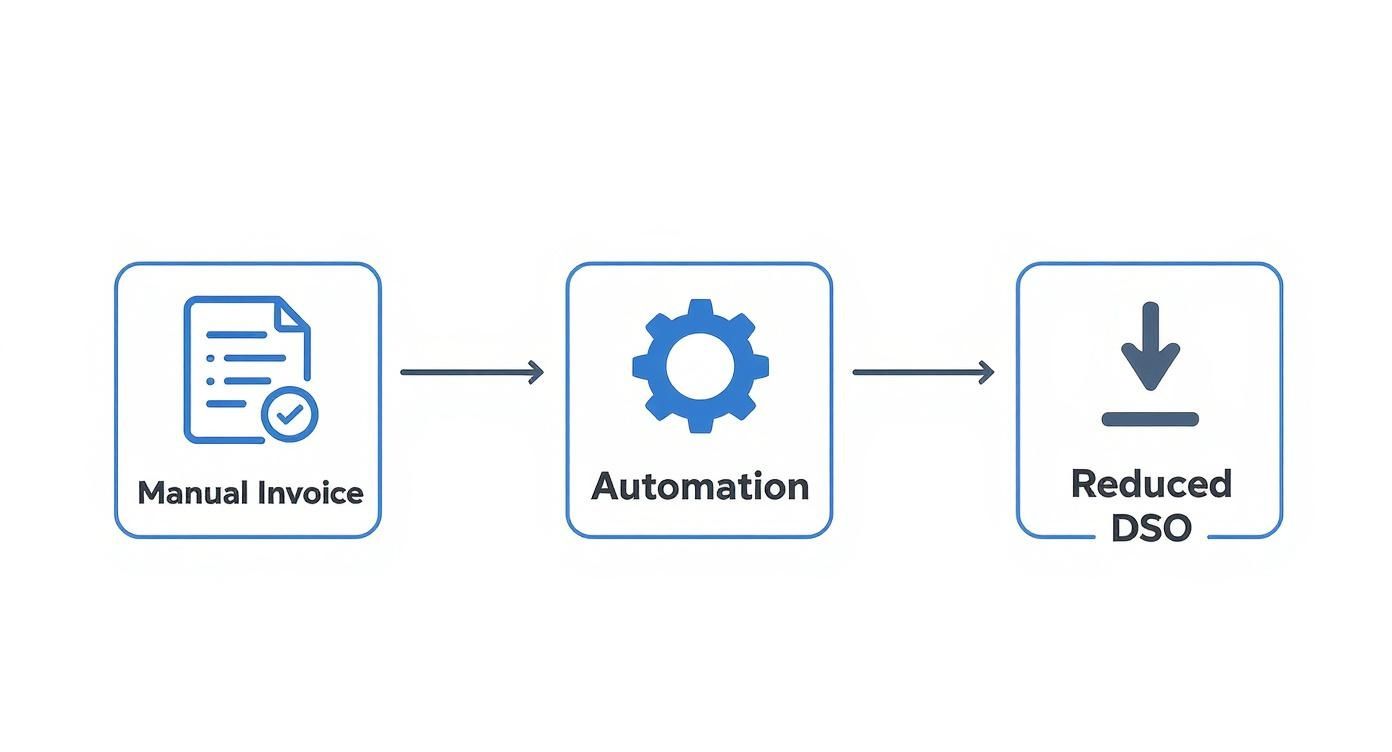
Technology is the catalyst. Platforms offering AR software for professional services, including tools that provide QuickBooks AR automation, give you the data and control to manage these KPIs without spreadsheets. Automating routine tasks frees your team to analyze results and make strategic adjustments.
Frequently Asked Questions from Finance Leaders
As a finance leader, you balance operational stability with strategic growth. Working capital is the bedrock for both. Here are answers to common questions from CFOs and controllers.
How quickly can we see a measurable impact on cash flow?
Faster than most expect. A disciplined focus on accounts receivable can reduce DSO by 10-15% within 90 days.
This is not about aggressive collections; it is about systemization. Implementing accounts receivable automation for reminders and providing simple payment options can shave days off your payment cycle almost immediately.
Should we focus on receivables or payables first?
For nearly every professional services firm, receivables offer the greatest leverage. Your team’s time is your primary asset; converting it to cash quickly is paramount. A five-day reduction in DSO almost always unlocks more capital than a five-day extension in DPO.
However, the two are not mutually exclusive. A comprehensive strategy addresses both simultaneously. While implementing AR software for professional services, begin conversations with key vendors about better terms.
A healthy working capital strategy treats cash inflows and outflows with equal discipline.
What’s the biggest mistake firms make when trying to improve working capital?
The most common error is treating it as a one-time "collections project" instead of a permanent operational discipline. A push to clear old invoices provides a temporary cash infusion, but the underlying process failures remain.
Without a system for continuous monitoring, DSO will inevitably creep back up. Lasting improvement comes from building a framework with clear KPIs, regular reporting, and technology like AI AR automation to enforce consistency.
I am concerned AR automation will damage client relationships.
This is a valid concern, but our experience shows the opposite. A well-executed automation strategy strengthens client relationships. Manual, inconsistent follow-ups can create friction.
An automated system is professional, predictable, and helpful. It sends polite reminders with easy payment links, creating a frictionless experience for your client. You are providing a better service by removing human error. Tools like QuickBooks AR automation are designed to be persistent without being intrusive.
Resolut automates AR for professional services—consistent, accurate, and human.