A Finance Operator's Guide to Collection Letters That Get Paid
Learn how to write collection letters that secure payments while protecting client relationships. Get templates, timing strategies, and automation tips.
A collection letter is a tool for financial control, not just a request for money. For a professional services firm, it's a formal communication to secure payment while preserving a client relationship. It is a critical component of your accounts receivable process and requires precision.
The Foundation for Effective Collections
A generic, heavy-handed approach to collections can destroy a client relationship that took years to build. Getting paid isn't about a single aggressive demand. It's a controlled, staged communication process that protects cash flow without damaging your reputation.
The process must move logically from a gentle reminder to a firm demand. Professionalism is non-negotiable at every stage. This creates a clear, defensible communication trail that protects your firm and sets clear expectations with clients.
The Anatomy of a Legally Sound Collection Letter
Every communication must contain specific, non-negotiable elements. Missing one provides a client a reason to delay payment. According to general business communication guidelines, a professional format isn't optional; it's essential for documentation.
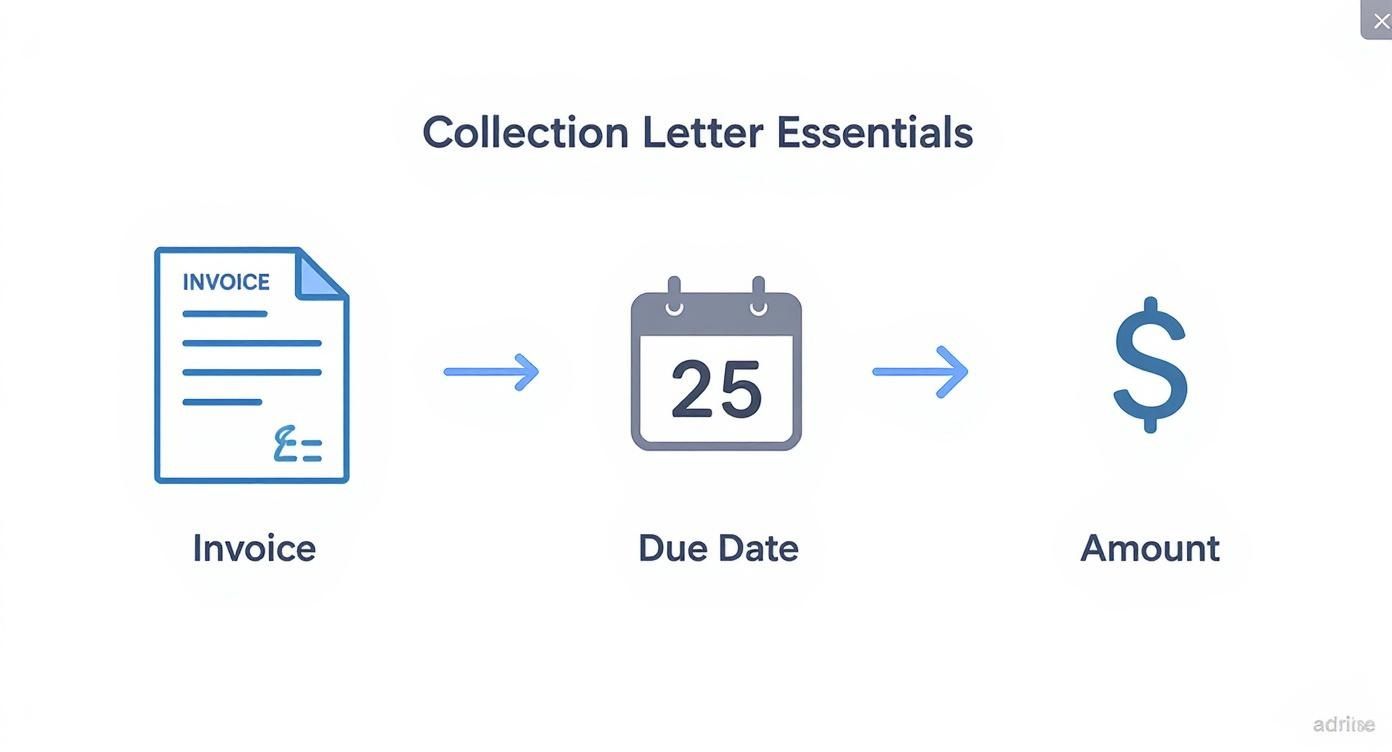
Before considering tone or timing, ensure every letter includes the core components of a legitimate business document. Below is a checklist.
Core Components of a Professional Collection Letter
Component | Purpose | Example |
|---|---|---|
Invoice Number | Eliminates confusion about which bill is being discussed. | "Regarding Invoice #INV-2024-034" |
Original Due Date | Anchors the conversation to agreed-upon payment terms. | "This invoice was due on March 15, 2024." |
Outstanding Balance | States the exact amount owed, including any late fees. | "The outstanding balance is $5,250.00." |
Payment Instructions | Provides a clear, direct path to payment. | "You can pay securely online via this link: [Payment Portal Link]" |
Nailing these components is fundamental to an operational process that improves cash flow and reduces your Days Sales Outstanding (DSO). For a firm with $10M in annual revenue and a DSO of 60 days, over $1.6M is tied up in receivables. Cutting DSO by just 10 days frees up over $270,000 in cash. That is the measurable outcome of a disciplined process.
A collection letter is an operational tool, not an emotional one. It should function with the precision of a balance sheet entry—clear, accurate, and indisputable. Its purpose is to document a business transaction and compel a specific action: payment.
Why a Staged Process Matters
Sending a harsh demand letter the moment an invoice is 30 days past due is poor operational practice. It is inefficient and damages the client relationship.
A staged cadence signals control and process. A client who is 7 days late is a different operational problem than one who is 60 days late. Your communication must reflect that reality.
Implementing a structured sequence—from a pre-due date nudge to a final demand—transforms collections from a reactive problem into a predictable system. This is the foundation of effective accounts receivable automation and is essential for any firm managing hundreds of invoices.
Designing Your Collection Cadence for Predictable Results
A single collection letter is an isolated action. A structured, automated collection cadence is an operational system that delivers predictable cash flow. For professional services firms, this system must preserve client relationships while maintaining firm control over accounts receivable.
A well-designed cadence standardizes your approach. No invoice is missed, and every client receives consistent communication. This is not about aggression; it is about process. The goal is to move from a polite reminder to a formal demand with deliberate, measured steps.
This transforms AR from a reactive, manual task into a strategic function. It creates a predictable workflow that directly impacts your ability to forecast cash. The key is defining each stage with precision—the timing, tone, and call to action.
The Four Stages of an Effective Collection Cadence
A robust cadence typically has four phases, each triggered by the age of the invoice. This controlled escalation ensures your response is proportional to the situation, protecting goodwill early while establishing firm boundaries as delinquency increases.
Here’s how it works:
- The Proactive Reminder (Pre-Due Date): Sent 3–5 days before the due date, this is a customer service touchpoint, not a collection notice.
- The Initial Past-Due Notice (7-10 Days Past Due): The first official follow-up. The tone is helpful, assuming oversight.
- The Firmer Follow-up (30 Days Past Due): The tone shifts from helpful to direct and formal, emphasizing the overdue status.
- The Final Demand (60+ Days Past Due): The last communication before escalation to a collections agency or legal action. It is unambiguous.
A collection cadence is a signaling mechanism. It communicates to your clients that you have disciplined financial controls and expect timely payment as part of your professional relationship.
Stage 1: The Proactive Reminder
The most efficient way to handle a late payment is to prevent it. A simple reminder sent days before the due date is a powerful tool to reduce DSO. It frames the communication as helpful service.
Subject Line: Reminder: Invoice [Invoice Number] due on [Due Date]
Body Copy Example:
Hi [Client Name],
This is a reminder that invoice [Invoice Number] for [Amount] is due on [Due Date].
You can view the invoice and pay online here: [Payment Link]
We appreciate your business.
This small step has a significant impact. Most late payments are due to oversight, not unwillingness to pay.
Stage 2: The Initial Past-Due Notice
Once an invoice is 7-10 days past due, it's time for the first official notice. The goal is to bring the overdue invoice to their attention while maintaining a professional tone. Assume it was an oversight.
Subject Line: Follow-Up: Invoice [Invoice Number] is Past Due
Body Copy Example:
Hi [Client Name],
Our records show that invoice [Invoice Number] for [Amount], due on [Due Date], is now past due.
Could you please let us know when we can expect payment? If you have already sent it, please disregard this message.
For your convenience, you can access the invoice and pay online here: [Payment Link]
This message is direct but not confrontational. It opens a line of communication and provides another immediate chance to pay.
Stage 3: The Firmer Follow-up
At 30 days past due, the situation requires a more serious tone. The language must be firm, professional, and clear. You are no longer assuming oversight; you are actively seeking resolution.
Subject Line: URGENT: Invoice [Invoice Number] is 30 Days Overdue
Body Copy Example:
[Client Name],
We are writing regarding invoice [Invoice Number] for [Amount], which is now 30 days past its due date of [Due Date]. Prompt payment is required to ensure no disruption to your account.
Please remit payment immediately via this link: [Payment Link]
If there is an issue preventing payment, contact us at [Phone Number].
The shift in tone and mention of consequences signal that this is no longer a routine follow-up. For more on building these controls, see our guide on effective procedures for accounts receivable that work.
Stage 4: The Final Demand
When an invoice reaches 60 days past due, the communication must be unequivocal. This letter is the final warning before escalation. The tone is formal, serious, and leaves no room for misinterpretation.
Subject Line: Final Notice: Invoice [Invoice Number]
Body Copy Example:
[Client Name],
This is our final notice regarding invoice [Invoice Number] for [Amount], now over 60 days past due. Immediate payment of [Amount] is required to prevent escalation to a third-party collections agency.
Failure to remit payment within 10 business days will result in this action.
Pay now to settle your account: [Payment Link]
This letter clearly states the consequences and provides a final, time-sensitive window to act. It is a necessary step to protect your firm’s financial interests.
Optimizing Language and Tone for Payment

The line between a paid invoice and a fractured client relationship is often drawn with tone. Your choice of language must be deliberate—firm, confident, and never aggressive. The goal is to complete a transaction, not start a confrontation.
Managing the tone of your letters is a critical skill. For deeper tactical insights, reviewing the principles of understanding tone in writing can be beneficial. The right words protect your cash flow without damaging client relationships.
Depersonalize the Issue
First, remove personal, accusatory language. Focus on the transaction, not the client. This keeps the conversation professional and grounded in facts.
Instead of "your overdue invoice," use "the outstanding invoice for Project Alpha." This connects the debt to the work delivered and frames it as an open business item.
Similarly, replace phrases like "you have failed to pay" with "payment has not yet been received." This change maintains an unemotional, professional posture.
Frame Payment as a Partnership Step
Do not frame your communication as a demand. Position payment as the next logical step in the business partnership. This approach reinforces the client's value while stating your operational needs.
- Connect to Future Work: "Prompt payment of this outstanding balance will ensure we can move forward with the next phase of our engagement without interruption."
- Emphasize Mutual Benefit: "Settling this invoice allows us to close out the books on this project and maintain the positive working relationship we value."
This language makes payment a standard procedure required for smooth operations. It is collaborative, not confrontational.
The most effective collection letters are unemotional and procedural. They communicate that paying on time is a standard component of a professional engagement, just like delivering high-quality work.
Maintain Legal and Compliance Guardrails
While firm, your language must stay within legal boundaries. The Fair Debt Collection Practices Act (FDCPA) is primarily for third-party collectors, but its principles provide a solid compliance framework for any firm.
Knowing what not to say is as important as knowing what to say. Adhering to these rules prevents legal issues and reinforces your firm's professionalism.
Avoid these tactics:
- Threats or Harassment: Never use language that implies threats, public shaming, or relentless contact. It is illegal and unprofessional.
- False Statements: Do not misrepresent the amount owed or suggest legal action you do not intend to take. The phrase "we will pursue legal action" should only appear in a final demand if it is your next step.
- Misleading Urgency: Avoid creating a false sense of urgency. Do not use "final notice" in your second email. Escalation must be logical and truthful.
This disciplined approach is the bedrock of effective accounts receivable automation. Your system, whether manual or powered by AI AR automation, must bake these principles into every communication.
Turning Your Collection Strategy Into an Automated System

Manual collections are a bottleneck. They are inconsistent, prone to human error, and create awkward client experiences. Accounts receivable automation eliminates these variables.
Effective AR software for professional services executes your collection cadence with perfect consistency, often through QuickBooks AR automation. The goal shifts from chasing invoices to monitoring improved metrics: a quantifiable reduction in DSO, better cash flow, and more time for high-value financial analysis.
From Manual Guesswork to Automated Execution
Automation transforms your collection policy from a document into a live, rules-based system. It does not replace people; it augments them, ensuring every client receives the right message at the right time.
You can set up triggers based on invoice age. For example, a rule can automatically send your 'Initial Past-Due Notice' template the moment an invoice becomes seven days overdue. This eliminates the risk of human oversight that directly impacts cash flow. To learn more, read about comprehensive document workflow automation.
Automation instills discipline. It turns your strategy into a system that operates with machine-like consistency, ensuring no invoice is overlooked and every client communication is on-brand and on-schedule.
Visual Idea: A split-screen cinematic shot. Left side: a stressed controller manually typing collection emails, looking frustrated. Right side: an AR automation dashboard calmly executing a predefined workflow, with metrics like "DSO Reduced by 12 Days" highlighted.
The Real Advantage of AI in AR Automation
Modern AR platforms are moving beyond simple rules. The integration of AI AR automation adds a layer of predictive intelligence.
AI algorithms analyze payment histories to identify patterns, predicting which clients are likely to pay late before they do. This enables proactive intervention with targeted reminders, preventing delinquency.
This predictive power offers clear advantages:
- Risk Segmentation: Automatically flag high-risk accounts for personalized attention.
- Optimized Timing: Send reminders based on a client's actual payment behavior, not a generic schedule.
- Improved Forecasting: Generate more accurate cash flow projections based on data, not assumptions.
This approach transforms your receivable management services from a reactive task into a proactive strategy, providing tighter financial control.
Measuring the Impact on Your Bottom Line
The ROI for AR automation is not abstract; it appears in hard numbers. Firms that implement these systems often see a 15-25% reduction in DSO within 6-12 months.
For a $10M firm with a DSO of 60 days, a 20% reduction lowers DSO to 48 days. This change injects approximately $328,000 of cash back into the business—capital previously trapped in receivables. This is the direct result of replacing inconsistent manual work with a systematic process.
The end goal is a collections engine that runs efficiently, turning invoices into cash with less friction and protecting the client relationships that drive your business.
Measuring and Refining Your Collections Strategy
Your collection strategy is not a "set it and forget it" system. Like financial forecasting, it is an operational process demanding measurement, analysis, and refinement. Without data, you are operating on assumptions.
The goal for finance leaders is to convert receivables into cash efficiently. This requires looking beyond a high-level metric like Days Sales Outstanding (DSO) to analyze the numbers that reveal the true health of your collections engine.
Key Metrics Beyond DSO
DSO is a lagging indicator. The following KPIs provide a granular view of your strategy's effectiveness and explain the "why" behind your DSO.
- Collection Effectiveness Index (CEI): This measures how much you collected versus how much was available to collect. A score near 100% indicates an efficient process.
- Average Days Delinquent (ADD): This shows, on average, how many days your invoices are past due. It is a clearer indicator of payment behavior than DSO alone.
- Invoice Payment by Stage: Track the percentage of invoices paid after each notice. This directly measures the impact of each letter in your cadence.
For example, if 75% of past-due invoices are paid only after the third notice, it signals that your first two communications are ineffective. This is an actionable insight pointing to a weakness in your templates or timing.
A collections strategy without measurement is just a series of hopeful emails. Data transforms it into a predictable system for cash flow management.
The Collection Effectiveness Index Formula
CEI provides a powerful snapshot of performance. The formula calculates the percentage of available receivables that you collected.
Here’s how to calculate it: (Beginning Receivables + Monthly Credit Sales - Ending Total Receivables) / (Beginning Receivables + Monthly Credit Sales - Ending Current Receivables) x 100
A consistently high CEI confirms your outreach works. A declining CEI is an early warning that part of the process is broken.
Using Data to Optimize Your Letters
With these metrics, you can begin A/B testing. Does a subject line with "URGENT" outperform "Follow-Up"? Does a payment link in the first sentence boost response rates? Good AI AR automation platforms can run these tests and report on what works, removing the guesswork.
This cycle of continuous refinement is essential. The reliance on documented outreach for critical functions like collections underscores the need to make every communication count. You can discover more insights about business mail trends that highlight this ongoing importance.
Visual Idea: An animated chart showing the Collection Effectiveness Index (CEI) for a firm over 12 months. The line starts flat, then shows a marked upward trend after "AR Automation Implemented" at month 3, reaching a stable 95-98%.
This data-driven loop—measure, analyze, refine—turns collections from a cost center into a strategic asset that strengthens your firm's financial health.
The Path to Controlled and Predictable Cash Flow
Effective collections are the result of a system, not a single letter. A structured cadence with clear, professional language transforms accounts receivable from a reactive problem into a controlled, predictable process. That control is the foundation of a healthy financial operation.
A good system provides consistency, which protects client relationships and generates the data needed for continuous improvement. The result is a direct, measurable improvement in your firm's financial position.
A disciplined collections process doesn't just recover late payments; it builds a financial culture of predictability. It signals to your entire operation—and your clients—that cash flow is managed with precision.
The Measurable Outcomes of a Systematized Approach
This approach delivers quantifiable results that appear on your balance sheet and cash flow statement. Firms that systematize collections consistently see:
- A tangible reduction in DSO, often by 15-25%, which directly injects working capital back into the business.
- Improved cash flow forecasting, as payment cycles become more reliable. Find more detail in our guide on **ways to increase cash flow**.
Ultimately, mastering how you write and deploy collection letters is about establishing financial control. It ensures you are paid for your work without damaging the client relationships that drive growth.
Common Questions About Collection Letters
What’s the most important part of a first collection letter?
Clarity and tone are paramount. The first letter should be a helpful reminder, not an accusation. Most clients have simply forgotten. State the invoice number, amount due, and original due date without ambiguity, and provide a simple way to pay. Aggressive language at this stage damages the relationship.
When should we start automating our collections?
The time to consider accounts receivable automation is when your team spends more time chasing payments than on higher-value financial management. Inconsistent follow-up is another key indicator. For firms in the $3M–$50M revenue range, the benefits are almost immediate. Automation standardizes communication, helps reduce DSO, and provides clear data.
Use templates as a baseline for consistency, not a replacement for human judgment. Good AR automation software allows for customization and personalization, such as client name or project details.
Don't collection letter templates sound robotic?
They can if implemented poorly. The best practice is to set the appropriate tone for each stage while enabling your team to intervene personally in sensitive situations. Effective AR software for professional services is built for this balance. A platform with QuickBooks AR automation can execute a perfect cadence while sounding authentic to your firm.
***
Resolut automates AR for professional services—consistent, accurate, and human.