A CFO's Guide to Implementing a Late Payment Fee Policy
A guide for CFOs on how to implement a late payment fee policy that improves cash flow and reduces DSO without harming client trust. Learn the best practices.
A late payment fee isn't a penalty. It’s a standard financial control used to manage accounts receivable and stabilize cash flow.
For professional services firms, adding a late fee clause to contracts does more than discourage late payments. It establishes clear expectations and reinforces the value of your work from day one.
Why a Late Payment Fee Is a Strategic Financial Tool
A late fee policy moves your collections process from reactive to proactive. It’s not about punishing clients; it’s about setting professional boundaries that protect your firm's working capital.
Waiting on client payments creates operational drag. An analysis of over $8 trillion in B2B transactions found that businesses wait an average of 51 days to get paid—a standard 32-day term plus an extra 19 days of delay.
A formal late payment policy creates a clear financial consequence for stretching terms, providing a lever to improve payment velocity.
The Impact of Payment Delays on Cash Flow
Consistent payment delays strain your firm's cash flow, forcing you to fund operations with working capital or debt that should be fueling growth.
A well-structured late fee policy directly addresses this challenge:
- Reduces DSO: It creates a tangible incentive for clients to pay on time, directly impacting your Days Sales Outstanding (DSO). For example, firms automating their AR often see a 10-25% reduction in DSO within months.
- Improves Forecast Accuracy: Reliable payment schedules lead to more accurate cash flow forecasting and smarter capital allocation.
- Strengthens Client Communication: The policy makes payment expectations a clear, non-negotiable term of business, reducing the need for awkward follow-up conversations.
This data highlights the significance of these payment delays.
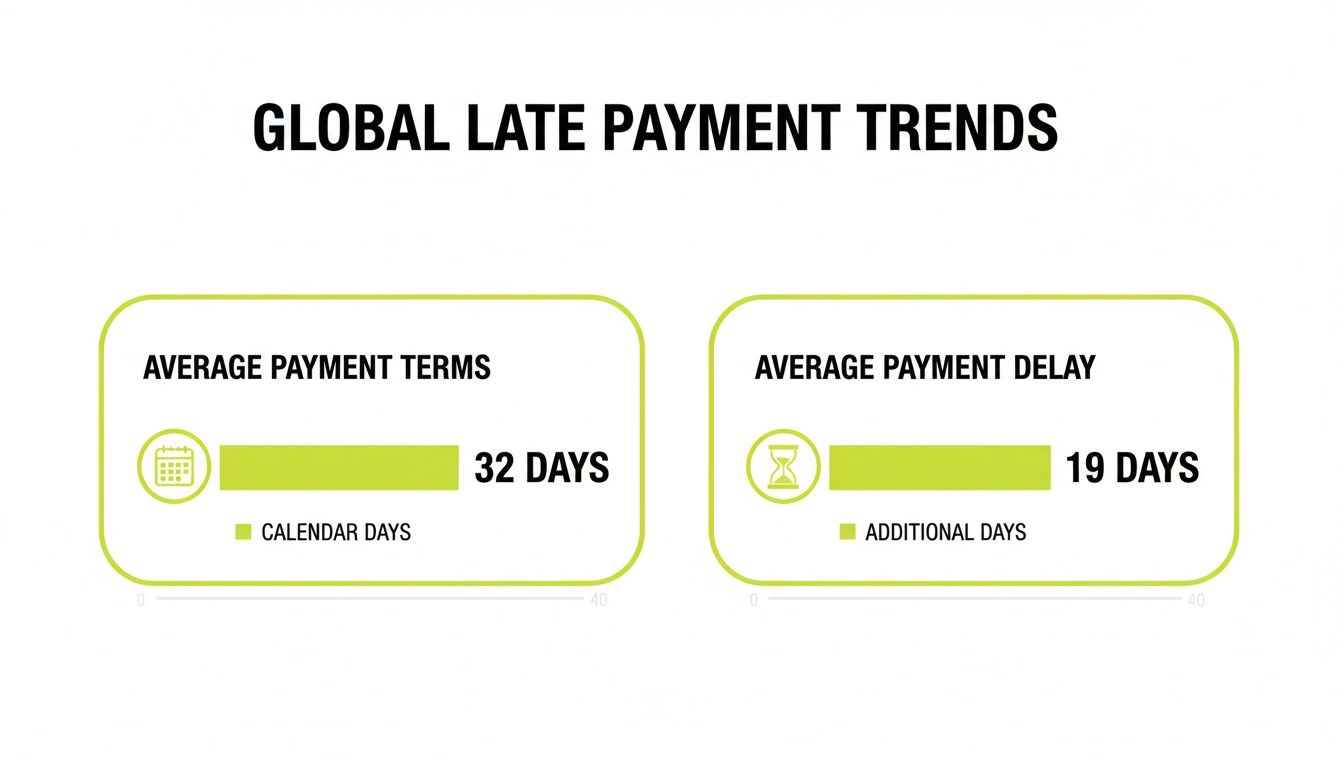
That 19-day delay means your firm is floating the cost of delivered work for nearly three weeks. A late fee is designed to systematically close that gap.
The Fee as a Control Mechanism
A late payment fee is most effective when integrated into a broader accounts receivable automation strategy. Manual enforcement is often inconsistent and can feel personal.
Automated systems, by contrast, apply the policy without bias.
Systematizing the application of late fees removes emotion and subjectivity from collections. The policy becomes a standard business term, not a personal penalty.
This systematic approach is how you improve cash flow without creating client friction. When a policy is integrated correctly using AI AR automation, you rarely have to enforce it—its existence is often enough to change payment behavior.
How to Structure Your Late Fee Policy
A late fee policy is a tool for managing cash flow and client expectations. The structure must be clear, fair, and effective at encouraging on-time payment without damaging the relationship.
The right model—flat fee, percentage, or interest—depends on your typical invoice size and client base. Let's analyze the most common structures.
The Three Main Fee Structures
Each of these models serves a different purpose and has a different impact on client behavior.
A flat fee is a fixed dollar amount, such as $50, applied to an overdue invoice. It is simple to implement but lacks scalability. A $50 fee on a $250,000 invoice is operationally meaningless.
A percentage-based fee scales with the invoice value. A common rate is 1.5% per month, making the fee proportional to the amount owed. This model is a better fit for firms with a wide range of project values.
An interest-based fee accrues daily on the outstanding balance. While it is the most precise reflection of the time value of money, it is complex to calculate and communicate without specialized AR software for professional services.

To help you decide, this table compares how each structure impacts a typical $20,000 invoice in a professional services context.
Comparing Late Fee Structures for Professional Services
Fee Structure | Best For | Example Calculation (on $20,000 Invoice) | Pros | Cons |
|---|---|---|---|---|
Flat Fee | Firms with very consistent, smaller invoice amounts. | A $50 fee is applied once the invoice is past due. | Simple to calculate and communicate. | Loses impact on larger invoices; may feel punitive on very small ones. |
Percentage | Firms with a wide range of invoice values. | 1.5% of $20,000 = $300 fee per month past due. | Scales appropriately; always feels proportional to the work delivered. | Requires clear communication; can be a significant amount that surprises clients if not disclosed upfront. |
Interest | Firms that want the most precise financial penalty and have automated systems. | 1.5% per month (compounded daily) = approx. $10.00 per day. | Most accurate financial deterrent; compounds to create urgency over time. | Complex to calculate and track manually; can be confusing for clients. |
The financial impact varies dramatically. A flat fee might be sufficient for a design agency with small, recurring projects. A consulting firm with six-figure contracts will find a percentage-based fee far more effective.
The fee must be substantial enough to get noticed by a client's accounts payable department.
- On a $5,000 invoice, a 1.5% fee is $75.
- On a $50,000 invoice, 1.5% is $750.
- On a $250,000 invoice, the fee is $3,750. This amount gets a CFO's attention.
A $50 flat fee on that same $250,000 invoice is just 0.02%—rounding noise. For firms managing high-value contracts, a percentage-based structure is the only logical choice.
The goal of a late fee is not to generate revenue. It is to influence behavior. The best structure is the one that sends the clearest signal to your clients about the importance of paying on time.
Of course, this is all contingent on having solid underlying terms. Before implementation, ensure your contracts are unambiguous. Our guide on how to define payment terms provides a detailed framework.
Even the best-designed policy fails without a consistent process. Integrating late fee rules into an accounts receivable platform like Resolut ensures every client receives the same clear, professional communication, removing human error and improving cash flow.
Ensuring Your Policy Is Legally Enforceable
The effectiveness of a late payment fee hinges on its legal enforceability. A policy built on a weak legal foundation creates confusion and invites disputes, eroding client trust.
For professional services firms where relationships are paramount, getting this right is non-negotiable.
Defining Terms in Your Contracts
The foundation of a defensible late fee policy is your Master Service Agreement (MSA) or client contract. The terms must be agreed to before work begins.
Your contract language must be explicit and answer three key questions:
- The Grace Period: How many days after the due date before a fee applies? A 15 to 30-day window is standard and generally considered fair.
- The Calculation Method: Is it a flat fee or a percentage? If a percentage, specify the rate (e.g., 1.5% per month) and the base amount (total outstanding invoice).
- The Accrual Date: When does the fee begin to accrue? Pinpointing the start date avoids disputes over prorated charges.
Here is an example of direct, defensible language:
"If any invoiced amount is not received by its due date, a late payment fee of 1.5% per month will be applied to the outstanding balance. This fee will be assessed starting on the first day after a 15-day grace period and will continue to accrue monthly until the balance is paid in full."
This language sets the rate, grace period, and trigger, creating a firm and transparent framework.
Navigating Jurisdictional Variances
Late fee regulations vary by state and municipality. What is acceptable in one jurisdiction may be considered usury (excessive interest) in another.
Local laws often cap the maximum interest rates chargeable on commercial debts. Ignoring these statutes can render your policy unenforceable. Always have legal counsel review your policy to ensure compliance in all jurisdictions where you operate.
These regulations can also change. While the CFPB's attempt to cap consumer credit card late fees was blocked and didn't apply to B2B transactions, it shows how quickly payment fee regulations can evolve. You can find more insights on the evolving landscape of payment fees on trustdale.com.
The Role of AR Automation in Consistent Enforcement
Once you have a legally sound policy, consistent enforcement is the final piece. Waiving fees for some clients but not others weakens your legal standing in a dispute.
This is where dedicated AR software for professional services is essential. With AI AR automation, you program your exact late fee rules into the billing workflow. The system then tracks due dates, calculates fees, and applies them consistently.
This accounts receivable automation removes human error and favoritism. Every client is managed by the same rules they agreed to, reinforcing your legal position and helping reduce DSO. For firms using QuickBooks, specialized QuickBooks AR automation can integrate directly, turning a manual task into a reliable system to improve cash flow.
How to Communicate and Implement Your New Policy
A well-designed late fee policy requires effective implementation. For finance leaders, the rollout is about communicating with confidence and reinforcing the firm's operational maturity.
The goal is to set clear, firm-wide expectations without creating conflict with valued clients. A smooth rollout protects cash flow and can strengthen client partnerships.
A Step-by-Step Rollout Plan
A clear game plan is necessary. The approach for existing clients will differ from new ones, but both require a steady hand to project confidence.
Here is a practical checklist for a smooth transition:
- Align Your Internal Team. Before any client is notified, your partners and project managers must understand the "why"—to improve cash flow and standardize terms.
- Update All Legal Documents. Embed the specific late fee clause into your MSA, SOWs, and all other client-facing contracts.
- Notify Existing Clients. Provide at least 30–60 days' notice. Frame it as a firm-wide update to standardize billing practices for all clients.
- Integrate into New Client Onboarding. The late payment fee clause must be a standard, non-negotiable part of every new contract and reviewed during kickoff.
Communicating with Existing Clients
This is the most delicate step. You are introducing a fee to established relationships. Position it as an operational improvement, not a penalty.
Frame the announcement as a routine update to your terms of service. Explain that as the firm grows, you are standardizing processes to ensure fairness and clarity for all clients.
The conversation is about mutual respect. You deliver exceptional work on time. In return, you expect payment terms to be respected. It's a simple, professional standard.
Here is a simple email template with a calm, matter-of-fact tone.
Subject: An Update to Our Billing and Payment Terms
Dear [Client Name],
As part of our ongoing work to streamline operations, we are updating our standard payment terms for all clients, effective [Date].
Starting on this date, a late payment fee of 1.5% per month will be applied to invoices more than 15 days past their due date. This helps us maintain consistent financial operations, allowing us to focus on delivering the highest quality of service to you.
This update will be reflected in all future agreements. We value our partnership and appreciate your understanding as we implement this standard practice.
Thank you, [Your Name/Firm Name]
This message is professional, non-confrontational, and establishes the new rule as a firm-wide policy.
Handling the First Overdue Invoice
Eventually, an invoice will become overdue. A systemized, automated approach removes the awkwardness of manual follow-ups.
Often, a proactive nudge is all it takes. AI AR automation can send a polite reminder a few days before the grace period expires.
If the fee is applied, the notification should be equally professional. A clear, concise email can be triggered to inform the client of the updated balance, removing emotion from the process and helping to reduce DSO. For firms using QuickBooks, integrating QuickBooks AR automation ensures this process runs seamlessly.
Automating Enforcement with AR Software
A late fee policy on paper is only as good as its enforcement. Manual enforcement is inconsistent, prone to human error, and forces finance teams into unproductive conversations.
Automation turns policy into a hands-off, systematic process. It eliminates the friction and guesswork of discretionary enforcement, which undermines the policy and creates internal conflict.
The Power of Systematic Enforcement
Financial control comes from systems, not heroic efforts. Accounts receivable automation platforms apply your financial rules with perfect consistency.
By setting up grace periods, fee structures, and communication schedules once, you create a reliable operational workflow.
When a late payment fee is applied automatically, it is no longer a personal decision but a standard business process. This shift depersonalizes enforcement and reinforces that payment terms are a firm part of your agreement, improving cash flow without creating client tension.
![Visual Idea: Cinematic shot of a sleek, modern server room with subtle data visualizations overlaid, representing the 'brain' of the automated AR system working silently in the background.]
How AR Automation Works
Modern AR automation coordinates the entire collections process based on your firm’s specific rules for applying a late payment fee.
The workflow is straightforward but powerful:
- Track Due Dates Automatically: The system monitors every invoice and its due date, eliminating manual tracking spreadsheets.
- Calculate Fees with Precision: Once an invoice passes its grace period, the software instantly calculates the correct fee based on your policy (e.g., 1.5% of the outstanding balance).
- Apply Fees to Invoices: The fee is added as a line item to the outstanding invoice, making the client's new balance officially documented and clear.
- Trigger Personalized Communications: The platform sends automated, personalized notifications informing the client of the updated balance, eliminating awkward calls.
Here’s a glimpse of how this workflow is managed. You configure the rules once, and the system handles enforcement automatically.

The dashboard provides finance leaders with complete visibility, ensuring the policy is enforced without fail. Effective Accounts Receivable management is the engine that makes this automation effective, turning policy into measurable cash flow improvements.
The Link Between Invoice Accuracy and Timely Payments
Automation also solves a hidden driver of late payments: billing errors. A staggering 61% of B2B late payments are due to invoicing mistakes.
A client will not pay an incorrect invoice. The payment cycle stops while your team investigates, corrects, and reissues it.
By automating invoice creation and fee application, you slash the risk of human error. This not only ensures your late fee policy is applied correctly but also eliminates the top reason clients dispute payments.
Using a platform with integrated accounts receivable automation software ensures a seamless data flow from invoice generation to reconciliation. Automation turns your late payment fee from a source of conflict into a quiet, consistent process that reinforces financial discipline.
Measuring Success and Balancing Client Relationships
Implementing a late payment fee policy is just the beginning. The true measure of success is not the fee revenue you collect—in fact, less is better. A successful policy is a deterrent that encourages on-time payment.
The goal is to improve cash flow while protecting client relationships. If a large portion of clients are incurring fees, it's a red flag that something in the process is broken.

Key Metrics to Track
To measure your policy's true impact, look beyond a single metric like Days Sales Outstanding (DSO). A balanced set of KPIs reveals whether you are building discipline or frustrating clients.
Track these metrics:
- Average Days Delinquent (ADD): This directly measures the average number of days invoices are overdue. A declining ADD means the policy is working.
- Percentage of Invoices with Fees: What portion of invoices incur a late payment fee? A high or growing percentage indicates the policy is not an effective deterrent.
- Late Fee Collection Rate: Of the fees applied, what percentage are collected? A low rate suggests clients are ignoring or disputing the fees.
- DSO Trend: A sustained reduction in DSO is the ultimate outcome. If you see DSO drop by 15 days and ADD fall by 10 days in the first quarter, you have a clear, measurable win.
Balancing Policy with Partnership
A rigid, zero-tolerance policy can damage a strong relationship over a simple mistake. Strategically waiving a fee can be the smartest move.
This is not inconsistency; it is strategic relationship management. Maintain an internal playbook for waivers. A first-time oversight from a high-value, long-term client is different from a new client who is chronically late.
The late fee policy is a tool for discipline, not a weapon. A strategic waiver can build more goodwill than the fee itself is worth, reinforcing the relationship while reminding the client of the standard terms.
![Visual Idea: A split-screen chart. On one side, 'DSO Before Automation' shows a volatile, high line graph. On the other, 'DSO After Automation' shows a stable, significantly lower line, demonstrating measurable improvement.]
Smart automation enforces your policy consistently, removing emotion from the daily process. It also provides the data needed to make intelligent exceptions. An AI Finance Invoice Processor can further enhance this by flagging accounts that need a personal touch before a fee is applied.
Frequently Asked Questions
Implementing a late payment policy raises practical "what if" scenarios. Here is straightforward guidance on common questions from finance leaders.
What If a Major Client Objects to the New Policy?
When a top client pushes back, frame the conversation around partnership, not penalties. This is not about singling them out; it is about standardizing operations for all clients.
Explain that this is a firm-wide rollout to ensure fairness. Reassure them that you value their business and, given their payment history, you don't anticipate the policy will ever apply to them. This positions the change as a mark of professionalism.
How Should We Handle Waiver Requests?
Waivers should be a strategic decision, not a gut reaction. Create an internal playbook for when it makes sense to forgive a fee.
Consider these factors:
- Payment History: Is this a one-off error or a recurring pattern?
- Client Value: What is the client's strategic value to the firm?
- Reason for Delay: Was it a genuine administrative error or simple neglect?
A first-time mistake from a high-value, long-term client warrants a one-time waiver. A new client who is late on their first invoice does not. The goal is a conscious choice that protects cash flow and the relationship.
How Will This Policy Affect Our DSO?
A well-enforced late fee policy is a direct tool to reduce DSO. It is a financial incentive that discourages clients from deprioritizing your invoices. The mere existence of the fee often changes payment behavior.
Firms using accounts receivable automation to apply these policies consistently see a measurable drop in their Average Days Delinquent, often by 15-30%, within the first few months. That improvement directly translates to more predictable cash flow.
--- Resolut automates AR for professional services—consistent, accurate, and human.